- Physics Lab Equipment
- Chemistry Lab Equipment
- Biology Lab Equipment
- Anatomical Lab Equipment
- Learning
- Educational Lab Equipment
- Magnets
- Agriculture
- Astronomy
- Earth Science
- Geography Lab Equipment
- Safety Lab Coat
- Laboratory
- Meteorological
- Electricity & Magnetism
- Heat
- School Lab Equipment
- Lab Glassware
- Science Lab Equipment
- Tvet Lab Equipment
- Robotics Kits Supplier and Manufacturer for Schools India
- Math Lab Equipment Manufacturers and Exporters in Ambala
- STEM Kits Manufacturers and Supplier India
- Engineering Lab Equipment
- Hospital Lab Equipment
- Water, Sanitation & Hygiene Supplies
- Cold Chain, Solar & Communication Equipment
- Nutrition
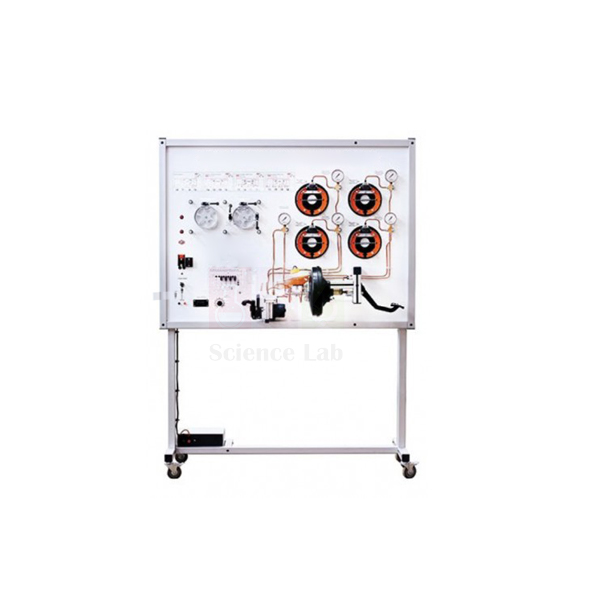
ABS Braking System Training Board Simulator
ABS Braking System Training Board Simulator (Product Code: SLE/MCE/60) is a training board used to teach the layout and working of an anti-lock braking system (ABS) in automotive training workshops and engineering classrooms. Instructors in ITI, diploma and degree automotive courses use it to explain how ABS keeps wheels from locking under hard braking, and its detailed specification is confirmed with each quotation. It is made by Jain Scientific Equipments Pvt Ltd (ScienceLab), an OEM manufacturer, at its own factory in Ambala, India.
Key Details
| Parameter | Detail |
|---|---|
| Product type | Training board simulator |
| System covered | ABS (anti-lock braking system) |
| Intended use | Teaching and demonstration in automotive training |
| Technical specification | Confirmed on request with your quotation |
| Product code | SLE/MCE/60 |
| Manufacturer | Jain Scientific Equipments Pvt Ltd (ScienceLab) — OEM |
| Country of origin | India (made in Ambala, Haryana) |
What Is the ABS Braking System Training Board Used For?
An anti-lock braking system watches the speed of each wheel and, when one begins to lock during hard braking, rapidly reduces and restores the brake pressure to that wheel so the driver keeps steering control. Studying ABS on a training board lets students follow this sequence of wheel-speed sensing, control-unit decision and pressure modulation without working under a vehicle.
Training boards of this kind are used in motor vehicle courses to connect conventional brake hydraulics with vehicle electronics and fault diagnosis. For colleges and ITIs sourcing lab equipment for technical institutes, it is a natural next step after a basic hydraulic brake model. Because configurations vary, ask us for the current specification sheet before you finalise an order.
OEM Manufacturer
ScienceLab is the brand of Jain Scientific Equipments Private Limited, the OEM (original equipment manufacturer) of the ABS Braking System Training Board Simulator. The board is made at the company’s own licensed factory at Saha, Ambala, Haryana, India, and the specification you receive with a quotation comes from the manufacturer itself rather than a reseller. Repeat orders and replacement parts are handled the same way, so please ask us. Company details are on the ScienceLab profile.
Related Automotive Training Equipment
These trainers cover the braking and electronics topics taught around ABS.
- Working Model Of Hydraulic Braking System — the conventional hydraulic brakes that ABS builds on.
- Trailer Air Brake Training Equipment — air-brake systems used on heavy vehicles.
- Automotive Engine Fault Diagnosis Simulator Auto Fault — further practice in vehicle electronic fault diagnosis.
- Engine management system (MPI) — another electronic control system found in modern vehicles.
View all Automotive Training Equipment.
Frequently Asked Questions
What is the ABS Braking System Training Board Simulator used for?
The ABS Braking System Training Board Simulator is used to teach how an anti-lock braking system works, so students can study ABS operation and layout on a board rather than under a vehicle. It suits automotive training workshops and engineering classrooms.
What specifications does the ABS Braking System Training Board Simulator have?
Detailed specifications of the ABS Braking System Training Board Simulator, such as dimensions, weight, power supply and the components fitted, are confirmed with each quotation. Please send your requirements through the contact page and we will share the current specification.
Who is the ABS training board suitable for?
The ABS Braking System Training Board Simulator suits instructors and students in automotive and mechanical engineering courses, vocational training centres and vehicle service training, where anti-lock braking is taught alongside conventional hydraulic brakes.
Who manufactures the ABS Braking System Training Board Simulator?
Jain Scientific Equipments Pvt Ltd (ScienceLab) is the OEM of the ABS Braking System Training Board Simulator and makes it at its own licensed factory at Saha, Ambala, Haryana, India. Quotations and repeat orders are handled directly by the manufacturer.
Is a calibration certificate available for the ABS training board?
A calibration certificate is not listed for the ABS Braking System Training Board Simulator. If your institution requires one for any measuring instruments on the board, please discuss this with us through the contact page before you order.
What does a quotation for the ABS training board need?
A quotation for the ABS Braking System Training Board Simulator needs the quantity, the delivery location in India or abroad, your mains supply and the syllabus topics the board should cover, so the specification we offer matches your course.
Request a Quote
Request the current specification and a quotation for the ABS Braking System Training Board Simulator (SLE/MCE/60) through the contact page, or add it to the enquiry cart. Both come directly from the manufacturer, Jain Scientific Equipments Pvt Ltd (ScienceLab).
Last updated: 24 September 2026
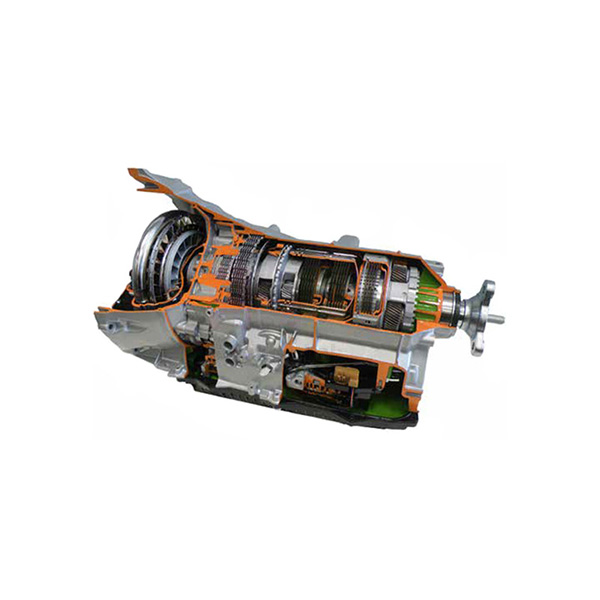
Cut Model Of Automatic Transmission System
Cut Model Of Automatic Transmission System (Product Code: SLE/MCE/61) is a sectioned teaching model used to show how a hydraulic automatic transmission shifts gears, in automotive engineering classrooms and workshops. Made from a full-size original car automatic transmission, it is cut open to reveal the torque converter, planetary gear set, clutches, bands and control valves, and is turned by a hand crank. It is made by Jain Scientific Equipments Pvt Ltd (ScienceLab), an OEM manufacturer, at its own factory in Ambala, India.
Specifications
| Parameter | Detail |
|---|---|
| Base unit | Full-size original automatic transmission of a car (a previously used unit), sectioned for teaching |
| Transmission type | Hydraulic automatic |
| Parts shown | Hydraulic torque converter, planetary gear set, multiple-plate clutches, bands, control valves; hydraulic and lubricating oil paths |
| Gear change | Epicyclic, 5 forward speeds plus reverse |
| Sectioning | Cut to show the internal gear mechanism for forward and reverse speeds |
| Operation | Manual, by hand crank applied on the torque converter |
| Finish | Colour-coded parts; imported colour paint with Miracle gloss coating; many parts chromium plated and galvanized; hardware and gears electroplated |
| Mounting | Tubular frame stand with wheels |
| Dimensions | 750 × 550 × 700 mm (approx.) |
| Weight | 110 kg (approx.) |
| Product code | SLE/MCE/61 |
| Manufacturer | Jain Scientific Equipments Pvt Ltd (ScienceLab) — OEM |
| Country of origin | India (made in Ambala, Haryana) |
What Is the Automatic Transmission Cut Model Used For?
Turning the hand crank on the torque converter lets the instructor show, step by step, how oil in the converter carries the drive, how the planetary gear set produces different ratios, and how clutches and bands hold or release gear members to give each of the five forward speeds and reverse. Colour-coding helps students tell the converter, gear train and valve body apart at a glance.
The model suits automobile engineering degrees, diploma courses and TVET lab equipment set-ups where automatic shifting must be explained clearly without a running vehicle. Tip: turn the crank slowly when demonstrating a shift, and move the 110 kg model on its wheeled stand rather than lifting it.
OEM Manufacturer
Jain Scientific Equipments Private Limited (CIN U29309HR2020PTC087597), known to customers as ScienceLab, is the OEM (original equipment manufacturer) of this automatic transmission cut model. The model is prepared at the company’s licensed factory at 449, HSIIDC Industrial Area, Saha, Ambala, Haryana (Factory Licence AMB-ONLINE-CHD-J-414), and supplied factory-direct to institutions, dealers and importers. Repeat orders and any replacement parts are handled by the manufacturer, so ask us directly. Read more on the ScienceLab profile.
Related Automotive Training Equipment
These models and trainers cover the other parts of a vehicle drivetrain.
- Cut Model Of Planetary Gear System — isolates the planetary gear set that gives the automatic its ratios.
- FF Auto Transmission Stand Type — a stand-mounted automatic transmission trainer for further practice.
- Vehicle Transmission 5 Speed Manual Gearbox — compares automatic shifting with manual gear selection.
- Clutch Structure Trainer Hydraulics — explains hydraulic clutch operation in more detail.
Browse the full Automotive Training Equipment category.
Frequently Asked Questions
What parts can students see in the Cut Model Of Automatic Transmission System?
The Cut Model Of Automatic Transmission System shows the hydraulic torque converter, planetary gear set, multiple-plate clutches, bands and control valves. It is sectioned to reveal the gear mechanism for forward and reverse speeds, with colours used to separate the parts.
How is the automatic transmission cut model operated?
The Cut Model Of Automatic Transmission System is operated manually by a hand crank applied on the torque converter, so the instructor can turn the mechanism slowly and stop at any point to explain each gear change.
Is the Cut Model Of Automatic Transmission System made from a real transmission?
Yes, the Cut Model Of Automatic Transmission System is made from a full-size original automatic transmission of a car, a previously used unit, which is sectioned, painted and plated for teaching. Its epicyclic gear change has five forward speeds plus reverse.
How big and heavy is the Cut Model Of Automatic Transmission System?
The Cut Model Of Automatic Transmission System measures about 750 × 550 × 700 mm and weighs about 110 kg. It is mounted on a tubular frame stand with wheels, so it can be moved between the classroom and the workshop.
Who manufactures the Cut Model Of Automatic Transmission System?
Jain Scientific Equipments Pvt Ltd (ScienceLab) manufactures the Cut Model Of Automatic Transmission System as the OEM at its own licensed factory in Saha, Ambala, Haryana, India. Quotations and repeat orders come directly from the manufacturer.
Can the automatic transmission model be supplied to overseas institutions?
Yes, ScienceLab supplies the Cut Model Of Automatic Transmission System to institutions and dealers in India and international markets. Send your quantity and delivery destination through the contact page to receive a quotation.
Request a Quote
For the Cut Model Of Automatic Transmission System (SLE/MCE/61), request a quotation on our contact page or add it to the enquiry cart. Every quotation is prepared directly by the manufacturer in Ambala.
Last updated: 24 September 2026
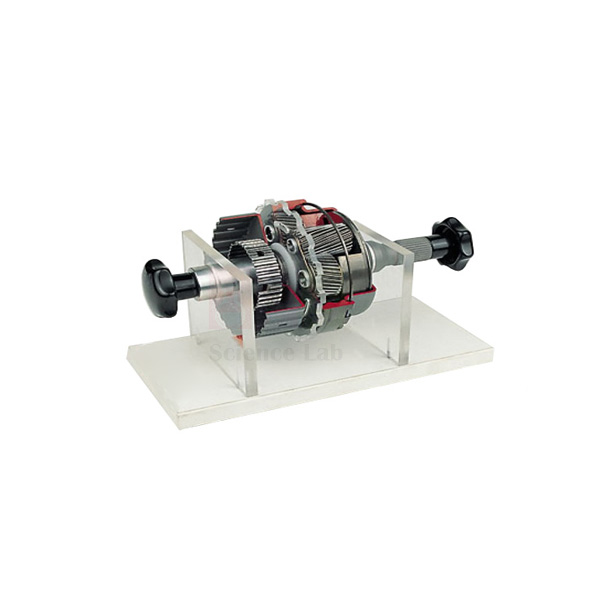
Cut Model Of Planetary Gear System
Cut Model Of Planetary Gear System (Product Code: SLE/MCE/62) is a hand-operated cutaway model used to demonstrate how a sun gear, planet gears, planet carrier and ring gear work together, in machine design and automotive classrooms. Built from original components that keep their full mechanical function, it lets students make the sun gear, carrier or ring gear the driving, driven or fixed member. It is made by Jain Scientific Equipments Pvt Ltd (ScienceLab), an OEM manufacturer, at its own factory in Ambala, India.
Specifications
| Parameter | Detail |
|---|---|
| Gear type | Planetary gear drive |
| Members | Central sun gear; multiple planet gears on a planet carrier; internally toothed ring gear |
| Configurations | Sun gear, planet carrier and ring gear may each be driving, driven or fixed |
| Load sharing | Torque and power distributed among several planet gears |
| Construction | Cutaway of original components; active parts clearly visible; full mechanical functionality kept |
| Mounting | Securely mounted on a base plate with carrying handles |
| Operation | By hand |
| Applications illustrated | Automotive construction and shipbuilding |
| Dimensions | 450 × 400 × 300 mm (approx.) |
| Weight | 10 kg (approx.) |
| Product code | SLE/MCE/62 |
| Manufacturer | Jain Scientific Equipments Pvt Ltd (ScienceLab) — OEM |
| Country of origin | India (made in Ambala, Haryana) |
What Is the Planetary Gear Cut Model Used For?
By holding one member still and turning another by hand, students see how a single gear set can give a speed reduction, an overdrive or a reversal. Fixing the ring gear and driving the sun gear, for instance, makes the carrier turn slowly in the same direction, while holding the carrier makes the ring gear run backwards — the principle behind automatic gearboxes and marine drives.
It supports theory of machines and automobile engineering practicals on gear ratios and load sharing, and it sits well alongside other engineering lab equipment in India’s polytechnics and colleges. At about 10 kg with carrying handles, one person can take it from the store to any classroom.
OEM Manufacturer
This planetary gear cut model is an OEM product of Jain Scientific Equipments Private Limited, which trades as ScienceLab. It is made at the company’s own licensed factory at Saha, Ambala, Haryana, India, and dispatched factory-direct to schools, colleges, training institutes, dealers and importers. Because the manufacturer handles quotations and repeat orders itself, you can add matching gear models to the same order — just ask us. Visit the ScienceLab profile for more about the company.
Related Automotive Training Equipment
These models extend the lesson from one gear set to complete drivetrains.
- Cut Model Of Automatic Transmission System — shows planetary gear sets at work inside a complete automatic gearbox.
- Gear Train Model — compares simple and compound gear trains with the planetary arrangement.
- Internal Gear Pinion Drive — studies the internal-tooth meshing used by the ring gear.
- Differential Gear — another drivetrain gear arrangement that divides torque between wheels.
See all Automotive Training Equipment and the Theory of Machines range.
Frequently Asked Questions
What does the Cut Model Of Planetary Gear System demonstrate?
The Cut Model Of Planetary Gear System demonstrates a planetary gear drive in which several planet gears on a carrier revolve around a central sun gear and mesh with an internally toothed ring gear, sharing torque and power between them.
Can different gear combinations be set on the planetary gear model?
Yes. On the Cut Model Of Planetary Gear System, the sun gear, planet carrier and ring gear may each be used as the driving, driven or fixed member, so students can compare output speed and direction for every combination.
How is the Cut Model Of Planetary Gear System powered?
The Cut Model Of Planetary Gear System is powered by hand. Its cutaway original components keep full mechanical function, so the gears can be turned and observed directly while the active parts remain clearly visible.
How portable is the Cut Model Of Planetary Gear System?
The Cut Model Of Planetary Gear System measures about 450 × 400 × 300 mm and weighs about 10 kg. It is securely mounted on a base plate with handles, so one person can carry it between classroom and laboratory.
Who manufactures the Cut Model Of Planetary Gear System?
Jain Scientific Equipments Pvt Ltd (ScienceLab) is the OEM of the Cut Model Of Planetary Gear System and makes it at its own licensed factory at Saha, Ambala, Haryana, India, supplying it factory-direct to schools, colleges and dealers.
What should a quotation request for the planetary gear model include?
A quotation request for the Cut Model Of Planetary Gear System should state the number of models, the delivery location in India or abroad and any related gear models you want for the same lab, so the manufacturer can quote them together.
Request a Quote
Ask for a quotation on the Cut Model Of Planetary Gear System (SLE/MCE/62) through the contact page or collect it with other models in the enquiry cart. The manufacturer replies with the quotation directly.
Last updated: 24 September 2026
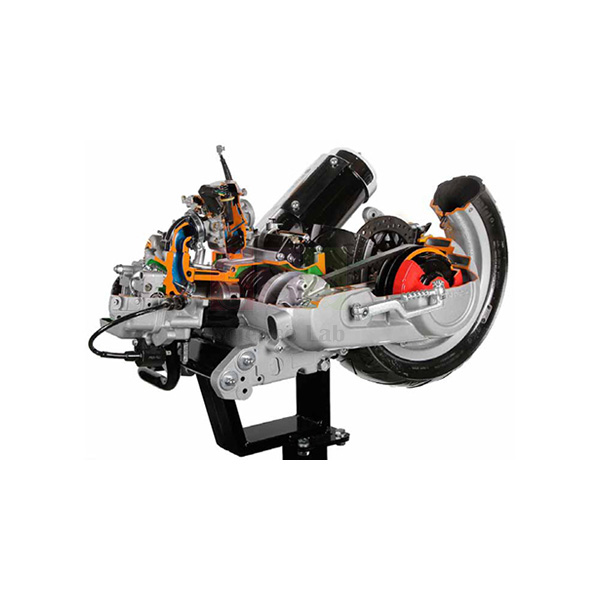
Cut Section Model Of Four Stroke Petrol Engine
Cut Section Model Of Four Stroke Petrol Engine (Product Code: SLE/MCE/63) is a sectioned real engine used to show the internal parts and working cycle of a petrol engine in automotive and mechanical engineering classrooms. Based on an actual 160 cc, 6 HP engine with its flywheel on a sturdy iron frame, it is turned by a crank handle so students can follow the moving parts through all four strokes. It is made by Jain Scientific Equipments Pvt Ltd (ScienceLab), an OEM manufacturer, at its own factory in Ambala, India.
Specifications
| Parameter | Detail |
|---|---|
| Engine | Actual four-stroke petrol engine, cut-sectioned for training |
| Displacement | 160 cc |
| Power | 6 HP |
| Operation | Manual, through a crank handle |
| Flywheel | Provided |
| Mounting | Sturdy iron frame, on base |
| Colour coding | Parts, cross-sections, lubricating circuits, fuel system and cooling system painted in different colours |
| Construction | Specially made dissectible for demonstration |
| Supplied with | Key card and literature on the working of the engine |
| Dimensions | 500 × 500 × 600 mm |
| Weight | 35 kg (approx.) |
| Product code | SLE/MCE/63 |
| Manufacturer | Jain Scientific Equipments Pvt Ltd (ScienceLab) — OEM |
| Country of origin | India (made in Ambala, Haryana) |
What Is the Petrol Engine Cut Section Model Used For?
Turning the crank slowly takes the class through the intake, compression, power and exhaust strokes while the cut-outs show the piston, valves and crankshaft moving together. The colour-coded lubricating, fuel and cooling systems let students trace each circuit, and because the model is dissectible, the instructor can remove parts to show them one at a time.
The key card identifies each component and the supplied literature explains the engine’s working, which helps students revise after the lesson. It is a staple of technical educational equipment for motor mechanic trades, polytechnics, engineering colleges and senior school technology streams. Keep it covered between classes so dust stays out of the sectioned parts.
OEM Manufacturer
Jain Scientific Equipments Private Limited, trading as ScienceLab, is the OEM (original equipment manufacturer) that prepares this cut section petrol engine for teaching. The work is carried out at the company’s own licensed factory at Saha, Ambala, Haryana, India, and the finished model goes factory-direct to schools, ITIs, colleges, dealers and importers. When a school needs a second model or a replacement key card, the request is handled by the manufacturer itself — please ask us. More on the ScienceLab profile.
Related Automotive Training Equipment
These engines and models build on what students learn from the petrol engine section.
- Section Model Of Four-Stroke Diesel Engine — compares compression ignition with this spark-ignition engine.
- 4 Stroke Petrol Engine — a petrol engine for practical work after the sectioned demonstration.
- Four Stroke Four Cylinder Petrol Engine Test Bench — moves on to multi-cylinder performance testing.
- Wankel Engine Model — contrasts the reciprocating piston with a rotary engine.
Find more in Automotive Training Equipment.
Frequently Asked Questions
What engine is used in the Cut Section Model Of Four Stroke Petrol Engine?
The Cut Section Model Of Four Stroke Petrol Engine is an actual cut section engine of 160 cc displacement and 6 HP power, fitted with its flywheel and mounted on a sturdy iron frame for classroom demonstration.
How is the petrol engine cut section model operated?
The Cut Section Model Of Four Stroke Petrol Engine is operated manually through a crank handle. Turning it slowly lets students follow the piston, crankshaft and valve movement through each of the four strokes of the cycle.
What comes with the Cut Section Model Of Four Stroke Petrol Engine?
The Cut Section Model Of Four Stroke Petrol Engine is supplied with a key card and literature explaining the working of the engine. The key card helps students identify each colour-coded part and system shown in the cut sections.
Can the petrol engine model be taken apart?
Yes, the Cut Section Model Of Four Stroke Petrol Engine is specially made dissectible for demonstration purposes, so instructors can show individual parts as well as the sectioned engine as a whole during lessons on engine construction.
Who manufactures the Cut Section Model Of Four Stroke Petrol Engine?
Jain Scientific Equipments Pvt Ltd (ScienceLab) is the OEM of the Cut Section Model Of Four Stroke Petrol Engine, preparing it at its own licensed factory at Saha, Ambala, Haryana, India. Orders and quotations are handled by the manufacturer directly.
How much space does the petrol engine cut section model need?
The Cut Section Model Of Four Stroke Petrol Engine measures 500 × 500 × 600 mm and weighs about 35 kg, so it fits on a sturdy classroom table or workshop bench for group demonstrations.
Request a Quote
To order the Cut Section Model Of Four Stroke Petrol Engine (SLE/MCE/63), use the contact page or add it to the enquiry cart with your other engine models. The quotation is sent to you directly by the manufacturer.
Last updated: 24 September 2026
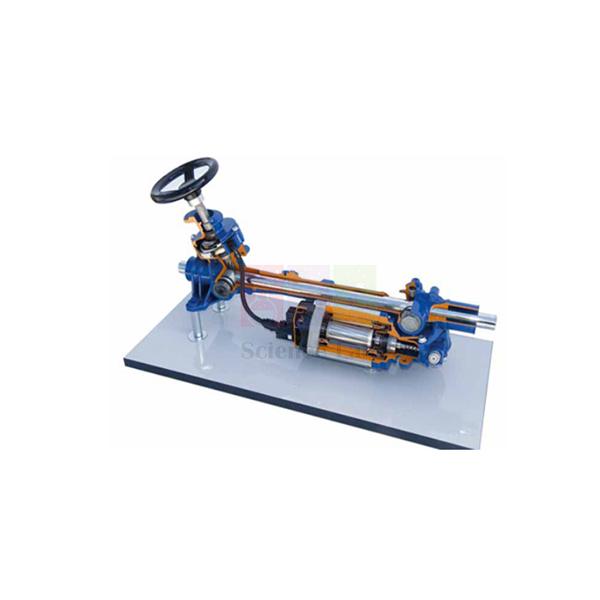
Cut Model Of Rack And Pinion Steering
Cut Model Of Rack And Pinion Steering (Product Code: SLE/MCE/64) is a sectioned steering-system model used to show how turning the steering is converted into side-to-side movement of the rack, in automotive training classrooms and workshops. Besides the rack type steering box, it carries a hydraulic pump, an oil tank with filter and connecting pipes, so the power-assist circuit can be traced as well. It is made by Jain Scientific Equipments Pvt Ltd (ScienceLab), an OEM manufacturer, at its own factory in Ambala, India.
Specifications
| Parameter | Detail |
|---|---|
| Steering type | Rack and pinion, rack type steering box |
| Hydraulic components | Hydraulic pump; oil tank with relevant filter; connecting pipes |
| Operation | Manual, by crank handle |
| Mounting | Tubular frame, on base |
| Finish | Imported colour paint with Miracle coating for gloss and shine; hardware and gears electroplated |
| Dimensions | 1000 × 600 × 550 mm |
| Weight | 25 kg (approx.) |
| Product code | SLE/MCE/64 |
| Manufacturer | Jain Scientific Equipments Pvt Ltd (ScienceLab) — OEM |
| Country of origin | India (made in Ambala, Haryana) |
What Is the Rack and Pinion Steering Model Used For?
When the crank is turned, the pinion rolls along the toothed rack and slides it sideways — the same motion that pushes the tie rods and swings the front wheels of a car. The hydraulic pump, oil tank and pipes show students where the power-assist fluid circulates, which prepares them for inspecting and fault-finding on real steering systems.
The model fits motor vehicle mechanic trades, diploma and degree automobile courses, and any institute building a chassis section with lab equipment for technical institutes. At about 25 kg and 1000 mm long, it can stand on a bench facing the class so everyone sees the rack move.
OEM Manufacturer
The Cut Model Of Rack And Pinion Steering is made by ScienceLab — the trading name of Jain Scientific Equipments Private Limited — as the OEM (original equipment manufacturer). Production takes place at the company’s own licensed factory at Saha, Ambala, Haryana, India, so your enquiry reaches the maker directly instead of passing through a trader. Institutions, dealers and importers can place repeat orders or ask about replacement parts with the same team. Company information is on the ScienceLab profile.
Related Automotive Training Equipment
These chassis and drivetrain trainers complete the steering lesson.
- Power Steering Gear — a further steering gear trainer for comparing power steering designs.
- Working Model Of Hydraulic Braking System — another chassis system built on hydraulic principles.
- Differential Gear — explains how wheels turn at different speeds when the vehicle is steered round a bend.
- Vehicle Transmission 5 Speed Manual Gearbox — completes the drivetrain section of the lab.
More models are listed under Automotive Training Equipment.
Frequently Asked Questions
What does the Cut Model Of Rack And Pinion Steering include?
The Cut Model Of Rack And Pinion Steering includes a rack type steering box, a hydraulic pump, an oil tank with its filter and connecting pipes, all mounted on a tubular frame so the mechanical and hydraulic parts can be studied together.
How is the rack and pinion steering model operated?
The Cut Model Of Rack And Pinion Steering is operated manually with a crank handle. Turning the handle moves the pinion along the rack, so students can watch rotary input become the linear movement that steers the wheels.
What finish does the Cut Model Of Rack And Pinion Steering have?
The Cut Model Of Rack And Pinion Steering is finished in imported colour paint with a Miracle coating for gloss and shine, and its hardware and gears are electroplated. The colours help students separate components during demonstrations.
What are the size and weight of the steering cut model?
The Cut Model Of Rack And Pinion Steering measures 1000 × 600 × 550 mm and weighs about 25 kg. It stands on a base, so it can be placed on a bench or table in a classroom or workshop.
Who manufactures the Cut Model Of Rack And Pinion Steering?
Jain Scientific Equipments Pvt Ltd (ScienceLab) is the OEM of the Cut Model Of Rack And Pinion Steering and makes it at its own licensed factory at Saha, Ambala, Haryana, India. Spare-part and repeat-order enquiries go directly to the manufacturer.
Is the Cut Model Of Rack And Pinion Steering available for export orders?
Yes, the Cut Model Of Rack And Pinion Steering is supplied to institutions, dealers and importers in India and international markets. Share quantities and the destination through the contact page for a quotation from the manufacturer.
Request a Quote
Get a quotation for the Cut Model Of Rack And Pinion Steering (SLE/MCE/64) by writing to us on the contact page, or add it to the enquiry cart. Quotes are prepared by the manufacturer itself in Ambala.
Last updated: 24 September 2026
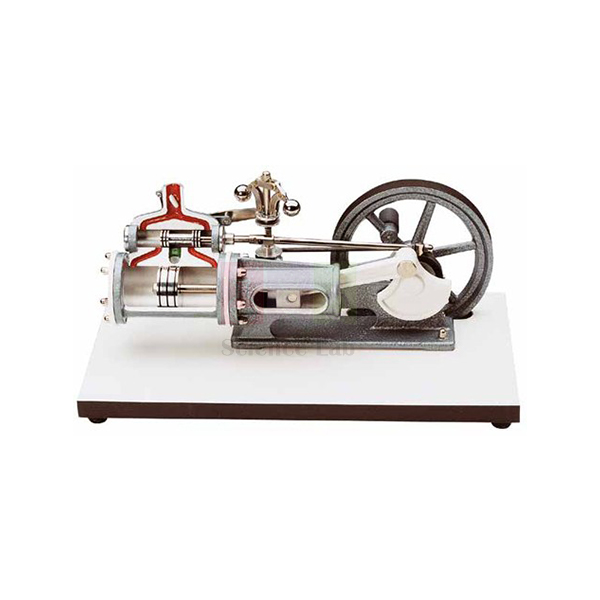
Steam Engine Model
Steam Engine Model (Product Code: SLE/MCE/65) is a sectioned demonstration model used to show the internal structure and operating principle of a reciprocating steam engine in physics and engineering classrooms. Its metal cylinder is cut open and covered with a clear plate, so students can watch the piston and slide valve move while the link motion and reversing method operate. It is made by Jain Scientific Equipments Pvt Ltd (ScienceLab), an OEM manufacturer, at its own factory in Ambala, India.
Specifications
| Parameter | Detail |
|---|---|
| Type | Cutaway classroom model of a working steam engine |
| Cylinder | Metal cylinder, cross-section cut, covered with a clear plate to show the piston |
| Working parts | Piston and slide valve both move; link motion and reversing method operate |
| Wheel movement | Light enough to demonstrate even by blowing air |
| Finish | Parts and cross-sections painted in different colours; many parts chromium-plated and galvanized for longer life |
| Dimensions | 450 × 350 × 300 mm (approx.) |
| Weight | 9 kg (approx.) |
| Product code | SLE/MCE/65 |
| Manufacturer | Jain Scientific Equipments Pvt Ltd (ScienceLab) — OEM |
| Country of origin | India (made in Ambala, Haryana) |
What Is the Steam Engine Model Used For?
Teachers use the model to explain how the slide valve admits steam first to one side of the piston and then the other, producing a back-and-forth motion that the connecting rod and wheel turn into rotation. Moving the link motion shows how the valve timing is shifted to reverse the engine, the same method once used on steam locomotives.
The wheel runs so freely that a gentle breath of air sets it turning, which makes it a memorable demonstration model for the physics lab when heat engines and energy conversion are introduced. In engineering thermodynamics it gives students a clear picture of the earliest practical heat engine before they study modern IC engines and turbines.
OEM Manufacturer
ScienceLab, the trading name of Jain Scientific Equipments Private Limited, is the OEM (original equipment manufacturer) of this Steam Engine Model and makes it at its own licensed factory at Saha, Ambala, Haryana, India. The company is registered as an MSME with manufacturing as its major activity (Udyam UDYAM-HR-01-0003714) and ships overseas orders under Importer-Exporter Code AAECJ8618A from DGFT. Schools, colleges, dealers and importers receive models factory-direct, and repeat orders are handled by the manufacturer. See the ScienceLab company profile.
Related Automotive Training Equipment
These items continue the story of steam and other heat engines.
- Thermal Power Plant with Steam Engine Trainer — takes the steam engine principle into a complete power-plant trainer.
- Saturated Steam The Marcet Boiler — studies the pressure and temperature of the steam that drives such engines.
- Stirling Engine — another external-combustion heat engine for comparison.
- Hand-Powered Engine Models — further hand-turned models of engine cycles.
Browse Automotive Training Equipment and Thermodynamics & Heat Transfer Lab Equipment.
Frequently Asked Questions
What parts of the Steam Engine Model move?
On the Steam Engine Model, the piston and slide valve both move, and the link motion and reversing method operate, so students can see the complete valve gear of a working steam engine and how its direction of rotation is changed.
Can students see inside the cylinder of the Steam Engine Model?
Yes. The Steam Engine Model has a metal cylinder that is cross-section cut and covered with a clear plate, so the movement of the piston inside the cylinder stays visible while the wheel turns.
How is the Steam Engine Model set in motion for a demonstration?
The Steam Engine Model’s wheel moves so lightly that it can be demonstrated even by blowing air, so a teacher can start it with a gentle air stream or a slight push while students watch the piston and slide valve.
How big is the Steam Engine Model?
The Steam Engine Model measures about 450 × 350 × 300 mm and weighs about 9 kg, a convenient size for a teacher’s desk and easy to carry from one classroom to another.
Who manufactures the Steam Engine Model?
Jain Scientific Equipments Pvt Ltd (ScienceLab) manufactures the Steam Engine Model as the OEM at its own licensed factory at Saha, Ambala, Haryana, India, and supplies it factory-direct to schools, colleges, dealers and importers.
How durable is the Steam Engine Model?
Many parts of the Steam Engine Model are chromium-plated and galvanized for a longer life, and the sections are painted in different colours. Wiping it with a dry cloth and storing it covered keeps the finish clean between lessons.
Request a Quote
Request a quotation for the Steam Engine Model (SLE/MCE/65) through the contact page or by adding it to the enquiry cart. You will hear back directly from the manufacturer, Jain Scientific Equipments Pvt Ltd (ScienceLab).
Last updated: 24 September 2026
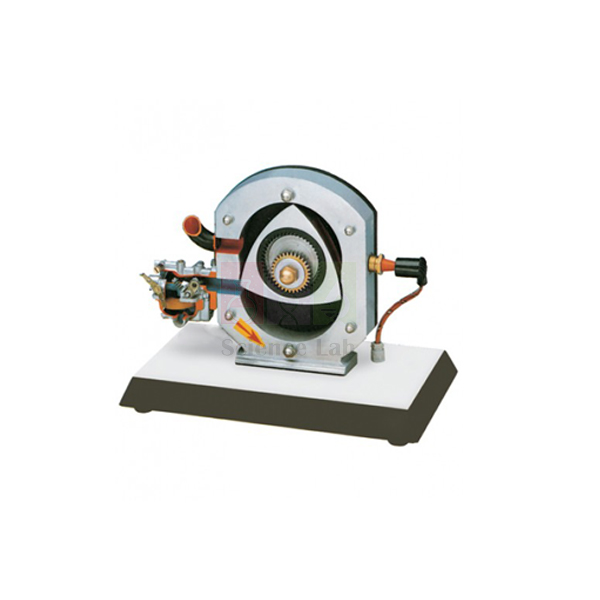
Wankel Engine Model
Wankel Engine Model (Product Code: SLE/MCE/66) is a sectioned rotary-engine model used to show how a triangular rotor produces the working phases inside a stator, in automotive and mechanical engineering lessons. Turned by a crank handle, the light metal model has a small bulb that lights up at the compression phase to simulate gas ignition. It is made by Jain Scientific Equipments Pvt Ltd (ScienceLab), an OEM manufacturer, at its own factory in Ambala, India.
Specifications
| Parameter | Detail |
|---|---|
| Engine type | Wankel (rotary) engine, cut-away for training |
| Rotor | Triangular piston operated by the driving shaft, rotating inside the stator and clearly showing the different phases |
| Ignition simulation | Small bulb lights up at the compression phase |
| Construction | Light metal; various parts cross-sectioned to show internal operation |
| Colour coding | Parts, cross sections and fuel system painted in different colours |
| Operation | Manual, by crank handle |
| Mounting | On a base with wheel |
| Dimensions | 350 × 400 × 300 mm |
| Weight | 7 kg (approx.) |
| Product code | SLE/MCE/66 |
| Manufacturer | Jain Scientific Equipments Pvt Ltd (ScienceLab) — OEM |
| Country of origin | India (made in Ambala, Haryana) |
What Is the Wankel Engine Model Used For?
As the crank turns, each flank of the triangular rotor sweeps round the stator and students can watch the chamber between rotor and housing grow and shrink through intake, compression, power and exhaust — with no up-and-down piston or poppet valves. The bulb lights at the compression phase, marking the point where a spark would fire the mixture.
Setting this model beside a reciprocating engine section helps students see why rotary engines are compact and smooth, and where their sealing challenges lie. Being light metal and only about 7 kg, it is easy to pass round a small group, making it useful technical educational equipment for engine theory classes.
OEM Manufacturer
Jain Scientific Equipments Private Limited, operating under the ScienceLab name, is the OEM (original equipment manufacturer) of the Wankel Engine Model. Each model is made at the company’s own licensed factory at Saha, Ambala, Haryana, India, and sold factory-direct, so colleges, training centres, dealers and importers get quotations straight from the maker. Additional units for a class set, or a replacement part, can be requested from the same manufacturer — ask us. More background is on the ScienceLab profile.
Related Automotive Training Equipment
Compare the rotary engine with these reciprocating and early heat-engine models.
- Cut Section Model Of Four Stroke Petrol Engine — the reciprocating spark-ignition engine for side-by-side comparison.
- Section Model Of Four-Stroke Diesel Engine — shows compression ignition in a piston engine.
- Steam Engine Model — traces heat engines back to the reciprocating steam engine.
- Hand-Powered Engine Models — more hand-turned models for engine-cycle lessons.
View the complete Automotive Training Equipment range.
Frequently Asked Questions
How does the Wankel Engine Model show the engine cycle?
The Wankel Engine Model shows the cycle through a triangular rotor, operated by the driving shaft, that rotates inside the stator. As the crank handle is turned, the sectioned housing clearly shows the different phases taking place in the chambers around the rotor.
Does the Wankel Engine Model show ignition?
Yes. On the Wankel Engine Model, a small bulb lights up during the compression phase to simulate gas ignition, helping students link the rotor position to the moment the mixture would be fired.
How is the Wankel Engine Model operated?
The Wankel Engine Model is operated manually by a crank handle. The instructor can turn it slowly, pause at each phase and point out the rotor, the chambers and the colour-coded fuel system parts.
What is the Wankel Engine Model made of, and how big is it?
The Wankel Engine Model is of light metal construction, mounted on a base, and measures 350 × 400 × 300 mm with a weight of about 7 kg, so it is easy to carry to any classroom.
Who manufactures the Wankel Engine Model?
Jain Scientific Equipments Pvt Ltd (ScienceLab) is the OEM of the Wankel Engine Model, making it at its own licensed factory at Saha, Ambala, Haryana, India. Quotations and any spare-part requests are handled directly by the manufacturer.
What should I include when requesting a quotation for the Wankel Engine Model?
When requesting a quotation for the Wankel Engine Model, include the number of models, your delivery location in India or abroad and any other engine models you want for the same course, so they can be quoted together.
Request a Quote
Enquire about the Wankel Engine Model (SLE/MCE/66) on the contact page, or place it in the enquiry cart alongside other engine models. The manufacturer sends the quotation to you directly.
Last updated: 24 September 2026
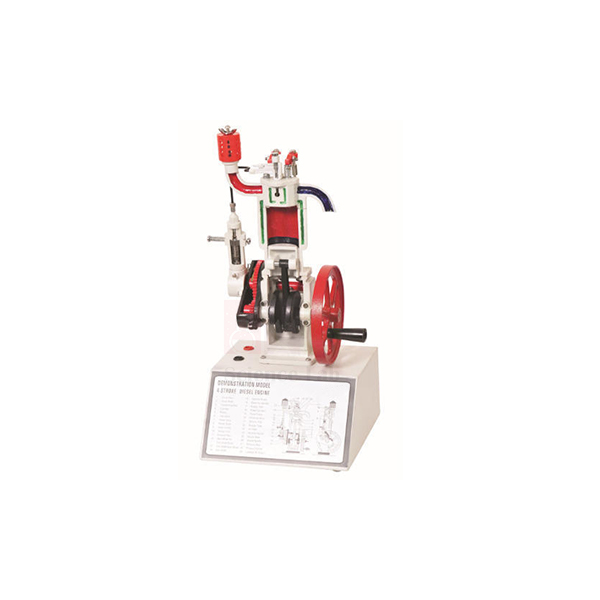
Section Model Of Four-Stroke Diesel Engine
Section Model Of Four-Stroke Diesel Engine (Product Code: SLE/MCE/67) is a sectioned training model used to explain the construction and working cycle of an indirect-injection diesel engine in automotive and mechanical engineering classes. Its internal surfaces are colour-coded for air, fuel and gas mixture, and exhaust gas, while a 3-volt bulb glows at the firing point of the cycle. It is made by Jain Scientific Equipments Pvt Ltd (ScienceLab), an OEM manufacturer, at its own factory in Ambala, India.
Specifications
| Parameter | Detail |
|---|---|
| Engine type | Four-stroke diesel, indirect injection, sectioned for training |
| Displacement | 100 cc |
| Power | 6 HP |
| Injection system | Injection pump, injector, pre-chamber, preheating glow plug |
| Fuel system details | Cam-operated jerk pump and manually operated air inlet diaphragm injection nozzle and starting valve |
| Valve train | Camshaft in the crankcase, overhead valves |
| Other parts shown | Rpm regulator, oil pump, air filter, silencer, tank, cooling system, distribution circuit |
| Firing indication | 3-volt bulb glows at the correct point in the cycle through an electrical contact system in the model |
| Colour coding | Internal surfaces coloured for air, fuel and gas mixture, and exhaust gas; parts, lubricating circuits, fuel and cooling systems painted in different colours |
| Dimensions | 500 × 500 × 650 mm |
| Weight | 25 kg (approx.) |
| Product code | SLE/MCE/67 |
| Manufacturer | Jain Scientific Equipments Pvt Ltd (ScienceLab) — OEM |
| Country of origin | India (made in Ambala, Haryana) |
What Is the Diesel Engine Section Model Used For?
The model shows why a diesel needs no spark: only air is drawn in and squeezed until it is hot enough to ignite fuel sprayed into the pre-chamber, with the glow plug helping on cold starts. As the crankshaft is rotated, the coloured surfaces show which gas fills the cylinder at each stroke and the bulb marks the instant combustion begins.
Instructors use it to walk through the injection pump, injector and pre-chamber in sequence before students work on real fuel systems. It suits diesel mechanic trades, automobile diploma courses and engineering colleges setting up lab equipment for technical institutes. Tip: explain the petrol cycle first, then use this section to highlight what changes in a compression-ignition engine.
OEM Manufacturer
This diesel engine section model is an OEM product of ScienceLab, which is how Jain Scientific Equipments Private Limited trades. The model is prepared at the company’s own licensed factory at Saha, Ambala, Haryana, India, and supplied factory-direct to institutes, dealers and importers without a trading layer in between. For a replacement bulb or other part, or to repeat an order, contact the manufacturer directly — ask us. Find out more on the ScienceLab profile.
Related Automotive Training Equipment
Use these alongside the section model to cover diesel engines in depth.
- Cut Section Model Of Four Stroke Petrol Engine — the spark-ignition engine to compare against.
- 4 Stroke Diesel Engine — a diesel engine for practical work after the sectioned demonstration.
- Diesel Fuel Injection System Inline Pump — a detailed study of the in-line injection pump.
- Diesel Fuel Injection System VE pump — covers the distributor-type injection pump.
See all Automotive Training Equipment.
Frequently Asked Questions
What type of diesel engine does the Section Model Of Four-Stroke Diesel Engine show?
The Section Model Of Four-Stroke Diesel Engine shows an indirect-injection four-stroke diesel engine of 100 cc and 6 HP, complete with injection pump, injector, pre-chamber, preheating glow plug, cooling system and distribution circuit, sectioned for training.
How does the diesel engine section model show the firing point?
The Section Model Of Four-Stroke Diesel Engine uses a 3-volt bulb that glows at the correct point in the cycle, switched by an electrical contact system inside the model, so students can see exactly when combustion begins.
What do the colours on the Section Model Of Four-Stroke Diesel Engine mean?
On the Section Model Of Four-Stroke Diesel Engine, internal surfaces are finished in different colours to indicate air, the fuel and gas mixture, and exhaust gas, while parts, lubricating circuits, fuel and cooling systems are also painted distinctly.
What valve arrangement does the Section Model Of Four-Stroke Diesel Engine have?
The Section Model Of Four-Stroke Diesel Engine has its camshaft in the crankcase and overhead valves, and also shows the rpm regulator, oil pump, air filter, silencer and tank alongside the fuel injection system.
Who manufactures the Section Model Of Four-Stroke Diesel Engine?
Jain Scientific Equipments Pvt Ltd (ScienceLab) is the OEM of the Section Model Of Four-Stroke Diesel Engine, which it prepares at its own licensed factory at Saha, Ambala, Haryana, India. Quotations and repeat orders come straight from the manufacturer.
How big is the diesel engine section model?
The Section Model Of Four-Stroke Diesel Engine measures 500 × 500 × 650 mm and weighs about 25 kg, compact enough to stand on a lecture-room table where a whole group can see the coloured sections.
Request a Quote
For a quotation on the Section Model Of Four-Stroke Diesel Engine (SLE/MCE/67), contact us through the contact page or use the enquiry cart. The manufacturer prepares and sends the quotation itself.
Last updated: 24 September 2026