- Physics Lab Equipment
- Chemistry Lab Equipment
- Biology Lab Equipment
- Anatomical Lab Equipment
- Learning
- Educational Lab Equipment
- Magnets
- Agriculture
- Astronomy
- Earth Science
- Geography Lab Equipment
- Safety Lab Coat
- Laboratory
- Meteorological
- Electricity & Magnetism
- Heat
- School Lab Equipment
- Lab Glassware
- Science Lab Equipment
- Tvet Lab Equipment
- Robotics Kits Supplier and Manufacturer for Schools India
- Math Lab Equipment Manufacturers and Exporters in Ambala
- STEM Kits Manufacturers and Supplier India
- Engineering Lab Equipment
- Hospital Lab Equipment
- Water, Sanitation & Hygiene Supplies
- Cold Chain, Solar & Communication Equipment
- Nutrition
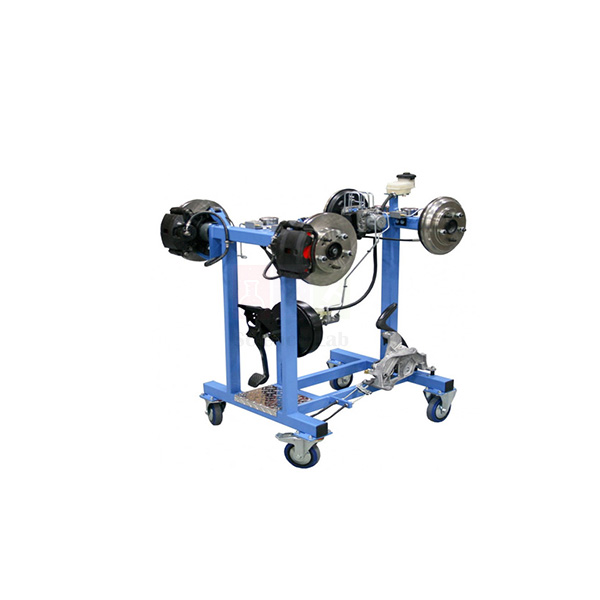
Working Model Of Hydraulic Braking System
Working Model Of Hydraulic Braking System (Product Code: SLE/MCE/68) is a functional brake trainer used to demonstrate a complete four-wheel hydraulic braking system in automotive classrooms and service-training workshops. Built from real automotive disc and drum brake components on a heavy-duty metal stand with casters, it has a pressure gauge at each wheel showing the actual braking pressure. It is made by Jain Scientific Equipments Pvt Ltd (ScienceLab), an OEM manufacturer, at its own factory in Ambala, India.
Specifications
| Parameter | Detail |
|---|---|
| System | Fully functional four-wheel hydraulic braking system, disc and drum |
| Components | Real automotive components: all hydraulic components, brake pedal, power brake booster, parking brake pedal and parking brake components |
| Parking brake | Fully functional parking brake system |
| Pressure indication | Hydraulic pressure gauge at each wheel showing actual braking pressure |
| Access | Easy access to all brake components without the confines of a real vehicle |
| Stand | Heavy-duty metal stand with casters for easy transport |
| Dimensions | 1000 × 800 × 1200 mm |
| Weight | 140 kg (approx.) |
| Product code | SLE/MCE/68 |
| Manufacturer | Jain Scientific Equipments Pvt Ltd (ScienceLab) — OEM |
| Country of origin | India (made in Ambala, Haryana) |
What Is the Hydraulic Braking System Model Used For?
When a student presses the brake pedal, the power brake booster adds to the effort, fluid pressure travels through the lines, and the four gauges show the pressure reaching each disc or drum brake. The parking brake pedal can be applied separately to show how the mechanical parking system holds the wheels independently of the hydraulics.
Because every component can be reached on the open stand, the trainer doubles as a practice rig for brake repair and service procedures such as inspection, adjustment and bleeding. It is a practical choice of vocational training lab equipment for motor vehicle trades, diploma courses and automobile engineering departments.
OEM Manufacturer
ScienceLab is the trading name of Jain Scientific Equipments Private Limited, the OEM (original equipment manufacturer) of the Working Model Of Hydraulic Braking System. The trainer is assembled at the company’s own licensed factory at Saha, Ambala, Haryana, India, using real automotive brake components, and supplied factory-direct to institutions, dealers and importers. Brake parts that wear with repeated practice can be requested from the manufacturer, which also handles repeat orders — ask us. Company details: ScienceLab profile.
Related Automotive Training Equipment
These trainers extend the brake lesson to other systems on the vehicle.
- ABS Braking System Training Board Simulator — the next step, from conventional to anti-lock braking.
- Trailer Air Brake Training Equipment — air brakes used on heavy vehicles and trailers.
- Clutch Structure Trainer Hydraulics — another hydraulically operated vehicle system.
- Cut Model Of Rack And Pinion Steering — completes the chassis systems section.
Browse the Automotive Training Equipment category for more.
Frequently Asked Questions
What does the Working Model Of Hydraulic Braking System include?
The Working Model Of Hydraulic Braking System includes real automotive components: all hydraulic components, disc and drum brakes, the brake pedal, parking brake pedal and parking brake components, a power brake booster and a hydraulic pressure gauge at each wheel.
Is the hydraulic braking model fully functional?
Yes. The Working Model Of Hydraulic Braking System demonstrates the full functionality of a four-wheel hydraulic brake system, including a fully functional parking brake, so students can operate the pedals and watch the brakes respond.
What do the pressure gauges on the Working Model Of Hydraulic Braking System show?
The pressure gauges on the Working Model Of Hydraulic Braking System show the actual braking pressure at each of the four wheels, letting students compare pedal effort with the hydraulic pressure delivered to every brake.
Can the Working Model Of Hydraulic Braking System be moved?
Yes. The Working Model Of Hydraulic Braking System stands on a heavy-duty metal stand with casters for easy transport. It measures 1000 × 800 × 1200 mm and weighs about 140 kg, so check doorway widths along the route.
Who manufactures the Working Model Of Hydraulic Braking System?
Jain Scientific Equipments Pvt Ltd (ScienceLab) is the OEM of the Working Model Of Hydraulic Braking System and builds it at its own licensed factory in Saha, Ambala, Haryana, India, supplying it direct to institutions and dealers.
Can the hydraulic brake trainer be used for service training?
Yes. Besides classroom demonstration, the Working Model Of Hydraulic Braking System serves as educational equipment for brake system repair and service procedures, because every brake component is easy to reach without the confines of a real vehicle.
Request a Quote
Send a quotation request for the Working Model Of Hydraulic Braking System (SLE/MCE/68) via the contact page, or add the trainer to the enquiry cart. The quotation comes directly from the manufacturer in Ambala.
Last updated: 24 September 2026
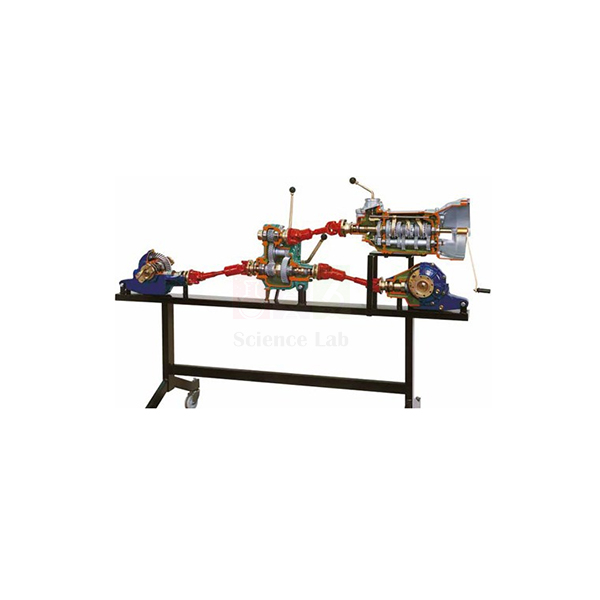
Vehicle Transmission 5 Speed Manual Gearbox
Vehicle Transmission 5 Speed Manual Gearbox (Product Code: SLE/MCE/69) is a real cutaway drivetrain model used to show how a manual gearbox, reduction gear and differentials deliver controlled power to the wheels, in automotive engineering training. Its sectioned parts — a gearbox with 5 speeds and reverse, a 2-speed reduction gear, drive shafts with universal joints and self-locking hypoid differentials — are connected so they work together under manual operation. It is made by Jain Scientific Equipments Pvt Ltd (ScienceLab), an OEM manufacturer, at its own factory in Ambala, India.
Specifications
| Parameter | Detail |
|---|---|
| Gearbox | 5 speeds and reverse |
| Reduction gear | 2-speed |
| Drive shafts | With universal joints |
| Differentials | Self-locking hypoid |
| Control | Movement restorer with front-wheel-drive manual control |
| Operation | Manual |
| Construction | Accurate real cutaway parts, connected together to show their operation |
| Finish | Parts and cross-sections painted in different colours |
| Dimensions | 800 × 300 × 1100 mm (approx.) |
| Weight | 225 kg |
| Product code | SLE/MCE/69 |
| Manufacturer | Jain Scientific Equipments Pvt Ltd (ScienceLab) — OEM |
| Country of origin | India (made in Ambala, Haryana) |
What Is the 5 Speed Manual Gearbox Model Used For?
A transmission provides controlled application of engine power, and this model lets students see how. As each gear is selected and the drivetrain is turned by hand, they watch which gear pair carries the drive and follow the power onward through the reduction gear, drive shafts and universal joints to the hypoid differentials.
It serves as a visual aid for mechanical and automotive subjects and as equipment for repair and service training, which makes it a core item of engineering lab equipment in India’s automobile departments and training centres. At 225 kg, it should be given a permanent place in the workshop, with suitable handling equipment used whenever it has to be moved.
OEM Manufacturer
Jain Scientific Equipments Private Limited, trading as ScienceLab, is the OEM (original equipment manufacturer) of the Vehicle Transmission 5 Speed Manual Gearbox and prepares it at its own licensed factory at Saha, Ambala, Haryana, India. For institutional and tender buyers who need vendor registration details, the company’s identifiers are GSTIN 06AAECJ8618A1ZT and LEI 3358004HRD1JIVXKYX49. Quotations, repeat orders and replacement parts are handled by the manufacturer itself. Read more on the ScienceLab profile.
Related Automotive Training Equipment
These items cover the rest of the manual drivetrain and its alternatives.
- Clutch Structure Trainer Mechanical Manual — the clutch that connects the engine to a manual gearbox.
- Differential Gear — a dedicated model for studying the differential in detail.
- Cut Model Of Automatic Transmission System — compares manual gear selection with automatic shifting.
- Gear Train Model — the gear-ratio basics behind every gearbox.
Explore more Automotive Training Equipment.
Frequently Asked Questions
What does the Vehicle Transmission 5 Speed Manual Gearbox model include?
The Vehicle Transmission 5 Speed Manual Gearbox includes a gearbox with 5 speeds and reverse, a 2-speed reduction gear, drive shafts with universal joints, self-locking hypoid differentials and a movement restorer with front-wheel-drive manual control, all as real cutaway parts.
Is the Vehicle Transmission 5 Speed Manual Gearbox made from real parts?
Yes. The parts of the Vehicle Transmission 5 Speed Manual Gearbox are supplied as accurate real cutaways, connected together so their operation is shown in an easy, immediately understandable way, and painted in different colours for clarity.
How is the manual gearbox model operated?
The Vehicle Transmission 5 Speed Manual Gearbox is operated manually, so the instructor can select each gear and turn the drivetrain at teaching speed while students follow the power path from gearbox to differentials.
How heavy is the Vehicle Transmission 5 Speed Manual Gearbox?
The Vehicle Transmission 5 Speed Manual Gearbox weighs 225 kg and measures about 800 × 300 × 1100 mm. Plan a permanent position in the workshop and use suitable handling equipment when it has to be moved.
Who manufactures the Vehicle Transmission 5 Speed Manual Gearbox?
Jain Scientific Equipments Pvt Ltd (ScienceLab) is the OEM of the Vehicle Transmission 5 Speed Manual Gearbox and makes it at its own licensed factory at Saha, Ambala, Haryana, India. Quotations come directly from the manufacturer.
Can the Vehicle Transmission 5 Speed Manual Gearbox be shipped overseas?
Yes, ScienceLab supplies the Vehicle Transmission 5 Speed Manual Gearbox to institutions, dealers and importers in India and international markets. Send the quantity and destination through the contact page for a quotation.
Request a Quote
To receive a quotation for the Vehicle Transmission 5 Speed Manual Gearbox (SLE/MCE/69), write to us on the contact page or add it to the enquiry cart. The manufacturer quotes you directly, including for tender enquiries.
Last updated: 24 September 2026
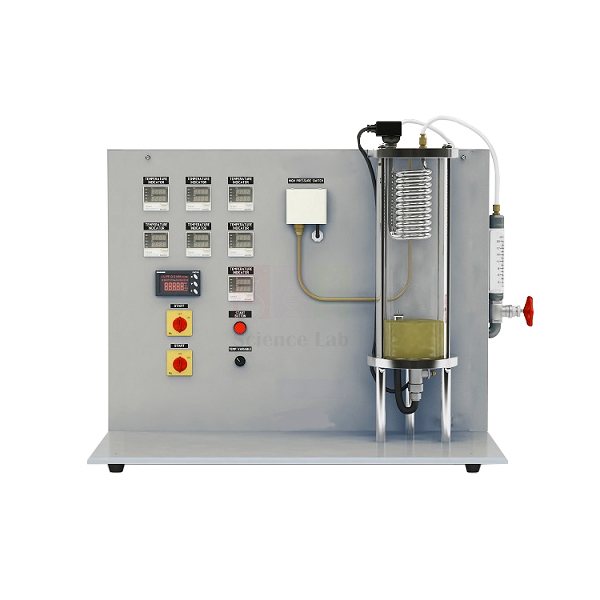
Computerized Boiling Heat Transfer Apparatus
Computerized Boiling Heat Transfer Apparatus (Product Code: SLE/MCE/70) is a bench unit used to observe and measure boiling heat transfer on a heated surface in engineering heat transfer laboratories. Colleges choose this engineering educational equipment in India because its transparent process tank shows evaporation on a heated cylinder that models a fire tube, while sensor data can be sent to a PC via USB. It is made by Jain Scientific Equipments Pvt Ltd (ScienceLab), an OEM manufacturer, at its own factory in Ambala, India.
Specifications
| Parameter | Detail |
|---|---|
| Process tank | Transparent, for clear observation of evaporation at the heated cylinder; tank 10 L |
| Heated cylinder | Model of a fire tube heated from the inside |
| Heater power | 250 W, continuously adjustable |
| Heater surface area | 0.001875 m² |
| Diameter | 80 mm |
| Surface area | 0.0578 m² |
| Cooler | Copper coil; integrated water-cooled condenser for a continuous boiling process |
| Working liquid | Special liquid that evaporates at low temperatures |
| Safety valve | Opens at 2.2 bar |
| Measuring range – pressure | 0–4 bar absolute |
| Measuring range – flow rate | 0.05–1.8 L/min |
| Measuring range – temperature (thermocouple) | 0–200 °C |
| Display and data | Digital displays; values can be transmitted directly to a PC via USB |
| Power supply | 230 V, 50/60 Hz, 1 phase or 120 V, 60 Hz, 1 phase |
| Dimensions | 900 × 450 × 820 mm (approx.) |
| Weight | 60 kg (approx.) |
| Product code | SLE/MCE/70 |
| Manufacturer | Jain Scientific Equipments Pvt Ltd (ScienceLab) — OEM |
| Country of origin | India (made in Ambala, Haryana) |
What Is the Boiling Heat Transfer Apparatus Used For?
Students raise the heater power in steps and watch through the transparent tank as the low-boiling special liquid begins to form bubbles on the heated cylinder. At each setting they record heater power and the temperature difference between the heated surface and the liquid, then plot a boiling curve and estimate heat transfer coefficients. Because the cylinder represents a fire tube heated from inside, the results connect directly to boiler design topics.
The integrated water-cooled condenser turns the vapour back into liquid, so boiling can continue for as long as the experiment needs. Pressure, flow rate and thermocouple temperatures are recorded together, which also lets students explore how boiling temperature follows system pressure. Make sure cooling water is flowing before switching on the heater, and keep the safety valve (opening at 2.2 bar) unobstructed.
What to Specify When Ordering
- Power supply version: 230 V 50/60 Hz or 120 V 60 Hz, single phase
- Cooling-water availability at the bench for the condenser
- Whether a PC is available at the bench for USB data transfer
- Number of units for the heat transfer laboratory
OEM Manufacturer
As the original equipment manufacturer, Jain Scientific Equipments Private Limited — known to customers as ScienceLab — produces the Computerized Boiling Heat Transfer Apparatus at its licensed factory in Saha, Ambala, Haryana. Institutions buy it factory-direct, and dealers or importers receive quotations from the maker itself rather than through a trading chain.
For replacement parts or repeat units, ask us and the manufacturing team will reply. Read about the company on the ScienceLab company profile.
Related Thermodynamics & Heat Transfer Lab Equipment
Phase-change and steam experiments continue naturally on these units:
- Film wise And Dropwise Condensation And Boiling — the companion study of condensation modes alongside boiling
- Saturated Steam The Marcet Boiler — relates saturation pressure and temperature
- Separating & Throttling Calorimeter with mini boiler Test Bench — measures the quality of steam produced by boiling
- Temperature Measurement and Calibration Apparatus — for checking thermocouples used in heat transfer work
Explore the whole Thermodynamics & Heat Transfer Lab Equipment category for conduction, convection and radiation apparatus.
Frequently Asked Questions
What can be observed with the Computerized Boiling Heat Transfer Apparatus?
The Computerized Boiling Heat Transfer Apparatus lets students watch evaporation on a heated cylinder through a transparent process tank. The cylinder models a fire tube heated from inside, and a special liquid that boils at low temperatures makes the process visible at modest heater power.
How much heater power does the Computerized Boiling Heat Transfer Apparatus have?
The Computerized Boiling Heat Transfer Apparatus has a 250 W heater that is continuously adjustable, so heat input can be raised in small steps to record how the boiling process changes with heat flux.
Can data from the Computerized Boiling Heat Transfer Apparatus be logged on a PC?
Yes. Measured values on the Computerized Boiling Heat Transfer Apparatus appear on digital displays and can also be transmitted directly to a PC via USB, which makes recording and plotting of results much quicker.
What are the measuring ranges of the Computerized Boiling Heat Transfer Apparatus?
The Computerized Boiling Heat Transfer Apparatus measures pressure from 0 to 4 bar absolute, flow rate from 0.05 to 1.8 L/min and thermocouple temperature from 0 to 200 °C. Its safety valve opens at 2.2 bar.
How big is the Computerized Boiling Heat Transfer Apparatus?
The Computerized Boiling Heat Transfer Apparatus measures about 900 × 450 × 820 mm and weighs about 60 kg, so it can sit on a sturdy laboratory bench close to cooling water and a power outlet.
Who manufactures the Computerized Boiling Heat Transfer Apparatus?
The Computerized Boiling Heat Transfer Apparatus is made by Jain Scientific Equipments Pvt Ltd (ScienceLab), the OEM, at its own factory in Ambala, Haryana, India. Institutions and importers buy directly from the manufacturer.
Is the Computerized Boiling Heat Transfer Apparatus available for export?
Yes. The Computerized Boiling Heat Transfer Apparatus is supplied to engineering institutions in India and international markets, with 230 V and 120 V single-phase versions listed. Share your destination and supply voltage when requesting a quotation.
Request a Quote
Send your enquiry for the Computerized Boiling Heat Transfer Apparatus through the contact page or collect it with other items in the enquiry cart. The quotation will come straight from the manufacturer.
Last updated: 24 September 2026
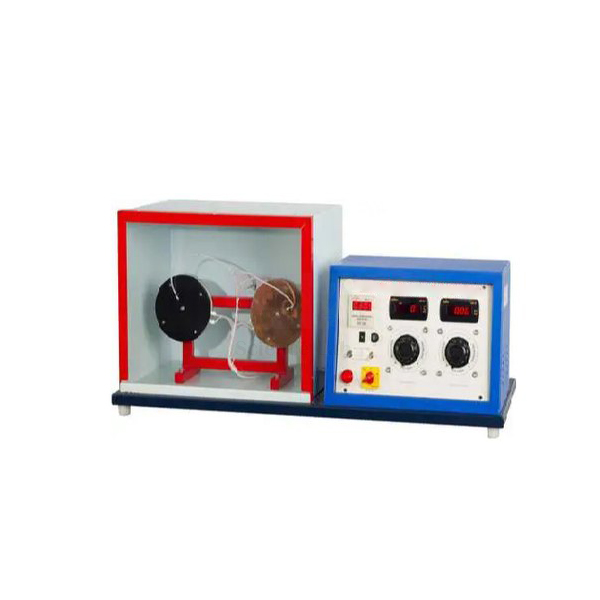
Computerized Emissivity Measurement Apparatus
Computerized Emissivity Measurement Apparatus (Product Code: SLE/MCE/71) is a thermal radiation experiment unit used to compare how strongly different metal surfaces emit heat in heat transfer and thermal engineering laboratories. Colleges looking for a radiation experiment kit at degree level choose it for its 20 mm aluminium, steel and copper samples with different finishes, heated by a 150 W halogen lamp focused through a parabolic reflector. It is made by Jain Scientific Equipments Pvt Ltd (ScienceLab), an OEM manufacturer, at its own factory in Ambala, India.
Specifications
| Parameter | Detail |
|---|---|
| Heat source | Continuously adjustable halogen lamp with parabolic reflector; electrical power 150 W |
| Maximum temperature | Approx. 560 °C |
| Sample position | On a thermocouple at the focal point of the reflector |
| Radiation detector | Thermopile mounted on a moveable carriage for measurements at different distances |
| Aluminium samples, Ø 20 mm | 1 × matt anodised on both sides; 1 × nickel-plated; 1 × heavily oxidised |
| Steel samples, Ø 20 mm | 1 × heavily oxidised; 1 × painted on both sides; 1 × matt anodised with one painted side |
| Copper samples | Ø 20 mm |
| Measuring range – temperature | 0–780 °C |
| Measuring range – radiation intensity | 0–1250 W/m² |
| Dimensions | 700 × 450 × 400 mm |
| Weight | Approx. 20 kg |
| Power supply options | 230 V, 50 Hz, 1 phase; 230 V, 60 Hz, 1 phase; or 120 V, 60 Hz, 1 phase |
| Product code | SLE/MCE/71 |
| Manufacturer | Jain Scientific Equipments Pvt Ltd (ScienceLab) — OEM |
| Country of origin | India (made in Ambala, Haryana) |
What Is the Emissivity Measurement Apparatus Used For?
Heat radiation is one of the three basic forms of heat transfer; unlike conduction and convection it travels as electromagnetic waves and can even cross a vacuum. In this apparatus a metallic sample sits on a thermocouple at the focal point of the reflector, is heated by the concentrated halogen beam, and the radiation it gives off is picked up by a thermopile. Comparing readings for anodised, nickel-plated, oxidised and painted samples at the same temperature shows students clearly how surface finish controls emissivity.
Moving the thermopile carriage to different distances lets the class examine how measured radiation intensity changes with distance from the sample. For consistent results, let each sample reach a steady temperature before reading, keep the thermopile face clean, and change hot samples only with tongs after the lamp has been switched off.
What to Specify When Ordering
- Power supply version: 230 V 50 Hz, 230 V 60 Hz or 120 V 60 Hz, single phase
- Whether extra aluminium, steel or copper samples are wanted for parallel student groups
- Number of units for the heat transfer laboratory
OEM Manufacturer
Jain Scientific Equipments Private Limited, which trades under the ScienceLab name, is the OEM of this emissivity apparatus. It manufactures the unit at its own licensed factory at Saha, Ambala, in Haryana, and sells it directly to universities, polytechnic institutes, laboratory dealers and importers.
Because you deal with the manufacturer, questions about replacement samples, halogen lamps or extra units go straight to the people who build it — simply ask us. Background on the company is available on the ScienceLab profile page.
Related Thermodynamics & Heat Transfer Lab Equipment
To cover all three modes of heat transfer, laboratories often add these units:
- Emissivity Natural Convection And Radiation — looks at radiation together with natural convection losses
- Free and Force Convection Apparatus — the convection counterpart, with four selectable heating elements
- Computerized Thermal Conductivity of Powder — the conduction counterpart, using concentric spheres
- Temperature Measurement and Calibration Apparatus — for checking thermocouples before radiation tests
Visit the Thermodynamics & Heat Transfer Lab Equipment category for the full list of heat transfer trainers.
Frequently Asked Questions
What samples come with the Computerized Emissivity Measurement Apparatus?
The Computerized Emissivity Measurement Apparatus lists 20 mm diameter samples: aluminium (matt anodised on both sides, nickel-plated, heavily oxidised), steel (heavily oxidised, painted on both sides, matt anodised with one painted side) and copper samples.
How is the sample heated in the Computerized Emissivity Measurement Apparatus?
In the Computerized Emissivity Measurement Apparatus, a continuously adjustable 150 W halogen lamp and a parabolic reflector concentrate light onto the sample at the focal point, with a listed maximum temperature of about 560 °C.
How is radiation measured on the Computerized Emissivity Measurement Apparatus?
The Computerized Emissivity Measurement Apparatus uses a thermopile on a moveable carriage to measure the radiation emitted by the sample over 0–1250 W/m², while a thermocouple under the sample reads its temperature over 0–780 °C.
Can the Computerized Emissivity Measurement Apparatus show the effect of distance?
Yes. Because the thermopile of the Computerized Emissivity Measurement Apparatus is mounted on a moveable carriage, radiation can be measured at different distances from the sample to study how intensity changes with distance.
Who manufactures the Computerized Emissivity Measurement Apparatus?
The Computerized Emissivity Measurement Apparatus is manufactured by Jain Scientific Equipments Pvt Ltd (ScienceLab), which is the OEM, at its own factory in Saha, Ambala, Haryana, India, and is quoted directly to buyers.
Is a calibration certificate available for the thermopile?
For the Computerized Emissivity Measurement Apparatus, whether a calibration certificate can be provided for the thermopile or thermocouple should be discussed with us before you order; please state your requirement on the contact page.
What details are needed to quote the Computerized Emissivity Measurement Apparatus?
A quotation for the Computerized Emissivity Measurement Apparatus needs the number of units, the power supply version, the delivery address or port, and any extra samples you want. Send them through the contact page or the enquiry cart.
Request a Quote
Request your quotation for the Computerized Emissivity Measurement Apparatus on the contact page, or add it to the enquiry cart if you are listing several items. Quotes are issued directly by the manufacturer in Ambala.
Last updated: 24 September 2026
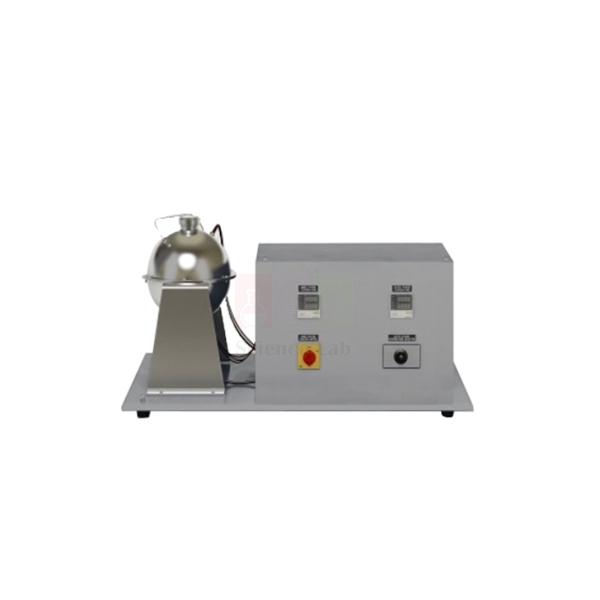
Computerized Thermal Conductivity of Powder
Computerized Thermal Conductivity of Powder (Product Code: SLE/MCE/72) is a concentric-sphere apparatus used to determine the thermal conductivity of an insulating powder in heat transfer laboratories. As lab equipment for technical institutes, it lets mechanical and chemical engineering students measure radial heat flow between a 50 mm and a 100 mm radius copper sphere using ten embedded thermocouples. It is made by Jain Scientific Equipments Pvt Ltd (ScienceLab), an OEM manufacturer, at its own factory in Ambala, India.
Specifications
| Parameter | Detail |
|---|---|
| Construction | Two thin-wall concentric copper spheres with insulating powder packed between the shells |
| Radius of inner copper sphere | 50 mm |
| Radius of outer copper sphere | 100 mm |
| Heater | Mica type: nichrome wire wound on mica sheet, housed in the inner sphere |
| Heating power | 350 W |
| Temperature limitation | 95 °C |
| Thermocouples | 4 embedded on the inner sphere and 6 on the outer sphere (10 in total) |
| Heater supply and measurement | Supplied through a dimmer stat; measured by voltmeter and ammeter |
| Test medium | Commercially available insulating powder packed between the two spheres (confirm the powder type with your quotation) |
| Measuring range – temperature | 2 × 0–325 °C |
| Measuring range – heating power | 0–450 W |
| Power supply options | 230 V, 50 Hz, 1 phase; 230 V, 60 Hz, 1 phase; or 120 V, 60 Hz, 1 phase |
| Product code | SLE/MCE/72 |
| Manufacturer | Jain Scientific Equipments Pvt Ltd (ScienceLab) — OEM |
| Country of origin | India (made in Ambala, Haryana) |
What Is the Thermal Conductivity of Powder Apparatus Used For?
Heat produced by the coil inside the inner sphere can only escape outwards through the powder layer, so once temperatures are steady the electrical input (from the voltmeter and ammeter readings) equals the heat conducted through the insulation. Using the average inner and outer surface temperatures from the ten thermocouples and the two sphere radii, students calculate the powder’s thermal conductivity from the steady-state equation for a spherical shell.
The experiment is a practical way to compare insulating materials of the kind used on pipes, furnaces and cold stores. Raise the dimmer stat gradually, record all ten thermocouples only after the readings stop drifting, and respect the 95 °C temperature limitation. Repeating the test at two or three power settings is a simple check that the conductivity value is consistent.
What to Specify When Ordering
- Power supply version: 230 V 50 Hz, 230 V 60 Hz or 120 V 60 Hz, single phase
- The insulating powder you want to test, so the filling can be confirmed in the quotation
- The computerised data logging you expect, so the arrangement can be confirmed before ordering
- Number of units required
OEM Manufacturer
Jain Scientific Equipments Private Limited is the original equipment manufacturer of this concentric-sphere apparatus and sells it under its trading name, ScienceLab. The unit is manufactured at the company’s own licensed factory at Saha, Ambala, Haryana, India, and supplied direct to engineering colleges, research laboratories, dealers and importers.
Need a replacement heater or thermocouple later? Ask us — as the maker, we deal with such requests ourselves. The ScienceLab profile has more about the company.
Related Thermodynamics & Heat Transfer Lab Equipment
Conduction studies usually extend to these related set-ups:
- Radial Heat Conduction Experiment — radial conduction in a different geometry for comparison
- Conductivity Of Liquid And Gases — extends conductivity measurement to fluids
- Unsteady State Heat Transfer — adds transient conduction to the steady-state method
- Apparatus Heat/Thermal Conductivity — a simpler conduction demonstration for introductory classes
Find more conduction, convection and radiation units in the Thermodynamics & Heat Transfer Lab Equipment category.
Frequently Asked Questions
How does the Computerized Thermal Conductivity of Powder apparatus work?
The Computerized Thermal Conductivity of Powder apparatus heats an inner copper sphere with a mica-type heater; heat flows radially through insulating powder packed between it and an outer sphere, and ten thermocouples record the temperature drop used to calculate conductivity.
What are the sphere sizes of the Computerized Thermal Conductivity of Powder apparatus?
The Computerized Thermal Conductivity of Powder apparatus uses thin-wall concentric copper spheres with radii of 50 mm (inner) and 100 mm (outer), so the powder forms a 50 mm thick spherical layer between them.
What heater does the Computerized Thermal Conductivity of Powder apparatus use?
The heater of the Computerized Thermal Conductivity of Powder apparatus is a mica type made of nichrome wire wound on mica sheet, rated 350 W, with a 95 °C temperature limitation and a 0–450 W power measuring range.
Which insulating powder is used in the Computerized Thermal Conductivity of Powder apparatus?
The Computerized Thermal Conductivity of Powder apparatus uses a commercially available insulating powder packed between the two spheres. Please confirm the powder type with us when you request a quotation, especially if you plan to test your own material.
Who manufactures the Computerized Thermal Conductivity of Powder apparatus?
Jain Scientific Equipments Pvt Ltd (ScienceLab) manufactures the Computerized Thermal Conductivity of Powder apparatus as the OEM at its own factory in Ambala, Haryana, India, and supplies it directly to institutions, dealers and importers.
Can a calibration certificate be provided for the instruments?
Please discuss calibration-certificate availability for the thermocouples, voltmeter and ammeter of the Computerized Thermal Conductivity of Powder apparatus with us before ordering, and list your requirement on the contact page so it is covered in the quotation.
Request a Quote
Tell us the quantity and delivery location for the Computerized Thermal Conductivity of Powder apparatus through the contact page, or add it to the enquiry cart. Every quotation is issued by the manufacturer itself.
Last updated: 24 September 2026
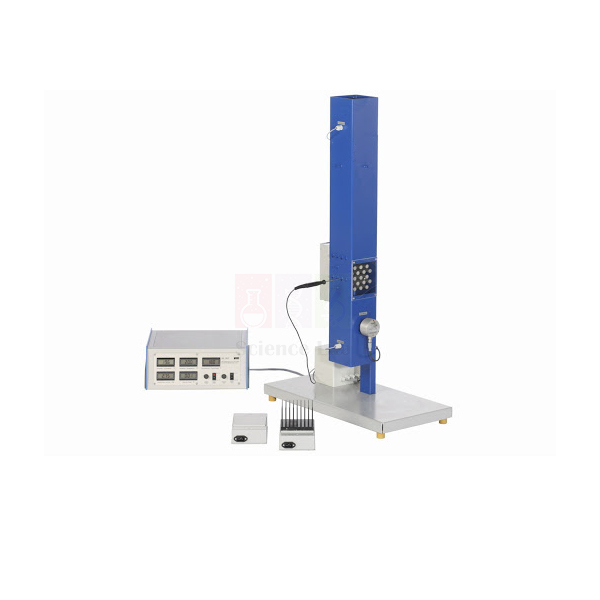
Free and Force Convection Apparatus
Free and Force Convection Apparatus (Product Code: SLE/MCE/73) is an air-duct experiment unit used to study natural (free) and forced convection heat transfer from heated surfaces in heat transfer laboratories. Among engineering lab equipment in India it is distinguished by four selectable heating elements of different geometries — a plate, two cylinders and a 23-tube element — tested in a 120 × 120 mm duct with an axial fan. It is made by Jain Scientific Equipments Pvt Ltd (ScienceLab), an OEM manufacturer, at its own factory in Ambala, India.
Specifications
| Parameter | Detail |
|---|---|
| Air duct flow cross-section | 120 × 120 mm |
| Height | Approx. 0.6 m |
| Heating elements | Four, with different geometries; designed to release heat only at their surface; temperature limitation 90 °C |
| Tube element | 23 tubes; heating power 20 W; heat transfer area 0.001 m² |
| Cylinder (surface temperature measured) | Heating power 20 W; heat transfer area 0.0112 m² |
| Plate | Heating power 40 W; heat transfer area 2 × 0.01 m² |
| Cylinder | Heating power 40 W; heat transfer area 0.0112 m² |
| Axial fan | Max. flow rate 500 m³/h; max. pressure difference approx. 950 Pa |
| Sensors | Temperature at the inlet and outlet of the air duct; air velocity for determining airflow rate |
| Instrumentation | Microprocessor-based, protected in the housing; heating power and flow rate adjusted and displayed via the software |
| Software | System operation, data acquisition and educational software; PC connection via USB |
| Measuring range – air velocity | 0–10 m/s |
| Measuring range – temperature | 4 × 0–325 °C |
| Measuring range – heating power | 0–50 W |
| Power consumption | 90 W |
| Dimensions | 800 × 600 × 800 mm |
| Weight | Approx. 30 kg |
| Power supply options | 230 V, 50 Hz, 1 phase; 230 V, 60 Hz, 1 phase; or 120 V, 60 Hz, 1 phase |
| Product code | SLE/MCE/73 |
| Manufacturer | Jain Scientific Equipments Pvt Ltd (ScienceLab) — OEM |
| Country of origin | India (made in Ambala, Haryana) |
What Is the Free and Force Convection Apparatus Used For?
Air flows past the selected heating element and absorbs heat from its surface. With the fan off, air moves past the element by buoyancy alone (free convection); with the fan running, forced convection takes over and heat transfer rises with air velocity. Students record inlet and outlet air temperatures, element surface temperature, air velocity and heating power, then calculate heat transfer coefficients for each geometry and compare them with textbook correlations.
Because the elements release heat only at their surface and the unit is compact, they heat up quickly and each run is short, so a class can test several geometries in one session. Fit one element at a time, let temperatures settle at every fan setting, and keep element temperatures within the 90 °C limitation. Logging through the USB software keeps a complete record for the lab report.
What to Specify When Ordering
- Power supply version: 230 V 50 Hz, 230 V 60 Hz or 120 V 60 Hz, single phase
- A PC at the bench for the USB operating, data-acquisition and educational software
- Number of units, based on how many student groups will run convection practicals
OEM Manufacturer
Jain Scientific Equipments Private Limited (CIN U29309HR2020PTC087597), trading as ScienceLab, is the OEM that manufactures the Free and Force Convection Apparatus. Production takes place at its licensed factory at 449, HSIIDC Industrial Area, Saha, Ambala, Haryana, which operates under Factory Licence AMB-ONLINE-CHD-J-414.
Buying from the manufacturer means engineering colleges, dealers and importers get quotations, technical answers and spares enquiries from one source — ask us for anything you need. See the company profile for more.
Related Thermodynamics & Heat Transfer Lab Equipment
Convection practicals are often taught alongside these units:
- Emissivity Natural Convection And Radiation — separates natural convection from radiation losses
- Extended Surface Heat Transfer — shows how fins and extended surfaces increase heat transfer
- Computerized Emissivity Measurement Apparatus — covers radiation, the third mode of heat transfer
- Convection in Air Apparatus — a simpler convection demonstration for school physics
For the complete range, open the Thermodynamics & Heat Transfer Lab Equipment category.
Frequently Asked Questions
What heating elements come with the Free and Force Convection Apparatus?
The Free and Force Convection Apparatus has four selectable heating elements with different geometries: an element with 23 tubes (20 W), a cylinder with surface temperature measurement (20 W), a plate (40 W) and a second cylinder (40 W).
What airflow can the fan of the Free and Force Convection Apparatus provide?
The axial fan of the Free and Force Convection Apparatus delivers a maximum flow rate of 500 m³/h and a maximum pressure difference of about 950 Pa, while air velocity in the duct is measured over 0–10 m/s.
Is software included with the Free and Force Convection Apparatus?
Yes. The Free and Force Convection Apparatus includes software for system operation, data acquisition and educational use, connected to a PC via USB; heating power and flow rate are adjusted and displayed through it.
How long does an experiment on the Free and Force Convection Apparatus take?
The Free and Force Convection Apparatus is compact and its elements release heat only at their surface, so they heat up rapidly and experiment times are short — useful when several student groups share one unit.
Who manufactures the Free and Force Convection Apparatus?
The Free and Force Convection Apparatus is manufactured by Jain Scientific Equipments Pvt Ltd (ScienceLab), the OEM, at its licensed factory in Saha, Ambala, Haryana, India. Quotations and repeat orders are handled by the manufacturer directly.
What power does the Free and Force Convection Apparatus need?
The Free and Force Convection Apparatus consumes 90 W and is listed for 230 V 50 Hz, 230 V 60 Hz or 120 V 60 Hz single-phase supply. Mention your laboratory supply when requesting a quotation.
Can the Free and Force Convection Apparatus be ordered in bulk or for export?
Yes. The Free and Force Convection Apparatus is supplied to universities, polytechnics and dealers in India and international markets. For several units, share the quantity, supply voltage and destination so one consolidated quotation can be prepared.
Request a Quote
To get a quotation for the Free and Force Convection Apparatus, write to us through the contact page or add it to the enquiry cart. The quote is prepared by the manufacturer, not a reseller.
Last updated: 24 September 2026
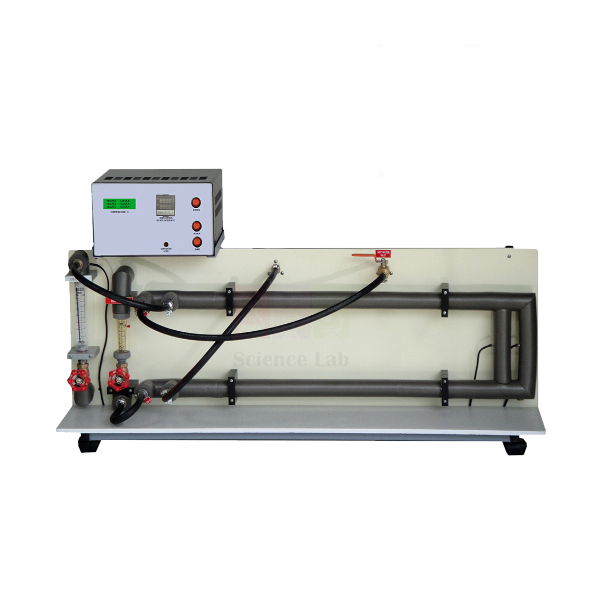
Parallel and Counter Flow Heat Exchanger
Parallel and Counter Flow Heat Exchanger (Product Code: SLE/MCE/74) is a concentric-tube heat exchanger trainer used to compare parallel-flow and counter-flow operation and to determine the heat transfer coefficient in heat transfer laboratories. As engineering educational equipment for colleges and research laboratories, it combines two insulated stainless steel tube sections with a 3000 W heated hot-water tank, hot- and cold-water flow meters and data acquisition software. It is made by Jain Scientific Equipments Pvt Ltd (ScienceLab), an OEM manufacturer, at its own factory in Ambala, India.
Specifications
| Parameter | Detail |
|---|---|
| Construction | 2 sections of insulated concentric stainless steel tubes |
| Flow arrangements | Parallel flow and counter flow |
| Hot water supply | Hot water tank and pump; heater 3000 W |
| Temperature control unit | 1 |
| Stirrer | 0–500 rpm |
| Flow meters | Hot water and cold water |
| Temperature measurement | 6 measuring points; measuring range 0–325 °C |
| Measuring range – heating power | 0–3000 W |
| Software functions | Educational software, data acquisition and system operation |
| Dimensions | 1200 × 600 × 800 mm |
| Weight | 40 kg |
| Power supply options | 230 V, 50 Hz, 1 phase; 230 V, 60 Hz, 1 phase; or 120 V, 60 Hz, 1 phase |
| Product code | SLE/MCE/74 |
| Manufacturer | Jain Scientific Equipments Pvt Ltd (ScienceLab) — OEM |
| Country of origin | India (made in Ambala, Haryana) |
What Is the Parallel and Counter Flow Heat Exchanger Used For?
In parallel flow the hot and cold streams enter at the same end and their temperatures converge along the tube; in counter flow they enter at opposite ends, so the cold outlet can approach the hot inlet temperature more closely. Switching between the two on the same exchanger lets students measure inlet and outlet temperatures of both streams, calculate the log-mean temperature difference, heat duty and heat transfer coefficient, and see for themselves why counter flow is usually more effective.
Changing the hot and cold water flow rates, and the hot water temperature through the temperature control unit, shows the effects of flow rate and temperature difference on performance. Let the hot water tank reach its set temperature before the first reading, keep both flows steady during each run, and use the data acquisition software to build a complete record for effectiveness calculations.
What to Specify When Ordering
- Power supply version: 230 V 50 Hz, 230 V 60 Hz or 120 V 60 Hz, single phase (note the 3000 W heater)
- Cold-water supply and drain available at the bench
- A PC for the educational, data-acquisition and operating software
- Number of units required
OEM Manufacturer
Jain Scientific Equipments Private Limited, trading as ScienceLab, is the OEM behind the Parallel and Counter Flow Heat Exchanger. The trainer is built at the company’s own licensed factory in Saha, Ambala, Haryana, India, and dispatched factory-direct to engineering colleges, research laboratories, laboratory dealers and importers.
As an engineering lab equipment manufacturer, the company answers spares and repeat-order queries itself — just ask us. Company background is on the profile page.
Related Thermodynamics & Heat Transfer Lab Equipment
Heat exchanger laboratories usually compare several designs; these complete the set:
- Concentric Tube Heat Exchanger — another concentric-tube design for cross-checking results
- Shell and Tube Heat Exchanger — the multi-tube configuration common in process plants
- Plate Heat Exchanger — a compact plate design for comparison of performance
- Cross Flow Heat Exchangers — the third basic flow arrangement after parallel and counter flow
All heat exchanger trainers are listed in the Thermodynamics & Heat Transfer Lab Equipment category.
Frequently Asked Questions
Can the Parallel and Counter Flow Heat Exchanger run in both flow modes?
Yes. The Parallel and Counter Flow Heat Exchanger demonstrates heat transfer under both parallel flow and counter flow, so students can compare temperature profiles, heat duty and heat transfer coefficient for the two arrangements on one unit.
What is the Parallel and Counter Flow Heat Exchanger built from?
The Parallel and Counter Flow Heat Exchanger is built from two sections of insulated concentric stainless steel tubes, supplied with hot water from a tank heated by a 3000 W heater and circulated by a pump.
What instruments does the Parallel and Counter Flow Heat Exchanger have?
The Parallel and Counter Flow Heat Exchanger has six temperature measuring points, hot- and cold-water flow meters, one temperature control unit and software for education, data acquisition and system operation.
How large is the Parallel and Counter Flow Heat Exchanger?
The Parallel and Counter Flow Heat Exchanger measures 1200 × 600 × 800 mm and weighs 40 kg, so it can be placed on a laboratory bench or table close to a water supply and drain.
Who manufactures the Parallel and Counter Flow Heat Exchanger?
Jain Scientific Equipments Pvt Ltd (ScienceLab) is the OEM of the Parallel and Counter Flow Heat Exchanger and makes it at its own factory in Ambala, Haryana, India; quotations come directly from the manufacturer.
Is a calibration certificate available for the sensors?
Calibration-certificate availability for the temperature sensors and flow meters of the Parallel and Counter Flow Heat Exchanger should be discussed with us at the enquiry stage. Please list your documentation needs on the contact page.
What should a quotation request for this heat exchanger include?
For a Parallel and Counter Flow Heat Exchanger quotation, tell us the number of units, your power supply (230 V 50 Hz, 230 V 60 Hz or 120 V 60 Hz) and the delivery location in India or abroad.
Request a Quote
Use the contact page to request a quotation for the Parallel and Counter Flow Heat Exchanger, or save it in the enquiry cart while you build a full laboratory list. Quotes are sent by the manufacturer directly.
Last updated: 24 September 2026
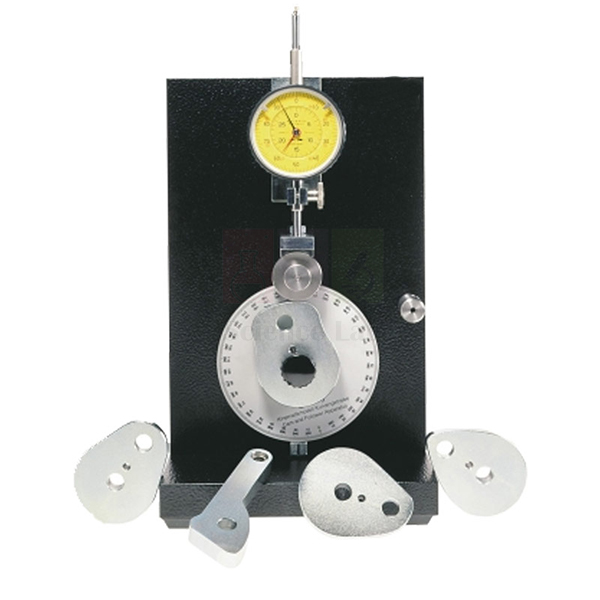
Cam Mechanism
Cam Mechanism (Product Code: SLE/MCE/75) is a bench-top demonstration unit used to show how a rotating cam converts uniform rotation into non-uniform follower motion, with or without dwell, in theory of machines laboratories. Students fit one of four cam shapes and one of three engaging members, then read the follower stroke on a 0–30 mm dial gauge against the cam angle on a 360° scale. It is made by Jain Scientific Equipments Pvt Ltd (ScienceLab), an OEM manufacturer, at its own factory in Ambala, India.
Specifications
| Parameter | Detail |
|---|---|
| Cam shapes | 4: circular arc, tangent, hollow, asymmetric |
| Engaging members | 3: roller plunger, flat plunger, cam follower |
| Angular scale | 0–360°, graduation 1°, for the angle of rotation |
| Dial gauge for the stroke | 0–30 mm, graduation 0.01 mm |
| Changeover | Cam and engaging member exchanged without tools |
| Dimensions | 300 x 300 x 400 mm |
| Weight | 8 kg |
| Product code | SLE/MCE/75 |
| Manufacturer | Jain Scientific Equipments Pvt Ltd (ScienceLab) — OEM |
| Country of origin | India (made in Ambala, Haryana) |
What Is the Cam Mechanism Used For?
A cam is a shaped disc that pushes a follower through a planned motion as it turns, as in engine valve gear and automatic machinery. On this unit, students set the cam to successive positions on the angular scale and record the stroke on the dial gauge, building a displacement diagram of follower lift against cam angle. Repeating the test with the circular arc, tangent, hollow and asymmetric cams shows how the profile shapes the rise, dwell and return of the follower.
Swapping between the roller plunger, flat plunger and cam follower needs no tools, so the class can compare how each engaging member traces the same profile within one session. From the displacement readings, advanced students can estimate follower velocity and acceleration by differentiating the curve, a standard exercise in a kinematics of machines course. Keep the dial gauge plunger clean and square to the follower to make full use of its 0.01 mm graduation.
OEM Manufacturer
The Cam Mechanism is an OEM product of ScienceLab. Jain Scientific Equipments Private Limited, trading under the ScienceLab name, manufactures it at its own licensed factory at Saha, Ambala, Haryana, India, and sells it factory-direct to engineering colleges, polytechnics, ITIs, dealers and importers.
Because the maker handles each order, questions about extra cams, spare engaging members or repeat orders for more benches can be raised with us directly. The ScienceLab company profile explains more about the company as an engineering lab equipment manufacturer.
Related Theory of Machines Equipment
Mechanisms that are usually taught alongside cams in a kinematics laboratory:
- Cam Analysis Machine — a further machine for studying cam and follower behaviour.
- Four Bar Chain Apparatus — the basic linkage studied next to cams in motion conversion.
- Gear Trainer Demonstrator — gear drives for comparison with cam-driven motion.
- Internal Gear Pinion Drive — another hands-on power transmission demonstration.
Explore the wider Theory of Machines category for more mechanism trainers.
Frequently Asked Questions
Which cam shapes come with the Cam Mechanism?
The Cam Mechanism has four cam shapes: circular arc, tangent, hollow and asymmetric. Using all four on the same unit lets students compare the follower displacement that each profile produces and relate the curve to the shape of the cam.
What followers can be used on the Cam Mechanism?
The Cam Mechanism accepts three engaging members: a roller plunger, a flat plunger and a cam follower. Both the cam and the engaging member can be exchanged without tools, so changeovers between tests take very little class time.
How are readings taken on the Cam Mechanism?
On the Cam Mechanism, the follower stroke is read on a dial gauge with a 0–30 mm range and 0.01 mm graduation, while the cam rotation is read on an angular scale from 0 to 360° with 1° graduation.
How large is the Cam Mechanism?
The Cam Mechanism measures 300 x 300 x 400 mm and weighs 8 kg. It is a bench-top unit, so it can be set up on an ordinary laboratory bench without a dedicated frame or floor space.
Who manufactures the Cam Mechanism?
The Cam Mechanism is manufactured by Jain Scientific Equipments Pvt Ltd (ScienceLab), the OEM, at its own licensed factory at Saha, Ambala, Haryana, India. Quotations come directly from the manufacturer, not from an intermediary.
Is a calibration certificate available for the Cam Mechanism dial gauge?
Calibration paperwork for the Cam Mechanism dial gauge is not stated in the product listing. If your department needs a calibration certificate, mention it in your enquiry so that availability can be discussed with us before you order.
Can the Cam Mechanism be supplied for several laboratories?
Yes, the Cam Mechanism can be quoted in multiple units for colleges, training institutes and dealers in India and international markets. Send the quantity and destination through the contact page for a consolidated quotation.
Request a Quote
Request a price for the Cam Mechanism (SLE/MCE/75) through our contact page or by adding it to the enquiry cart. Quotations are sent directly by the manufacturer in Ambala.
Last updated: 24 September 2026