- Physics Lab Equipment
- Chemistry Lab Equipment
- Biology Lab Equipment
- Anatomical Lab Equipment
- Learning
- Educational Lab Equipment
- Magnets
- Agriculture
- Astronomy
- Earth Science
- Geography Lab Equipment
- Safety Lab Coat
- Laboratory
- Meteorological
- Electricity & Magnetism
- Heat
- School Lab Equipment
- Lab Glassware
- Science Lab Equipment
- Tvet Lab Equipment
- Robotics Kits Supplier and Manufacturer for Schools India
- Math Lab Equipment Manufacturers and Exporters in Ambala
- STEM Kits Manufacturers and Supplier India
- Engineering Lab Equipment
- Hospital Lab Equipment
- Water, Sanitation & Hygiene Supplies
- Cold Chain, Solar & Communication Equipment
- Nutrition
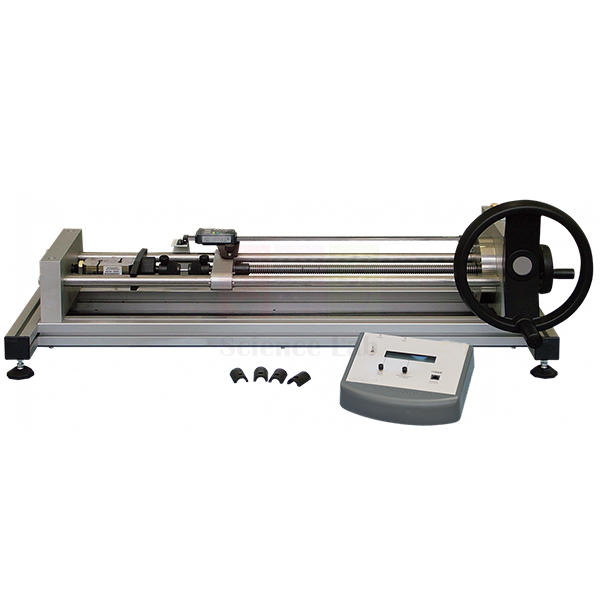
Bench Top Tensile Testing Machine
Bench Top Tensile Testing Machine (Product Code: SLE/ETP/19) is a small-scale, hand-operated tensile tester used to run simple tensile tests on metal specimens up to a maximum load of 20 kN in engineering teaching laboratories. A worm-and-wheel drive with about 400 mm of lead-screw travel, a strain-gauged load cell with peak hold and a sliding digital extension display make it practical lab equipment for technical institutes. It is made by Jain Scientific Equipments Pvt Ltd (ScienceLab), an OEM manufacturer, at its own factory in Ambala, India.
Specifications
| Parameter | Detail |
|---|---|
| Maximum load | 20 kN |
| Specimens | Metal specimens, for simple tensile tests |
| Format | Small-scale machine that fits on a benchtop |
| Load application | Hand-driven worm-and-wheel gearbox driving a lead screw |
| Lead screw travel | Approximately 400 mm |
| Bearings | Low-friction bearings with a large handwheel; ball races and self-aligning ball thrust races in the direction of loading |
| Operation | Smooth and progressive, helping the user apply a steady strain rate; maximum load reached with minimum effort |
| Load measurement | Strain-gauged load cell connected to a microprocessor-controlled digital display |
| Peak hold | Registers the maximum load before the specimen breaks |
| Extension measurement | Sliding digital display measures tensile displacement over the entire movement |
| Product code | SLE/ETP/19 |
| Manufacturer | Jain Scientific Equipments Pvt Ltd (ScienceLab) — OEM |
| Country of origin | India (made in Ambala, Haryana) |
What Is the Bench Top Tensile Tester Used For?
The tensile test is the foundation of materials science: from one specimen, students obtain yield strength, ultimate tensile strength, elongation and a full load-extension curve. This machine brings that test onto an ordinary laboratory bench, so every group can run its own specimens instead of watching a single large machine from a distance.
Students turn the handwheel steadily, reading load from the digital display and extension from the sliding digital display at regular intervals. The peak-hold function keeps the maximum load on screen after the specimen breaks, so it is never missed. Mark the gauge length before testing, keep the handwheel speed even for a steady strain rate, and make sure everyone nearby wears eye protection in case of sudden fracture.
What to Specify When Ordering
- The metals you plan to test, so specimen types can be discussed within the 20 kN maximum load.
- Whether you need the Compression Cage for compressive-load and Brinell experiments.
- How many specimens you need for your student groups.
- The number of machines and the delivery destination.
OEM Manufacturer
ScienceLab is the trading name of Jain Scientific Equipments Private Limited, the OEM (original equipment manufacturer) of the Bench Top Tensile Testing Machine. The machine is made and assembled at the company's own licensed factory at Saha, Ambala, Haryana, and supplied factory-direct to engineering colleges, polytechnics, dealers and importers. As the manufacturer, the company also handles follow-up orders for ancillaries and spare parts; ask us what you need. See the company profile.
Related Materials Testing and Properties Equipment
Ancillaries, specimens and alternatives for bench-top tensile testing:
- Compression Cage — fits the tensile test area to add compressive-load experiments.
- Speciman — long-style carbon steel tensile specimen listed for this machine.
- Double Shear Test Specimens — copper specimens for shear experiments.
- Tensile Tester Kit — a cased introductory kit for younger students.
The Materials Testing and Properties category has the full range of testing apparatus.
Frequently Asked Questions
What is the maximum load of the Bench Top Tensile Testing Machine?
The Bench Top Tensile Testing Machine carries out simple tensile tests of metal specimens up to a maximum load of 20 kN. It is a small-scale machine that fits on a benchtop in a teaching laboratory.
How is load applied on the Bench Top Tensile Testing Machine?
Load on the Bench Top Tensile Testing Machine is applied by hand through a worm-and-wheel gearbox driving a lead screw with approximately 400 mm of travel. Low-friction bearings and a large handwheel let the user reach maximum load with minimum effort.
How are load and extension measured?
The Bench Top Tensile Testing Machine measures load with a strain-gauged load cell and a microprocessor-controlled digital display with peak hold, while a sliding digital display measures extension over the entire movement.
Is a calibration certificate available for the Bench Top Tensile Testing Machine?
Whether a calibration certificate can be supplied with the Bench Top Tensile Testing Machine should be discussed with us before ordering. Mention it through the contact page so it is addressed in your quotation.
Who manufactures the Bench Top Tensile Testing Machine?
The Bench Top Tensile Testing Machine is manufactured by Jain Scientific Equipments Pvt Ltd (ScienceLab), the OEM, at its own licensed factory in Saha, Ambala, Haryana, India. Quotations and spares come from the manufacturer directly.
What should a Bench Top Tensile Testing Machine enquiry include?
A Bench Top Tensile Testing Machine enquiry should include the product code SLE/ETP/19, the quantity, the metals you plan to test, any ancillaries such as the Compression Cage, and the delivery destination in India or abroad.
Request a Quote
To receive a Bench Top Tensile Testing Machine quotation from the manufacturer, write through the contact page or add it to the enquiry cart. We supply institutions, dealers and importers in India and international markets.
Last updated: 24 September 2026
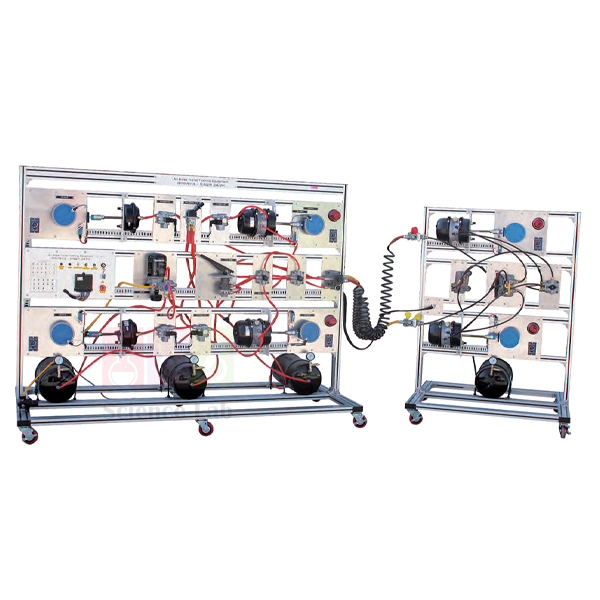
Trailer Type Air Brake System Training Equipment
Trailer Type Air Brake System Training Equipment (Product Code: SLE/ATE/11) is a heavy-truck air brake trainer used to teach the operation, inspection and maintenance of air brakes and ABS in automotive and vocational training workshops. A body-part stand and a separate trailer unit are coupled by air line, so trainees practise connecting the trailer brake circuit while four 120W motors spin the wheels. It is made by Jain Scientific Equipments Pvt Ltd (ScienceLab), an OEM vocational training lab equipment manufacturer, at its own factory in Ambala, India.
Specifications
| Parameter | Detail |
|---|---|
| Configuration | Brake system from the body part plus a separate trailer unit |
| Driving motor | Single phase 220V, speed control type, 120W — 4 nos |
| Wheel control | Wheel rotation and speed controlled with motor |
| Composition | Air tank, pressure regulator, brake pedal, air pressure gauge, single chamber (2 nos), double chamber (2 nos), ECU, parking brake valve, check valve, ABS pulse ring, PCV modulator, quick release valve, air dryer, double check valve, etc. |
| Control panel | Check terminal, power lamp, fuse holder, key switch, power switch, emergency switch |
| Size | Approx. 2,400 x 600 x 1,800 mm (main unit) + 800 x 600 x 1,600 mm (trailer) |
| Weight | Approx. 150 kg (main unit) + 60 kg (trailer) |
| Testing | Tests can be carried out with the installed air tank and all components of the air brake system |
| Product code | SLE/ATE/11 |
| Manufacturer | Jain Scientific Equipments Pvt Ltd (ScienceLab) — OEM |
| Country of origin | India (made in Ambala, Haryana) |
Training contents:
- ABS waveform test
- ABS modulator resistance test
- How to use the foot brake and hand control valve
- Completing the brake air line test
- Connecting the air line from the trailer brake system
- Output voltage test
What Is the Trailer Air Brake Trainer Used For?
The feature that sets this trainer apart is the coupling exercise. With the trailer unit parked beside the main stand, students connect the trailer air line and then confirm that a brake application at the pedal or hand control valve reaches the trailer chambers as well as the main unit. Instructors can disconnect the line again to show what happens when the trailer circuit loses supply, which makes the purpose of the check valves and double check valve easy to explain.
Electrical work follows on the same rig: ABS modulator resistance and output voltage are taken at the check terminal, and the ABS waveform is recorded while the motors spin the wheels. For colleges choosing lab equipment for technical institutes with limited floor space, the narrow main stand and separate trailer can be arranged to suit the workshop layout. Switch off at the key switch or emergency switch before touching any rotating wheel or air fitting.
OEM Manufacturer
ScienceLab is the brand name of Jain Scientific Equipments Private Limited, the OEM (original equipment manufacturer) that builds and assembles this trailer-type air brake trainer at its own licensed factory at Saha, Ambala, Haryana, India. The company is incorporated with the Ministry of Corporate Affairs under CIN U29309HR2020PTC087597, and its production site at 449, HSIIDC Industrial Area, Saha, Ambala holds Factory Licence AMB-ONLINE-CHD-J-414. Trainers are supplied factory-direct to ITIs, polytechnics, engineering colleges, dealers and importers, and repeat orders or spare-part requests go straight back to the manufacturer, so just ask us. More details are in our company profile.
Related Automotive Training Equipment
Useful additions for a truck-and-trailer brake training bay:
- Trailer Air Brake Training Equipment — a single-stand air brake and ABS rig for when a separate trailer is not needed.
- Working Model Of Hydraulic Braking System — a four-wheel hydraulic brake rig for contrasting car brakes with truck air brakes.
- Large Yard Tractor Engine Fault Diagnosis System — engine-side training for the tractor units that haul trailers.
- Standard Digital Multimeter — for resistance and voltage readings at the check terminal.
- Oscilloscope Dual Trace — to view the ABS waveform during testing.
Explore more vehicle system trainers in our Automotive Training Equipment category.
Frequently Asked Questions
How does the Trailer Type Air Brake System Training Equipment differ from the single-stand trailer air brake trainer?
The Trailer Type Air Brake System Training Equipment separates the trailer brake circuit into its own unit, so trainees can practise connecting the air line from the trailer brake system, an exercise the single-stand Trailer Air Brake Training Equipment does not list.
What are the dimensions and weights of the Trailer Type Air Brake System Training Equipment?
The main unit of the Trailer Type Air Brake System Training Equipment is approx. 2,400 x 600 x 1,800 mm and 150 kg; the trailer is approx. 800 x 600 x 1,600 mm and 60 kg, so plan floor space for both.
How many wheel motors does the Trailer Type Air Brake System Training Equipment use?
The Trailer Type Air Brake System Training Equipment uses four speed-control motors of 120W, each for a single phase 220V supply, to turn the wheels. If your workshop has a different mains supply, tell us when you enquire.
Which brake components are fitted to the Trailer Type Air Brake System Training Equipment?
The Trailer Type Air Brake System Training Equipment includes an air tank, pressure regulator, brake pedal, air pressure gauge, two single and two double chambers, ECU, parking brake valve, check valve, ABS pulse ring, PCV modulator, quick release valve, air dryer and double check valve.
What practical exercises does the Trailer Type Air Brake System Training Equipment support?
Listed training contents for the Trailer Type Air Brake System Training Equipment are the ABS waveform test, ABS modulator resistance test, use of the foot brake and hand control valve, the brake air line test, trailer air line connection and the output voltage test.
Who manufactures the Trailer Type Air Brake System Training Equipment?
The Trailer Type Air Brake System Training Equipment is manufactured by Jain Scientific Equipments Pvt Ltd (ScienceLab), the OEM, at its own licensed factory at Saha, Ambala, Haryana, India. Quotations and spare-part requests are handled directly by the manufacturer.
Can a calibration certificate be supplied for the air pressure gauge?
Please raise any calibration or inspection document needed for the Trailer Type Air Brake System Training Equipment at the enquiry stage through our contact page; we will confirm what can be supplied with your order.
What should a tender enquiry for this trainer include?
Include the quantity of Trailer Type Air Brake System Training Equipment, the delivery address in India or abroad, your mains supply and any installation or training expectations, so the manufacturer can prepare a complete quotation.
Request a Quote
For a price, send us your requirement or place the trainer in your enquiry cart. Quotations come directly from ScienceLab as the manufacturer, for institutions across India and international markets.
Last updated: 24 September 2026
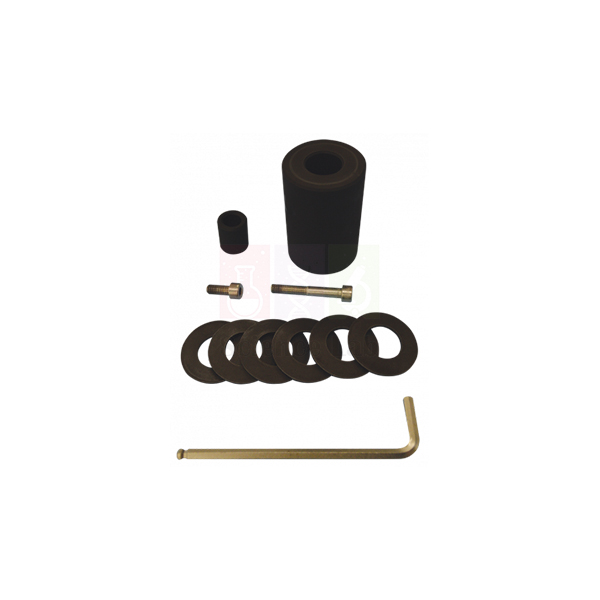
Disc Spring
Disc Spring (Product Code: SLE/ETP/20) is a spring-testing accessory used to study how disc springs stacked in series, in parallel or in a combination of both respond to a compressive load, in machine design and strength-of-materials labs. A disc guide and a compression cylinder fit the platens of a pump-operated testing machine, so students can compare the deflection rates of different stack arrangements. It is made by Jain Scientific Equipments Pvt Ltd (ScienceLab), an OEM and scientific lab equipment manufacturer in Ambala, India, at its own factory.
Key Details
| Parameter | Detail |
|---|---|
| Parts used | Disc springs, a disc guide and a compression cylinder |
| Fitting | Disc guide fitted to the lower compression platen; compression cylinder fitted to the upper platen |
| Stack arrangements | In parallel, in series, or a combination of series and parallel, stacked on the disc guide |
| Loading | Pump operated to raise the ram and compress the springs |
| Typical application | Uses that need a small deflection at high force levels |
| Product code | SLE/ETP/20 |
| Manufacturer | Jain Scientific Equipments Pvt Ltd (ScienceLab) — OEM |
| Country of origin | India (made in Ambala, Haryana) |
What Is the Disc Spring Experiment Used For?
Disc springs are common in many industries, from bolted joints and clutches to valves and heavy tooling, wherever a large force must be carried in a very small deflection. Their big advantage is flexibility of design: the same discs can be stacked in different ways to change the deflection rate. This experiment lets students discover those rules by measurement.
Students stack the discs on the disc guide in the chosen combination, operate the pump to raise the ram, and record force against deflection. Discs stacked in series give more deflection for the same force, discs in parallel carry more force for the same deflection, and mixed stacks fall in between. Keep the stack centred on the guide, raise the ram slowly, and repeat each arrangement to check consistency.
What to Specify When Ordering
- The testing machine in your laboratory, with its compression platens and pump-operated ram, so fitting can be confirmed.
- The stack arrangements you intend to teach: series, parallel or combined.
- The number of Disc Spring sets needed.
OEM Manufacturer
The Disc Spring experiment is made by ScienceLab, the trading name of Jain Scientific Equipments Private Limited, which is its OEM (original equipment manufacturer). Manufacturing takes place at the company's own licensed factory at Saha, Ambala, Haryana, and the finished sets go factory-direct to engineering colleges, polytechnics, dealers and importers. For extra discs or other spares later, ask us: the manufacturer deals with those requests itself. Background is on the ScienceLab profile.
Related Materials Testing and Properties Equipment
Spring experiments that pair naturally with disc springs:
- Coil Spring — a heavy-duty helical spring for comparing spring rates with disc stacks.
- Hook's Law And Spring Rate — introductory spring testing with masses and a scale.
- Electronic Spring Tension Machine — a dedicated machine for spring load measurement.
- Compression Cage — adds compressive-load experiments to the Bench Top Tensile Testing Machine.
Browse more under Materials Testing and Properties.
Frequently Asked Questions
What is the Disc Spring experiment used for?
The Disc Spring experiment is used to study how stacking disc springs in series, in parallel or in combination changes their deflection rate under a compressive load, and why disc springs suit small deflections at high force.
How can the disc springs be stacked?
In the Disc Spring experiment, the spring discs can be stacked on the disc guide in parallel, in series or in a combination of series and parallel, so students can compare several arrangements with the same set of discs.
How is the load applied in the Disc Spring experiment?
For the Disc Spring experiment, the disc guide is fitted to the lower compression platen and the compression cylinder to the upper platen. The pump is then operated to raise the ram and compress the springs.
Where are disc springs used in practice?
Disc springs, like those in the Disc Spring experiment, are used in many industries where a small deflection must carry a high force, for example in bolted joints, clutches, valves and tooling, because stacking lets designers tune the deflection rate.
Who manufactures the Disc Spring experiment?
The Disc Spring experiment is manufactured by Jain Scientific Equipments Pvt Ltd (ScienceLab), the OEM, at its own licensed factory in Ambala, Haryana, India. Orders and spare-part requests are handled by the manufacturer directly.
What should a Disc Spring quotation request include?
A Disc Spring quotation request should include the product code SLE/ETP/20, the number of sets, details of the testing machine it will be used on and the delivery destination, sent through our contact page or enquiry cart.
Request a Quote
Ask for a Disc Spring quotation direct from the manufacturer through the contact page, or add it to the enquiry cart. We supply institutions, dealers and importers in India and international markets.
Last updated: 24 September 2026
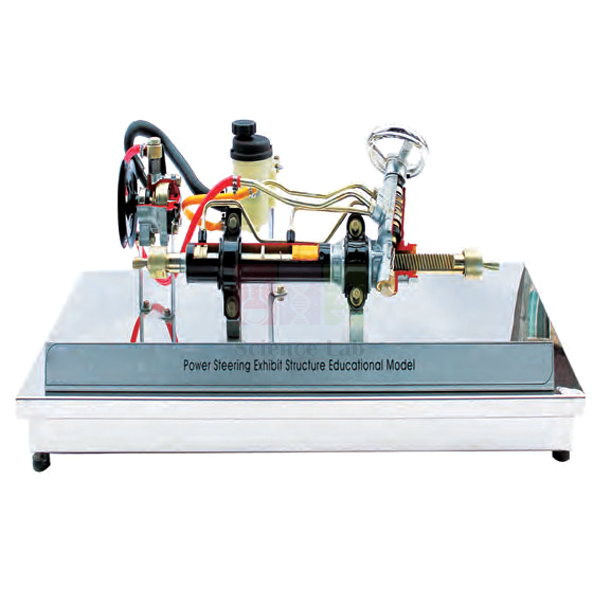
Power Steering Gear
Power Steering Gear (Product Code: SLE/ATE/12) is a sectioned structure education unit used to show how a vehicle's power steering gear, steering oil pump and oil tank work together, in automobile engineering classes and mechanic training. Students can move the gear by hand, check oil flow from the power pump and pick out each part by its colour-painted incised section. It is made by Jain Scientific Equipments Pvt Ltd (ScienceLab), the OEM manufacturer, at its own factory in Ambala, India, as engineering educational equipment for colleges and ITIs.
Specifications
| Parameter | Detail |
|---|---|
| Type | Structure education unit of a power steering gear (sectioned) |
| Composition | Power steering gear, steering oil pump, oil tank |
| Operation | Movement observed by manual operation; oil flow can be checked by power pump |
| Finish | Painted and coated with vehicle-only materials; incised sections painted in different colours |
| Weight | Approx. 45 kg |
| Size | Approx. 600 × 400 × 400 mm |
| Product code | SLE/ATE/12 |
| Manufacturer | Jain Scientific Equipments Pvt Ltd (ScienceLab) — OEM |
| Country of origin | India (made in Ambala, Haryana) |
What Is the Power Steering Gear Cutaway Used For?
In a steering and suspension lesson, the instructor turns the gear by hand while students watch the internal parts move through the sectioned housing, then relates what they see to the oil pump and tank. The pump supplies pressurised oil, the gear uses it to reduce the effort the driver needs, and the oil returns to the tank. Tracing that loop on a real, colour-coded assembly helps trainees explain each part and the power delivery principle in their own words before they meet a steering fault on a vehicle.
Because the unit is compact, it can move between classroom and workshop on a trolley, or sit on a bench beside a live vehicle so students can compare the cutaway with a complete steering box. In engineering colleges and ITIs it fits the chassis section of lab equipment for technical institutes, next to transmission and differential cutaways.
OEM Manufacturer
The Power Steering Gear trainer is an original ScienceLab product. Jain Scientific Equipments Private Limited, which trades as ScienceLab, is its OEM (original equipment manufacturer) and makes it at the company's own licensed factory at Saha, Ambala, Haryana, India.
Colleges, training centres, dealers and importers order it straight from the factory, without a trader in between, and can ask the manufacturer directly about replacement parts or matching units for a second lab. Find out more on our company profile.
Related Automotive Training Equipment
Other chassis and driveline units that fit the same course:
- Cut Model Of Rack And Pinion Steering — the other common steering layout, for side-by-side comparison
- Differential Gear — another sectioned driveline component for the chassis module
- Clutch Structure Trainer Hydraulic Manual — continues the study of hydraulically operated vehicle controls
- CRDI Diesel Engine Power Train System F/R Type — shows a steering system in place within a complete vehicle power train
Browse the full Automotive Training Equipment collection.
Frequently Asked Questions
Is the Power Steering Gear a working steering system or a cutaway?
The Power Steering Gear is a sectioned teaching unit rather than a part for fitting to a vehicle. The gear can be moved by hand to show its action, and oil flow can be checked by the power pump, so students see the hydraulic assistance principle on real components.
What parts come with the Power Steering Gear trainer?
The Power Steering Gear trainer consists of the power steering gear itself, the steering oil pump and the oil tank. Its incised sections are painted in different colours, and the unit is finished with vehicle-only paint and coating materials.
Will the Power Steering Gear fit on a standard workbench?
Yes, on a sturdy one. The Power Steering Gear measures approximately 600 × 400 × 400 mm and weighs about 45 kg, so it suits a strong bench or trolley; use two people to lift it between rooms.
How is the pump driven for the oil flow check?
The drive arrangement for the steering oil pump on the Power Steering Gear is not detailed in our product documentation. If your lesson plan depends on it, contact us before ordering and we will confirm how oil flow is demonstrated on the unit quoted.
How should the colour-coded sections be cared for?
Wipe the Power Steering Gear with a dry or lightly damp cloth and avoid harsh solvents, which can dull the colour coding that makes each incised section easy to identify. Keep it covered when not in use so workshop dust does not settle on the cut faces.
Who manufactures the Power Steering Gear?
The Power Steering Gear is manufactured by Jain Scientific Equipments Private Limited, which trades as ScienceLab, as the OEM at its own licensed factory at Saha, Ambala, Haryana, India. Colleges and dealers deal directly with the manufacturer for quotations and repeat orders.
Can we order several units for an automotive lab?
Yes. The Power Steering Gear can be quoted in single or multiple units for colleges, ITIs and training centres in India and international markets. State the quantity and delivery location in your enquiry so the quotation is complete.
Request a Quote
Request a factory-direct quotation through our contact page, or add the Power Steering Gear to your enquiry cart along with other items for your lab.
Last updated: 24 September 2026
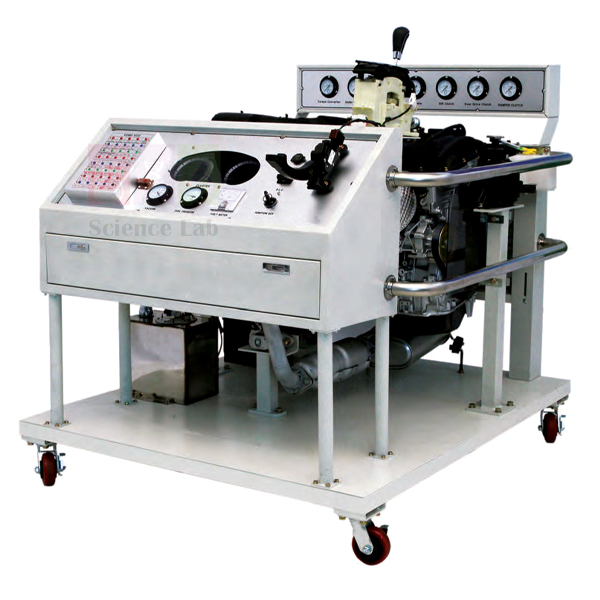
Automotive Engine Fault Diagnosis Simulator Auto Fault
Automotive Engine Fault Diagnosis Simulator Auto Fault (Product Code: SLE/ATE/13) is a mobile engine simulator used to practise diagnosing faults on an electrically controlled gasoline engine and automatic transmission in automotive training workshops. It carries complete fuel, cooling, intake, exhaust and vehicle electrical systems plus pressure and voltage gauges, so polytechnics and TVET centres can teach maintenance on a running stand. Jain Scientific Equipments Pvt Ltd (ScienceLab) builds the simulator's training stand, control box and panels as the OEM manufacturer at its own factory in Ambala, India; the gasoline engine and automatic transmission assemblies are sourced production units, not made in Ambala.
Specifications
| Parameter | Detail |
|---|---|
| Engine | Electrical control gasoline engine assembly, Auto Fault |
| Transmission | Automatic transmission assembly |
| Electrical and electronic devices | ECM, TCM, AFS, CKP, CMP, O2 sensor, WTS, control relay, etc. |
| Fuel and charging | Injector, fuel filter, fuel tank (removable), fuel pump, fuel equipment, DC 12V/60A vehicle battery, generator |
| Ignition | Ignition coil, spark plug, high voltage cables, ignition switch (key switch) |
| Cooling | Radiator, overflow tank, relay, electric fan; radiator-only stand |
| Exhaust | Catalytic converter, emission parts, silencer |
| Controls | Control box, accelerator lever |
| Gauges | Automatic transmission oil pressure gauges (1.5 MPa and 2.5 MPa); vacuum pressure gauge (0.1 MPa); fuel pressure gauge (1 MPa); battery voltage gauge (30 V) |
| Frame and protection | Stainless molding type safety guard; laser processing protection panel; anti-vibration dampers; urethane wheels |
| Storage | Drawer type storage space, 1 no |
| Weight | Approx. 400 kg |
| Size | Approx. 1,500 × 1,400 × 1,300 mm |
| Engine / assembly | Sourced production unit (as listed) |
| Product code | SLE/ATE/13 |
| Manufacturer | Jain Scientific Equipments Pvt Ltd (ScienceLab) — OEM |
| Country of origin | India (trainer built in Ambala, Haryana) |
Training contents:
- Connector checking terminal for inspection of sensors and actuators
- Inspection of every part of the intake and exhaust system
- Various practices by self-diagnosis
- Measurement and inspection of the automatic transmission
- Electric-controlled gasoline engine tune-up practice
- Hydraulic measurement and inspection in accordance with A/T range
- Exhaust measurement; measurement and inspection of cylinder compression pressure
- Radiator cap pressure measurement and radiator leakage inspection
- Measurement and adjustment of timing chain and fan belt tension
- Fuel pump operation test; oil pressure measurement and inspection
- Voltage and current measurement and adjustment in charging and starting circuits
- Inspection of automotive electrical parts, fuel system, ECU, sensors and actuators
- Inspection of cooling system belts and pumps
What Is the Gasoline Engine Fault Diagnosis Simulator Used For?
A typical session starts with a symptom. The instructor sets up a fault, and students work through a structured diagnosis: reading self-diagnosis results, probing sensors and actuators at the connector checking terminal, then confirming with the fitted gauges. Because the engine and automatic transmission share one stand, trainees see how an engine-side problem such as low fuel pressure or poor vacuum shows up alongside transmission behaviour, and the A/T oil pressure gauges let them check hydraulic pressure in each range.
Mechanical work is covered too: compression tests, timing chain and fan belt tension, radiator cap pressure and leak checks. For institutions assembling TVET lab equipment on a single budget line, this one unit spans engine, electrical, cooling and transmission modules. Run the engine only in a well-ventilated workshop or with exhaust extraction, and keep hands clear of the fan and belts while it is running.
OEM Manufacturer
This simulator's training stand, control box and protection panels come from their original maker: Jain Scientific Equipments Private Limited, trading as ScienceLab, is the OEM (original equipment manufacturer) and builds them at the company's own licensed factory at Saha, Ambala, Haryana, India. The electrically controlled gasoline engine and the automatic transmission assembly at the heart of the stand are sourced production units, not made in Ambala.
Polytechnics, engineering colleges, dealers and importers buy the complete simulator factory-direct. Follow-up needs such as spare gauges, replacement parts or a second unit for another workshop can be raised with ScienceLab directly, so ask us. Our company profile has more background.
Related Automotive Training Equipment
Equipment that pairs well with this fault simulator:
- Engine management system (MPI) — focused study of fuel injection control and sensor inputs
- FF Auto Transmission 6 Steps — shows the automatic transmission internals behind the pressure readings
- Digital Multimeter — for voltage and current checks in charging and starting circuits
- Oscilloscope Dual Trace — for viewing sensor and actuator signals at the checking terminal
- Diesel Engine Fault Diagnosis Training Equipment Auto Fault — the diesel counterpart for compression-ignition training
View the whole Automotive Training Equipment category.
Frequently Asked Questions
Does the engine run on the Automotive Engine Fault Diagnosis Simulator Auto Fault?
Yes. The Automotive Engine Fault Diagnosis Simulator Auto Fault is an engine simulator with its own fuel, ignition, cooling, intake, exhaust and electrical systems, and its training contents include exhaust measurement, engine tune-up and fuel pump operation tests.
What does Auto Fault mean on this simulator?
On the Automotive Engine Fault Diagnosis Simulator Auto Fault, Auto Fault refers to the fault diagnosis function: faults that can occur on an actual vehicle system can be checked and diagnosed on the stand. For the list of fault conditions available, contact us before ordering.
Which gauges are fitted?
The Automotive Engine Fault Diagnosis Simulator Auto Fault carries automatic transmission oil pressure gauges (1.5 MPa and 2.5 MPa), a vacuum pressure gauge (0.1 MPa), a fuel pressure gauge (1 MPa) and a battery voltage gauge (30 V) for live readings during exercises.
Is a diagnostic scan tool included?
No diagnostic scan tool is listed in the composition of the Automotive Engine Fault Diagnosis Simulator Auto Fault. Tell us which diagnostic equipment your lab already uses for the self-diagnosis exercises, and we will advise on it when preparing the quotation.
Can the simulator be moved around the workshop?
Yes. The Automotive Engine Fault Diagnosis Simulator Auto Fault rides on urethane wheels with anti-vibration dampers. At approximately 400 kg and 1,500 × 1,400 × 1,300 mm, move it on level floors with enough people to control it safely.
Who manufactures the Automotive Engine Fault Diagnosis Simulator Auto Fault?
Jain Scientific Equipments Private Limited, trading as ScienceLab, manufactures the training stand, control box and panels of the Automotive Engine Fault Diagnosis Simulator Auto Fault as the OEM at its own licensed factory at Saha, Ambala, Haryana, India. Its gasoline engine and automatic transmission assemblies are sourced production units, not made in Ambala.
Are calibration certificates available for the gauges?
Calibration-certificate availability for the gauges on the Automotive Engine Fault Diagnosis Simulator Auto Fault depends on the order. Please mention the requirement through our contact page when you request a quotation, so it can be discussed before purchase.
Request a Quote
Please contact us with your quantity and delivery location, or use the enquiry cart to request a quotation direct from the manufacturer.
Last updated: 24 September 2026
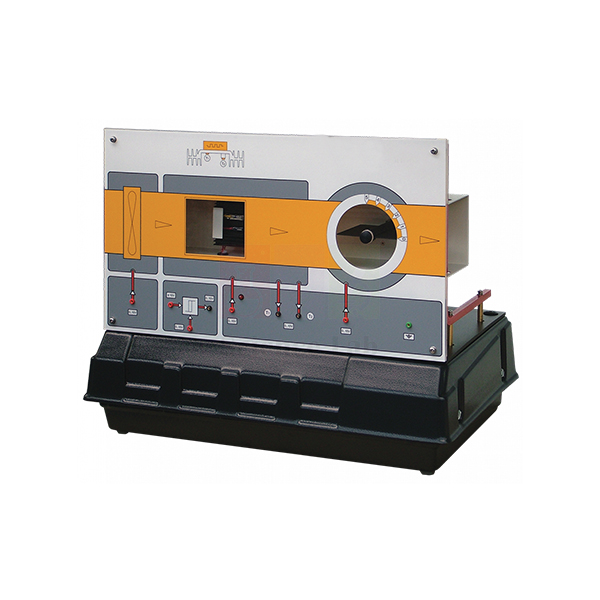
Thermal Control Process Apparatus
Thermal Control Process Apparatus (Product Code: SLE/ETC/01) is a temperature-control process plant used to teach how heater power, air flow and flow restriction combine to hold a process temperature in control engineering laboratories. It models a common industrial process such as an air-conditioning plant, with scaled-down time constants so experiments fit into a normal laboratory session. It is manufactured by Jain Scientific Equipments Pvt Ltd (ScienceLab), an OEM manufacturer, at its own factory in Ambala, India.
Key Details
| Parameter | Detail |
|---|---|
| Process modelled | A common industrial process, such as an air-conditioning plant, where a combination of adjustments controls temperature |
| Air path | Variable-speed fan forcing air through a duct |
| Process block | Electrically heated process block inside the duct |
| Temperature sensors | Two: one in direct thermal contact with the block; one mounted on an insulating spacer to introduce thermal inertia and variable time constants into the loop |
| Flow restriction | Servo-driven vane mounted after the fan and process block, creating a variable downstream restriction for advanced experiments |
| Control inputs | Electrical energy to the heater, air flow rate (fan speed) and vane rotation |
| Time constants | Scaled down for shorter laboratory time |
| Product code | SLE/ETC/01 |
| Manufacturer | Jain Scientific Equipments Pvt Ltd (ScienceLab) — OEM |
| Country of origin | India (made in Ambala, Haryana) |
What Is the Thermal Control Process Apparatus Used For?
The block settles at a steady temperature when heat gained from the electric heater balances heat lost by convection and conduction to the moving air. The control problem is to keep that process temperature within acceptable limits while conditions change, using heater power, fan speed and vane rotation singly or in combination.
Students can begin with single-loop heater control, then treat fan speed or vane position as a disturbance, and finally explore multi-input strategies. Comparing the two sensors shows clearly how measurement lag — added on purpose by the insulating spacer — makes a loop harder to tune. For universities and colleges sourcing engineering lab equipment, the apparatus turns slow thermal behaviour into experiments that can be completed within one practical.
OEM Manufacturer
The Thermal Control Process Apparatus is made by Jain Scientific Equipments Private Limited, the company behind the ScienceLab name, which is the OEM for this unit. Production takes place at its own licensed factory in Saha, Ambala, Haryana, India, and orders go out factory-direct to colleges, research groups, dealers and importers.
ScienceLab is a registered MSME (Udyam UDYAM-HR-01-0003714), and export consignments move under Importer-Exporter Code AAECJ8618A issued by the DGFT. See the ScienceLab company profile for more background.
Related Control & Process Engineering Trainers
These companion units follow the same control-engineering approach and let students compare thermal behaviour with fluid, mechanical and electronic systems.
- Process Trainer — heating and cooling loops around a stirred vessel for multi-variable process work
- Coupled Tanks Apparatus — liquid-level control with faster, clearly visible dynamics
- Controller — analogue blocks including phase lead and a three-term PID block
- Digital Interface — links analogue signals to a computer for monitoring and control
More apparatus is listed in the Control & Process Engineering Trainers category.
Frequently Asked Questions
What controls the temperature in the Thermal Control Process Apparatus?
Temperature in the Thermal Control Process Apparatus is controlled by regulating the electrical energy to the heater, varying the air flow rate from the variable-speed fan and rotating the servo-driven vane, used singly or in combination.
Why does the Thermal Control Process Apparatus have two temperature sensors?
The Thermal Control Process Apparatus uses two sensors so students can compare measurements. One sits in direct thermal contact with the block; the other is mounted on an insulating spacer, adding thermal inertia and variable time constants to the control loop.
Are experiments on the Thermal Control Process Apparatus slow?
No. Experiments on the Thermal Control Process Apparatus are kept short because the apparatus has scaled-down time constants for shorter laboratory time. Actual durations depend on the exercise and settings the instructor chooses.
What is the servo-driven vane on the Thermal Control Process Apparatus for?
The servo-driven vane on the Thermal Control Process Apparatus is mounted after the fan and the process block. It creates a variable downstream restriction to the air flow, which is used for more advanced control experiments.
Who manufactures the Thermal Control Process Apparatus?
Jain Scientific Equipments Pvt Ltd (ScienceLab) is the OEM manufacturer of the Thermal Control Process Apparatus, producing it at its own licensed factory in Saha, Ambala, Haryana, India. Repeat orders and spare-part questions for the apparatus are handled by the manufacturer directly.
Can the Thermal Control Process Apparatus be supplied outside India?
Yes. The Thermal Control Process Apparatus is supplied to institutions, dealers and importers in India and international markets. Share your quantity, destination and any documentation needs through our contact page to receive a quotation.
Request a Quote
Request a quotation for the Thermal Control Process Apparatus through the contact page, or add it to the enquiry cart together with any other trainers you need. Quotes are issued directly by the manufacturer, ScienceLab.
Last updated: 24 September 2026
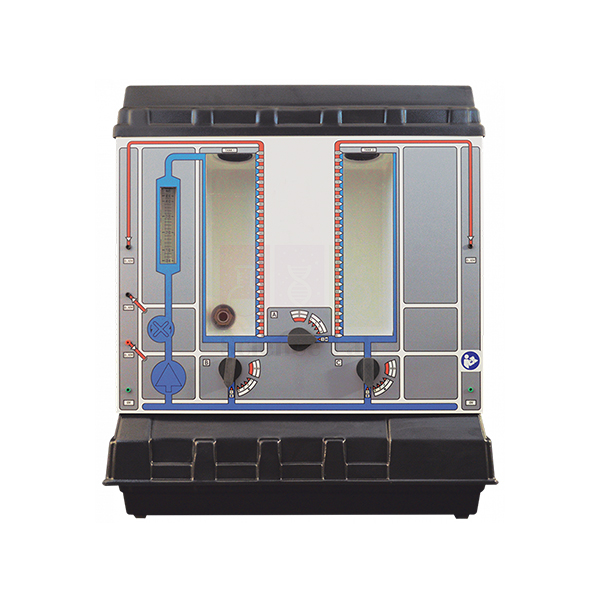
Coupled Tanks Apparatus
Coupled Tanks Apparatus (Product Code: SLE/ETC/02) is a liquid-level control trainer used to investigate basic and advanced control engineering principles with one or two interconnected tanks in university and college laboratories. A variable-speed pump fills the left-hand tank, a connecting valve brings in the second tank for two-tank work, and each tank has a level sensor plus a scale for checking its calibration. Jain Scientific Equipments Pvt Ltd (ScienceLab), an OEM manufacturer, makes it at its own factory in Ambala, India.
Key Details
| Parameter | Detail |
|---|---|
| Tanks | Two tanks; a valve connects the left-hand tank to the second tank when two-tank experiments are needed |
| Pump | Variable-speed pump forcing water into the left-hand tank |
| Level sensing | A level sensor on each tank, giving an output signal proportional to the water level |
| Level scales | Scale on each tank so students can check the level-sensor calibration |
| Flow measurement | Rotameter-type flow meter showing flow rate, plus an electronic flow meter measuring it |
| Topics covered | Static and dynamic systems; fluid transport and liquid-level control problems; suits other strategies such as fuzzy logic |
| Product code | SLE/ETC/02 |
| Manufacturer | Jain Scientific Equipments Pvt Ltd (ScienceLab) — OEM |
| Country of origin | India (made in Ambala, Haryana) |
What Is the Coupled Tanks Apparatus Used For?
The basic control problem is to regulate the liquid level in one of the tanks by varying the speed of the circulating pump. With the connecting valve closed, students work with a single tank — a simple first-order process — and later open the valve to couple the tanks, creating an interacting two-tank system that is noticeably harder to control.
Having both a rotameter and an electronic flow meter lets learners check the pump's delivery by eye while also measuring it electrically, and the tank scales let them confirm the level sensors before relying on them. Beyond PID practicals, the apparatus suits modelling, system identification and advanced approaches such as fuzzy logic, making it a flexible piece of lab equipment for technical institutes and universities.
OEM Manufacturer
Jain Scientific Equipments Private Limited trades as ScienceLab and is the original equipment manufacturer of the Coupled Tanks Apparatus. Each unit is produced at the company's own licensed factory at Saha, Ambala, Haryana, India, rather than bought in from a trader. Quotations for a single bench or a full laboratory set come from the factory itself. The ScienceLab profile has more about the company.
Related Control & Process Engineering Trainers
Students who have worked through level control on the Coupled Tanks Apparatus can move on to these related trainers.
- PLC Process — two-tank rig with solenoid valves and a float switch for sequencing practice
- Process Trainer — level, temperature and pressure in one process vessel
- Controller — analogue PID and phase-lead blocks for closing the level loop
- Digital Interface — computer monitoring and control of the tank signals
The complete range is in the Control & Process Engineering Trainers category.
Frequently Asked Questions
How many tanks does the Coupled Tanks Apparatus have?
The Coupled Tanks Apparatus has two tanks. The pump fills the left-hand tank, and a valve connects it to the second tank when needed, so the same unit covers both single-tank and two-tank experiments.
How is flow measured on the Coupled Tanks Apparatus?
The Coupled Tanks Apparatus measures flow in two ways: a rotameter-type flow meter shows the flow rate visually, and an electronic flow meter measures it for signal-based monitoring and control work.
How can students check the level sensors on the Coupled Tanks Apparatus?
Each tank on the Coupled Tanks Apparatus has a scale, so students can compare the visible water level with the level-sensor output, which is proportional to the water level, and confirm the sensor calibration before experiments.
Which control methods can be studied with the Coupled Tanks Apparatus?
The Coupled Tanks Apparatus supports study of static and dynamic systems, fluid transport and liquid-level control, from basic feedback loops to advanced strategies such as fuzzy logic. The core task is regulating tank level by varying pump speed.
Who manufactures the Coupled Tanks Apparatus?
The Coupled Tanks Apparatus is manufactured by Jain Scientific Equipments Pvt Ltd (ScienceLab), the OEM, at its licensed factory in Saha, Ambala, Haryana, India. Colleges that later add benches can order matching units from the same manufacturer.
What details are needed for a Coupled Tanks Apparatus quotation?
For a Coupled Tanks Apparatus quotation, tell us the number of units, the delivery location and whether you also want a controller or computer interface from the same range. Send the request via our contact page or the enquiry cart.
Request a Quote
Ask for a Coupled Tanks Apparatus quotation through the contact page or by adding it to the enquiry cart. The quote is prepared by the manufacturer, Jain Scientific Equipments Pvt Ltd (ScienceLab), for buyers in India and international markets.
Last updated: 24 September 2026
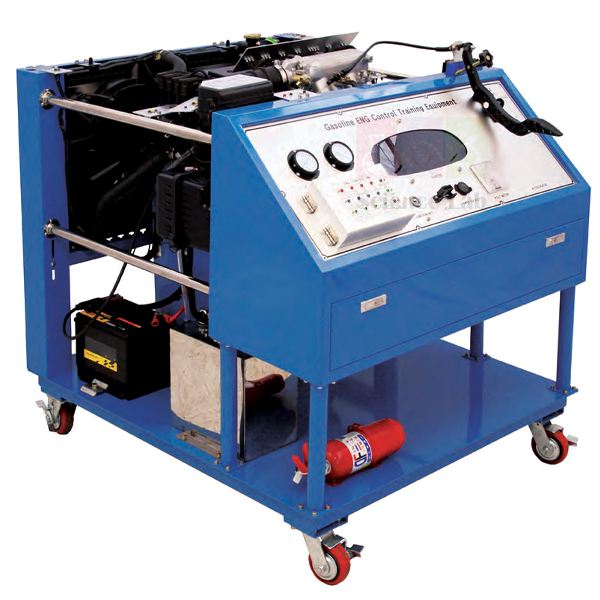
Diesel Engine Fault Diagnosis Training Equipment Auto Fault
Diesel Engine Fault Diagnosis Training Equipment Auto Fault (Product Code: SLE/ATE/14) is a running diesel engine simulator used to teach fault finding and maintenance of diesel vehicle systems in ITIs, polytechnics and engineering colleges. A check terminal box lets students test electronic circuits and sensors with a diagnostic device, and a fault insertion feature with a 3-stage PCB board lets instructors set realistic problems. Jain Scientific Equipments Pvt Ltd (ScienceLab) makes the training stand, control panel and fault-insertion system as an OEM manufacturer at its own factory in Ambala, India, while the diesel engine assembly is a sourced production unit, not made in Ambala.
Specifications
| Parameter | Detail |
|---|---|
| Engine | Diesel engine assembly |
| Fuel and electrical | Fuel filter, fuel tank, fuel pump, fuel devices, DC 12V car battery, generator |
| Cooling | Radiator, electric fan, overflow tank, relay, antifreeze; radiator-only stand |
| Exhaust | Catalyst converter, silencer |
| Controls | Start switch (key switch), control box for waveform measurement, fuel tank, accelerator lever |
| Diagnosis features | Check terminal box for testing electronic circuits and sensors with a diagnostic device; fault insertion; control panel open and close feature; 3-stage PCB board mounted |
| Frame and protection | Stainless molding type safety guard; laser processing protection panel; anti-vibration dampers; urethane wheels |
| Storage | Drawer type storage space, 1 no |
| Weight | Approx. 430 kg |
| Size | Approx. 1,500 × 1,400 × 1,300 mm |
| Engine / assembly | Sourced production unit (as listed) |
| Product code | SLE/ATE/14 |
| Manufacturer | Jain Scientific Equipments Pvt Ltd (ScienceLab) — OEM |
| Country of origin | India (trainer built in Ambala, Haryana) |
Training contents:
- Measurement and adjustment of timing chain and fan belt tension
- Measurement and adjustment of voltage and current in charging and starting circuits
- Various practices by self-diagnosis
- Exhaust measurement; measurement and inspection of cylinder compression pressure
- Radiator cap pressure measurement and radiator leakage inspection
- Connector checking terminal for inspection of sensors and actuators
- Inspection of cooling system belts and pumps
- Inspection of every part of the intake and exhaust system
- Fuel pump operation test; oil pressure measurement and inspection
- Inspection of automotive electrical parts, fuel system, ECU, sensors and actuators
- Inspection of the remaining parts
What Is the Diesel Engine Fault Trainer Used For?
Diesel diagnosis depends on fuel delivery, compression and sensor signals, and this trainer lets each of those be tested on a real engine. A common exercise has students start the engine, notice a symptom and narrow it down: waveform readings at the control box, sensor and actuator checks at the check terminal box, fuel pump and oil pressure tests, and finally a compression test to rule out mechanical causes. The fault insertion feature and 3-stage PCB board give instructors a repeatable way to set assessment tasks for whole batches of trainees.
Routine service skills fit the same stand: belt tension, radiator cap pressure and cooling leak checks, and charging and starting circuit measurements. Running it beside a fuel injection pump trainer helps vocational students connect what happens in the pump with what they measure on the engine, which makes it practical engineering lab equipment in India for diesel mechanic courses. Operate it only with exhaust extraction or good ventilation, keep the stainless guard in place, and let the engine cool before opening the radiator.
OEM Manufacturer
ScienceLab is the trading name of Jain Scientific Equipments Private Limited, the OEM (original equipment manufacturer) of this diesel fault trainer's stand, control panel and fault-insertion system. These are built and assembled at the company's own licensed factory at Saha, Ambala, Haryana, India. The diesel engine assembly they are built around is a sourced production unit, not made in Ambala.
Training institutes, dealers and importers buy the complete trainer directly from ScienceLab rather than through a trader, and anything needed later — a replacement part, a repeat unit or advice on setting up a second workshop — can be requested from us; just ask. See our company profile for background.
Related Automotive Training Equipment
Items used alongside this diesel fault trainer:
- Diesel Fuel Injection System VE pump — explains the distributor-type pump that meters diesel to the injectors
- Diesel Fuel Injection System Inline Pump — the inline pump design for comparison
- Oscilloscope Dual Trace — for reading waveforms from the control box
- Advanced Digital Multimeter — for sensor, charging and starting circuit measurements
- Automotive Engine Fault Diagnosis Simulator Auto Fault — the gasoline engine and automatic transmission version
More engine and vehicle trainers are listed under Automotive Training Equipment.
Frequently Asked Questions
How are faults created on the Diesel Engine Fault Diagnosis Training Equipment Auto Fault?
The Diesel Engine Fault Diagnosis Training Equipment Auto Fault has a fault insertion feature, a control panel that opens and closes, and a mounted 3-stage PCB board. For the number and types of faults available, please contact us before ordering.
Which diesel engine model is fitted?
The Diesel Engine Fault Diagnosis Training Equipment Auto Fault is listed with a diesel engine assembly, without a named engine model. If your syllabus calls for a particular engine type or displacement, ask us to confirm what the quoted unit carries.
Do we need our own oscilloscope for waveform work?
Probably yes. The Diesel Engine Fault Diagnosis Training Equipment Auto Fault includes a control box for waveform measurement, but no oscilloscope is listed in its composition, so plan to use your lab's instrument or order one separately.
Is a battery included?
Yes. A DC 12V car battery and a generator are part of the Diesel Engine Fault Diagnosis Training Equipment Auto Fault, along with the fuel filter, fuel tank, fuel pump and the start (key) switch.
How big and heavy is the trainer?
The Diesel Engine Fault Diagnosis Training Equipment Auto Fault measures approximately 1,500 × 1,400 × 1,300 mm and weighs about 430 kg. It stands on urethane wheels with anti-vibration dampers, so it can be repositioned on a level workshop floor.
Who manufactures the Diesel Engine Fault Diagnosis Training Equipment Auto Fault?
Jain Scientific Equipments Private Limited, trading as ScienceLab, is the OEM that manufactures the stand, control panel and fault-insertion system of the Diesel Engine Fault Diagnosis Training Equipment Auto Fault at its own licensed factory at Saha, Ambala, Haryana, India. The diesel engine assembly itself is a sourced production unit, not made in Ambala.
What should an institutional quotation request include?
For the Diesel Engine Fault Diagnosis Training Equipment Auto Fault, send the quantity, the delivery location in India or abroad, and any installation or documentation requirements your institution has. The quotation then comes directly from the manufacturer.
Request a Quote
Send your requirement through our contact page or add this trainer to the enquiry cart, and the manufacturer will reply with a quotation.
Last updated: 24 September 2026