- Physics Lab Equipment
- Chemistry Lab Equipment
- Biology Lab Equipment
- Anatomical Lab Equipment
- Learning
- Educational Lab Equipment
- Magnets
- Agriculture
- Astronomy
- Earth Science
- Geography Lab Equipment
- Safety Lab Coat
- Laboratory
- Meteorological
- Electricity & Magnetism
- Heat
- School Lab Equipment
- Lab Glassware
- Science Lab Equipment
- Tvet Lab Equipment
- Robotics Kits Supplier and Manufacturer for Schools India
- Math Lab Equipment Manufacturers and Exporters in Ambala
- STEM Kits Manufacturers and Supplier India
- Engineering Lab Equipment
- Hospital Lab Equipment
- Water, Sanitation & Hygiene Supplies
- Cold Chain, Solar & Communication Equipment
- Nutrition
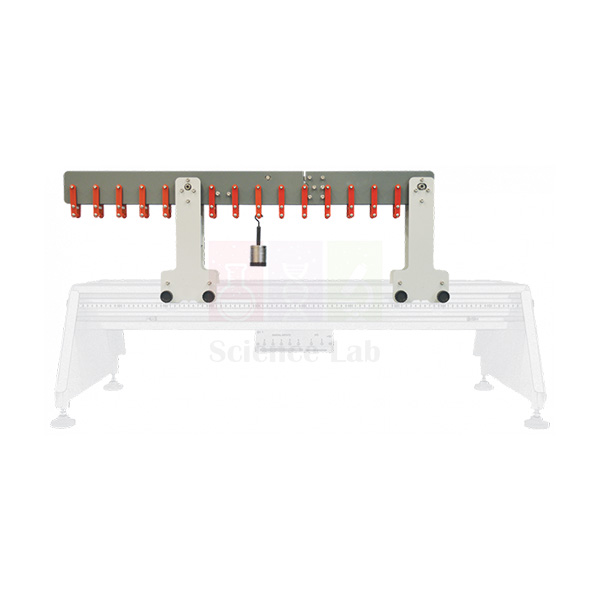
Bending Moments In a Beam
Bending Moments In a Beam (Product Code: SLE/EG/11) is a beam experiment that measures bending moment directly: a load cell bridges a cut at mid-span, so the moment carried across the cut is read as loads are hung along the beam. The beam sits on a pinned support and a roller support, has an overhanging end for positive and negative moments, and comes with a uniformly distributed load (UDL) for comparison with single point loads. It is manufactured by Jain Scientific Equipments Pvt Ltd (ScienceLab), Ambala, as foundational mechanics lab equipment for engineering students.
Key Details
| Parameter | Detail |
|---|---|
| Type | Bending moment experiment for a simply supported beam with overhang |
| Supports | Two: one pinned (rotation only), one roller (allows translation) |
| Beam layout | Central span with an overhanging end, giving positive and negative bending moments |
| Loading | Loads on hangers suspended along the beam |
| Included load | Uniformly distributed load (UDL) that can be applied across the span |
| Measurement | Load cell at the cut at mid-span measures bending moment |
| Positioning | Pointers that work with the scale on the Structures Platform |
| Data connection | Load cell connects to the USB interface hub of the Structures Platform |
Typical Use
Students place the supports with the pointers and scale, hang a load at a chosen position and note the bending moment at the cut from the load cell. They calculate the same value from the reactions and compare. Moving a single load across the span and onto the overhang, and plotting the mid-span moment for each position, produces the influence line for bending moment at that section; loads on the overhang show the moment at mid-span changing sign.
Next, the UDL is laid across the span and the result compared with a point load of the same total size, showing why distributed loads give lower peak moments. Combining several hangers lets students build full bending moment diagrams and test the principle of superposition. It is often the first structures practical in a civil or mechanical syllabus, and a sensible starting point for colleges assembling engineering lab equipment in India for strength of materials.
Manufacturer
The beam module is manufactured by Jain Scientific Equipments Private Limited, based in Ambala, Haryana, and sold under the ScienceLab name. Purchase departments completing vendor forms can use our registration details: GSTIN 06AAECJ8618A1ZT and LEI 3358004HRD1JIVXKYX49. The company profile has more background.
Related Laboratory Equipment
Natural next steps and companions for this experiment:
- Structures Platform — supplies the positioning scale and logs the mid-span load cell
- Bending Stress In a Beam — links the measured bending moment to stresses in the section
- Deflection of Beams and Cantilevers — the stiffness side of beam behaviour under the same kinds of load
- Continuous and Indeterminate Beams — extends the analysis to beams on more than two supports
- Bending Moments In A Portal Frame — moves bending moment diagrams from a beam to a frame
Explore the full General Products range of structures equipment.
Frequently Asked Questions
How does the apparatus measure bending moment?
The beam is cut at mid-span and a load cell across the cut measures the bending moment transmitted there.
Why does the beam have an overhang?
Loads on the overhanging end produce negative (hogging) moments, so students can study both positive and negative bending moments.
Is a distributed load included?
Yes, a UDL is included and can be applied across the span for comparison with a single point load.
Are the hangers and point-load masses supplied?
Loads are applied to hangers along the beam, but the exact hanger and mass contents are not listed in our current description. Please contact us to confirm.
Is the Structures Platform needed?
Yes, for positioning with its scale and for computer display of the load cell. It is ordered as a separate item.
What details should a college include when requesting a quotation?
Quantity, delivery address, whether a platform is also needed, and any tender reference. Warranty terms and any calibration document requests are handled in the quotation.
Do you supply outside India?
Yes, we serve institutions in India and international markets.
Request a Quote
To receive a quotation for Bending Moments In a Beam, write to us through the contact page or add it to the enquiry cart with the Structures Platform.
Last updated: 24 September 2026
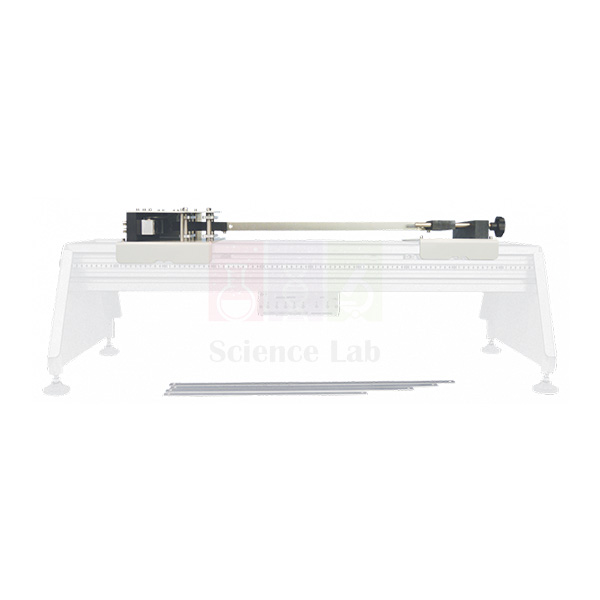
Euler Buckling of Struts
Euler Buckling of Struts (Product Code: SLE/EG/12) is a structures experiment in which students load a slender strut in compression, record the force through a load cell and note the point at which the strut collapses sideways, or buckles. They then predict the same buckling loads from textbook equations, including Euler’s theory, and compare prediction with measurement. Manufactured by Jain Scientific Equipments Pvt Ltd (ScienceLab), Ambala, it is engineering lab equipment for civil and mechanical engineering departments, polytechnics and technical institutes teaching strength of materials.
Key Details
| Parameter | Detail |
|---|---|
| Type | Strut buckling experiment for compression members |
| Load measurement | Load cell measures the applied buckling force |
| Specimens | Specimen struts of different lengths, for comparing buckling loads |
| End conditions | Different strut end fixings, to compare their effect on the buckling load and on the shape of the strut as it buckles |
| Included tool | Vernier caliper for measuring the cross-section of the struts |
| Data connection | Load cell connects to the USB interface hub of the Structures Platform for computer display and data acquisition |
| Theory covered | Euler’s theory and related textbook buckling equations, compared with measured results |
Typical Use
A typical practical begins with students measuring each strut’s cross-section with the supplied Vernier caliper, so they can work out the second moment of area that Euler’s formula needs. With a chosen pair of end fixings in place, the compressive load is raised steadily while the load cell reading is watched; the peak value just before the strut bows out is taken as its buckling load. Repeating the test on the struts of different lengths lets the class plot buckling load against length and see how sharply slenderness reduces the load a strut can carry.
Swapping the end fixings then shows how the way a strut is held changes both the load it supports and the curve it takes as it fails — the idea behind effective length, which students usually meet only as a factor in a table. Comparing each result with the Euler prediction confirms how well the textbook equations hold and prompts discussion of why small differences appear, such as slight initial crookedness. Logging through the Structures Platform’s USB hub puts the load on screen, which suits mechanics lab equipment sessions where one group’s test is reviewed by the whole class.
Manufacturer
This buckling module is manufactured by Jain Scientific Equipments Private Limited, the Ambala, Haryana company that trades under the ScienceLab name and builds apparatus for engineering colleges and technical institutes. Read more in our company profile.
Related Laboratory Equipment
Items that sit alongside the buckling practical in a structures laboratory:
- Structures Platform — the platform whose USB interface hub displays and logs the load cell reading
- Caliper Vernier (Metal) — a spare caliper so several groups can measure strut sections at the same time
- Deflection of Beams and Cantilevers — explores the elastic properties that appear in the Euler equation through beam bending
- Torsion of Circular Sections — a companion practical on the elastic behaviour of metal rods under twist
See every structures module in our General Products range.
Frequently Asked Questions
What is included with the Euler Buckling of Struts module?
Specimen struts of different lengths, different end fixings, a load cell and a Vernier caliper. For the exact number of struts and fixings in the current build, please contact us.
Why does it come with more than one type of end fixing?
So students can compare how end conditions change the buckling load and the buckled shape. Euler’s theory expresses this through effective length, and the fixings let students test that idea on real struts.
Do I need the Structures Platform to run it?
The load cell is designed to connect to the USB interface hub of the Structures Platform for computer display and data acquisition, so plan to use the module with that platform. The Structures Platform has its own listing; tell us whether your quotation should include it.
Is a calibration certificate available for the load cell?
Calibration certificate availability should be discussed with us when you enquire — contact us with your requirement.
What should an institutional quotation request include?
The number of sets, whether the Structures Platform is needed, the delivery address in India or abroad and any tender format you must follow. Send these through our contact page or enquiry cart.
Do you supply engineering colleges outside India?
Yes. We supply institutions in India and international markets; share the destination so we can advise on packing and shipping.
Request a Quote
To price this buckling module for your structures laboratory, contact us or add it to your enquiry cart with the quantity required.
Last updated: 24 September 2026
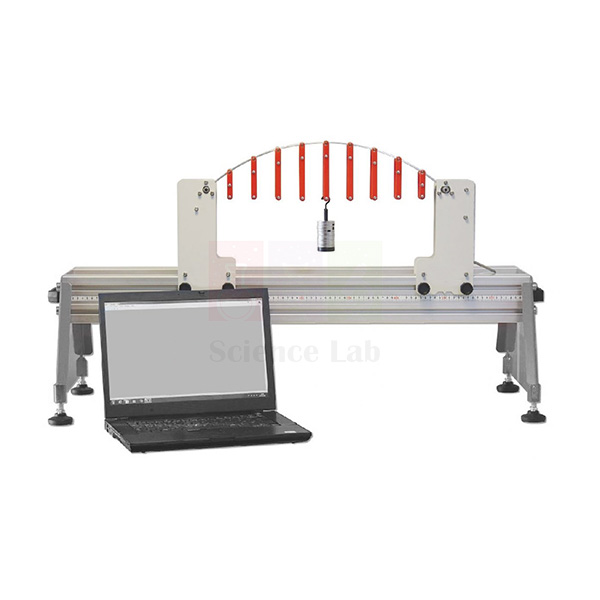
Two Pinned Arch
Two Pinned Arch (Product Code: SLE/EG/13) lets students load an arch held between two supports and measure the horizontal reaction that the arch develops at its base. One support is a pin that allows rotation only; the other is a roller that would slide sideways, but a load cell prevents that translation and reads the horizontal force instead. Manufactured by Jain Scientific Equipments Pvt Ltd (ScienceLab) in Ambala, it is a structures practical for civil engineering courses, polytechnics and other technical institutes.
Key Details
| Parameter | Detail |
|---|---|
| Type | Two-pinned arch experiment |
| Supports | One pinned support (rotational movement only) and one roller support (translational movement) |
| Horizontal reaction | Measured by a load cell that prevents the roller support from translating |
| Loading | Loads applied on hangers suspended from the arch |
| Distributed load | Additional masses for applying a uniformly distributed load (UDL) across the span |
| Positioning | Pointers on each support work with the scale on the platform |
| Data connection | Load cell connects to the USB interface hub of the Structures Platform for computer display and data acquisition |
| Learning outcomes | Predicting reaction forces, drawing influence lines and bending moment diagrams |
Typical Use
Students set the supports using the pointers against the platform scale, hang a load at one position and record the horizontal reaction from the load cell. Moving the same load step by step across the arch, and plotting the reaction for each position, builds the influence line for horizontal thrust — a curve students can check against the values given by textbook arch equations.
In a second run the extra masses are spread along the span as a uniformly distributed load, and the reaction is compared with the result for a single point load. From the measured reactions students then draw bending moment diagrams for the arch and see how the horizontal thrust reduces bending compared with a simply supported beam of the same span. Because a two-pinned arch is statically indeterminate, the experiment shows clearly why a measured reaction is so useful, making it a valued piece of mechanics lab equipment for structural analysis teaching.
Manufacturer
ScienceLab is the trading name of Jain Scientific Equipments Private Limited, a maker of engineering teaching apparatus based in Ambala, Haryana. The company profile describes our wider range and how we work with colleges.
Related Laboratory Equipment
Useful companions when teaching arches and reactions:
- Structures Platform — carries the scale used by the support pointers and the USB hub that logs the load cell
- Bending Moments In a Beam — introduces influence lines on a beam before students move on to the arch
- Frame Deflections And Reactions — another experiment built around support reactions, this time in a frame
- Simple Suspension Bridge — a contrasting long-span structure where cable tension, rather than arch thrust, carries the load
Browse the complete General Products section for more structures apparatus.
Frequently Asked Questions
Which reaction does the load cell measure?
The horizontal reaction. The load cell restrains the roller support, so the force needed to stop it moving is read as the horizontal reaction caused by the load.
Can a distributed load be applied, not just point loads?
Yes. Additional masses are included so a uniformly distributed load can be spread across the span and the result compared with a single point load.
How are the supports positioned accurately?
Each support has pointers that line up with the scale on the platform, so spans and load positions can be set and repeated.
What analysis do students carry out?
They predict the reaction forces with textbook equations, compare them with the measured values, and use the results to create influence lines and bending moment diagrams.
What warranty applies?
Warranty terms are confirmed with each quotation — please contact us for the current terms.
Can we order several sets for a teaching laboratory?
Yes. We quote multiple sets for institutions in India and international markets; add the item to your enquiry cart with the quantity and delivery location.
Request a Quote
For a price on the Two Pinned Arch, alone or with the Structures Platform, contact us or use the enquiry cart.
Last updated: 24 September 2026
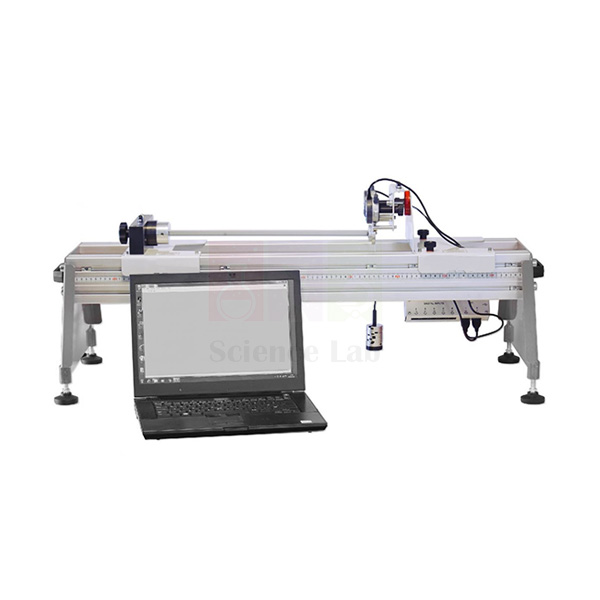
Unsymmetrical Bending and Shear Centre
Unsymmetrical Bending and Shear Centre (Product Code: SLE/EG/14) is a two-part cantilever experiment on how beams behave when a load does not act along a principal axis. In one set-up a chuck clamps a ‘U’ section beam and a plate at its free end takes offset loads that twist the section, so students can locate its shear centre; in the other, a beam is held so it can rotate on its own axis and loads are applied at various angles. It is manufactured by Jain Scientific Equipments Pvt Ltd (ScienceLab), Ambala, for advanced strength of materials teaching in engineering colleges.
Key Details
| Parameter | Detail |
|---|---|
| Type | Shear centre and symmetrical / non-symmetrical bending experiment |
| Shear centre set-up | Chuck clamps a ‘U’ section beam; a plate clamped to the free end allows various offset loads to twist the beam |
| Bending set-up | Chuck clamps a beam while allowing rotation on its axis, so loads can be applied at various angles |
| Deflection measurement | A pair of precision indicators measures the deflections produced by loads at the free end |
| Indicator display | Indicators have their own displays and can also connect to the USB interface hub of the Structures Platform for computer display and data acquisition |
| Included tool | Vernier caliper for accurate measurement of the beam cross-sections |
| Analysis | Comparison with arbitrary section axes and textbook beam equations; Mohr’s circle to find the experimental principal second moments of area and the position of the principal axes |
Typical Use
For the shear centre test, students hang loads at a series of offsets on the end plate of the ‘U’ section and watch the two indicators. The offset at which the section deflects without twisting marks the shear centre — a point that lies outside the channel itself, which explains why channel sections used as purlins or rails tend to twist unless they are loaded through it.
In the unsymmetrical bending tests the beam is turned in its chuck so the same load acts at a range of angles to the section. The deflections read by the indicators are compared with those expected for the arbitrary section axes and with values from textbook beam equations, and students plot their results on a Mohr’s circle to find the experimental principal second moments of area and the orientation of the principal axes. Dimensions taken with the included Vernier caliper feed every calculation. It is a demanding final-year practical and a worthwhile addition to engineering lab equipment in India for structural design courses.
Manufacturer
Jain Scientific Equipments Private Limited manufactures this apparatus under its ScienceLab trading name in Ambala, Haryana, as part of a series of structures experiments. Background on the business is available in our company profile.
Related Laboratory Equipment
Apparatus that supports the same topic, from first beam tests to logging results:
- Unsymmetrical Cantilever — an alternative unsymmetrical bending experiment from our materials testing range
- Bending Stress In a Beam — stresses in the simpler symmetrical case, for comparison
- Deflection of Beams and Cantilevers — builds cantilever deflection skills before sections are loaded off-axis
- Structures Platform — USB interface hub for computer display of the two deflection indicators
- Caliper Vernier (Metal) — an extra caliper when several groups measure sections at once
More structures modules are listed under General Products.
Frequently Asked Questions
What is the shear centre, and how does this apparatus find it?
It is the point through which a load must pass for a section to bend without twisting. The plate on the free end of the ‘U’ section lets students apply loads at different offsets and find the position where twisting stops.
How are the deflections measured?
By a pair of precision indicators at the free end of the beam, each with its own display.
Do the indicators need a computer?
No. They can be read directly; connecting them to the USB interface hub of the Structures Platform is optional and adds computer display and data acquisition.
Is a Vernier caliper included?
Yes, a Vernier caliper is included for measuring the beam cross-sections.
Which syllabus topics does it support?
Unsymmetrical bending, principal second moments of area and principal axes, Mohr’s circle for sections, and the shear centre of an open channel section.
Is a calibration certificate available for the indicators?
Please discuss calibration certificate availability with us at the enquiry stage through our contact page.
What details should we send for a quotation?
Quantity, whether you also need the Structures Platform, and the delivery location in India or overseas. Use the enquiry cart or contact form.
Request a Quote
Planning an advanced structures lab? Contact us for pricing on this apparatus or add it to your enquiry cart.
Last updated: 24 September 2026
Torsion of Circular Sections
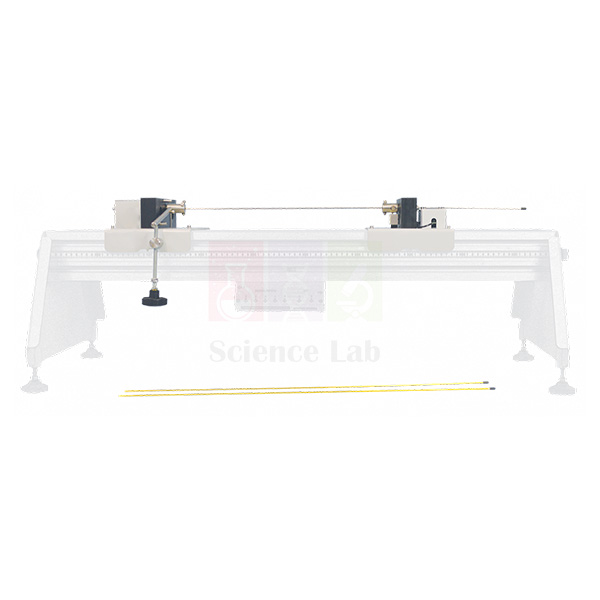
Torsion of Circular Sections (Product Code: SLE/EG/15) twists circular rods and a tube held between two chucks, so students can relate applied torque to angle of twist. One chuck, fitted with a precision potentiometer, applies and measures the angular deflection; the other is connected to a load cell that measures the resulting torque. Manufactured by Jain Scientific Equipments Pvt Ltd (ScienceLab) of Ambala, it serves mechanical and civil engineering laboratories studying shafts and torsional stiffness.
Key Details
| Parameter | Detail |
|---|---|
| Type | Torsion experiment for solid rods and a hollow tube |
| Twisting chuck | Applies angular deflection to the specimen; includes a precision potentiometer to measure it |
| Reaction chuck | Connected to a load cell that measures the resulting torque |
| Specimens | A set of rods of different metals and a tube |
| Comparisons | Elastic properties, dimensions and polar second moment of area (‘J’ value) |
| Effective length | Can be varied to show its effect on deflection for a given torque |
| Data connection | Potentiometer and load cell connect to the USB interface hub of the Structures Platform for computer display and data acquisition |
Typical Use
Students clamp a rod, turn the potentiometer chuck through a series of angles and record the torque at each step, building a torque-against-twist graph whose slope gives the torsional stiffness of that specimen. Using the rod dimensions and the textbook torsion equation, they predict the same relationship and compare the calculated line with the measured one, then work out the shear modulus of each metal.
Changing the effective length shows that, for the same torque, a longer rod twists further. Comparing a solid rod with the tube shows how the polar second moment of area, not simply the amount of material, controls stiffness — the reason many drive shafts are hollow. With both sensors logged through the Structures Platform, the torque-twist line builds up on screen as the test runs, which makes this module useful mechanics lab equipment for lectures on shaft design.
Manufacturer
The apparatus comes from Jain Scientific Equipments Private Limited, which trades as ScienceLab and is based in Ambala, Haryana. The company is incorporated under CIN U29309HR2020PTC087597 and manufactures at its licensed factory at 449, HSIIDC Industrial Area, Saha, Ambala (Factory Licence AMB-ONLINE-CHD-J-414). More about us is in the company profile.
Related Laboratory Equipment
Equipment that pairs well with torsion testing:
- Stiffness - Bending and Torsion — an alternative from our materials testing range comparing bending and torsional stiffness
- Structures Platform — the USB interface hub that logs the potentiometer and load cell
- Caliper Vernier (Metal) — for measuring rod and tube diameters when calculating the ‘J’ value
- Deflection of Beams and Cantilevers — the bending counterpart, comparing elastic properties of metal beams
- Euler Buckling of Struts — another elastic-behaviour practical that logs through the same platform hub
Find the rest of the series in General Products.
Frequently Asked Questions
Which specimens are supplied?
A set of rods of different metals and a tube. For the specific metals and specimen dimensions, please contact us for the datasheet.
How is the angle of twist measured?
By a precision potentiometer built into the chuck that applies the angular deflection.
How is torque measured?
The opposite chuck is connected to a load cell, which measures the torque that results from the applied twist.
Why is a tube included as well as solid rods?
It lets students compare a hollow section with solid ones through the polar second moment of area (‘J’ value), showing how section shape affects torsional stiffness.
Is a Vernier caliper part of this module?
A caliper is not listed for this module. If you need one to measure rod and tube diameters, see Caliper Vernier (Metal) or ask us to add it to your quotation.
What warranty is offered?
Warranty terms are stated in each quotation; contact us for current terms.
Request a Quote
Send your quantity and delivery location through our contact page, or add this torsion module to the enquiry cart, and we will reply with pricing.
Last updated: 24 September 2026
Bending Stress In a Beam
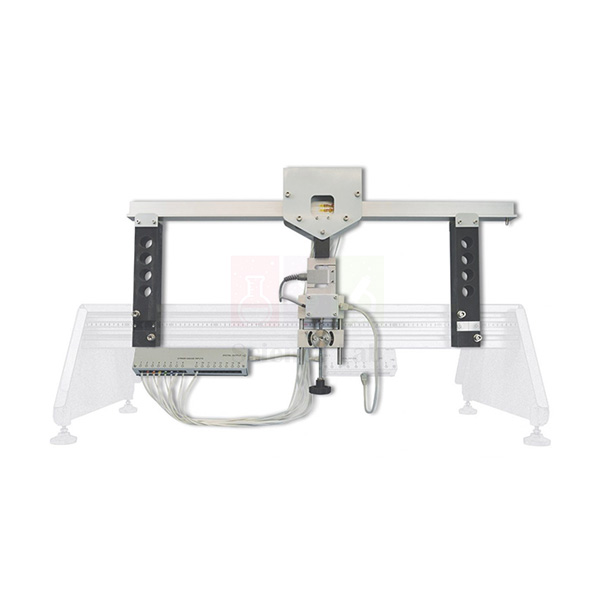
Bending Stress In a Beam (Product Code: SLE/EG/16) is a structures experiment that measures the strains a beam develops under load, so students can convert them into bending stresses and test the results against beam theory. Its strain gauges feed a strain gauge amplifier, which reports together with the load cell to the Structures Platform for on-screen display. The apparatus is manufactured by Jain Scientific Equipments Pvt Ltd (ScienceLab), Ambala, for engineering colleges and polytechnics teaching strength of materials.
Key Details
| Parameter | Detail |
|---|---|
| Type | Beam bending stress experiment based on strain measurement |
| Strain measurement | Strain gauges record the strains produced by the applied load |
| Load measurement | Load cell |
| Signal path | Strain gauges connect to a strain gauge amplifier, which connects (with the load cell) to the USB interface hub of the Structures Platform for computer display and data acquisition |
| Included tool | Vernier caliper for accurate measurement of the beam cross-section |
| Theory covered | Predicting stresses and bending moments for a given load with textbook beam equations, then comparing with measured results |
Typical Use
After measuring the beam’s width and depth with the included Vernier caliper, students apply a load and read the strains. Multiplying strain by the elastic modulus of the beam material gives a measured stress, which they compare with the value from the bending equation, using the bending moment worked out from the load and support positions. The closeness of the two figures confirms how far simple bending theory can be trusted.
Repeating the test at several loads shows whether stress rises in proportion to load, as elastic theory expects. Because the amplifier and load cell log through the Structures Platform, strain and load are captured side by side, making the experiment a practical introduction to strain gauge instrumentation. Colleges assembling engineering lab equipment in India often place it straight after a bending moment experiment so students see moment and stress as two views of the same loading.
Manufacturer
This beam apparatus is produced by Jain Scientific Equipments Private Limited — known to customers as ScienceLab — from its base in Ambala, Haryana. Our company profile gives an overview of the business.
Related Laboratory Equipment
Items that link naturally to bending stress work:
- Bending Moments In a Beam — measures the bending moment that this experiment turns into stress
- Strain Gauge Trainer — teaches strain gauge principles before students rely on them in beam tests
- Plastic Bending Of Beams — follows beam behaviour beyond the elastic range
- Structures Platform — the USB interface hub that the amplifier and load cell connect to
The full structures series is in General Products.
Frequently Asked Questions
What does the experiment measure directly?
Strain, through strain gauges, and load, through a load cell. Stresses are then calculated from the measured strains.
Is the strain gauge amplifier supplied with this module?
The strain gauges connect to a strain gauge amplifier, which then links with the load cell to the Structures Platform. Please confirm with us whether the amplifier is supplied with this module or separately so your order is complete — contact us.
Is a caliper included for measuring the beam?
Yes, a Vernier caliper is included for measuring the beam cross-section.
Can results be shown on a computer?
Yes. Through the USB interface hub of the Structures Platform, strain and load readings can be displayed and recorded on a computer.
Is a calibration certificate available?
Calibration certificate availability is something to discuss with us when you request a quotation.
Can you supply several sets for a large class or an overseas college?
Yes. We supply institutions in India and international markets and can quote for multiple sets; share quantity and destination through the enquiry cart.
Request a Quote
To receive pricing for Bending Stress In a Beam, get in touch or add it to the enquiry cart.
Last updated: 24 September 2026
Deflection of Beams and Cantilevers
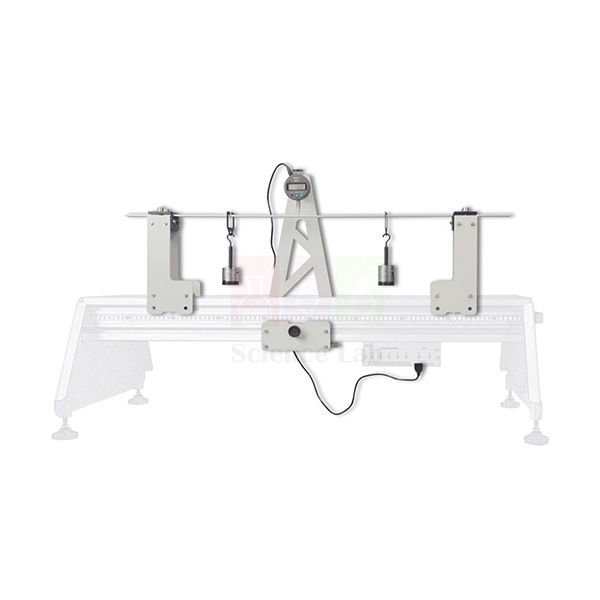
Deflection of Beams and Cantilevers (Product Code: SLE/EG/17) is a flexible beam experiment: loads can be placed at any position along the beam and the resulting deflection measured at any point, with the beam on its supports or fitted to a single support as a cantilever. Built by Jain Scientific Equipments Pvt Ltd (ScienceLab) in Ambala, it comes with beam specimens in different metals and cross-sections for strength of materials classes in engineering colleges and technical institutes.
Key Details
| Parameter | Detail |
|---|---|
| Type | Beam and cantilever deflection experiment |
| Loading | Loads applied at any position along the beam |
| Deflection measurement | Deflection indicator with its own display, usable at any point along the beam |
| Configurations | Beam on supports, or fitted to one support only to form a cantilever |
| Specimens | Set of beam specimens of different metals and cross-sections, for comparing elastic properties and ‘I’ value |
| Span | Effective length of the beam can be varied |
| Positioning | Pointers on each support work with the scale on the platform |
| Data connection | Deflection indicator can connect to the USB interface hub of the Structures Platform for computer display and data acquisition |
Typical Use
A standard session starts with one metal beam at a fixed span: students add load in steps, record deflection and compare it with the value predicted by the textbook beam formula. They then reset the span with the support pointers and platform scale and see how quickly deflection grows as the beam gets longer, before moving the indicator to other points to map the deflected shape.
Switching specimens separates the two ingredients of beam stiffness — the metal’s elastic modulus and the section’s second moment of area (‘I’ value) — so students see why a deeper section or a stiffer metal deflects less. Removing one support turns the beam into a cantilever for tip-load tests. As the indicator works on its own display, the practical runs well as lab equipment for college groups even before the computer link is set up.
Manufacturer
Jain Scientific Equipments Private Limited, trading as ScienceLab, manufactures structures teaching apparatus such as this from Ambala in Haryana, India. Visit the company profile to learn more about us.
Related Laboratory Equipment
Natural next steps from basic beam deflection:
- Continuous and Indeterminate Beams — for beams with extra supports, where reactions cannot be found from statics alone
- Unsymmetrical Bending and Shear Centre — deflection of sections loaded away from their principal axes
- Bending Stress In a Beam — relates similar loads to measured stresses
- Structures Platform — provides the positioning scale and computer display for the deflection indicator
Explore the other modules in General Products.
Frequently Asked Questions
Can the apparatus be used as a cantilever?
Yes. Fit the beam to one support only and it becomes a cantilever.
Which beam specimens are included?
A set of beam specimens in different metals and cross-sections. For the specific metals and sizes, please contact us.
Does the deflection indicator need a computer?
No, it has its own display. Connecting it to the USB interface hub of the Structures Platform is optional for on-screen display and data logging.
Can the span be changed?
Yes. The effective length can be varied, and pointers on each support work with the platform scale for accurate positioning.
Can students estimate the elastic modulus of each metal?
Yes. Combining the measured deflection with the beam equation and the section’s ‘I’ value lets students compare the elastic properties of the different metals.
What warranty and lead time apply?
Both are confirmed in the quotation for your order — ask through the contact page.
Do you ship to institutions abroad?
Yes, we supply colleges in India and international markets; add the item to the enquiry cart with your destination.
Request a Quote
For pricing on this deflection apparatus, contact us or place it in your enquiry cart.
Last updated: 24 September 2026
Additional Load Cell
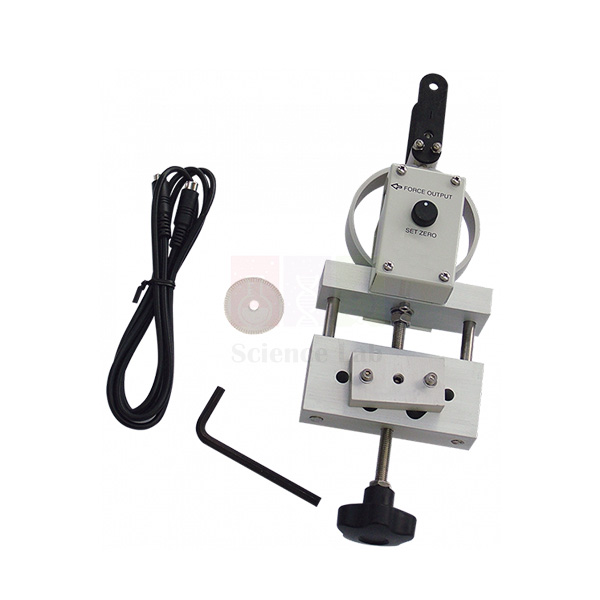
The Additional Load Cell (Product Code: SLE/EG/18) is an add-on for the Pin-Jointed Frameworks apparatus. An extra load cell allows more than one load to be applied and measured on the test framework at the same time, so students can study how a framework responds to combined loading rather than one load at a time. It is manufactured by Jain Scientific Equipments Pvt Ltd (ScienceLab), Ambala, for engineering laboratories that already run, or are setting up, a frameworks experiment.
Key Details
| Parameter | Detail |
|---|---|
| Type | Load cell, supplied as an additional unit |
| For use with | Pin-Jointed Frameworks apparatus |
| Purpose | Allows multiple loads to be applied and measured simultaneously on the test framework |
| Supplied as | Accessory, ordered in addition to the frameworks apparatus |
| Suitable for | Engineering colleges, polytechnics and technical institutes teaching framework analysis |
Typical Use
In a pin-jointed framework practical, students load the framework and compare what they measure with the results of hand analysis by the method of joints or the method of sections. An additional load cell means a second load can be applied and read at the same moment as the first, so the class can test superposition — whether the framework’s response to two loads equals the sum of their separate effects — and look at loading cases that resemble real roof and bridge trusses.
It also suits project work on combined or asymmetric loading, and lets a department extend an existing rig instead of buying a second one. For institutions building up lab equipment for technical institutes step by step, it is a low-disruption way to widen the range of experiments. Before ordering, check how many simultaneous load points your framework exercises need.
Manufacturer
The load cell is made by Jain Scientific Equipments Private Limited, whose trading name is ScienceLab, at Ambala in Haryana. Our company profile explains more about the company and its engineering range.
Related Laboratory Equipment
Other apparatus from the same structures series:
- Structures Platform — the base platform of the structures range
- Redundant Truss, Next Generation Structures — a truss experiment for studying member forces in a redundant framework
- Frame Deflections And Reactions — a frame experiment focused on deflections and support reactions
- Two Pinned Arch — another structures module in which a load cell measures a support reaction
See all related modules under General Products.
Frequently Asked Questions
Which apparatus is this load cell for?
It is listed for the Pin-Jointed Frameworks apparatus. If you want to use it with any other module, contact us to confirm compatibility first.
Why would a laboratory need an additional load cell?
To apply and measure several loads on the test framework simultaneously, instead of testing one load case at a time.
Is the Pin-Jointed Frameworks apparatus included?
No. This listing covers the additional load cell only. Ask us about the frameworks apparatus itself if you are equipping a new laboratory.
What is the load cell’s capacity and connection type?
These details are not given in our current product listing; contact us for the datasheet before ordering.
Is a calibration certificate available?
Calibration certificate availability should be discussed with us at the time of enquiry.
How do we order it for an overseas institution?
Send the quantity and destination through our contact page; we supply customers in India and international markets.
Request a Quote
To price one or more additional load cells, contact us or add the item to your enquiry cart.
Last updated: 24 September 2026