- Physics Lab Equipment
- Chemistry Lab Equipment
- Biology Lab Equipment
- Anatomical Lab Equipment
- Learning
- Educational Lab Equipment
- Magnets
- Agriculture
- Astronomy
- Earth Science
- Geography Lab Equipment
- Safety Lab Coat
- Laboratory
- Meteorological
- Electricity & Magnetism
- Heat
- School Lab Equipment
- Lab Glassware
- Science Lab Equipment
- Tvet Lab Equipment
- Robotics Kits Supplier and Manufacturer for Schools India
- Math Lab Equipment Manufacturers and Exporters in Ambala
- STEM Kits Manufacturers and Supplier India
- Engineering Lab Equipment
- Hospital Lab Equipment
- Water, Sanitation & Hygiene Supplies
- Cold Chain, Solar & Communication Equipment
- Nutrition
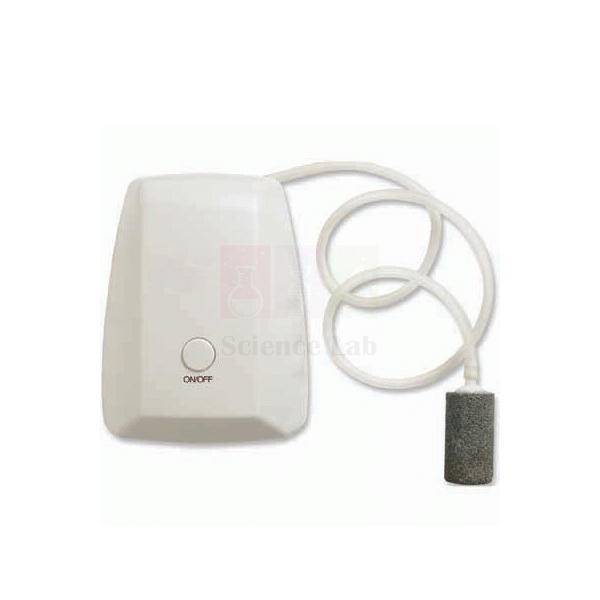
Bucket Aerator
Bucket Aerator (Product Code: SLE/EZ/26) is a portable air pump used to keep fish and other aquatic animals oxygenated in a bucket of water during field sampling and transport. Suitable for fresh and salt water, it pairs a quiet diaphragm pump with a 24 ft air hose and can work in a 5-gallon bucket. It is supplied by Jain Scientific Equipments Pvt Ltd (ScienceLab), Ambala, India, for school, college and fisheries fieldwork.
Specifications
| Parameter | Detail |
|---|---|
| Function | Keeps samples oxygenated in the field |
| Pump type | Quiet diaphragm pump |
| Air hose | 24 ft |
| Water type | Fresh and salt water |
| Container | Can work in a 5-gallon bucket |
| Power source | Not stated — confirmed on quotation |
| Product code | SLE/EZ/26 |
| Supplied by | Jain Scientific Equipments Pvt Ltd (ScienceLab), Ambala, India |
What Is the Bucket Aerator Used For?
Fish and invertebrates held in a bucket quickly use up the oxygen in the water, especially on a warm day or when several animals share one container. A bucket aerator pumps air through a hose into the water, where the rising bubbles replace lost oxygen and keep the catch in good condition while it is sorted, measured and returned. It is equally useful for carrying live samples back to the lab for a classroom aquarium.
The long air hose lets the pump sit on the bank or in the vehicle while the hose runs to the bucket. Keep the pump dry and above the water level, shade the bucket, and avoid overcrowding it. After use in salt water, flush the hose with fresh water and let it dry. Pair it with a dissolved oxygen meter if students want to measure the effect of aeration directly.
Supplier
Jain Scientific Equipments Private Limited, known as ScienceLab, supplies the bucket aerator from Ambala, Haryana, India. Schools, colleges, fisheries courses, research groups and distributors can source it with nets, traps and measuring boards on one quotation, with delivery within India and to international markets. More details are on the company profile page.
Related Zoology Equipment
Items that go with the aerator on a fish-sampling trip:
- Minnow Seine, Thrifty — catches the small fish that the aerated bucket will hold.
- Gee Minnow Trap — a passive trap whose catch can wait in the bucket.
- Aquarium Dip Net — for lifting individual fish out of the bucket.
- Digital Dissolved Oxygen Meter — for measuring oxygen levels in the bucket or at the site.
Browse the Zoology category for more fieldwork equipment.
Frequently Asked Questions
What size bucket does the Bucket Aerator work with?
The Bucket Aerator can work in a 5-gallon bucket, a practical size for holding a morning's catch of small fish during fieldwork. Use a bucket with a lid or cover for transport, leaving a gap for the air hose.
Can the Bucket Aerator be used in salt water?
Yes. The Bucket Aerator is listed for both fresh and salt water. After salt-water use, flush the air hose through with fresh water and let everything dry, so salt does not build up in the line.
How long is the air hose on the Bucket Aerator?
The Bucket Aerator comes with a 24 ft air hose. The long hose lets the quiet diaphragm pump stay on dry ground or in a vehicle while the air is delivered to the bucket.
How is the Bucket Aerator powered?
The listing for the Bucket Aerator does not state its power source. Please ask through our contact page, and we will confirm the power requirements with the quotation so you can plan for fieldwork away from mains supply.
Is the Bucket Aerator noisy?
The Bucket Aerator uses a quiet diaphragm pump, which suits use in a classroom or near other groups during fieldwork. Stand the pump on a firm, dry surface to keep vibration and noise to a minimum.
Who supplies the Bucket Aerator?
The Bucket Aerator is supplied by Jain Scientific Equipments Pvt Ltd (ScienceLab), Ambala, Haryana, India. Schools, colleges and dealers in India and international markets can order it alone or with other fish-sampling equipment.
Request a Quote
For a Bucket Aerator quotation, send the quantity and delivery location through our contact page, or add it to the enquiry cart with nets and traps.
Last updated: 24 September 2026
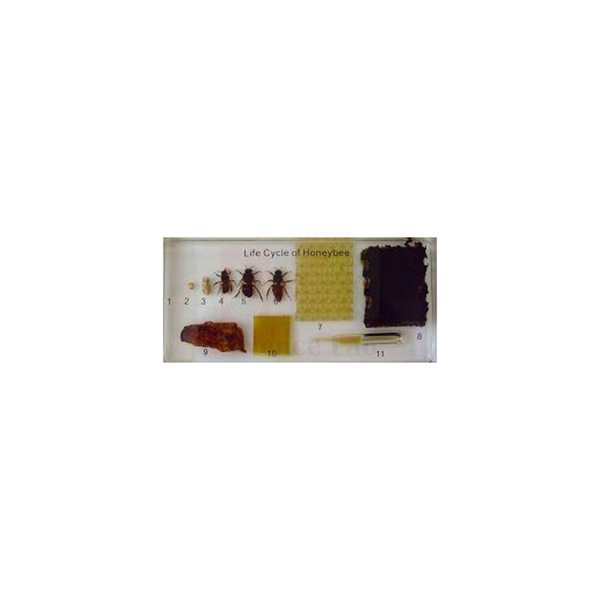
Honeybee Lifecycle Plastomount
Honeybee Lifecycle Plastomount (Product Code: SLE/EZ/27) is a labelled set of real honeybee specimens embedded in an acrylic block, used to teach complete metamorphosis and bee biology in school and college zoology classes. It shows the egg, larva, pupa, worker, drone and adult forms, together with samples of honeycomb, beeswax and honey, in a 140 x 64 x 18 mm block weighing 190 g. It is supplied by Jain Scientific Equipments Pvt Ltd (ScienceLab), Ambala, India.
Specifications
| Parameter | Detail |
|---|---|
| Stages shown | Egg, larva, pupa, worker, drone and adult forms |
| Bee products included | Honeycomb, beeswax and honey samples |
| Labelling | Labelled set |
| Encasement | Acrylic block, listed as unbreakable; protects specimens from decay |
| Size | 140 x 64 x 18 mm |
| Weight | 190 g |
| Product code | SLE/EZ/27 |
| Supplied by | Jain Scientific Equipments Pvt Ltd (ScienceLab), Ambala, India |
What Is the Honeybee Lifecycle Plastomount Used For?
The honeybee passes through four distinct stages — egg, larva, pupa and adult — and this block lets students see all of them side by side, which makes complete metamorphosis far easier to grasp than from a diagram. Including both worker and drone adults opens a discussion of the division of labour in a colony, while the comb, wax and honey samples link the biology to apiculture and the economic importance of bees, a topic in many Indian zoology syllabi.
Because the specimens are sealed in acrylic, the block can be handed round a class, placed under a hand lens or set out at a practical station without risk of damage to the insects. Wipe it with a soft, damp cloth, avoid solvents that can cloud acrylic, and keep it out of long exposure to strong sunlight. It is a durable lab specimen for biology teaching that lasts through many batches of students.
Supplier
Jain Scientific Equipments Private Limited, which trades as ScienceLab, supplies the honeybee lifecycle plastomount from Ambala, Haryana, India. Schools, colleges, agriculture and apiculture training institutes, and educational dealers can order it on its own or with other insect lifecycle blocks, with delivery across India and to international markets. Company background is on the company profile page.
Related Zoology Equipment
Specimens that build a fuller lesson on insect life cycles and bees:
- Silkworm Lifecycle Plastomount — another complete-metamorphosis insect, linked to sericulture.
- Grasshopper Lifecycle — an incomplete-metamorphosis life cycle for contrast.
- Bee, Part of the Mouth, Whole Body — a microscope preparation for studying bee mouthparts.
- Bee, Hind Leg — shows the leg structures bees use to carry pollen.
More specimens are in the Zoology category.
Frequently Asked Questions
Which stages are shown in the Honeybee Lifecycle Plastomount?
The Honeybee Lifecycle Plastomount shows the egg, larva, pupa, worker, drone and adult forms of the honeybee in a labelled set. Samples of honeycomb, beeswax and honey are included in the same acrylic block.
What size is the Honeybee Lifecycle Plastomount?
The Honeybee Lifecycle Plastomount measures 140 x 64 x 18 mm and weighs 190 g. The compact block fits comfortably in one hand and stores easily in a specimen drawer.
Are the specimens in the Honeybee Lifecycle Plastomount real?
Yes, the Honeybee Lifecycle Plastomount holds real specimens encased in an acrylic block, which protects them from decay and handling damage. Small natural differences between blocks are normal.
Can students handle the Honeybee Lifecycle Plastomount?
Yes. The Honeybee Lifecycle Plastomount is sealed in acrylic listed as unbreakable, so students can hold it and view it through a hand lens. Avoid dropping it on hard floors and clean it with a soft, damp cloth only.
What does the Honeybee Lifecycle Plastomount teach about metamorphosis?
The Honeybee Lifecycle Plastomount shows complete metamorphosis, where a larva turns into an adult through a pupal stage. Setting it beside a grasshopper life cycle helps students compare complete and incomplete metamorphosis.
Who supplies the Honeybee Lifecycle Plastomount?
The Honeybee Lifecycle Plastomount is supplied by Jain Scientific Equipments Pvt Ltd (ScienceLab), Ambala, Haryana, India. Schools, colleges and dealers in India and international markets can request a quotation through the contact page.
Request a Quote
For a quotation on the Honeybee Lifecycle Plastomount, send the quantity and delivery location through our contact page, or add it to the enquiry cart with other lifecycle specimens.
Last updated: 24 September 2026
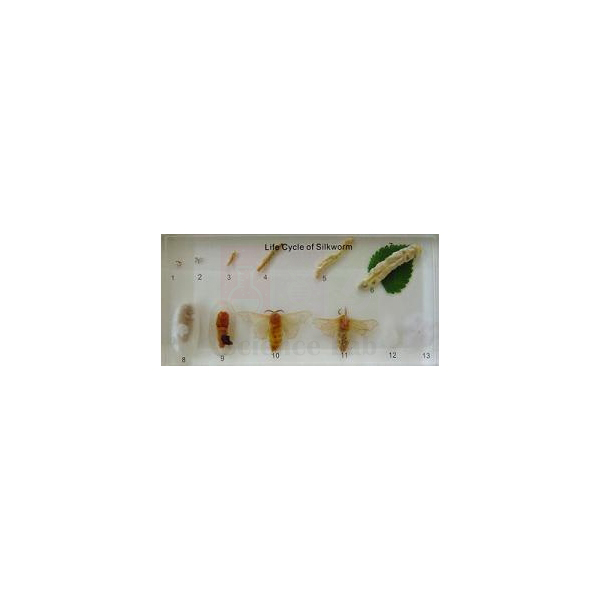
Silkworm Lifecycle Plastomount
Silkworm Lifecycle Plastomount (Product Code: SLE/EZ/28) is a labelled set of real silkworm specimens sealed in an acrylic block, used to teach the silkworm's metamorphosis and the basics of sericulture in school and college zoology. It shows the egg, larva, caterpillar, pupa and adult, and adds mulberry leaves plus samples of raw silk and silk fabric, so students follow the story from food plant to finished cloth. It is supplied by Jain Scientific Equipments Pvt Ltd (ScienceLab), Ambala, India.
Key Details
| Parameter | Detail |
|---|---|
| Stages shown | Egg, larva, caterpillar, pupa and adult |
| Also included | Mulberry leaves; samples of raw silk and silk fabric |
| Labelling | Labelled set |
| Encasement | Acrylic block, listed as unbreakable; protects specimens from decay |
| Block size | Not stated — ask us |
| Product code | SLE/EZ/28 |
| Supplied by | Jain Scientific Equipments Pvt Ltd (ScienceLab), Ambala, India |
What Is the Silkworm Lifecycle Plastomount Used For?
Sericulture, the rearing of silkworms for silk, is a standard topic in economic zoology, and this block turns it into something students can hold. They can trace the growth from tiny egg to feeding larva and mature caterpillar, then the pupa and the adult moth, and see why the mulberry leaf matters as the larva's food. The raw silk and fabric samples complete the chain from insect to textile, which helps connect biology lessons with India's silk industry.
Use the block at a practical station with a worksheet asking students to name each stage and describe what happens between them, then compare it with a grasshopper life cycle to contrast complete and incomplete metamorphosis. Since the specimens are sealed, the block can be passed around freely. Clean it with a soft, damp cloth and store it away from strong sunlight. It is a long-lasting addition to zoology lab equipment in India.
Supplier
The silkworm lifecycle plastomount is supplied by Jain Scientific Equipments Private Limited, trading as ScienceLab, from Ambala, Haryana, India. Schools, colleges, sericulture and agriculture training institutes, and dealers can order it singly or as part of an insect lifecycle collection, for delivery across India and to international markets. See the company profile for more about the company.
Related Zoology Equipment
Other resources for lessons on insect life cycles and sericulture:
- Honeybee Lifecycle Plastomount — a second economically important insect with complete metamorphosis.
- Grasshopper Lifecycle — an incomplete-metamorphosis example for comparison.
- Silk Worm (Life Cycle) — a wall chart of the silkworm life cycle for whole-class teaching.
- Lens — a 3x and 6x magnifier for examining the smaller stages.
Explore the Zoology category for more specimens.
Frequently Asked Questions
What stages does the Silkworm Lifecycle Plastomount show?
The Silkworm Lifecycle Plastomount shows the egg, larva, caterpillar, pupa and adult of the silkworm in a labelled set. Seeing every stage in one block helps students describe complete metamorphosis in order.
What else is included in the Silkworm Lifecycle Plastomount?
Besides the life stages, the Silkworm Lifecycle Plastomount includes mulberry leaves, the silkworm's food plant, and samples of raw silk and silk fabric. These link the insect's biology to silk production.
Are the specimens in the Silkworm Lifecycle Plastomount real?
Yes. The Silkworm Lifecycle Plastomount contains real specimens encased in an acrylic block, which protects them from decay. As natural material, the specimens can vary slightly in size and colour between blocks.
What size is the Silkworm Lifecycle Plastomount?
The listing for the Silkworm Lifecycle Plastomount does not give the block dimensions. If you need them for storage or display planning, ask through our contact page and we will confirm with the quotation.
Is the Silkworm Lifecycle Plastomount suitable for student handling?
Yes. The Silkworm Lifecycle Plastomount is sealed in acrylic listed as unbreakable, so it can be passed around a class. Clean it with a soft, damp cloth and keep it away from long exposure to strong sunlight.
Who supplies the Silkworm Lifecycle Plastomount?
The Silkworm Lifecycle Plastomount is supplied by Jain Scientific Equipments Pvt Ltd (ScienceLab), Ambala, Haryana, India. Schools, colleges, training institutes and dealers in India and international markets can request a quotation.
Request a Quote
To get a price for the Silkworm Lifecycle Plastomount, send the quantity and delivery location through our contact page, or add it to the enquiry cart.
Last updated: 24 September 2026
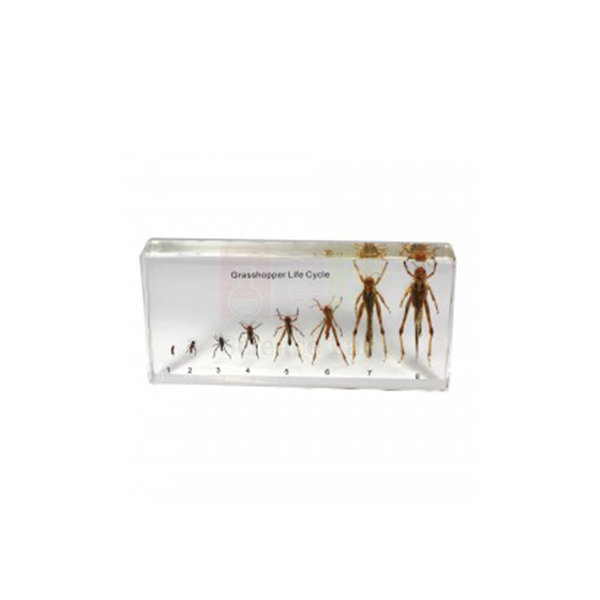
Grasshopper Lifecycle
Grasshopper Lifecycle (Product Code: SLE/EZ/29) is a teaching kit with preserved grasshopper specimens in a clear resin block, used to show incomplete metamorphosis in school and college biology lessons. One 6 1/2 x 3 x 1 in specimen block holds different stages of the grasshopper Oxya chinensis, and the kit's overall size is listed as 8 1/4 x 4 3/4 x 1 1/2 in. It is supplied by Jain Scientific Equipments Pvt Ltd (ScienceLab), Ambala, India, as a durable lab specimen.
Specifications
| Parameter | Detail |
|---|---|
| Topic | Life cycle of the grasshopper (incomplete metamorphosis) |
| Species | Oxya chinensis |
| Specimens | Different stages of the grasshopper, preserved |
| Encasement | Clear resin |
| Blocks included | One specimen block, 6 1/2 x 3 x 1 in |
| Overall size (as listed) | 8 1/4 x 4 3/4 x 1 1/2 in |
| Product code | SLE/EZ/29 |
| Supplied by | Jain Scientific Equipments Pvt Ltd (ScienceLab), Ambala, India |
What Is the Grasshopper Lifecycle Used For?
Grasshoppers develop by incomplete metamorphosis: a nymph hatches from the egg looking like a small, wingless version of the adult, then grows through a series of moults, with wing buds getting larger each time, until it becomes a winged adult. There is no pupal stage. A resin block of real specimens lets students line these stages up and see the gradual change for themselves, which is much clearer than a textbook drawing.
Oxya chinensis is a grasshopper of rice fields, so the block also suits lessons on crop pests in agricultural zoology. Teachers often place it beside a honeybee or silkworm lifecycle block and ask students to list the differences between complete and incomplete metamorphosis. The resin protects the specimens during handling; wipe it with a soft cloth and store it away from strong sunlight.
Supplier
Jain Scientific Equipments Private Limited, which trades as ScienceLab, supplies the grasshopper lifecycle kit from Ambala, Haryana, India. Schools, colleges, agricultural institutes and educational distributors can order it with other insect specimens and collecting equipment, for delivery across India and to international markets. More about the company is on the company profile page.
Related Zoology Equipment
Items for comparing life cycles and studying live grasshoppers:
- Honeybee Lifecycle Plastomount — a complete-metamorphosis life cycle for direct comparison.
- Silkworm Lifecycle Plastomount — another complete-metamorphosis insect with a pupal stage.
- Insect Net, Economy — for catching live grasshoppers and nymphs in the school grounds.
- Insect Mount Set — a wider set of insects and other arthropods for classification work.
See the Zoology category for more.
Frequently Asked Questions
What type of metamorphosis does the Grasshopper Lifecycle kit show?
The Grasshopper Lifecycle kit shows incomplete metamorphosis, in which young nymphs resemble small adults and grow through moults without a pupal stage. It contrasts well with insects such as bees and silkworms that pass through a pupa.
Which grasshopper species is used in the Grasshopper Lifecycle kit?
The Grasshopper Lifecycle kit uses specimens of Oxya chinensis, a grasshopper associated with rice fields. The different stages are preserved and encased in clear resin in a single specimen block.
How many specimen blocks are in the Grasshopper Lifecycle kit?
The Grasshopper Lifecycle kit includes one specimen block measuring 6 1/2 x 3 x 1 in. The overall size is listed as 8 1/4 x 4 3/4 x 1 1/2 in, so allow for that when planning storage.
Which stages are included in the Grasshopper Lifecycle block?
The listing says the Grasshopper Lifecycle block contains the different stages of the grasshopper but does not list them individually. Ask through our contact page if you need the exact stages confirmed before ordering.
How should the Grasshopper Lifecycle block be cared for?
Wipe the Grasshopper Lifecycle resin block with a soft, dry or slightly damp cloth, avoid solvents, and store it away from strong sunlight and heat. Handle it over a table so it is not dropped on a hard floor.
Who supplies the Grasshopper Lifecycle kit?
The Grasshopper Lifecycle kit is supplied by Jain Scientific Equipments Pvt Ltd (ScienceLab), Ambala, Haryana, India. Schools, colleges and dealers in India and international markets can order it on its own or with other insect specimens.
Request a Quote
For a Grasshopper Lifecycle quotation, send the quantity and delivery location through our contact page, or place it in the enquiry cart with other lifecycle specimens.
Last updated: 24 September 2026
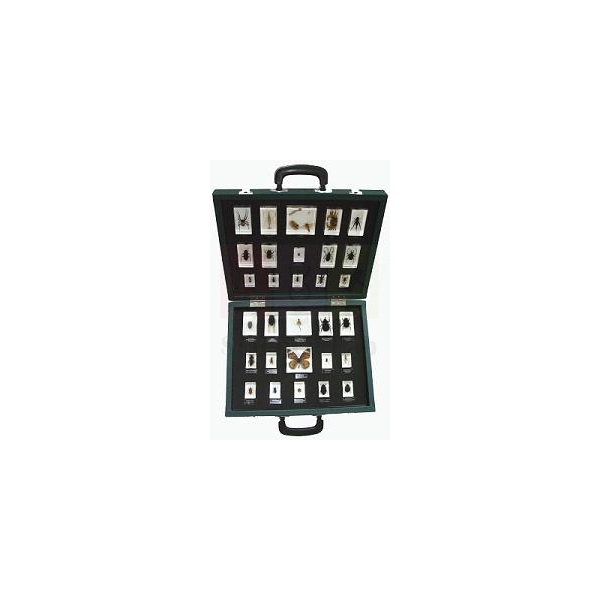
Insect Mount Set
Insect Mount Set (Product Code: SLE/EZ/30) is a versatile collection of mounted insects and other arthropods, including spiders, scorpions, crabs and shrimps, used for identification and classification work in school and college zoology. Beetles, wasps, a monarch butterfly, a dragonfly and many more are held in a carrying case with die-cut foam inserts and a sturdy handle, so the set travels safely between classrooms. It is supplied by Jain Scientific Equipments Pvt Ltd (ScienceLab), Ambala, India.
Key Details
| Parameter | Detail |
|---|---|
| Contents | Mounted insect and arthropod specimens (full list below) |
| Case | Die-cut foam inserts and sturdy handle |
| Mounting method | Not stated — ask us |
| Product code | SLE/EZ/30 |
| Supplied by | Jain Scientific Equipments Pvt Ltd (ScienceLab), Ambala, India |
Specimens in the set, grouped here to help with teaching:
- Arachnids: spider, scorpion
- Crustaceans: shrimp, crab
- Beetles: stag beetle, longhorned beetle, antler horned beetle, wood tiger beetle, green tiger beetle, rhino beetle, dung beetle, bamboo weevil, grey weevil, ladybug, great diving beetle, chafer beetle
- Ants, bees and wasps: ant, honeybee, giant hornet wasp, paper wasp
- Crickets and grasshoppers: cricket, mole cricket, grasshopper
- Bugs and cicadas: shield bug, cicada
- Other insects: silkworm, cockroach, onion fly, dragonfly, monarch butterfly
What Is the Insect Mount Set Used For?
Because the set mixes true insects with spiders, scorpions, crabs and shrimps, it is ideal for the classic classification question: what makes an insect an insect? Students count legs and body sections, look for antennae and wings, and sort the specimens into arachnids, crustaceans and insects before going further into insect orders such as beetles, bees and wasps, crickets, true bugs, flies, dragonflies and butterflies.
The set also supports lessons on adaptation, from the digging forelegs of the mole cricket and the swimming legs of the diving beetle to the long jumping legs of the grasshopper. Place specimens at numbered stations with a dichotomous key and a hand lens, and return each to its foam slot afterwards. It serves well as a reference collection alongside a school insect collection kit.
Supplier
Jain Scientific Equipments Private Limited, trading as ScienceLab, supplies the insect mount set from Ambala, Haryana, India. Schools, colleges, museums, nature centres and educational dealers can order it with lifecycle blocks, nets and magnifiers on one quotation, with delivery across India and to international markets. Background on the company is on the company profile page.
Related Zoology Equipment
Items that extend work with the insect mount set:
- Lens — a 3x and 6x magnifier for examining legs, antennae and mouthparts.
- Insect Anatomy Slide Set of 9 — microscope slides showing insect body parts in finer detail.
- Insect Net, Economy — for collecting live insects to compare with the reference set.
- Insect Pin Holder — for students who go on to pin their own specimens.
Browse the Zoology category for more specimens and tools.
Frequently Asked Questions
Which specimens are in the Insect Mount Set?
The Insect Mount Set includes a spider, scorpion, shrimp, crab, many beetles and weevils, an ant, honeybee, wasps, crickets, a grasshopper, shield bug, cicada, silkworm, cockroach, onion fly, dragonfly and monarch butterfly. The full list is shown above.
Does the Insect Mount Set include animals that are not insects?
Yes. The Insect Mount Set also contains arachnids (spider and scorpion) and crustaceans (shrimp and crab). This makes it useful for teaching how insects differ from other arthropods in legs, body sections and antennae.
How are the specimens in the Insect Mount Set stored?
The Insect Mount Set comes in a case with die-cut foam inserts, which hold each specimen in its own slot, and a sturdy handle for carrying. Return every specimen to its slot after use so none are lost.
Are the specimens in the Insect Mount Set in resin blocks?
The listing does not say how the specimens in the Insect Mount Set are mounted. Please ask through our contact page, and we will confirm the mounting method and specimen sizes before you order.
What age group is the Insect Mount Set suitable for?
The Insect Mount Set suits middle and senior school biology as well as undergraduate zoology, since it supports both simple sorting activities and detailed classification into insect orders. Younger pupils can use it with teacher guidance.
Who supplies the Insect Mount Set?
The Insect Mount Set is supplied by Jain Scientific Equipments Pvt Ltd (ScienceLab), Ambala, Haryana, India. Schools, colleges, museums and dealers in India and international markets can request a quotation through the contact page or the enquiry cart.
Request a Quote
For an Insect Mount Set quotation, send the quantity and delivery location through our contact page, or add it to the enquiry cart with other specimens.
Last updated: 24 September 2026
Tray
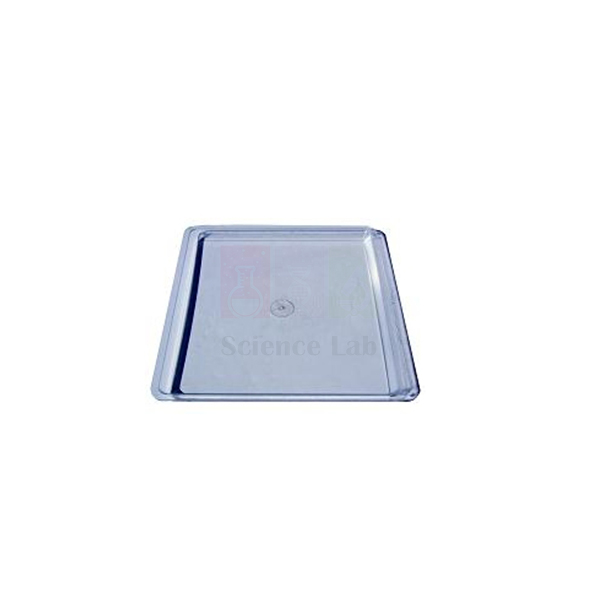
Tray (Product Code: SLE/EZ/31) is a 22.5 x 25 cm plastic tray used for picking out small critters from field samples and for studying small objects on the bench in biology and general science classes. Teachers use it to give each group a defined work area that keeps animals, seeds, shells or soil samples together and contains spills. It is supplied by Jain Scientific Equipments Pvt Ltd (ScienceLab), Ambala, India, as practical, everyday school biology lab equipment.
Specifications
| Parameter | Detail |
|---|---|
| Material | Plastic |
| Size | 22.5 x 25 cm |
| Intended use | Picking critters; studying small objects |
| Product code | SLE/EZ/31 |
| Supplied by | Jain Scientific Equipments Pvt Ltd (ScienceLab), Ambala, India |
What Is the Plastic Tray Used For?
A leaf-litter or soil sample tipped onto a tray can be spread out and searched a little at a time, so students find the woodlice, springtails, beetles and worms hiding in it. The same tray works for a scoop of pond water, a handful of seeds to sort, or shells and pebbles to examine under a lens. Keeping everything inside the tray means fewer lost specimens and a cleaner bench at the end of the lesson.
At 22.5 x 25 cm, this tray is larger than a pocket sorting tray but still easy to pass between students. Use soft forceps or a small brush to move animals, keep live specimens in the shade, and return them to where they were found. Wash the tray with mild soap and water afterwards. A set of trays is a simple, low-cost way to organise group practicals in school biology lab equipment.
Supplier
This plastic tray is supplied by Jain Scientific Equipments Private Limited, which trades as ScienceLab, from Ambala, Haryana, India. Schools, colleges, activity centres and educational dealers can order it in class sets alongside nets, magnifiers and sorting trays, for delivery within India and to international markets. More information is on the company profile page.
Related Zoology Equipment
Tools that are handy alongside the tray:
- Sorting Tray — a smaller white tray for separating critters into groups.
- Invertebrate Sampling Tray — a large fibreglass tray for whole stream samples.
- Forceps, Plastic — gentle forceps for lifting small animals from the tray.
- Lens — a 3x and 6x magnifier for studying small objects in the tray.
More equipment is listed in the Zoology category.
Frequently Asked Questions
What size is the Tray (SLE/EZ/31)?
The Tray (SLE/EZ/31) measures 22.5 x 25 cm. That gives a group enough room to spread out a leaf-litter, soil or pond sample and search it thoroughly, while still fitting easily on a shared bench.
What is the Tray (SLE/EZ/31) made of?
The Tray (SLE/EZ/31) is made of plastic, so it is light to carry and can be washed with mild soap and water after each practical. Avoid very hot water and solvent cleaners to keep it in good shape.
What can students do with the Tray (SLE/EZ/31)?
Students use the Tray (SLE/EZ/31) to pick critters out of field samples and to study small objects such as seeds, shells or pebbles. It keeps specimens together in one place and contains any spilled water or soil.
What colour is the Tray (SLE/EZ/31) and is it deep enough for water?
The listing for the Tray (SLE/EZ/31) does not give its colour or depth. If you plan to use it with pond water, ask through our contact page and we will confirm these details before quoting.
How is the Tray (SLE/EZ/31) different from the Sorting Tray?
The Tray (SLE/EZ/31) is a 22.5 x 25 cm plastic tray, while the Sorting Tray is a smaller 5 x 7 in white HDPE pan with a pour spout. Many classes use the larger tray first and the smaller one for sorting.
Who supplies the Tray (SLE/EZ/31)?
The Tray (SLE/EZ/31) is supplied by Jain Scientific Equipments Pvt Ltd (ScienceLab), Ambala, Haryana, India. Schools, colleges and dealers in India and international markets can order class sets through the contact page or the enquiry cart.
Request a Quote
To order the Tray, send the quantity and delivery location through our contact page, or add it to the enquiry cart.
Last updated: 24 September 2026

Health and Harmony
Health and Harmony (Product Code: SLE/EB/01) is a cross-curricular health education kit used to teach how the nervous system works, and how drugs affect neurotransmitters, across physics, chemistry, biology and mathematics lessons in schools. It combines brain, head, spine, arm and wave models with a conductivity of water tester and teacher activities and instructions. It is made by Jain Scientific Equipments Pvt Ltd (ScienceLab), an OEM manufacturer, at its own factory in Ambala, India.
Key Details
| Parameter | Detail |
|---|---|
| Type | Cross-curricular nervous system and health kit |
| Disciplines covered | Physics, Chemistry, Biology and Mathematics |
| Topics | Effect of drugs on neurotransmitters; message transmission through the body; wavelength and frequency; the nervous system as the body’s processing system |
| Teacher support | Teacher activities and instructions |
| Product code | SLE/EB/01 |
| Manufacturer | Jain Scientific Equipments Pvt Ltd (ScienceLab) — OEM |
| Country of origin | India (made in Ambala, Haryana) |
Kit contents:
- Conductivity of Water Tester
- Wave Model
- Spine Model
- Arm Model
- Brain Model
- Head Model
- Teacher Activities and instructions
What Is the Health and Harmony Kit Used For?
The kit lets one topic travel between departments. In biology, students follow a signal from the brain model down the spine model to the arm model, seeing how the nervous system links many working parts into one processing network. In chemistry, the conductivity of water tester shows that dissolved substances change how well water carries a current, a starting point for discussing the charged particles involved in nerve signalling. In physics, the wave model makes wavelength and frequency visible, and in mathematics students can measure, tabulate and graph the results they collect.
Because the topic of drugs and neurotransmitters can raise personal questions, many teachers run it alongside their school’s health and wellbeing programme, using the teacher activities and instructions to plan each session. As human biology model sets go, this one is aimed at connecting subjects rather than at detailed anatomy, so it pairs well with a dedicated nervous system or brain model for older classes.
What to Specify When Ordering
- Which version you need: Health and Harmony, which lists teacher activities and instructions, or the Superior Kit, whose listing adds a Motor Neuron Model.
- The number of kits per school or department and the delivery locations.
- Your curriculum level, so we can advise on suitability before you order.
OEM Manufacturer
Health and Harmony is an original ScienceLab kit. Jain Scientific Equipments Private Limited, the company that trades under the ScienceLab name, is its OEM (original equipment manufacturer) and makes and assembles the kit at its own licensed factory at Saha, Ambala, Haryana, India. Schools, education departments, dealers and importers receive quotations straight from the manufacturer, and replacement models for a kit already in use can be requested from the same team — just ask us. Visit our company profile to learn more.
Related Biology Kits
Models and kits that extend the nervous-system and health theme:
- Health and Harmony Superior Kit — the version whose listing adds a Motor Neuron Model.
- Human Nervous System Model — a whole-body view of the nerve network for anatomy lessons.
- Human Brain Model in Head — shows the brain’s position within the head in more detail.
- Neuron Model — zooms in on the single nerve cell that carries each message.
- Wave Form, Helix — an additional demonstrator for wavelength and frequency in physics.
Explore more hands-on kits in our Biology Kits category.
Frequently Asked Questions
What is included in the kit?
The Health and Harmony kit includes a conductivity of water tester, a wave model, spine model, arm model, brain model and head model, together with teacher activities and instructions that guide the lessons built around them.
Which subjects can use it?
Health and Harmony is designed for use across physics, chemistry, biology and mathematics, with the nervous system as the linking theme, so one kit can move between science departments and maths lessons during a term.
Who manufactures the Health and Harmony kit?
The Health and Harmony kit is manufactured by Jain Scientific Equipments Pvt Ltd (ScienceLab), the OEM, at its own licensed factory at Saha, Ambala, Haryana, India. Schools, education departments and dealers receive quotations directly from the manufacturer.
How does it differ from the Health and Harmony Superior Kit?
The Health and Harmony Superior Kit’s listing adds a Motor Neuron Model to the same models and tester, while this standard Health and Harmony kit lists teacher activities and instructions among its contents.
Does the kit contain any drugs or medicines?
No drugs or medicines are listed among the contents of Health and Harmony. The effect of drugs on neurotransmitters is explored through the activities, discussion and models rather than with any real substance.
Which class levels is it suitable for?
Suitable age groups for Health and Harmony are not specified in our listing. Please contact us with your curriculum level and class sizes, and we will advise whether the kit matches your syllabus before you order.
Can you supply kits for several schools or for export?
Yes. Health and Harmony can be quoted for single schools, education departments and dealers in India and international markets. Share the number of kits and the delivery locations in your enquiry.
Request a Quote
To receive a quotation for Health and Harmony, write to our team or add the kit to your enquiry cart along with any extra models; the quote comes direct from the manufacturer.
Last updated: 24 September 2026

Health and Harmony Superior Kit
Health and Harmony Superior Kit (Product Code: SLE/EB/02) is a nervous system teaching kit used to show how messages travel from the brain to a working muscle, and how drugs affect neurotransmitters, in school biology and health lessons. Its distinguishing piece is a Motor Neuron Model, added to brain, head, spine, arm and wave models and a conductivity of water tester. It is made by Jain Scientific Equipments Pvt Ltd (ScienceLab), an OEM manufacturer, at its own factory in Ambala, India.
Key Details
| Parameter | Detail |
|---|---|
| Type | Nervous system and health activity kit with motor neuron model |
| Topics | Effect of drugs on neurotransmitters; the body’s message-transmission network; wavelength and frequency; the nervous system as an integrated processing system |
| Distinguishing item | Motor Neuron Model |
| Product code | SLE/EB/02 |
| Manufacturer | Jain Scientific Equipments Pvt Ltd (ScienceLab) — OEM |
| Country of origin | India (made in Ambala, Haryana) |
The kit includes:
- Conductivity of Water Tester
- Wave Model
- Spine Model
- Arm Model
- Brain Model
- Head Model
- Motor Neuron Model
What Is the Health and Harmony Superior Kit Used For?
The motor neuron model is the bridge between the spine and arm models: students see the cell body, the long axon and the terminal branches that pass a signal on to muscle, then relate that structure to what happens when a person decides to move. This makes the kit especially useful for lessons on synapses, where the discussion of how drugs interfere with neurotransmitters becomes concrete once learners can point to the place where chemical messages are released.
A common teaching sequence starts with the brain and head models to locate the control centre, moves down the spine model, uses the motor neuron model to explain the final step to the muscle, and finishes with the wave model and conductivity tester to connect nerve signalling to ideas from physics and chemistry. As biology teaching aids, the models are best stored away from direct sunlight so the fine detail on the neuron stays clear.
What to Specify When Ordering
- The version: this Superior Kit with its Motor Neuron Model, or the standard Health and Harmony kit, which lists teacher activities and instructions.
- Whether you need teacher documentation, since it is not listed among this kit’s contents.
- The number of kits and the delivery address for each school.
OEM Manufacturer
Jain Scientific Equipments Private Limited, trading as ScienceLab, is the OEM (original equipment manufacturer) of the Health and Harmony Superior Kit and produces it at its own licensed factory at Saha, Ambala, Haryana, India, rather than sourcing it from a trader. Because the manufacturer quotes directly, schools, colleges, education departments, dealers and importers can combine this kit with other ScienceLab models in one order, and questions about spare models are answered by the same team. More is on our company profile.
Related Biology Kits
Kits and models that complement the Superior Kit:
- Health and Harmony — the standard kit, which lists teacher activities and instructions for four disciplines.
- Dissectible Human Neuron — a take-apart neuron for looking closer at nerve cell structure.
- Nervous System Model — places the motor pathway in the context of the whole body.
- Human Spine with Femur Heads Model — a fuller skeletal view of the spinal column that protects the cord.
- Breathing Fitness Health Lab — another health-focused investigation for the same age group.
See all activity kits in the Biology Kits category.
Frequently Asked Questions
What comes in the Superior Kit?
The Health and Harmony Superior Kit contains a conductivity of water tester and wave, spine, arm, brain, head and motor neuron models, seven items in all, covering the nervous system from the brain to the muscle.
What does the Motor Neuron Model add?
In the Health and Harmony Superior Kit, the Motor Neuron Model shows the nerve cell that carries signals from the spinal cord to muscles, letting students link the spine and arm models and discuss where neurotransmitters act.
Who manufactures the Health and Harmony Superior Kit?
The Health and Harmony Superior Kit is manufactured by Jain Scientific Equipments Pvt Ltd (ScienceLab), the OEM, at its own licensed factory at Saha, Ambala, Haryana, India. Quotations for schools, dealers and importers come directly from the manufacturer.
Are teacher activities or instructions included?
Teacher materials are not listed among the Health and Harmony Superior Kit’s contents. Please ask us to confirm what documentation is supplied with the Superior Kit before you order, especially if several teachers will use it.
Is it only for biology classes?
No. Although the Health and Harmony Superior Kit centres on the nervous system, its wave model and conductivity tester bring in physics and chemistry ideas, so science departments often share the Superior Kit between subjects.
How should the models be cleaned?
Dust the models in the Health and Harmony Superior Kit with a soft dry cloth, avoid solvents or abrasive cleaners that could mark the surface, and store the Superior Kit away from direct sunlight between lessons.
What should I include in an institutional enquiry?
An enquiry for the Health and Harmony Superior Kit should give the number of kits, the delivery address, and whether you also want the standard Health and Harmony kit quoted for comparison. We supply India and international markets.
Request a Quote
Request pricing for the Health and Harmony Superior Kit through our contact page or by adding it to your enquiry cart; the quotation comes straight from the manufacturer.
Last updated: 24 September 2026