- Physics Lab Equipment
- Chemistry Lab Equipment
- Biology Lab Equipment
- Anatomical Lab Equipment
- Learning
- Educational Lab Equipment
- Magnets
- Agriculture
- Astronomy
- Earth Science
- Geography Lab Equipment
- Safety Lab Coat
- Laboratory
- Meteorological
- Electricity & Magnetism
- Heat
- School Lab Equipment
- Lab Glassware
- Science Lab Equipment
- Tvet Lab Equipment
- Robotics Kits Supplier and Manufacturer for Schools India
- Math Lab Equipment Manufacturers and Exporters in Ambala
- STEM Kits Manufacturers and Supplier India
- Engineering Lab Equipment
- Hospital Lab Equipment
- Water, Sanitation & Hygiene Supplies
- Cold Chain, Solar & Communication Equipment
- Nutrition
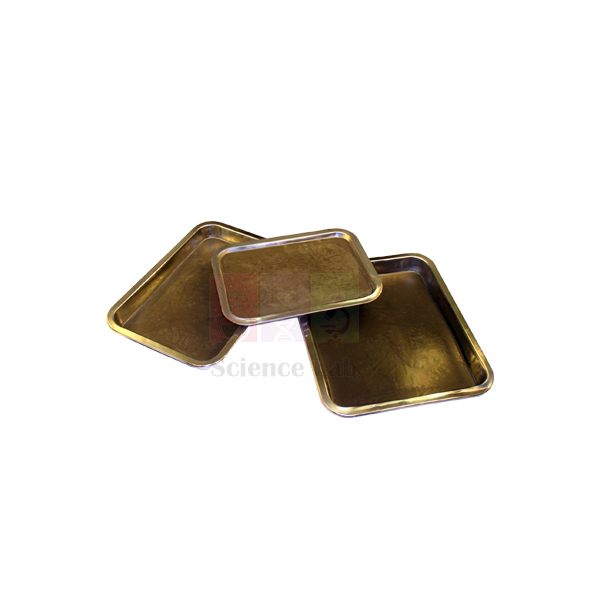
Dissection Pan
Dissection Pan (Product Code: SLE/EDE/11) is a shallow pan with a black wax surface into which specimens are pinned for dissection. The listed size is 26.5 × 19.5 × 2 cm (approx), and the pan is available in three sizes — small, medium and large — so it can be matched to anything from an earthworm to a larger preserved specimen. It is a basic item in any biology lab setup for schools in India and is made by Jain Scientific Equipments Pvt Ltd (ScienceLab), Ambala.
Specifications
| Parameter | Detail |
|---|---|
| Product type | Dissection pan |
| Dissecting surface | Black wax |
| Listed size | 26.5 × 19.5 × 2 cm (approx) |
| Size options | Small, medium and large |
| Suitable for | Pinning and dissecting preserved specimens in teaching laboratories |
Typical Use
The specimen is laid on the wax, pinned at the corners, and opened with scissors or a scalpel; pins pushed into the wax then hold back the body wall so organs can be traced and drawn. The dark background makes pale tissues, nerves and vessels stand out, and the raised edge of the pan keeps water or preservative from running onto the bench. Adding a little water over the specimen during the practical helps float delicate organs apart for easier viewing.
When choosing a dissection tray for school use, consider the specimen size first: a small pan is easy for younger students to handle, while the large size gives room for bigger specimens or group demonstrations. After use, remove pins, rinse the wax surface with cool or lukewarm water and wipe it dry; very hot water can soften wax, so avoid it.
Manufacturer
Jain Scientific Equipments Private Limited produces this pan under its ScienceLab brand at Ambala, Haryana, where it also makes the instruments and accessories that go with it. Visit the company profile to find out more about the company.
Related Dissection Equipment
Items used with a dissection pan in the same practical:
- Dissecting T-Pins — nickel-plated pins that fix the specimen into the wax.
- Dissection Pan, Pad & Cover — an alternative pan supplied with a pad and cover.
- Dissection Replacement Pad — a replacement pinning pad for worn surfaces.
- Dissecting Dishes — stainless steel dishes for organs removed from the pan.
- Dissecting Set, Student — the instruments needed to work on the pinned specimen.
Find more trays, boards and pads in the Dissection Equipment category.
Frequently Asked Questions
Which size do the listed dimensions refer to?
The listing gives 26.5 × 19.5 × 2 cm (approx) and states that small, medium and large sizes are available. Please confirm the dimensions of the size you want through the contact page when requesting a quote.
Why is the wax black?
A dark surface gives strong contrast with pale tissue, so organs, nerves and vessels are easier to see and draw.
What is the pan itself made of?
The listing specifies the black wax surface but not the material of the pan body. Ask us if your specification requires a particular material.
What happens when the wax becomes worn?
Wax gradually fills with pin holes over many practicals. Replacement pads are listed in the range; tell us your pan size and we will advise on a suitable replacement.
How should the pan be cleaned?
Remove every pin, rinse with cool or lukewarm water and a mild detergent, then wipe dry. Avoid very hot water and solvents that could soften or damage the wax.
Can you supply pans for several labs or for export?
Yes. State the sizes and quantities needed and your delivery location; we serve institutions and distributors in India and international markets.
Request a Quote
For a Dissection Pan quotation, share the size and quantity through the contact page or add the pan to the enquiry cart with pins and instruments.
Last updated: 24 September 2026
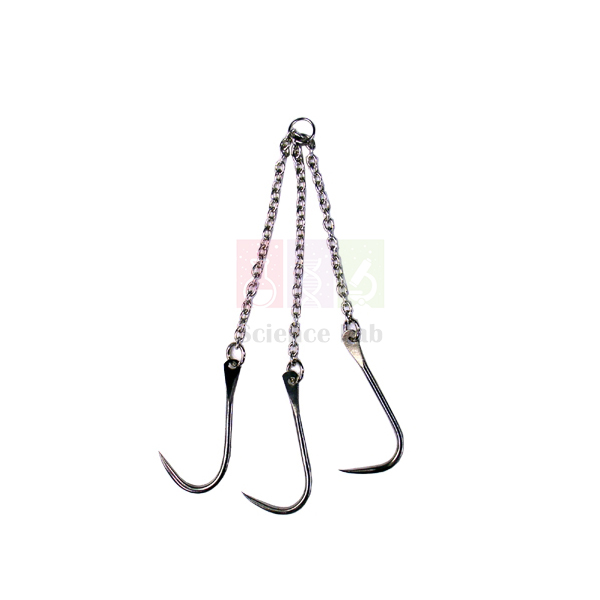
Dissecting Hook & Chain Set
Dissecting Hook & Chain Set (Product Code: SLE/EDE/12) holds specimens in place during dissection using 3 stainless steel hooks that are attached at one end by a loop. Once the body wall is opened, the hooks keep tissue drawn back so the student has both hands free for instruments, and the set is offered in a choice of large or small. It is made by Jain Scientific Equipments Pvt Ltd (ScienceLab), Ambala, a manufacturer and biology lab instruments supplier to schools, colleges and distributors.
Specifications
| Parameter | Detail |
|---|---|
| Product type | Dissecting hook and chain set |
| Hooks | 3 |
| Hook material | Stainless steel |
| Construction | Hooks attached at one end by a loop |
| Sizes | Large or small |
Typical Use
After the first incision, each hook is caught into the edge of the skin or body wall and the common loop is anchored, for example over a pin set into the wax of the pan. The three hooks spread the opening evenly on several sides, exposing organs without the crowd of pins that would otherwise be needed. Teachers find the set especially helpful in demonstrations, where the cavity must stay open while the class gathers round.
Pick the small size for small specimens and fine work, and the large size when more tissue has to be held back. Because the hooks are stainless steel, they can be washed and dried with the rest of the instruments at the end of the lesson. It makes a useful extra in any dissection kit for school biology rooms where students work in pairs.
Manufacturer
The set comes from Jain Scientific Equipments Private Limited, the Ambala, Haryana company behind the ScienceLab brand. The company is registered as an MSME with manufacturing as its main activity (Udyam UDYAM-HR-01-0003714) and holds Importer-Exporter Code AAECJ8618A from the Directorate General of Foreign Trade for its export business. The company profile has further details.
Related Dissection Equipment
These items work together with the hook and chain set:
- Dissection Pan — black wax base into which the specimen and anchor pin are set.
- Dissecting T-Pins — secure the specimen and the loop of the hook set.
- Probe & Hook — a hand-held hook and probe for lifting individual structures.
- Dissecting Board — an alternative base for mounting the specimen.
Browse all tools in the Dissection Equipment category.
Frequently Asked Questions
How many hooks are in the set?
Three stainless steel hooks, attached together at one end by a loop.
Should I order the large or small size?
Choose small for small specimens and delicate work, and large where more tissue must be held back. Exact dimensions are not listed, so please ask through the contact page if you need them.
How is the set anchored during dissection?
The loop is usually secured over a pin in a wax pan or board, while each hook holds back a section of the body wall.
Does it replace dissecting pins?
Not entirely. Pins still fix the specimen to the pan; the hook set retracts tissue so fewer pins are needed around the opening.
How should the hooks be cleaned?
Wash them in warm soapy water, rinse and dry thoroughly, then store the set so the hooks do not tangle with other instruments.
What should I include in a quotation request?
Give code SLE/EDE/12, the size (large or small), quantity and delivery address. We supply buyers across India and international markets.
Request a Quote
Request a price for the Dissecting Hook & Chain Set through our contact page, or add your chosen size to the enquiry cart.
Last updated: 24 September 2026
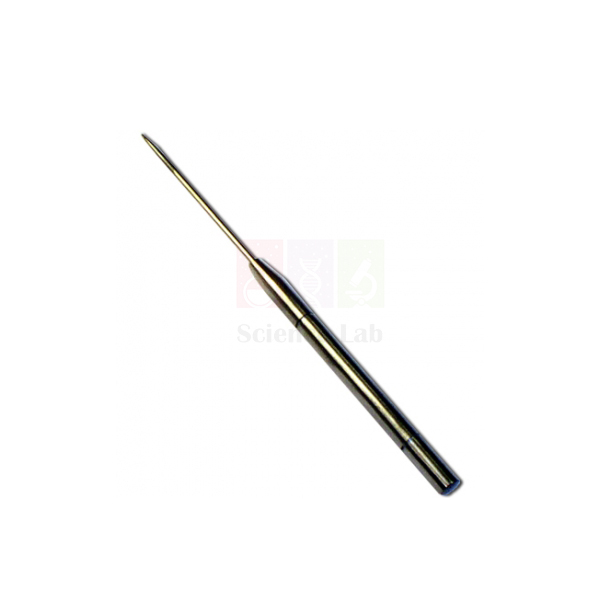
Dissecting Needle
Dissecting Needle (Product Code: SLE/EDE/13) is a sturdy steel needle used to tease apart tissue, separate fibres and lift fine structures during dissection and slide preparation. The listing gives two lengths: 125 mm long, and 130 mm long with handle. Equally at home as zoology or botany lab equipment in India, it is made by Jain Scientific Equipments Pvt Ltd (ScienceLab), Ambala, for school, college and university practicals.
Specifications
| Parameter | Detail |
|---|---|
| Product type | Dissecting needle |
| Material | Steel |
| Build | Sturdy |
| Sizes listed | 125 mm long; 130 mm long (with handle) |
| Suitable for | Teasing tissue, separating fibres and lifting small structures |
Typical Use
In zoology practicals the needle separates muscle bundles, frees nerves from connective tissue and lifts small ducts so they can be identified. On the microscope bench, two needles used together pull a sample apart in a drop of water or stain, which is how students spread plant tissue, separate anthers or tease out fibres before placing a cover slip.
Work with light, short strokes and let the point do the separating rather than forcing it through tissue. Because the needle is steel, dry it immediately after washing and store it dry; a light wipe before putting it away keeps the point clean for the next class. Labs that buy school biology lab equipment in India usually allow two needles per student for teasing work.
Manufacturer
The needle is manufactured by Jain Scientific Equipments Private Limited, which does business as ScienceLab from Ambala in Haryana and supplies teaching institutions with instruments, apparatus and models. The company profile introduces the company in more detail.
Related Dissection Equipment
Other needles and probes that complement this item:
- Dissecting Needle Plastic Handle — a version with a plastic grip for longer sessions.
- Teasing Needle (Probe) — a teasing needle listed in the zoology range.
- Probe, Chrome — a steel teasing probe for tracing structures.
- Needle, Stainless Steel — a stainless steel needle option.
- Dissecting Awl — for piercing tougher material before the needle is used.
The Dissection Equipment category lists all needles, probes and sets.
Frequently Asked Questions
Which lengths are available?
The listing states 125 mm long, and 130 mm long with handle. Mention the length you need in your enquiry so the correct version is quoted.
What is the needle made of?
It is made of steel and described as sturdy, so it resists bending during normal teasing work.
How should it be stored to avoid rust?
Dry it straight after washing and keep it in a dry case or drawer, away from damp cloths and specimen fluids.
How is a needle different from a seeker or probe?
A needle has a point for teasing and separating fine tissue. Blunter seekers and probes are preferred for tracing structures without piercing them, and many students keep both.
Is there a warranty on needles?
Terms are given in our quotation for each order. Contact us through the contact page if you need them documented.
Can you supply class packs or export quantities?
Yes. Send code SLE/EDE/13, the length, quantity and destination; we quote for buyers in India and international markets.
Request a Quote
For Dissecting Needle pricing, use the contact page or add the needle to the enquiry cart together with probes or sets.
Last updated: 24 September 2026
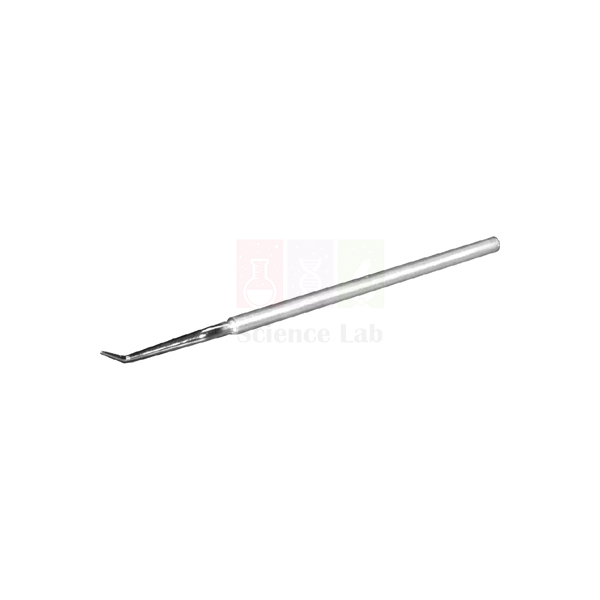
Probe, Chrome
Probe, Chrome (Product Code: SLE/EDE/14) is a teasing needle — also known as a small probe or dissecting needle — made of steel and 140 mm long. It is used to explore an opened specimen, separate layers of tissue and point out structures without cutting them, and it makes a dependable addition to a dissection set for biology students in India. The probe is made by Jain Scientific Equipments Pvt Ltd (ScienceLab), Ambala.
Specifications
| Parameter | Detail |
|---|---|
| Product type | Teasing needle (small probe / dissecting needle) |
| Material | Steel |
| Length | 140 mm |
| Suitable for | Teasing, separating and tracing structures in dissection and slide work |
Typical Use
Once a specimen has been pinned open, the probe is slid beneath a blood vessel, nerve or gut loop to lift it gently away from the surrounding tissue, so students can follow where it goes and label it in their diagrams. Its reach is handy when working deeper inside a body cavity, and the same tool can tease apart a small piece of tissue in a drop of water before a temporary mount is made.
Teachers often use a probe as a pointer during a live demonstration, indicating structures in the pan without disturbing them. Clean it after each class, dry it immediately and keep it apart from blades so the tip is not dulled. As a routine item from a science apparatus manufacturer in India, it is usually ordered in class quantities with forceps and scissors.
Manufacturer
ScienceLab probes are made by Jain Scientific Equipments Private Limited in Ambala, Haryana. Operating under the ScienceLab brand, the company supplies educational and laboratory equipment to institutions, dealers and project buyers; its company profile gives the full picture.
Related Dissection Equipment
Tools that are commonly used alongside this probe:
- Probe & Hook — adds a hook end for lifting and holding structures.
- Teasing Needle (Probe) — another teasing probe from the zoology range.
- Dissecting Needle — a sturdy steel needle for finer teasing.
- Forceps (Tweezers) Bent — curved tweezers to grip what the probe has lifted.
See all probes and instruments in the Dissection Equipment category.
Frequently Asked Questions
Is this a probe or a needle?
It is described as a teasing needle, which is also called a small probe or dissecting needle; the terms are used interchangeably in many labs.
How long is it and what is it made of?
It is 140 mm long and made of steel.
What does “Chrome” in the name refer to?
Chrome is part of the product name. The listing gives the material as steel; if you need details of the surface finish, please ask through the contact page.
Can it be used for slide preparation as well as dissection?
Yes. It can tease tissue apart in a drop of water or stain before the cover slip is placed, as well as tracing structures in an opened specimen.
How should it be cleaned and stored?
Wash, rinse and dry it straight away, then store it in a dry case or tray separate from sharp blades.
Do you supply bulk and export orders?
Yes. Share code SLE/EDE/14, the quantity and destination, and we will quote for delivery in India or international markets.
Request a Quote
To get a price for the Probe, Chrome, send your requirement through the contact page or add it to the enquiry cart.
Last updated: 24 September 2026
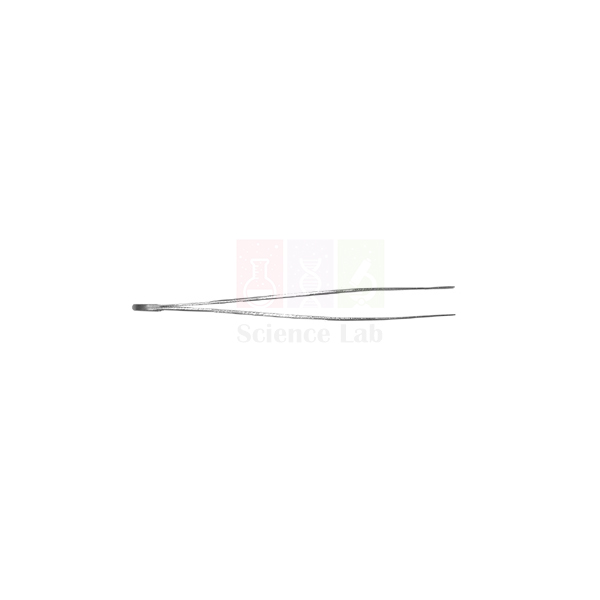
Forceps
Forceps (Product Code: SLE/EDE/15) are compact stainless steel forceps, 114 mm long, with precision ground points that meet cleanly to grip fine tissue, membranes and small specimens without slipping. Their short length gives close control for detailed work at the bench or under a magnifier, making them a handy piece of educational laboratory equipment in India for biology students, lab technicians and teachers. They are made by Jain Scientific Equipments Pvt Ltd (ScienceLab), Ambala.
Specifications
| Parameter | Detail |
|---|---|
| Product type | Forceps |
| Material | Stainless steel |
| Points | Precision ground |
| Length | 114 mm |
| Suitable for | Fine gripping in dissection, specimen handling and slide preparation |
Typical Use
During a dissection these forceps hold a fold of tissue taut while scissors or a scalpel make the cut, then lift away thin membranes to reveal the organs underneath. Because the points are ground to meet accurately, they can pick up very small items — a stained section, a seed, a single insect leg — and place them exactly where needed on a slide or in a dish.
The compact size suits work under a dissecting microscope, where long instruments are awkward to steer in the small field of view. Grip them near the tips for the finest control, keep pressure light, and never use the points as a lever. Wash and dry them after use and store them where the tips are protected, so they are ready for the next practical in a school or college lab.
Manufacturer
Jain Scientific Equipments Private Limited makes these forceps and markets them as ScienceLab from its home in Ambala, Haryana. The company equips teaching and practical laboratories with instruments and apparatus; read its company profile for more background.
Related Dissection Equipment
Instruments that are used with these forceps in the same work:
- Forceps (Tweezers) — longer fine-point tweezers for general picking and peeling.
- Forceps (Tweezers) Bent — a curved tip for reaching around structures.
- Scalpel — the cutting partner while the forceps hold tissue taut.
- Forceps, Nylon — a non-metal alternative for handling sensitive samples.
- Dissecting Microscope — magnification for the fine work these forceps are suited to.
More instruments are in the Dissection Equipment category.
Frequently Asked Questions
How long are these forceps?
They are 114 mm long, made of stainless steel.
What does “precision ground points” mean in practice?
The tips are finished so they close accurately against each other, which lets them hold small or thin items securely without crushing or dropping them.
When should I choose these instead of longer tweezers?
Pick these compact forceps for close, controlled work at the bench or under magnification; a longer pair gives more reach into deep containers or cavities.
How do I keep the points aligned?
Avoid dropping the forceps or using them to pry, and store them with the tips protected. Misaligned tips lose their grip on fine material.
What warranty applies?
Warranty terms are included in each quotation. Ask us through the contact page for details before you order.
Can you quote for institutions and distributors?
Yes. Send code SLE/EDE/15 with the quantity and delivery location; we supply buyers in India and international markets.
Request a Quote
Ask for Forceps pricing via the contact page, or add them to the enquiry cart along with the rest of your instrument list.
Last updated: 24 September 2026
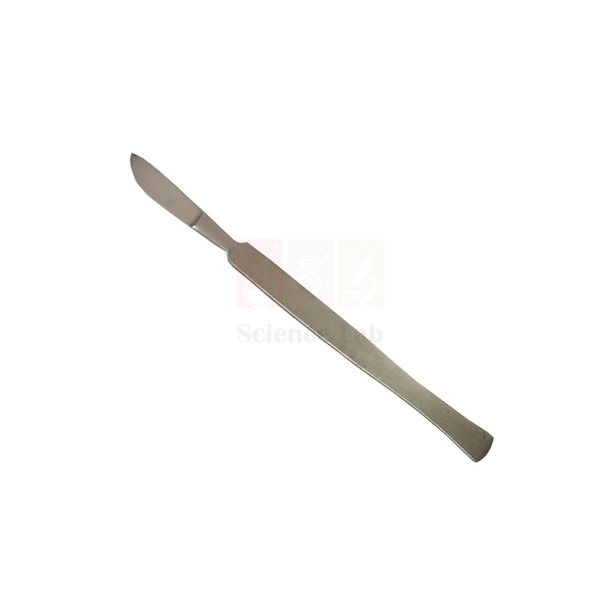
Scalpel
Scalpel (Product Code: SLE/EDE/16) is a stainless steel cutting instrument with a 1.5" blade and an overall length of about 6". It makes the clean, controlled incisions that open a specimen, cut through membranes and trim plant material, and it is used by students, teachers and technicians in school and college practicals. The scalpel is made by Jain Scientific Equipments Pvt Ltd (ScienceLab), Ambala, a scientific laboratory equipment manufacturer serving India and international markets.
Specifications
| Parameter | Detail |
|---|---|
| Product type | Scalpel |
| Material | Stainless steel |
| Blade | 1.5" |
| Overall length | 6" (approx) |
| Suitable for | Incisions and trimming in dissection and plant anatomy practicals |
Typical Use
The scalpel is held like a pencil for fine cuts, with the index finger resting on the back of the handle to steady the blade. In an animal dissection it makes the first shallow incision through the skin, frees organs from connective tissue and cuts neatly where scissors would tear. In plant work it slices stems, fruits and seeds in half so internal structures can be drawn and compared.
To keep the edge sharp, cut only on a wax pan, board or pad rather than on glass or metal. Pass the scalpel handle first, cut away from the body and put it down with the blade facing away from the user; after the practical, clean it carefully by holding the back of the blade and dry it before storage. It is one of the core items teachers list when ordering zoology lab equipment for a new batch of students.
Manufacturer
ScienceLab scalpels are made by Jain Scientific Equipments Private Limited in Ambala, Haryana, the company that owns the ScienceLab trading name. For institutional and tender buyers who need vendor registration details, it is a GST-registered business in Haryana (GSTIN 06AAECJ8618A1ZT) and holds the global Legal Entity Identifier 3358004HRD1JIVXKYX49. Visit the company profile for more.
Related Dissection Equipment
Items commonly used with a scalpel in dissection work:
- Scalpel Handle no.3 — a handle for detachable blades, if you prefer that style.
- Forceps — hold tissue taut while the scalpel cuts.
- Dissection Pan — black wax surface that protects the edge during cutting.
- Dissecting Board — a firm base for trimming plant material.
- Dissecting Set, Large — a cased set that includes scalpels with other instruments.
All cutting tools and sets are listed under Dissection Equipment.
Frequently Asked Questions
What are the blade and overall lengths?
The blade is 1.5" and the scalpel is about 6" long overall, made of stainless steel.
Does it take replaceable blades?
The listing does not state a blade-fitting system. If you want detachable blades, ask us through the contact page or consider a numbered scalpel handle with blades.
How can students use it safely?
Teach them to pass it handle first, cut away from the body and fingers, and never leave it hidden under paper towels or specimens. Collect and count scalpels at the end of each practical.
How do I keep the edge sharp?
Cut only on wax, a board or a pad, never on glass or metal trays, and store the scalpel so the blade does not rub against other instruments.
Which registration details can you provide for vendor onboarding?
Our GSTIN and LEI are given above; send any further vendor-form requirements with your enquiry and we will respond with the quotation.
Do you supply large or overseas orders?
Yes. Share code SLE/EDE/16, the quantity and destination; we serve schools, colleges and distributors in India and international markets.
Request a Quote
For a Scalpel quotation, write to us via the contact page or add the item to the enquiry cart with forceps, pans and other instruments.
Last updated: 24 September 2026
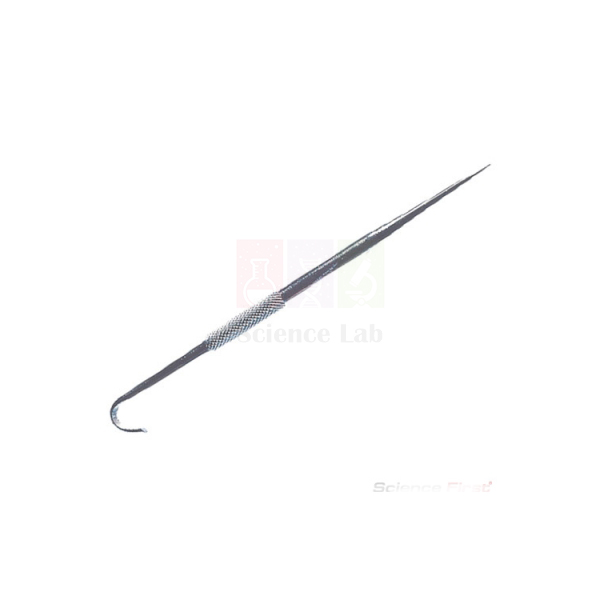
Probe & Hook
The Probe & Hook (Product Code: SLE/EDE/17) is a chrome plated steel dissecting probe with a hook on one end, 6 inches in length. Students use it to lift, separate and hold back soft tissue during practical dissections without cutting it, which is why a probe of this kind is a routine item in school biology lab equipment in India. It is manufactured by Jain Scientific Equipments Pvt Ltd (ScienceLab), Ambala, for schools, colleges and teacher-training laboratories.
Specifications
| Parameter | Detail |
|---|---|
| Type | Dissecting probe with hook |
| Material | Chrome plated steel |
| Hook | On one end of the probe |
| Length | 6 inches |
Typical Use
During a dissection the shaft is run along the natural divisions between organs to free connective tissue, to follow the course of a blood vessel or nerve, or to point out a structure to the class without damaging it. The hooked end catches a membrane or a flap of skin and draws it aside, so the region underneath stays in view while it is pinned, sketched or labelled. Because it is not a cutting tool, it is a safer first instrument for younger students than a scalpel.
As part of zoology lab equipment in India the probe and hook is usually issued alongside forceps and dissecting pins, and it is just as handy for opening up flowers or other plant material in botany practicals. After each session rinse off tissue and preservative, wash in mild detergent and dry the probe completely before storage; avoiding long soaks in water or harsh disinfectants helps protect the chrome plating.
Manufacturer
This probe is produced by Jain Scientific Equipments Private Limited, the company behind the ScienceLab brand, which makes dissection instruments and other teaching apparatus in Ambala, Haryana, India, for schools and colleges in India and international markets. Read more about the business in our company profile.
Related Dissection Equipment
Items commonly used alongside the probe and hook at the same dissection bench:
- Probe, Chrome — a chrome probe without a hook, for general tracing work
- Dissecting Hook & Chain Set — for keeping tissue retracted during longer dissections
- Forceps (Tweezers) — to grip tissue while the probe separates it
- Dissecting T-Pins — to fix the specimen and hold structures drawn aside by the hook
- Dissection Pan — a working surface to hold the specimen
See the complete Dissection Equipment range for instruments, sets, pans and boards.
Frequently Asked Questions
What is the Probe & Hook made of, and how long is it?
It is made of chrome plated steel and measures 6 inches in length, with a hook on one end.
Can it be used to cut tissue?
No. It is meant for lifting, separating and holding tissue aside; make incisions with a scalpel first, then use the probe to open up the structures.
How is the hook used in practice?
Slip the hook under a membrane or organ and draw it gently to one side so the structures beneath are exposed; pin the retracted tissue if it needs to stay in place.
How should it be cleaned and stored?
Wash off tissue and preservative, rinse, and dry thoroughly before storage. Avoid abrasive scrubbing and long soaks, which can wear or dull the plating.
Is it part of a dissecting set?
This listing is for the probe and hook as an individual instrument. Complete kits are listed in our dissection range, or contact us to check which instruments a particular set contains.
Is there a warranty?
Warranty terms are confirmed with each quotation; please contact us for details.
Can you supply class quantities or export orders?
Yes. We supply schools, colleges and distributors across India and international markets; share the product code SLE/EDE/17, the quantity and the delivery location when you enquire.
Request a Quote
To order the Probe & Hook for your laboratory, send your requirement through our contact page or add it to the enquiry cart together with any other dissection equipment you need, and we will reply with a quotation.
Last updated: 24 September 2026
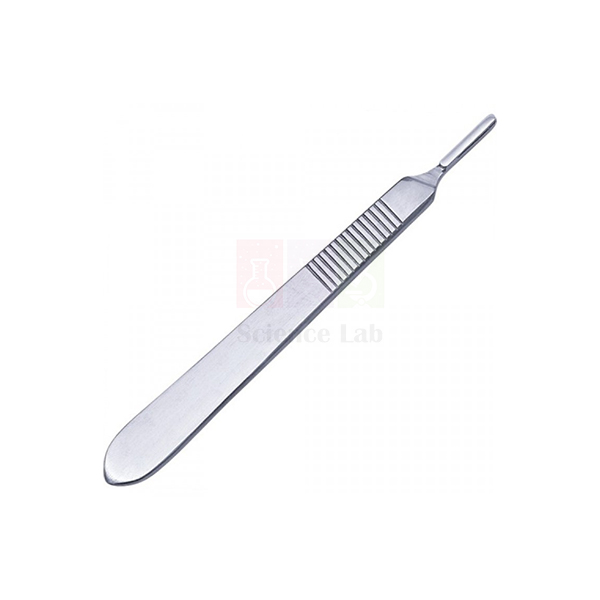
Scalpel Handle no.3
The Scalpel Handle no.3 (Product Code: SLE/EDE/18) is a stainless steel BP handle — the reusable holder into which detachable surgical blades are fitted. At 125mm long it gives a steady grip for controlled incisions in school, college and teacher-training dissections, and because only the blade is changed when it dulls, one handle can serve a laboratory for many practical sessions. It is made by Jain Scientific Equipments Pvt Ltd (ScienceLab) in Ambala and offered by the company as a biology lab equipment supplier in India.
Specifications
| Parameter | Detail |
|---|---|
| Type | BP scalpel handle, No.3 |
| Function | Holds surgical blades |
| Length | 125mm |
| Material | Stainless steel |
| Blades | Not listed as part of this item — confirm when enquiring |
Typical Use
A detachable-blade handle is the standard choice when a lab wants a sharp, consistent cutting edge for every class without regrinding fixed blades. The blade is slid onto the fitting at the tip of the handle and removed the same way; both steps should be done with forceps or a blade remover rather than fingers, with the cutting edge pointed away from the body. Hold the handle like a pencil for fine cuts through skin and body wall, and let the blade do the work rather than pressing hard.
When building a dissection set for biology in India, many teachers keep a few spare handles so that blades can be fitted before the lesson and removed safely afterwards. Used blades belong in a sharps container, never in general waste. Wash the handle in warm soapy water, rinse and dry it completely, and store it with no blade attached.
Manufacturer
Jain Scientific Equipments Private Limited manufactures this handle under its ScienceLab trade name at Ambala, Haryana, a long-standing centre for scientific instrument making in India. Our company profile describes the business and the laboratory ranges it produces.
Related Dissection Equipment
Useful companions for a detachable-blade scalpel handle:
- Scalpel, Stainless Steel — a complete stainless steel scalpel for students who need a ready-to-use instrument
- Scalpel — another scalpel option in the same dissection range
- Forceps — for fitting and removing blades safely and for holding tissue while cutting
- Dissecting Board — a firm surface to cut on
- Gloves W/o Powder Nitrile Disposable — hand protection while handling blades and specimens
Browse all instruments, sets and trays in our Dissection Equipment category.
Frequently Asked Questions
Are surgical blades included with the handle?
Blades are not listed as part of this item. If you need blades with the handles, mention it in your enquiry through our contact page and we will advise what can be supplied.
What size and material is the handle?
It is 125mm long and made of stainless steel.
Which blades fit a No.3 handle?
The handle is a No.3 BP pattern designed to hold surgical blades. Please check the blade numbers you already stock with us before ordering, so we can confirm compatibility.
How do I change a blade safely?
Grip the blade with forceps, not fingers, keep the edge facing away from you, and slide it on or off the fitting in a single controlled movement. Dispose of old blades in a sharps container.
How should the handle be cleaned?
Remove the blade first, then wash the handle in warm soapy water, rinse and dry it completely. If your lab follows a particular sterilisation routine, ask us for guidance before using it.
What information do you need for an institutional quotation?
Send the product code SLE/EDE/18, the number of handles, whether blades are required and the delivery address; we will quote for delivery within India or to international markets.
Request a Quote
Ready to equip your dissection bench? Use the contact form or place the Scalpel Handle no.3 in your enquiry cart, and our team will send a quotation with availability.
Last updated: 24 September 2026