- Physics Lab Equipment
- Chemistry Lab Equipment
- Biology Lab Equipment
- Anatomical Lab Equipment
- Learning
- Educational Lab Equipment
- Magnets
- Agriculture
- Astronomy
- Earth Science
- Geography Lab Equipment
- Safety Lab Coat
- Laboratory
- Meteorological
- Electricity & Magnetism
- Heat
- School Lab Equipment
- Lab Glassware
- Science Lab Equipment
- Tvet Lab Equipment
- Robotics Kits Supplier and Manufacturer for Schools India
- Math Lab Equipment Manufacturers and Exporters in Ambala
- STEM Kits Manufacturers and Supplier India
- Engineering Lab Equipment
- Hospital Lab Equipment
- Water, Sanitation & Hygiene Supplies
- Cold Chain, Solar & Communication Equipment
- Nutrition
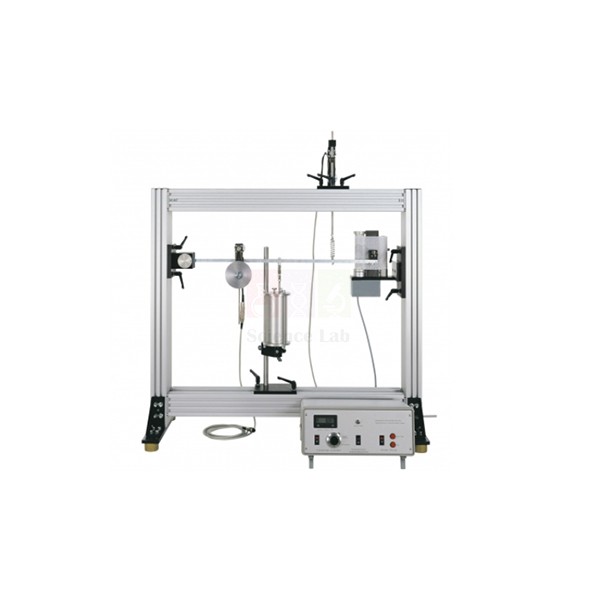
Free and Forced Vibration Apparatus
Free and Forced Vibration Apparatus (Product Code: SLE/MCE/76) is a vibration trainer used to study free, damped and forced mechanical vibration of a bar-type oscillator in mechanical engineering laboratories. Its electronically controlled exciter runs from 0 to 50 Hz, an oil-filled hydraulic damper gives adjustable damping, and a mechanical drum recorder traces each response on paper. It is made by Jain Scientific Equipments Pvt Ltd (ScienceLab), an OEM manufacturer, at its own factory in Ambala, India.
Specifications
| Parameter | Detail |
|---|---|
| Topics | Fundamentals of mechanical vibration theory: free, damped and forced |
| Bar-type oscillator (L x W x H) | 700 x 25 x 12 mm, 1.6 kg |
| Coil springs | 0.75 N/mm, 1.5 N/mm, 3.0 N/mm |
| Exciter frequency | 0–50 Hz, electronically controlled; set and displayed on a control unit |
| Imbalance exciter | Imbalance 0–1000 mmg |
| Displacement exciter | Stroke 20 mm |
| Damper | Oil hydraulic, oil-filled; damper constant 5–15 Ns/m, adjustable damping level |
| Drum recorder | Mechanical; feed 20 mm/s; paper width 100 mm |
| Data acquisition | Optional unit for displaying and analysing measured values on a PC |
| Dimensions | 1200 x 600 x 1400 mm |
| Weight | 125 kg |
| Power supply | 230 V, 50 Hz, 1 phase; or 230 V, 60 Hz, 1 phase; or 120 V, 60 Hz, 1 phase |
| Product code | SLE/MCE/76 |
| Manufacturer | Jain Scientific Equipments Pvt Ltd (ScienceLab) — OEM |
| Country of origin | India (made in Ambala, Haryana) |
What Is the Free and Forced Vibration Apparatus Used For?
The bar-type oscillator works together with interchangeable coil springs and, depending on the experiment, is left to vibrate freely, slowed by the oil damper, or driven by one of the two exciters. In free vibration tests, students displace the bar, release it and use the drum recorder trace to find the natural frequency; with the damper connected, the decay of successive peaks gives the logarithmic decrement and damping ratio. Changing between the 0.75, 1.5 and 3.0 N/mm springs shows how stiffness shifts the natural frequency.
For forced vibration, the control unit sets the excitation frequency up to 50 Hz, driving the bar through either the imbalance exciter (0–1000 mmg) or the displacement exciter (20 mm stroke). Stepping through the range and recording amplitude reveals resonance, and repeating the sweep at several damper settings shows how damping flattens the resonance peak. This makes the unit core engineering lab equipment for dynamics of machinery courses in India; let the exciter settle at each frequency before taking a trace.
What to Specify When Ordering
- Power supply version: 230 V 50 Hz, 230 V 60 Hz or 120 V 60 Hz, single phase
- Whether the optional data acquisition unit for PC display and analysis is required
- Spare 100 mm recorder paper for the drum recorder, if needed (ask us)
- Quantity and delivery location in India or abroad
OEM Manufacturer
This vibration trainer is manufactured by ScienceLab as the OEM. Jain Scientific Equipments Private Limited, whose trading name is ScienceLab, produces it at its own licensed factory at Saha, Ambala, Haryana, India, and quotes it directly to universities, engineering colleges, dealers and importers.
With the manufacturer as your single point of contact, questions on the power supply version, the optional data acquisition unit, or spares for the recorder and damper are answered by the people who build the unit. Visit the company profile for more about ScienceLab.
Related Theory of Machines Equipment
Apparatus that complements this trainer in a vibrations and dynamics laboratory:
- Free And Forced Vibrations — a further apparatus on the same topic for additional student groups.
- Damper Kit — for additional damping experiments.
- Vibration Of Spiral Spring Apparatus — torsional free vibration of a spiral spring.
- Free Vibrations Test Frame — a test frame for free vibration experiments.
The Theory of Machines category lists further vibration, balancing and mechanism equipment.
Frequently Asked Questions
What types of vibration can be studied on the Free and Forced Vibration Apparatus?
The Free and Forced Vibration Apparatus covers the fundamentals of mechanical vibration theory: free vibration, damped vibration using an adjustable oil hydraulic damper, and forced vibration driven by an electronically controlled exciter from 0 to 50 Hz.
Which springs does the Free and Forced Vibration Apparatus use?
The Free and Forced Vibration Apparatus lists three coil springs rated 0.75 N/mm, 1.5 N/mm and 3.0 N/mm. Changing the spring changes the natural frequency of the bar-type oscillator, which measures 700 x 25 x 12 mm and weighs 1.6 kg.
How are results recorded on the Free and Forced Vibration Apparatus?
The Free and Forced Vibration Apparatus records vibrations on a mechanical drum recorder with 20 mm/s feed and 100 mm paper width. An optional data acquisition unit lets measured values be displayed and analysed on a PC; ask us whether to include it in your quotation.
What power supply does the Free and Forced Vibration Apparatus need?
The Free and Forced Vibration Apparatus runs on single-phase power in one of three versions: 230 V 50 Hz, 230 V 60 Hz or 120 V 60 Hz. State your mains supply when ordering so that the matching version is quoted.
How much space does the Free and Forced Vibration Apparatus need?
The Free and Forced Vibration Apparatus measures 1200 x 600 x 1400 mm and weighs 125 kg. Plan a fixed position near a power outlet with enough room around it for a group of students to watch the recorder.
Who manufactures the Free and Forced Vibration Apparatus?
The Free and Forced Vibration Apparatus is manufactured by Jain Scientific Equipments Pvt Ltd (ScienceLab), the OEM, at its own licensed factory at Saha, Ambala, Haryana, India. Buyers deal with the manufacturer directly for quotations and spares.
Request a Quote
For a quotation on the Free and Forced Vibration Apparatus (SLE/MCE/76), tell us your power supply version, quantity and delivery location through the contact page, or add it to the enquiry cart. The quote comes direct from the manufacturer.
Last updated: 24 September 2026
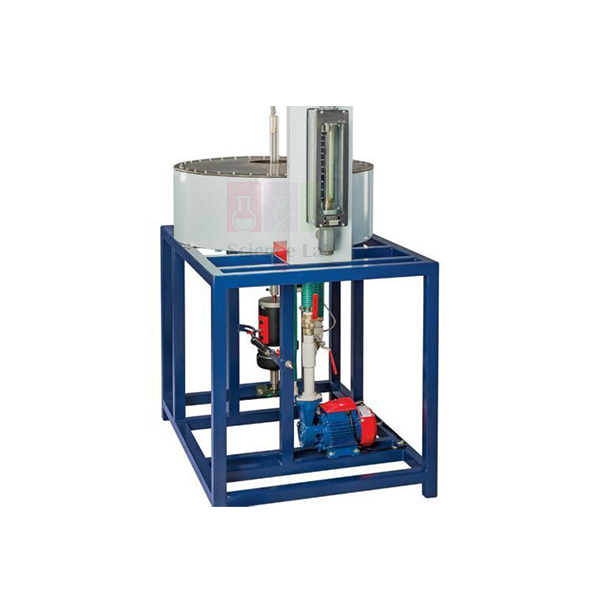
Corollis Component of Acceleration Apparatus
Corollis Component of Acceleration Apparatus (Product Code: SLE/MCE/77) is a self-contained water-jet rig used to determine the Coriolis component of acceleration at different rotation speeds and water flow rates in theory of machines laboratories. Water leaves rotating arms with 9 mm and 6 mm orifice diameters, while a 250–2500 LPH rotameter shows the flow and a variable-speed swinging-field motor sets the speed. It is made by Jain Scientific Equipments Pvt Ltd (ScienceLab), an OEM manufacturer, at its own factory in Ambala, India.
Specifications
| Parameter | Detail |
|---|---|
| Water tank | Stainless steel |
| Rotating arms | 9 mm / 6 mm orifice diameter, length 300 mm |
| Rotameter | 250 to 2500 LPH |
| Electric motor | Swinging field type, variable speed, with its own speed control unit |
| Pump | FHP (fractional horsepower) pump for water circulation |
| Water circuit | Self-contained, water re-circulating |
| Frame | Powder-coated rigid structure |
| Dimensions | 800 x 800 x 1200 mm |
| Weight | 115 kg |
| Power supply | 230 V, 50 Hz, 1 phase; or 230 V, 60 Hz, 1 phase; or 120 V, 60 Hz, 1 phase |
| Product code | SLE/MCE/77 |
| Manufacturer | Jain Scientific Equipments Pvt Ltd (ScienceLab) — OEM |
| Country of origin | India (made in Ambala, Haryana) |
What Is the Coriolis Acceleration Apparatus Used For?
When a body moves outward along a link that is itself rotating, it gains an extra acceleration at right angles to the link, equal to twice the product of the angular velocity and the sliding velocity. This is the Coriolis component, a key idea in the kinematics of slotted-link and quick-return mechanisms. In this apparatus the moving body is water flowing out along the rotating arms, which makes the effect measurable in a classroom.
A typical session holds the flow steady on the rotameter, runs the arms at several speeds with the speed control unit, then repeats at other flow rates, so students see how the component depends on both angular velocity and flow velocity and compare their results with theory. Because the tank, pump and arms form a closed re-circulating circuit on one powder-coated frame, the rig needs no water supply line, which suits engineering lab equipment rooms in India and abroad. Check the water level before each run and raise the speed gradually.
What to Specify When Ordering
- Power supply version: 230 V 50 Hz, 230 V 60 Hz or 120 V 60 Hz, single phase
- Number of units required
- Delivery location, so that the quotation matches your destination
OEM Manufacturer
ScienceLab builds this rig as the OEM. Its legal entity, Jain Scientific Equipments Private Limited, manufactures the Corollis Component of Acceleration Apparatus at its own licensed factory at Saha, Ambala, Haryana, and supplies it directly to engineering institutions, laboratory dealers and importers, with no trading intermediary in between.
For vendor files, the company is registered as an MSME enterprise whose major activity is manufacturing (Udyam UDYAM-HR-01-0003714), and overseas orders ship under DGFT Importer-Exporter Code AAECJ8618A. Learn more on the ScienceLab profile.
Related Theory of Machines Equipment
Other apparatus for rotating systems and the flow measurement behind this experiment:
- Flow Meter Demonstration Unit — explains the flow measurement principles behind the rotameter reading.
- Governor — another speed-dependent rotating mechanism in the same course.
- Gyroscope Experiment Manual — gyroscopic effects, a further topic in rotating-frame dynamics.
- Static and Dynamic Balancing Apparatus — inertia forces of rotating masses.
Find more equipment in the Theory of Machines category.
Frequently Asked Questions
What does the Corollis Component of Acceleration Apparatus measure?
The Corollis Component of Acceleration Apparatus is used to determine the Coriolis component of acceleration at various speeds of rotation and water flow rates, so students can compare their measured results with the theoretical value from angular velocity and flow velocity.
What flow range does the Corollis Component of Acceleration Apparatus cover?
The Corollis Component of Acceleration Apparatus has a rotameter reading from 250 to 2500 LPH (litres per hour). The water leaves rotating arms that have 9 mm and 6 mm orifice diameters and a length of 300 mm.
Does the Corollis Component of Acceleration Apparatus need a water connection?
No water line is listed: the Corollis Component of Acceleration Apparatus is self-contained and water re-circulating, with its own stainless steel tank, speed control unit and FHP circulating pump. Fill the tank before use and connect single-phase power.
What power supply does the Corollis Component of Acceleration Apparatus need?
The Corollis Component of Acceleration Apparatus needs single-phase power in one of three versions: 230 V 50 Hz, 230 V 60 Hz or 120 V 60 Hz. Tell us which supply your laboratory uses so that the correct version is quoted.
How big is the Corollis Component of Acceleration Apparatus?
The Corollis Component of Acceleration Apparatus measures 800 x 800 x 1200 mm and weighs 115 kg on a powder-coated rigid structure. Allow floor space for the unit plus room for students to read the rotameter safely.
Who manufactures the Corollis Component of Acceleration Apparatus?
The Corollis Component of Acceleration Apparatus is manufactured by Jain Scientific Equipments Pvt Ltd (ScienceLab), the OEM, at its own licensed factory at Saha, Ambala, Haryana, India. Quotations and spares requests are handled by the manufacturer itself.
Request a Quote
To price the Corollis Component of Acceleration Apparatus (SLE/MCE/77), send your power supply version, quantity and destination through the contact page, or add it to the enquiry cart. You receive the quotation directly from the manufacturer.
Last updated: 24 September 2026
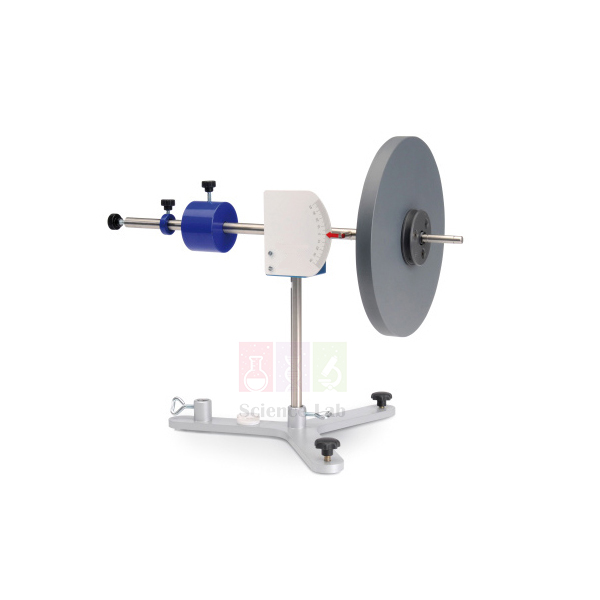
Gyroscope Experiment Manual
Gyroscope Experiment Manual (Product Code: SLE/MCE/78) is a hand-spun gyroscope apparatus used to demonstrate precession and the gyroscopic couple in theory of machines and physics laboratories. A 250 mm, 1500 g disc runs on dual ball bearings at one end of a tilting shaft, balanced by a movable 1400 g counterweight, and the shaft angle is read on a scale from -40° to +40°. It is made by Jain Scientific Equipments Pvt Ltd (ScienceLab), an OEM manufacturer, at its own factory in Ambala, India.
Specifications
| Parameter | Detail |
|---|---|
| Construction | Open design; shaft that can be tilted and rotated, attached to a stand rod |
| Disc | 250 mm diameter, 1500 g, on dual ball bearings |
| Counterweight | 1400 g, movable, for establishing equilibrium |
| Additional weight | 50 g |
| Inclination scale | -40° to +40°, 1° divisions |
| Levelling | Spirit level for adjusting the gyroscope to the horizontal |
| Fine adjustment | Thumbscrew at the end of the shaft |
| Disc drive | By hand or by means of a cord |
| Dimensions | 400 x 300 x 400 mm |
| Weight | 15 kg |
| Product code | SLE/MCE/78 |
| Manufacturer | Jain Scientific Equipments Pvt Ltd (ScienceLab) — OEM |
| Country of origin | India (made in Ambala, Haryana) |
What Is the Gyroscope Experiment Apparatus Used For?
With the disc at rest, students first use the movable counterweight, the spirit level and the thumbscrew to balance the shaft horizontally. They then spin the disc by hand or with the cord and apply the 50 g additional weight to unbalance the shaft: instead of simply dropping, the shaft swings slowly around the vertical axis. This precession is the classic gyroscopic effect, and timing it against the disc speed lets the class compare observed precession with the value predicted from the disc's angular momentum.
Because the dual ball bearings keep the rotation nearly frictionless, the disc keeps turning for long periods, leaving time for several readings from one spin. The open construction lets a whole group watch the shaft's motion, while the inclination scale records how far the shaft tilts. The apparatus links physics lab equipment in India for angular momentum with engineering cases such as the gyroscopic couple on ships, aircraft and vehicles taking a turn.
OEM Manufacturer
ScienceLab is the original equipment manufacturer of this gyroscope. Jain Scientific Equipments Private Limited, known to buyers as ScienceLab, makes it at its own licensed factory at Saha, Ambala, Haryana, India, and dispatches it factory-direct to schools, colleges, dealers and importers.
Queries on repeat orders, or on replacement parts such as the cord or weights, come straight to the maker; ask us for details. The ScienceLab company profile has more about the company.
Related Theory of Machines Equipment
Useful companions for angular momentum and rotating-system experiments:
- Gyroscope — a physics-lab gyroscope for introductory demonstrations.
- Rotational Moment of Inertia Apparatus — measures the moment of inertia that sets a disc's angular momentum.
- Stopwatch, Digital — times the precession of the shaft.
- Corollis Component of Acceleration Apparatus — another rotating-system effect in the same course.
Browse the Theory of Machines category for related trainers.
Frequently Asked Questions
Is the Gyroscope Experiment Manual a printed manual?
No. The Gyroscope Experiment Manual listed here is a gyroscope apparatus with a disc, counterweight and inclination scale, and its disc is set rotating by hand or with a cord. If you also need written experiment instructions, ask us through the contact page.
What are the disc details of the Gyroscope Experiment Manual?
The Gyroscope Experiment Manual has a disc of 250 mm diameter and 1500 g mass, mounted on dual ball bearings so that rotation is nearly frictionless. A 1400 g counterweight and a 50 g additional weight are also listed.
How is the Gyroscope Experiment Manual balanced before a test?
The Gyroscope Experiment Manual is balanced by moving the counterweight along the shaft, checking the horizontal position with the built-in spirit level and making the final correction with the thumbscrew at the end of the shaft.
What tilt range does the Gyroscope Experiment Manual scale show?
The inclination scale on the Gyroscope Experiment Manual reads from -40° to +40° in 1° divisions, so students can record how far the shaft tilts during precession experiments and when weights are added.
How large is the Gyroscope Experiment Manual?
The Gyroscope Experiment Manual measures 400 x 300 x 400 mm and weighs 15 kg. It stands on a laboratory bench, and its open construction lets students watch the gyroscopic motion clearly from around the table.
Who manufactures the Gyroscope Experiment Manual?
The Gyroscope Experiment Manual is manufactured by Jain Scientific Equipments Pvt Ltd (ScienceLab), the OEM, at its own licensed factory at Saha, Ambala, Haryana, India. Quotations for India and international markets come directly from the manufacturer.
Request a Quote
For a price on the Gyroscope Experiment Manual (SLE/MCE/78), contact us through the contact page or add it to the enquiry cart, stating quantity and delivery location. The manufacturer prepares your quotation directly.
Last updated: 24 September 2026
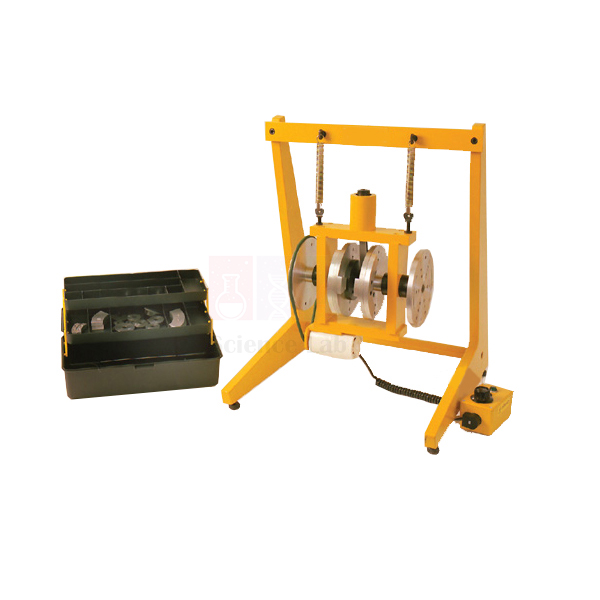
Static and Dynamic Balancing Apparatus
Static and Dynamic Balancing Apparatus (Product Code: SLE/MCE/79) is a rotating-shaft trainer used to show the difference between static and dynamic imbalance and to practise balancing rotating masses in theory of machines laboratories. Four imbalance masses attach to a smooth shaft at any angular and longitudinal position, and a variable-speed motor with belt drive turns the shaft up to 1400 rpm with a digital speed display. It is made by Jain Scientific Equipments Pvt Ltd (ScienceLab), an OEM manufacturer, at its own factory in Ambala, India.
Specifications
| Parameter | Detail |
|---|---|
| Main element | Smooth shaft mounted on ball bearings |
| Imbalance masses | 4, attachable at any angular and longitudinal position |
| Total imbalance | 880 cmg |
| Drive | Variable-speed electric motor with belt drive |
| Speed measuring range | 0–1400 min⁻¹ (rpm), displayed digitally |
| Guard | Transparent cover against contact with rotating parts, with a clear view of the shaft |
| Dimensions | 600 x 300 x 600 mm |
| Weight | 32 kg |
| Power supply | 230 V, 50 Hz, 1 phase; or 230 V, 60 Hz, 1 phase; or 120 V, 60 Hz, 1 phase |
| Product code | SLE/MCE/79 |
| Manufacturer | Jain Scientific Equipments Pvt Ltd (ScienceLab) — OEM |
| Country of origin | India (made in Ambala, Haryana) |
What Is the Static and Dynamic Balancing Apparatus Used For?
A rotor is statically balanced when it stays put in any angular position, yet it can still shake when it spins if its masses lie in different planes along the shaft; that is dynamic imbalance. On this unit, students first arrange the four imbalance masses so the shaft rests in any position, comparing the moment they produce about the shaft with the moment of the imbalance masses. They then run the motor and see whether the shaft turns smoothly or vibrates, which shows why static balance alone is not enough.
The usual exercise is to calculate the angular and axial positions of the masses by the graphical or analytical method taught in dynamics of machinery, set them on the shaft, and confirm the result by running at increasing speed on the digital display. Close the transparent cover before starting the motor and tighten every mass securely. For colleges building a set of mechanics lab equipment in India, it pairs naturally with whirling-of-shaft and vibration apparatus.
OEM Manufacturer
The Static and Dynamic Balancing Apparatus is produced by ScienceLab as the OEM. Jain Scientific Equipments Private Limited, which operates under the ScienceLab name, manufactures it at its own licensed factory at Saha, Ambala, Haryana, India, so universities, polytechnics, laboratory suppliers and importers can buy straight from the source.
Repeat orders and requests for spare imbalance masses or a replacement drive belt are handled by the manufacturer itself; ask us. More information is on the ScienceLab company profile.
Related Theory of Machines Equipment
Rotating-shaft apparatus often installed in the same dynamics laboratory:
- Whirling of Shaft Apparatus — critical speeds of slender rotating shafts.
- Free and Forced Vibration Apparatus — the forced vibration that an unbalanced rotor produces.
- Journal Bearing Demonstration — how shafts are supported in bearings.
See all apparatus in the Theory of Machines category.
Frequently Asked Questions
What does the Static and Dynamic Balancing Apparatus demonstrate?
The Static and Dynamic Balancing Apparatus demonstrates the difference between static and dynamic imbalance on a rotating shaft, and lets students balance four masses by calculation before checking the result with the shaft running under motor drive.
How many imbalance masses does the Static and Dynamic Balancing Apparatus have?
The Static and Dynamic Balancing Apparatus has four variable imbalance masses with a total imbalance of 880 cmg. Each mass can be attached to the smooth shaft at any angular and longitudinal position.
What speed range does the Static and Dynamic Balancing Apparatus cover?
The Static and Dynamic Balancing Apparatus runs from 0 to 1400 min⁻¹ (rpm). A variable-speed electric motor drives the shaft through a belt, and the shaft speed is displayed digitally for each test.
How are students protected on the Static and Dynamic Balancing Apparatus?
The Static and Dynamic Balancing Apparatus has a transparent cover that protects against contact with the rotating parts while leaving a clear view of the shaft. Keep the cover closed whenever the motor is running.
What power supply and space does the Static and Dynamic Balancing Apparatus need?
The Static and Dynamic Balancing Apparatus is offered for 230 V 50 Hz, 230 V 60 Hz or 120 V 60 Hz single-phase supply. It measures 600 x 300 x 600 mm and weighs 32 kg, so it fits on a sturdy bench.
Who manufactures the Static and Dynamic Balancing Apparatus?
The Static and Dynamic Balancing Apparatus is manufactured by Jain Scientific Equipments Pvt Ltd (ScienceLab), the OEM, at its own licensed factory at Saha, Ambala, Haryana, India. Orders from India and international markets are quoted directly by the manufacturer.
Request a Quote
Send the quantity, power supply version and delivery location for the Static and Dynamic Balancing Apparatus (SLE/MCE/79) through our contact page, or add it to the enquiry cart. The manufacturer replies with the quotation directly.
Last updated: 24 September 2026
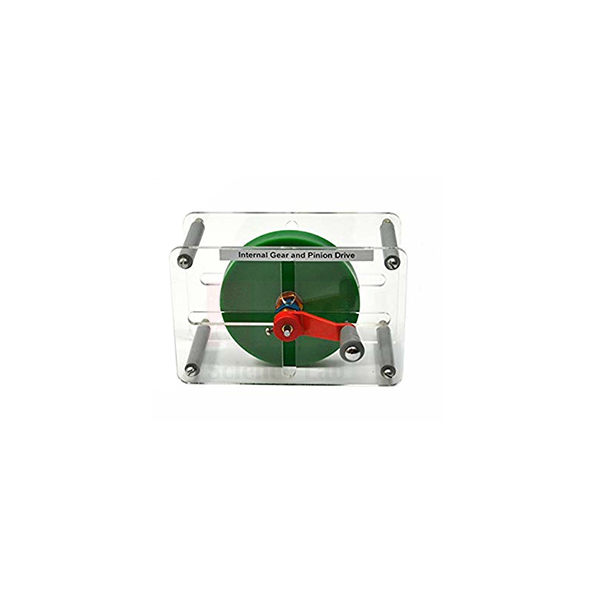
Internal Gear Pinion Drive
Internal Gear Pinion Drive (Product Code: SLE/MCE/80) is a hand-cranked bench-top model used to demonstrate the fundamentals of how an internal gear and pinion drive works in theory of machines and technical training classrooms. The gear train is left open for study between two clear plastic plates, and two dials show rotation so students can compare the movement of the gears. It is made by Jain Scientific Equipments Pvt Ltd (ScienceLab), an OEM manufacturer, at its own factory in Ambala, India.
Specifications
| Parameter | Detail |
|---|---|
| Operation | Manual, by hand crank |
| Construction | Heavy duty metal and plastic |
| Gear train | Open system for study, sandwiched between two clear plastic plates |
| Indicators | 2 dials to show rotation |
| Layout | On base; bench top or desktop use |
| Dimensions | 400 x 200 x 300 mm |
| Weight | 5 kg |
| Product code | SLE/MCE/80 |
| Manufacturer | Jain Scientific Equipments Pvt Ltd (ScienceLab) — OEM |
| Country of origin | India (made in Ambala, Haryana) |
What Is the Internal Gear and Pinion Drive Used For?
In an internal gear drive, a small pinion meshes with teeth cut on the inside of a larger ring gear. Unlike an ordinary external gear pair, both gears turn in the same direction and the centre distance is shorter, which is why the arrangement appears in planetary gearboxes and compact reduction drives. Turning the hand crank slowly lets students watch the teeth engage through the clear plates and see the same-direction rotation for themselves.
Using the two dials, the class can count turns and compare the result with the ratio of tooth numbers, then discuss why internal gearing gives a compact reduction. At 5 kg and 400 x 200 x 300 mm, the model is easy to carry between classroom and workshop, making it handy engineering educational equipment in India for ITI, polytechnic and first-year engineering courses. Wipe the plastic plates with a soft cloth so the mesh stays clearly visible.
OEM Manufacturer
This demonstrator is an OEM product. Jain Scientific Equipments Private Limited, trading as ScienceLab, manufactures the Internal Gear Pinion Drive at its own licensed factory at Saha, Ambala, Haryana, India, rather than reselling a bought-in model.
Training institutes, schools, dealers and importers order it directly from the manufacturer, which also handles repeat orders when more classrooms need the same model. Read more on the ScienceLab company profile.
Related Theory of Machines Equipment
Gear and mechanism models that complete a power transmission lesson:
- Gear Trainer Demonstrator — external gear pairs for direct comparison with internal gearing.
- Gear Train Model — gear trains and their overall speed ratio.
- Geared Systems — further geared arrangements for advanced classes.
- Cam Mechanism — another way of converting rotary motion.
More models are listed in the Theory of Machines category.
Frequently Asked Questions
What does the Internal Gear Pinion Drive demonstrate?
The Internal Gear Pinion Drive demonstrates the fundamentals of how an internal gear and pinion drive works: a pinion meshing inside a ring gear, same-direction rotation of both gears, and the speed ratio shown on its two rotation dials.
How is the Internal Gear Pinion Drive operated?
The Internal Gear Pinion Drive is operated manually with a hand crank, so no electrical connection is listed. Students control the speed themselves, which makes it easy to stop at any position and examine how the teeth mesh.
What is the Internal Gear Pinion Drive made of?
The Internal Gear Pinion Drive is constructed from heavy duty metal and plastic. Its open gear system sits between two clear plastic plates on a base, so the working parts remain visible from both sides during a demonstration.
How big is the Internal Gear Pinion Drive?
The Internal Gear Pinion Drive measures 400 x 200 x 300 mm and weighs 5 kg. It is designed as a bench top or desktop item, so it needs no special stand or floor space.
Who manufactures the Internal Gear Pinion Drive?
The Internal Gear Pinion Drive is manufactured by Jain Scientific Equipments Pvt Ltd (ScienceLab), the OEM, at its own licensed factory at Saha, Ambala, Haryana, India. It is supplied factory-direct to institutions, dealers and importers.
Can the Internal Gear Pinion Drive be ordered for several classrooms?
Yes, the Internal Gear Pinion Drive can be quoted in multiple units for schools, training institutes and dealers in India and international markets. Send the quantity and destination through the contact page for a single consolidated quotation.
Request a Quote
To order the Internal Gear Pinion Drive (SLE/MCE/80), use the contact page or add it to the enquiry cart with your quantity. Quotations are issued directly by the manufacturer in Ambala.
Last updated: 24 September 2026
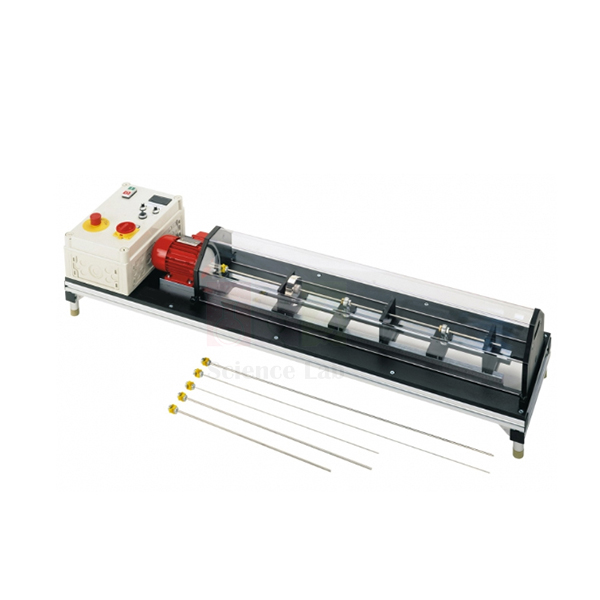
Whirling of Shaft Apparatus
Whirling of Shaft Apparatus (Product Code: SLE/MCE/81) is a rotor dynamics trainer used to find the critical (whirling) speeds and mode shapes of slender rotating shafts in mechanical engineering laboratories. Six high-strength steel rotor shafts of 3, 6 and 7 mm diameter and 600 or 900 mm length are driven by a 0.37 kW adjustable-speed motor up to 6000 rpm behind a transparent protective cover. It is made by Jain Scientific Equipments Pvt Ltd (ScienceLab), an OEM manufacturer, at its own factory in Ambala, India.
Specifications
| Parameter | Detail |
|---|---|
| Rotor shafts | 6, high-strength steel |
| Shaft diameters | 3 mm, 6 mm, 7 mm |
| Shaft lengths | 600 mm, 900 mm |
| Other listed data | Diameter 80 mm; weight 1 kg |
| Experiment variables | Bearing spacing and shaft diameter; mode shapes of continuous rotor shafts |
| Motor | 0.37 kW, adjustable speed, digital display, potentiometer adjustment, 2 preselectable rotational speeds |
| Speed range | 0–6000 min⁻¹ (rpm) |
| Guard | Transparent protective cover for clear observation |
| Dimensions | 1400 x 600 x 800 mm |
| Weight | 85 kg |
| Power supply | 230 V, 50 Hz, 1 phase; or 230 V, 60 Hz, 1 phase; or 120 V, 60 Hz, 1 phase |
| Product code | SLE/MCE/81 |
| Manufacturer | Jain Scientific Equipments Pvt Ltd (ScienceLab) — OEM |
| Country of origin | India (made in Ambala, Haryana) |
What Is the Whirling of Shaft Apparatus Used For?
Every slender shaft has speeds at which it bows outward and whirls, because the running speed coincides with a natural frequency of transverse vibration. Students fit a rotor shaft, raise the motor speed slowly with the potentiometers, and note on the digital display the speed at which the shaft visibly whirls, then compare it with the value calculated from shaft stiffness, mass and support conditions.
Repeating the run with the 3, 6 and 7 mm shafts, the 600 and 900 mm lengths and different bearing spacing shows how diameter, length and support position move the critical speed, while higher speeds reveal the mode shapes of a continuous rotor. The two preselectable speeds make it quick to return to a point of interest. Keep the cover closed and pass steadily through each critical speed; as engineering lab equipment in India for dynamics of machinery, it shows clearly why turbine and pump shafts are designed to run away from their critical speeds.
What to Specify When Ordering
- Power supply version: 230 V 50 Hz, 230 V 60 Hz or 120 V 60 Hz, single phase
- Spare rotor shafts, if you expect heavy student use (ask us)
- Number of units and the delivery location
OEM Manufacturer
ScienceLab manufactures the Whirling of Shaft Apparatus as the OEM at the licensed factory of Jain Scientific Equipments Private Limited in Saha, Ambala, Haryana, India. Engineering institutions, dealers and importers buy directly from the maker, so quotations, spare shafts and repeat orders are all handled by one company.
For institutional and tender vendor registration, the company's details are GSTIN 06AAECJ8618A1ZT and LEI 3358004HRD1JIVXKYX49. See the ScienceLab profile for more about the company.
Related Theory of Machines Equipment
Apparatus that builds the same rotor dynamics topic from different angles:
- Static and Dynamic Balancing Apparatus — the imbalance that excites whirling in real rotors.
- Free and Forced Vibration Apparatus — resonance studied on a spring-mounted beam.
- Free Vibrations Of A Cantilever — transverse vibration of a non-rotating member for comparison.
- Journal Bearing Demonstration — how rotating shafts are supported.
The Theory of Machines category lists all related trainers.
Frequently Asked Questions
What does the Whirling of Shaft Apparatus measure?
The Whirling of Shaft Apparatus is used to find the critical (whirling) speeds of rotating shafts and to observe the mode shapes of continuous rotor shafts, while varying bearing spacing and shaft diameter to see how each changes the result.
Which rotor shafts come with the Whirling of Shaft Apparatus?
The Whirling of Shaft Apparatus lists six rotor shafts of high-strength steel, with diameters of 3, 6 and 7 mm and lengths of 600 and 900 mm. Ask us through the contact page to confirm the exact diameter and length combination in the set.
What motor and speed range does the Whirling of Shaft Apparatus have?
The Whirling of Shaft Apparatus uses a 0.37 kW adjustable-speed motor running from 0 to 6000 min⁻¹ (rpm). Speed is set with potentiometers, shown on a digital display, and two rotational speeds can be preselected.
How does the Whirling of Shaft Apparatus protect users?
The Whirling of Shaft Apparatus has a transparent protective cover over the rotating shaft, so students can observe whirling and mode shapes closely without contact with moving parts. Keep the cover closed whenever the motor runs.
What space and power does the Whirling of Shaft Apparatus need?
The Whirling of Shaft Apparatus measures 1400 x 600 x 800 mm and weighs 85 kg. It is offered for 230 V 50 Hz, 230 V 60 Hz or 120 V 60 Hz single-phase supply, so state your mains supply when ordering.
Who manufactures the Whirling of Shaft Apparatus?
The Whirling of Shaft Apparatus is manufactured by Jain Scientific Equipments Pvt Ltd (ScienceLab), the OEM, at its own licensed factory at Saha, Ambala, Haryana, India. Quotations for India and international markets come directly from the manufacturer.
Is a calibration certificate available for the Whirling of Shaft Apparatus speed display?
Calibration documents for the Whirling of Shaft Apparatus speed display are not stated in the product listing. If your department requires a calibration certificate, mention it in your enquiry so that availability can be discussed with us before ordering.
Request a Quote
Request a quotation for the Whirling of Shaft Apparatus (SLE/MCE/81) through the contact page, or add it to the enquiry cart with your power supply version and quantity. The manufacturer quotes you directly.
Last updated: 24 September 2026
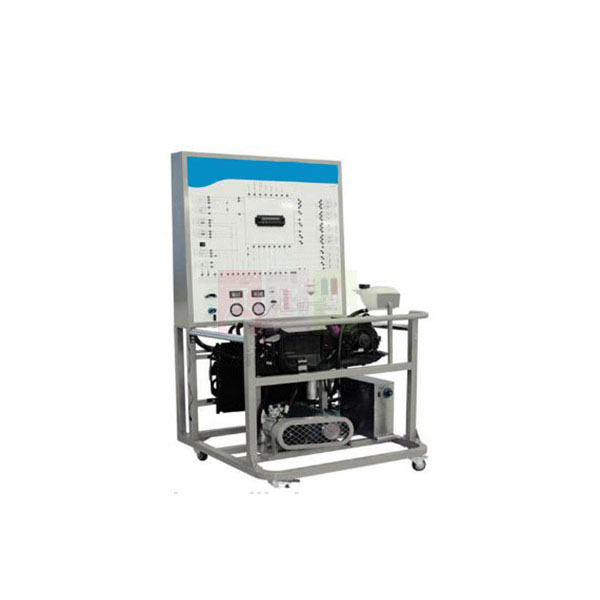
Air Conditioning System Trainer
Air Conditioning System Trainer (Product Code: SLE/MCE/82) is a refrigeration and air-handling training unit used to study cooling, heating, humidification and room loads in HVAC and thermal engineering laboratories. Polytechnics and engineering colleges choose this TVET lab equipment because an air duct with fan, air cooler, humidifier, flaps, air heater and sensors serves a chamber with adjustable wet and dry cooling loads. It is made by Jain Scientific Equipments Pvt Ltd (ScienceLab), an OEM manufacturer, at its own factory in Ambala, India.
Specifications
| Parameter | Detail |
|---|---|
| Air duct | With fan, air cooler, humidifier, flaps, air heater and sensors |
| Chamber | Wet (latent) and dry (sensible) heat source as cooling load |
| Cooling-load heaters | 2 heaters in the chamber; power output 0–250 W each, freely adjustable |
| Humidifier heating power | 400 W |
| Air heater power | 360 W |
| Refrigeration capacity | 320 W at +5/40 °C |
| Power consumption | 140 W at −10 °C |
| W × H | 155 × 155 mm |
| Refrigerant | A refrigerant currently available on the market; filling volume 1.2 kg; CO2-equivalent 0.8 t |
| Measuring range – temperature | 0–50 °C |
| Measuring range – relative humidity | 10–90% |
| Measuring range – power consumption | 0–600 W (condensing unit) |
| Measuring range – refrigerant flow rate | 1.5–23.5 L/h |
| Measuring range – air velocity | 0–2.5 m/s |
| Measuring range – cooling-load power | 2 × 0–300 W |
| Measuring range – refrigerant pressure | −1 to 9 bar / −1 to 24 bar |
| Power supply options | 230 V, 50 Hz, 1 phase or 230 V, 60 Hz, 1 phase |
| Product code | SLE/MCE/82 |
| Manufacturer | Jain Scientific Equipments Pvt Ltd (ScienceLab) — OEM |
| Country of origin | India (made in Ambala, Haryana) |
What Is the Air Conditioning System Trainer Used For?
Students follow the air through each stage of the duct — cooling on the air cooler, reheating on the air heater and adding moisture with the humidifier — and plot every change on a psychrometric chart from the temperature and relative-humidity readings. The chamber’s dry (sensible) and wet (latent) heat sources act as the room load, so the effect of heat and moisture gains on the conditioned space can be simulated and balanced.
On the refrigeration side, refrigerant pressures, refrigerant flow and condensing-unit power are measured, allowing students to work out cooling capacity and coefficient of performance for different load settings. Set the flaps and the cooling-load heaters for the chosen case before starting, and give the system time to stabilise before each set of readings.
What to Specify When Ordering
- Power supply version: 230 V 50 Hz or 230 V 60 Hz, single phase
- The refrigerant type acceptable in your country, since the trainer uses a refrigerant currently available on the market
- Number of trainers for the HVAC or refrigeration laboratory
OEM Manufacturer
The Air Conditioning System Trainer is manufactured by Jain Scientific Equipments Private Limited — the company that trades as ScienceLab — in its role as OEM. Production is carried out at the company’s licensed factory at Saha, Ambala, Haryana, and trainers are shipped factory-direct to technical institutes, colleges, dealers and importers.
Dealing with the maker keeps quotations, technical queries and later spares requests in one place; ask us whenever you need help. Company information is on the ScienceLab profile.
Related Thermodynamics & Heat Transfer Lab Equipment
HVAC and refrigeration courses typically build on this trainer with:
- Vapour Absorption Refrigeration Trainer — a heat-driven refrigeration cycle for comparison
- Gas Charging Trainer — practice in evacuating and charging refrigerant
- Computerized Cooling Tower Test Bench — evaporative cooling and humid-air processes
- Cut Section Model Of Rotary Hermetic Compressor — shows the inside of a small refrigeration compressor
Browse the Thermodynamics & Heat Transfer Lab Equipment category for more refrigeration and air-conditioning trainers.
Frequently Asked Questions
What processes can be studied on the Air Conditioning System Trainer?
The Air Conditioning System Trainer covers cooling, reheating, humidification and the handling of sensible and latent loads: its air duct holds a fan, air cooler, humidifier, flaps, air heater and sensors, and feeds a chamber with wet and dry heat sources.
What is the refrigeration capacity of the Air Conditioning System Trainer?
The Air Conditioning System Trainer has a listed refrigeration capacity of 320 W at +5/40 °C and a power consumption of 140 W at −10 °C, with a refrigerant filling volume of 1.2 kg.
Which refrigerant does the Air Conditioning System Trainer use?
The Air Conditioning System Trainer uses a refrigerant that is currently available on the market, with a 1.2 kg fill and a CO2-equivalent of 0.8 t. Please confirm which refrigerant is acceptable in your country when requesting a quotation.
How are cooling loads applied in the Air Conditioning System Trainer?
The chamber of the Air Conditioning System Trainer has two heaters as cooling load, each freely adjustable from 0 to 250 W, plus a wet (latent) heat source, so students can set different room-load conditions.
What does the Air Conditioning System Trainer measure?
The Air Conditioning System Trainer measures temperature 0–50 °C, relative humidity 10–90%, air velocity 0–2.5 m/s, refrigerant flow 1.5–23.5 L/h, condensing-unit power 0–600 W and refrigerant pressure −1 to 9 bar and −1 to 24 bar.
Who manufactures the Air Conditioning System Trainer?
Jain Scientific Equipments Pvt Ltd (ScienceLab), the OEM, manufactures the Air Conditioning System Trainer at its own factory in Saha, Ambala, Haryana, India, and supplies it directly to institutions, dealers and importers.
Is the Air Conditioning System Trainer suitable for vocational courses?
Yes. The Air Conditioning System Trainer suits polytechnic, TVET and engineering HVAC courses because students work with a real refrigeration circuit and air duct, measuring the same quantities a technician checks in the field.
Request a Quote
For a quotation on the Air Conditioning System Trainer, contact us through the contact page or add the trainer to the enquiry cart. Quotations are issued by the manufacturer directly.
Last updated: 24 September 2026
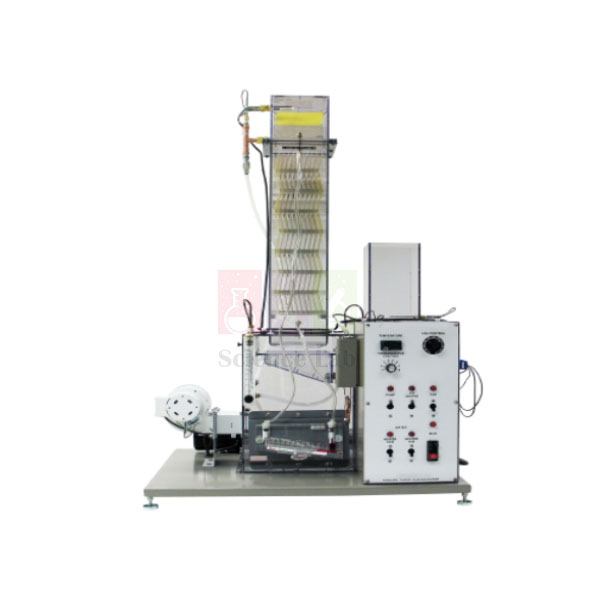
Computerized Cooling Tower Test Bench
Computerized Cooling Tower Test Bench (Product Code: SLE/MCE/83) is a fan-driven cooling tower model used to study the evaporative cooling of water by air in thermal and chemical engineering laboratories. Colleges add this engineering lab equipment because its 150 × 150 mm cooling column holds a wet deck with a specific surface of 110 m²/m³, and a three-stage heater (500, 1000 or 1500 W) sets the heat load. It is made by Jain Scientific Equipments Pvt Ltd (ScienceLab), an OEM manufacturer, at its own factory in Ambala, India.
Specifications
| Parameter | Detail |
|---|---|
| Cooling column cross-section | 150 × 150 mm |
| Wet deck specific surface | 110 m²/m³ |
| Airflow measurement | Volumetric airflow via orifice, Ø 80 mm |
| Heater | Adjustable in three stages: 500 W, 1000 W, 1500 W |
| Thermostat | Switches off at 50 °C |
| Fan | Power consumption 250 W; max. pressure difference 430 Pa; max. volumetric flow rate 13 m³/min |
| Pump | Max. head 70 m; max. flow rate 100 L/h |
| Tank for additional water | 4.2 L |
| Measuring range – differential pressure (air) | 0–1000 Pa |
| Measuring range – flow rate (water) | 12–360 L/h |
| Measuring range – temperature | 2 × 0–50 °C and 3 × 0–100 °C |
| Measuring range – relative humidity | 10–100% |
| Dimensions | 1200 × 600 × 1600 mm |
| Weight | Approx. 125 kg |
| Power supply options | 230 V, 50 Hz, 1 phase or 230 V, 60 Hz, 1 phase |
| Product code | SLE/MCE/83 |
| Manufacturer | Jain Scientific Equipments Pvt Ltd (ScienceLab) — OEM |
| Country of origin | India (made in Ambala, Haryana) |
What Is the Cooling Tower Test Bench Used For?
Warm water from the heated circuit is pumped to the column and spreads over the wet deck while air from the fan passes through it; part of the water evaporates and cools the rest. By measuring water and air temperatures, relative humidity, water flow and airflow through the 80 mm orifice, students calculate the cooling range, the approach to wet-bulb temperature, the heat removed and the water lost by evaporation.
Switching the heater between 500, 1000 and 1500 W and changing air and water flows shows how heat load and air-to-water ratio affect performance — the same questions faced in power-station and HVAC cooling towers. Keep the 4.2 L additional-water tank topped up, since evaporated water must be replaced, and remember that the thermostat switches the heater off at 50 °C.
What to Specify When Ordering
- Power supply version: 230 V 50 Hz or 230 V 60 Hz, single phase
- Floor space and headroom for a 1200 × 600 × 1600 mm bench of about 125 kg
- Water filling and draining arrangements at the installation point
- The computerised data-logging arrangement you expect, so it can be confirmed in the quotation
OEM Manufacturer
Jain Scientific Equipments Private Limited, the legal company behind the ScienceLab brand, is the OEM of the Computerized Cooling Tower Test Bench. Each bench is manufactured at the company’s own licensed factory in Saha, Ambala, Haryana, India, and delivered factory-direct to engineering colleges, polytechnics, dealers and importers.
If you later need wet-deck packing, a spare pump or another bench, ask us — enquiries go straight to the manufacturer. More on the company is on the ScienceLab profile.
Related Thermodynamics & Heat Transfer Lab Equipment
Cooling and humid-air practicals often extend to these units:
- Air Conditioning System Trainer — psychrometric processes of humid air in an air-handling duct
- Water To Air Heat Exchangers — cooling water with air without evaporation, for comparison
- Cross Flow Heat Exchangers — another arrangement for heat transfer between two streams
- Air Blower Test Setup — for studying the fan side of air-moving equipment
The Thermodynamics & Heat Transfer Lab Equipment category includes the full range of thermal trainers.
Frequently Asked Questions
What is the wet deck specification of the Computerized Cooling Tower Test Bench?
The Computerized Cooling Tower Test Bench has a cooling column of 150 × 150 mm cross-section whose wet deck offers a specific surface of 110 m²/m³, giving a large contact area between the water and the air.
How is heat load varied on the Computerized Cooling Tower Test Bench?
Heat load on the Computerized Cooling Tower Test Bench is set with a heater adjustable in three stages of 500 W, 1000 W and 1500 W; a thermostat switches it off at 50 °C.
What do the fan and pump of the Computerized Cooling Tower Test Bench deliver?
The fan of the Computerized Cooling Tower Test Bench consumes 250 W, with a maximum volumetric flow of 13 m³/min and a maximum pressure difference of 430 Pa; the pump offers a maximum head of 70 m and a maximum flow of 100 L/h.
What are the measuring ranges of the Computerized Cooling Tower Test Bench?
The Computerized Cooling Tower Test Bench measures air differential pressure 0–1000 Pa, water flow 12–360 L/h, temperature with two sensors at 0–50 °C and three at 0–100 °C, and relative humidity 10–100%.
Who manufactures the Computerized Cooling Tower Test Bench?
The Computerized Cooling Tower Test Bench is manufactured by Jain Scientific Equipments Pvt Ltd (ScienceLab) as the OEM at its own factory in Ambala, Haryana, India. Quotations and spares enquiries are answered directly by the maker.
How is data logged on the Computerized Cooling Tower Test Bench?
Please confirm the data-logging arrangement of the Computerized Cooling Tower Test Bench with us before ordering, as the listed specification covers its sensors and measuring ranges; tell us whether you need PC recording via the contact page.
How much space does the Computerized Cooling Tower Test Bench need?
The Computerized Cooling Tower Test Bench measures 1200 × 600 × 1600 mm and weighs about 125 kg, so check door widths and floor space, and provide water filling and draining near the installation point.
Request a Quote
Request a quotation for the Computerized Cooling Tower Test Bench through our contact page, or add it to the enquiry cart alongside other thermal trainers. The manufacturer quotes you directly.
Last updated: 24 September 2026