- Physics Lab Equipment
- Chemistry Lab Equipment
- Biology Lab Equipment
- Anatomical Lab Equipment
- Learning
- Educational Lab Equipment
- Magnets
- Agriculture
- Astronomy
- Earth Science
- Geography Lab Equipment
- Safety Lab Coat
- Laboratory
- Meteorological
- Electricity & Magnetism
- Heat
- School Lab Equipment
- Lab Glassware
- Science Lab Equipment
- Tvet Lab Equipment
- Robotics Kits Supplier and Manufacturer for Schools India
- Math Lab Equipment Manufacturers and Exporters in Ambala
- STEM Kits Manufacturers and Supplier India
- Engineering Lab Equipment
- Hospital Lab Equipment
- Water, Sanitation & Hygiene Supplies
- Cold Chain, Solar & Communication Equipment
- Nutrition
Last updated: 22 October 2026
Quick Answer
Jain Scientific Equipments Pvt Ltd (ScienceLab), Ambala, Haryana, a biology lab instruments supplier, lists 32 core apparatus and teaching aids for school and college biology practicals, arranged in 7 groups from respiration and breathing equipment, plant and food-energy experiments and soil ecology to health-education simulations, genetics and senses kits, basic instruments and wall posters. 9 of the items are manufactured by ScienceLab at its factory at Saha, Ambala, and 23 are supplied by ScienceLab. Each item has its own product page, linked from the product listing under this description. The company supplies buyers in India and in 110 countries.
Quick links: Request a quotation · Jump to specifications by group · Open your enquiry cart
Explore the Core Biology Lab Equipment Range
| Range | Items | What it covers |
|---|---|---|
| Respiration and breathing | 7 | A respiration apparatus and a respirometer with graduated manometer, a recording spirometer, a breathing fitness health lab, calibrated lung volume bags, a peak flow meter and disposable mouthpieces. |
| Plant, food-energy and membrane experiments | 5 | A three-chambered phototropism case, a food calorimeter for the energy value of food and fuels, an enzyme biotechnology kit, Visking dialysis tubing and tubing clips. |
| Soil and field ecology | 4 | Two Tullgren funnels for extracting soil invertebrates, a screw-type soil auger and garden secateurs. |
| Health education and simulations | 6 | An effects of smoking model, simulated HIV/AIDS and diabetes testing kits, a teaching about immunity board kit and inflatable Tumble & Teach cubes on exercise and substance abuse. |
| Genetics, senses and reaction time | 3 | A fruit fly genetics simulation kit, a sight and sound health lab and a reaction timer for light, sound and touch stimuli. |
| Basic instruments | 3 | A binocular biological microscope, a single-diaphragm stethoscope and disposable plastic forceps. |
| Wall posters | 4 | Posters on the classification of living things, systems of the human body, viruses and bacteria, and human genetic disorders. |
| Total | 32 | All items listed in the Biology Lab Equipment range |
Core Biology Lab Equipment Specifications
Key specifications below are taken from each product's own page; open a product for its full specifications and product code.
Respiration and breathing (7)
| Product | Key specification |
|---|---|
| Breathing Fitness Health Lab | Measurements: Breath rate, breath volume, breath recovery, breath control, lung volume and the amount of CO2 in exhaled air |
| Lung Volume Bags | Calibration: Each bag calibrated to 6 litres; Pack size: Pack of 4 bags (Set of 4); Material: Durable plastic |
| Peak Flow Meter | Scale: 60–800; Calibration: Individually calibrated for high inter- and intra-device accuracy; Type: Portable peak flow meter |
| Plastic Disposable Mouthpieces for Peak Flow Meter | Pack size: Pack of 15; Material: Plastic; Colour: White |
| Respiration Apparatus | Glass tubing: Two lengths, one short and one long, of 5 mm glass tubing; Tubes: Two boiling tubes, each with a stopper |
| Respirometer | Chambers: Two stoppered boiling tubes; Connection: Three-way taps to either limb of a graduated manometer |
| Spirometer | Float calibration: 0 to 7 x 0.5 litres; Pen arm: Corresponds to approximately 0.5 litres; Outer case: Durable painted outer case |
Plant, food-energy and membrane experiments (5)
| Product | Key specification |
|---|---|
| Apparatus Phototropic | Case: Three-chambered wood case that accepts a variety of shutters; Window: One chamber has a window at the top and back |
| Calorimeter Food | Lead: 1 m insulated lead; Vessel: Borosilicate glass vessel with a combustion chamber |
| Enzyme Biotechnology Kit | Experiment 1: Enzymes in washing powders; Experiment 2: Demonstration of pectinase in fruit juice production |
| Visking Tubing Clips | Membrane compatibility: Membranes up to 40mm flat width (to Size 7); Overall length when closed: 53mm; Width: 11mm |
| Visking Tubing, 30m | Molecular weight cut-off (MWCO): 12000–14000; Flat width: 25mm; Size: 2 |
Soil and field ecology (4)
| Product | Key specification |
|---|---|
| Funnel Tullgren | Sample container: Base made from gauze, with a mesh designed to hold soil particles but permit the animals to pass |
| Garden Auger Soil | Handle fitting: Eye to accept a tommy bar; Type: Soil auger, screw type; Purpose: Collection of soil samples |
| Garden Secateurs | Listed among: Garden tools; Type: Garden secateurs (hand pruning shears); Purpose: Snipping buds and similar plant material |
| Tullgren Funnel | Funnel diameter: 175mm; Sieve diameter: 170mm; Sieve depth: 65mm |
Health education and simulations (6)
| Product | Key specification |
|---|---|
| Effects of Smoking Model | Operation: Syringe pump (included) draws cigarette smoke into the model’s lungs; Guides: Detailed teacher and student guides |
| HIV/AIDS Testing Kit, Simulated | Class size: Sufficient reagent and materials for a class of 30 students; Type: Simulated HIV test activity kit for teaching |
| Simulated Diabetes Testing | Supplied as: Several patient medical histories with simulated blood and urine samples |
| Teaching About Immunity Kit | Demonstration board: 30 x 40 inch, with mounting legs; Pieces: Plastic pieces that will not break, chip, tear, peel or wear out |
| Tumble & Teach Exercise | Size when inflated: Approx 18cm square; Activities: A variety of basic exercises, from stretching and running to jumping jacks |
| Tumble & Teach Substance Abuse | Size when inflated: Approx 18cm square; Subjects: Use and abuse of tobacco, alcohol and drugs; Type: Inflatable discussion cube |
Genetics, senses and reaction time (3)
| Product | Key specification |
|---|---|
| Fruit fly Genetics Kit | Sheets: 15 sheets each, with snap-apart pieces; Pieces show: Male and female flies; 4 types of fruit flies |
| Reaction Timer | Stimuli covered: Various stimuli, including light, sound and touch; Type: Reaction timer for student investigations |
| Sight & Sound Health Lab | Kit contents: Vision disk, pinhole viewer, lenses, eye chart, masks, flashlight, rubber balls, extensive pack of activities, Teacher's Guide |
Basic instruments (3)
| Product | Key specification |
|---|---|
| Biological Microscope 1 | Magnification: Over 400x; Objectives: Three, plan type for better image quality; Illumination: Included |
| Forceps, Plastic | Length: 125mm; Material: Plastic; Type: Forceps, disposable (single use) |
| Stethoscope | Chest piece: Single diaphragm head; Used for: Listening to pulse and breathing; Type: Basic medical stethoscope |
Wall posters (4)
| Product | Key specification |
|---|---|
| Classification of Living Things Poster | Size: 890 mm W x 585 mm H; Topic: Classification of living things — a close-up view of the kingdoms of life; Type: Wall poster |
| Human Genetic Disorders Poster | Size: 890mm W x 585mm H; Chromosomes shown: All 23 human chromosome pairs, in detail |
| Systems of The Human Body Poster | Dimensions: 890mm W x 585mm H; Type: Human anatomy wall poster |
| Viruses & Bacteria Poster | Dimensions: 890mm W x 585mm H; Finish: Laminated; Learning focus: How to identify these agents and how they cause harm to humans |
Related Equipment in Other ScienceLab Ranges
Teachers using this range often add these items from other ScienceLab ranges:
Who Buys This Range
Secondary schools use the Respiration Apparatus, Apparatus Phototropic, Tullgren funnels, the Effects of Smoking Model and the wall posters in biology and health lessons. Senior-secondary schools and colleges add the Respirometer, Spirometer, Calorimeter Food, Enzyme Biotechnology Kit and Visking tubing for respiration, food-energy, enzyme and osmosis practicals. Health education, life-skills and physical education teachers use the simulated HIV/AIDS and diabetes testing kits, the Teaching About Immunity Kit, the Tumble & Teach cubes, the peak flow meter and the reaction timer. Dealers and tender buyers order these items singly or as class sets.
Other ScienceLab Equipment Ranges
| Range | What it covers |
|---|---|
| Botany | Plant models, potometers, a clinostat and plant hormone and nutrition kits |
| Zoology | Insect and dip nets, minnow seines, animal skeletons, insect mounts and lifecycle plastomounts |
| Biology Kits | Ready investigations on cells, blood typing, kidney filtration and microbes |
| Prepared Slides | Histology, botany, cell division and microorganism slide sets, Microslides and slide storage |
| Cell Biology Equipments | Plant, animal and prokaryotic cell models and mitosis models |
| Dissection Equipment | Dissecting sets, scalpels, forceps, trays and pins |
| Microscope | Monocular, binocular, trinocular, stereo and digital microscopes |
| Biology Lab | Biology lab equipment for school and college labs, including microscopes, glassware, reagents and charts |
Frequently Asked Questions
What does this core Biology Lab Equipment range include?
32 listed items in 7 groups, from the respiration apparatus, respirometer and spirometer to Tullgren funnels and a soil auger, a food calorimeter, simulated HIV/AIDS and diabetes testing kits, a fruit fly genetics kit, a binocular microscope and wall posters on classification, body systems, microbes and genetic disorders.
Which items does ScienceLab manufacture?
9 of the 32 items are manufactured by ScienceLab: the Respiration Apparatus, the Respirometer, the Apparatus Phototropic, the Calorimeter Food, both Tullgren funnels, the Garden Auger Soil, the Fruit fly Genetics Kit and the Effects of Smoking Model.
Which items are supplied rather than manufactured?
23 items are supplied by ScienceLab, including the Spirometer, Breathing Fitness Health Lab, Lung Volume Bags, Peak Flow Meter, Enzyme Biotechnology Kit, Visking tubing and clips, the simulated HIV/AIDS and diabetes kits, the Teaching About Immunity Kit, the Biological Microscope 1, the Stethoscope and the four wall posters.
How can students measure breathing and lung volumes?
The Spirometer measures tidal volume, respiratory rate, pulmonary ventilation, reserve volumes, vital capacity and oxygen consumption. For class work, the Lung Volume Bags are each calibrated to 6 litres, the Peak Flow Meter reads 60–800 with disposable mouthpieces in packs of 15, and the Breathing Fitness Health Lab measures breath rate, volume, recovery and control.
What is the difference between the Respiration Apparatus and the Respirometer?
The Respiration Apparatus uses two stoppered boiling tubes with 5 mm glass tubing to compare inhaled and exhaled air. The Respirometer links an experimental tube holding small organisms and a control tube through three-way taps to a graduated manometer, to compare the rates at which the organisms absorb or give off gases.
Which items are used for soil and field ecology?
The Funnel Tullgren and the Tullgren Funnel (175 mm funnel, 170 mm sieve with coarse and fine mesh) drive small invertebrates out of a soil or leaf-litter sample with heat and light from above. The Garden Auger Soil collects soil samples, and the Garden Secateurs snip buds and plant material.
Do the health-education kits use real samples?
No. The HIV/AIDS Testing Kit, Simulated uses simulated blood and reagents and has materials for a class of 30 students, and the Simulated Diabetes Testing kit uses patient histories with simulated blood and urine samples. The Fruit fly Genetics Kit teaches Drosophila inheritance without live flies.
What should I include in a quotation request?
Product names or codes (for example SLE/BL/044 for the Spirometer), quantities, the delivery location and any tender specification. Single items, class sets, bulk quantities, tender enquiries and export orders are accepted; product specifications are provided on request.
Request a Quote
Send product names or codes and quantities through the contact page, or add items to your enquiry cart and submit it.
ScienceLab (Jain Scientific Equipments Pvt Ltd)
1226/1-5, Bengali Mohalla, Science Market, Ambala Cantt, Haryana 133001, India
Phone: +91-7082934803
Email: sales@scilabexport.com

Apparatus Phototropic
Apparatus Phototropic (Product Code: SLE/BL/08) is a three-chambered wooden case used to study phototropism in seedlings in school and college plant physiology practicals. Teachers use it as a plant growth experiment kit that shows how excluding parts of the light spectrum changes the way seedlings grow, with three glass containers, opaque and slot shutters and an orange & blue filter. It is made by Jain Scientific Equipments Pvt Ltd (ScienceLab), an OEM manufacturer, at its own factory in Ambala, India.
Specifications
| Parameter | Detail |
|---|---|
| Purpose | Phototropism experiments with seedlings; shows the effect of excluding various parts of the light spectrum on growth |
| Case | Three-chambered wood case that accepts a variety of shutters |
| Window | One chamber has a window at the top and back |
| Seedling containers | Three glass containers |
| Shutters supplied | Opaque shutter and slot shutter |
| Filter supplied | One orange & blue filter |
| Overall size | 180 x 530 x 180 mm |
| Product code | SLE/BL/08 |
| Manufacturer | Jain Scientific Equipments Pvt Ltd (ScienceLab) — OEM |
| Country of origin | India (made in Ambala, Haryana) |
What Is the Phototropism Apparatus Used For?
Seedlings are raised in the three glass containers and one container is placed in each chamber. By fitting different shutters, the class sets up contrasting conditions side by side: the opaque shutter keeps a chamber dark, the slot shutter lets in a narrow beam of light from one direction, and the filter allows only part of the spectrum through. Over the following days students record the height and direction of growth in each chamber, and seedlings exposed to one-sided light bend towards it.
The filter comparison is the most instructive part, because phototropic bending responds far more strongly to blue light than to orange or red — an easy way into light-sensitive pigments and the plant hormone auxin. For reliable results, sow seeds of one variety, water all containers equally and keep the apparatus away from stray light from other sides. As plant biology lab equipment it can be reused year after year; wipe the wooden case dry and store the shutters and filter flat.
What to Specify When Ordering
- The number of sets — each set is one three-chambered case with three glass containers for seedlings.
- Whether you need shutters or filters beyond the opaque shutter, slot shutter and orange & blue filter supplied, since the case accepts a variety of shutters.
- Bench or shelf space for each set at 180 x 530 x 180 mm overall.
OEM Manufacturer
Jain Scientific Equipments Private Limited, which trades as ScienceLab, is the OEM (original equipment manufacturer) of the Apparatus Phototropic and makes it at its own licensed factory at Saha, Ambala, Haryana, India. Because the wooden case, shutters and filter come from the maker itself, schools and dealers can ask us directly about additional shutters, replacement glass containers or repeat sets for more benches. Institutions, distributors and importers all receive factory-direct quotations. Read more on our company profile.
Related Biology Lab Equipment
Apparatus for the wider plant physiology practical series:
- Clinostat (Electric) — a companion tropism experiment that cancels a one-sided stimulus
- Petri Dish — for germinating seeds before moving seedlings into the containers
- Photosynthesis Apparatus — another light-dependent plant experiment
- Kit for Demonstrating Seed Respiration in Germination — continues the germination topic
See the complete Biology Lab Equipment range for more plant and animal physiology apparatus.
Frequently Asked Questions
What comes with the Apparatus Phototropic?
The Apparatus Phototropic comes as a three-chambered wood case with three glass containers for seedlings, an opaque shutter, a slot shutter and one orange & blue filter. One chamber has a window at the top and back, and the case accepts a variety of shutters.
What is the overall size of the Apparatus Phototropic?
The Apparatus Phototropic measures 180 x 530 x 180 mm overall. That footprint lets the three chambers sit side by side on a laboratory bench or shelf away from stray light, where students can compare the seedlings in each chamber over several days.
Are seeds included with the Apparatus Phototropic?
Seeds are not listed as part of the Apparatus Phototropic. Quick-germinating seeds of a single variety, such as those your syllabus recommends, can be sown in the three glass containers a few days before the experiment begins.
Does the Apparatus Phototropic need a power supply?
No electrical parts are listed for the Apparatus Phototropic. The experiment relies on light reaching the seedlings through the window, the slot shutter and the orange & blue filter, so place the case where daylight or a lamp falls on it evenly.
Can extra shutters or filters be ordered for the Apparatus Phototropic?
The Apparatus Phototropic case accepts a variety of shutters and is supplied with an opaque shutter, a slot shutter and one orange & blue filter. For additional shutters or filters, contact us and we will confirm what can be quoted with your sets.
Who manufactures the Apparatus Phototropic?
Jain Scientific Equipments Pvt Ltd (ScienceLab) is the OEM manufacturer of the Apparatus Phototropic (SLE/BL/08). It is made at the company's own licensed factory at Saha, Ambala, Haryana, India, and supplied factory-direct to schools, colleges, dealers and importers.
Is the Apparatus Phototropic available for school tenders and export?
Yes. ScienceLab quotes the Apparatus Phototropic for school tenders, colleges and distributors in India and international markets. Send the number of sets and the delivery location, and the quotation will come directly from the manufacturer.
Request a Quote
For a quotation on the Apparatus Phototropic, contact us or add it to the enquiry cart with the rest of your plant physiology equipment. Quotes come directly from the manufacturer.
Last updated: 24 September 2026

Calorimeter Food
Calorimeter Food (Product Code: SLE/BL/12) is a combustion calorimeter used to determine the energy value of food and fuels in school and college biology and chemistry laboratories. Teachers use it as a calorimeter experiment kit for nutrition and combustion lessons, built around a borosilicate glass vessel with a combustion chamber under a clear plastic lid with wire stirrer. It is made by Jain Scientific Equipments Pvt Ltd (ScienceLab), an OEM biology lab equipment manufacturer in India, at its own factory in Ambala.
Specifications
| Parameter | Detail |
|---|---|
| Purpose | Determining the energy value of food and fuels |
| Vessel | Borosilicate glass vessel with a combustion chamber |
| Lid | Clear plastic lid with wire stirrer and a hole for a thermometer |
| Platform | Heat-resistant platform with support rod |
| Oxygen and ignition | Oxygen inlet tube and igniter coil mounting |
| Lead | 1 m insulated lead |
| Documentation | Supplied with instructions |
| Also required | Electrical supply, thermometer, oxygen supply and stand |
| Product code | SLE/BL/12 |
| Manufacturer | Jain Scientific Equipments Pvt Ltd (ScienceLab) — OEM |
| Country of origin | India (made in Ambala, Haryana) |
What Is the Food Calorimeter Used For?
A weighed sample of food is placed in the combustion chamber and a measured quantity of water is added to the vessel. The igniter coil lights the sample, oxygen is fed through the inlet tube so that it burns completely, and the heat released passes into the surrounding water while the wire stirrer keeps the temperature even. The thermometer reading before and after combustion gives the temperature rise; multiplying the mass of water by its specific heat capacity and by that rise, then dividing by the mass of sample burned, gives the energy value.
Because combustion takes place inside the water-filled vessel rather than under an open boiling tube, less heat escapes to the room than in the simple boiling-tube method. Students can compare fats, carbohydrates and proteins, or test fuels, and then discuss the remaining sources of error — a strong addition to school biology lab equipment in India for the nutrition topic. Keep oils and grease away from the oxygen supply, leave the gas and ignition to the teacher, and allow the glass vessel to cool before cleaning.
What to Specify When Ordering
- The number of calorimeters needed for your class or laboratory.
- Whether a thermometer should be quoted as well — one is required and passes through the hole in the lid.
- Whether a stand should be quoted, since a stand is listed as required.
- Your electrical and oxygen supply arrangements, so the igniter connection via the 1 m insulated lead can be confirmed for your lab.
OEM Manufacturer
Jain Scientific Equipments Private Limited, trading as ScienceLab, is the OEM (original equipment manufacturer) of the Calorimeter Food and makes it at its own licensed factory at Saha, Ambala, Haryana, India. The company is a registered MSME whose Udyam registration (UDYAM-HR-01-0003714) lists manufacturing as its major activity, and its export consignments are shipped under IEC AAECJ8618A issued by the DGFT. Colleges, schools and dealers buy factory-direct, and questions about the igniter coil, lid or replacement glass vessels go straight to the maker — just ask us. Visit our company profile for more.
Related Biology Lab Equipment
Items needed to set up and run the food calorimeter:
- Digital Thermometer — the calorimeter needs a thermometer through the lid
- Retort Stand — a stand is listed as required
- Thermometer Clamp — holds the thermometer steady during readings
- Glass Measuring Cylinder — for measuring the water added to the vessel
- Food Calorimeter — another food calorimeter from our Heat range, for comparison
Browse the Biology Lab Equipment range for more physiology and nutrition apparatus.
Frequently Asked Questions
What else do I need to use the Calorimeter Food?
The Calorimeter Food needs an electrical supply for the igniter, a thermometer, an oxygen supply and a stand, as these are listed as required alongside it. The thermometer passes through the hole in the clear plastic lid to read the water temperature.
What supply does the igniter coil of the Calorimeter Food need?
The supply rating for the igniter coil of the Calorimeter Food is not stated in our current details. Please contact us before choosing a power source, and we will confirm the connection for the 1 m insulated lead.
Is the Calorimeter Food vessel glass or metal?
The Calorimeter Food uses a borosilicate glass vessel containing a combustion chamber, closed by a clear plastic lid with a wire stirrer and a thermometer hole. The glass lets students watch the water and the burning sample throughout the experiment.
Can the Calorimeter Food test fuels as well as food?
Yes. The Calorimeter Food is designed to determine the energy value of both food and fuels, so the same apparatus serves nutrition lessons in biology and fuel-comparison work in chemistry, with the oxygen inlet tube helping each sample burn completely.
Are instructions provided with the Calorimeter Food?
Yes. The Calorimeter Food is supplied with instructions for its set-up and use. Teachers should still carry out a trial run before the class, particularly the ignition and oxygen supply steps, which should always remain teacher-operated.
Is a calibration certificate available for the Calorimeter Food?
Calibration-certificate availability for the Calorimeter Food should be discussed with us at the time of enquiry. Tell us what documentation your college or tender requires, and we will confirm what can accompany the units supplied.
Who manufactures the Calorimeter Food?
Jain Scientific Equipments Pvt Ltd (ScienceLab) is the OEM manufacturer of the Calorimeter Food (SLE/BL/12). It is made at the company's own licensed factory at Saha, Ambala, Haryana, India, and quoted factory-direct to colleges, schools, distributors and importers in India and international markets.
Request a Quote
To price the Calorimeter Food with its thermometer and stand, contact us or add it to the enquiry cart. Quotations come directly from the manufacturer.
Last updated: 24 September 2026

Classification of Living Things Poster
Classification of Living Things Poster (Product Code: SLE/BL/18) is a wall poster used to teach the kingdoms of life in school and junior-college biology classrooms. It shows representative organisms from the Archaebacteria, Eubacteria, Protista, Fungi, Plantae and Animalia kingdoms in photographs and detailed illustrations at 890 mm W x 585 mm H, making it a practical classification chart for biology rooms in India. It is supplied by Jain Scientific Equipments Pvt Ltd (ScienceLab), Ambala, India.
Specifications
| Parameter | Detail |
|---|---|
| Type | Wall poster |
| Topic | Classification of living things — a close-up view of the kingdoms of life |
| Kingdoms shown | Archaebacteria, Eubacteria, Protista, Fungi, Plantae, Animalia |
| Content | Representative organisms with photographs and detailed illustrations |
| Size | 890 mm W x 585 mm H |
| Product code | SLE/BL/18 |
| Supplied by | Jain Scientific Equipments Pvt Ltd (ScienceLab), Ambala, India |
What Is the Classification Poster Used For?
The poster follows a six-kingdom scheme, which is a helpful bridge for students who first learn the five-kingdom system: the prokaryotes grouped as Monera appear here as two kingdoms, Archaebacteria and Eubacteria. Teachers can use it to discuss the criteria behind classification — cell type, whether organisms are single-celled or multicellular, and how they obtain food — and then ask students to place new examples in the right kingdom.
It works well as the centrepiece of a biology chart set for school, with smaller charts on individual groups displayed around it. Hang it at eye level, away from direct sunlight to limit fading, and consider a frame or protective cover if it will be displayed in a busy corridor or laboratory.
Supplier
Jain Scientific Equipments Private Limited, which trades as ScienceLab from Ambala, Haryana, India, supplies the Classification of Living Things Poster alongside its biology apparatus, models and teaching aids. Schools setting up a biology room can order wall charts together with practical equipment and receive a single quotation. Our company profile explains more about the company.
Related Biology Lab Equipment
Resources that support a classification unit:
- Viruses & Bacteria Poster — more detail on the microbial groups
- Concepts Of Classification Kit — a hands-on sorting activity to follow the poster
- Classification of Living Things Lab Investigation — a practical investigation on the same topic
- Hand Lens — for examining specimens before students classify them
- Systems of The Human Body Poster — another wall poster for the biology room
Find more posters and teaching aids in the Biology Lab Equipment range.
Frequently Asked Questions
What size is the Classification of Living Things Poster?
The Classification of Living Things Poster measures 890 mm wide by 585 mm high. That size is large enough to anchor a classroom wall display and to stay legible while the teacher points out individual organisms during a lesson.
Which kingdoms does the Classification of Living Things Poster cover?
The Classification of Living Things Poster covers six kingdoms: Archaebacteria, Eubacteria, Protista, Fungi, Plantae and Animalia. Each is shown with representative organisms in photographs and detailed illustrations, so students can compare similarities and differences between groups of living things.
Does the poster suit a syllabus that teaches five kingdoms?
Yes. On the Classification of Living Things Poster, the two bacterial kingdoms, Archaebacteria and Eubacteria, together correspond to Monera in the five-kingdom system. Teachers can point this out when comparing the two classification schemes with their students.
Is the Classification of Living Things Poster laminated?
The finish of the Classification of Living Things Poster is not stated in our current details. Please contact us if you need a specific finish, such as lamination for a busy corridor, and we will confirm what can be supplied.
Are hanging fittings included with the poster?
Hanging fittings are not listed with the Classification of Living Things Poster. Standard poster rails, frames or clips can be used; hang it at eye level and away from direct sunlight to limit fading over the school year.
Who supplies the Classification of Living Things Poster?
Jain Scientific Equipments Pvt Ltd (ScienceLab), Ambala, India, supplies the Classification of Living Things Poster (SLE/BL/18) to schools, colleges and distributors. It is often ordered together with the other biology posters and classification kits listed on this page.
Can we order posters for several classrooms?
Yes. ScienceLab supplies the Classification of Living Things Poster in quantity to schools and distributors in India and international markets. Send the number of copies and the delivery location through the contact page for a quotation.
Request a Quote
To order the Classification of Living Things Poster, contact us or add it to the enquiry cart with other biology charts.
Last updated: 24 September 2026

Effects of Smoking Model
Effects of Smoking Model (Product Code: SLE/BL/28) is a “Smoking Man” demonstration model used to show the impact of smoking on the lungs in school biology and health education lessons. Its included syringe pump draws smoke from a cigarette you provide into the model's lungs, which start to darken after only a few puffs, making it a memorable centrepiece for a health education kit in schools. It is made by Jain Scientific Equipments Pvt Ltd (ScienceLab), an OEM manufacturer, at its own factory in Ambala, India.
Key Details
| Parameter | Detail |
|---|---|
| Type | Smoking demonstration model (“Smoking Man”) |
| Operation | Syringe pump (included) draws cigarette smoke into the model’s lungs |
| Visible effect | Lungs start to darken after only a few short puffs |
| Cigarettes | Not included — provided by the user |
| Guides | Detailed teacher and student guides |
| Guide content | Background on the dangers of smoking; scenarios for testing cigarette brands for tar content under various conditions |
| Product code | SLE/BL/28 |
| Manufacturer | Jain Scientific Equipments Pvt Ltd (ScienceLab) — OEM |
| Country of origin | India (made in Ambala, Haryana) |
What Is the Effects of Smoking Model Used For?
The model is used in biology lessons on the respiratory system and in health education sessions on tobacco. The teacher lights the cigarette and operates the syringe pump while students watch the lungs discolour as tar is deposited, turning an abstract warning into something they can see. The discussion that follows usually covers how tar damages the airways and air sacs and links smoking with lung disease.
The scenarios in the guides let older students plan a fair comparison between brands and conditions, record their observations and draw conclusions. Run the demonstration in a well-ventilated room or under a fume hood, keep it strictly teacher-operated, have a container of water ready for cigarette ends, and follow your institution’s rules and local law on obtaining cigarettes for teaching. Few biology teaching aids in India leave such a lasting impression on a class.
OEM Manufacturer
Jain Scientific Equipments Private Limited, which trades as ScienceLab, is the OEM (original equipment manufacturer) of the Effects of Smoking Model and makes it at its own licensed factory at Saha, Ambala, Haryana, India. Schools, health-education programmes and dealers buy it straight from the maker rather than through a trading intermediary. If you plan to run the demonstration often, ask us about replacement parts before ordering, so the answer comes from the people who build the model. See our company profile for more.
Related Biology Lab Equipment
Resources for a lesson on smoking and respiratory health:
- Smoking Experiment — a related smoking investigation from our Biology Kits range
- Microslide Smoking & Health — microscope views to accompany the demonstration
- Human Lung Model in Bell Jar — explains how breathing moves air in and out of the lungs
- Spirometer — lets students measure their own lung volumes
- Kit on the Consequences of Smoking — further activities on the same theme
Browse more health and physiology items in the Biology Lab Equipment range.
Frequently Asked Questions
Are cigarettes included with the Effects of Smoking Model?
No. The Effects of Smoking Model uses a cigarette that you provide, placed in the mouth of the “Smoking Man”. Obtain cigarettes for teaching in line with your institution's rules and local law, and keep them under the teacher's control at all times.
What is included with the Effects of Smoking Model?
The Effects of Smoking Model includes the “Smoking Man” model, the syringe pump that draws smoke into its lungs, and detailed teacher and student guides with background on the dangers of smoking and scenarios for testing cigarette brands for tar content.
Can the lungs of the Effects of Smoking Model be cleaned or replaced?
Cleaning or replacement of the lungs is not described for the Effects of Smoking Model. If you plan to run the demonstration often, please contact us before ordering so we can confirm what is available for repeated use.
Is the Effects of Smoking Model safe to use with students?
The Effects of Smoking Model should be operated only by the teacher, in a well-ventilated room or under a fume hood, with students observing. Keep a container of water ready for cigarette ends and never let students draw on the cigarette.
Which age groups is the Effects of Smoking Model suited to?
The Effects of Smoking Model is used in secondary school biology and health education. Its guides include scenarios for testing cigarette brands for tar content under various conditions, which suit older students planning their own fair comparisons.
Who manufactures the Effects of Smoking Model?
Jain Scientific Equipments Pvt Ltd (ScienceLab) is the OEM manufacturer of the Effects of Smoking Model (SLE/BL/28). It is made at the company's own licensed factory at Saha, Ambala, Haryana, India, and supplied factory-direct to schools, health programmes and dealers.
Is bulk or export supply of the Effects of Smoking Model available?
Yes. ScienceLab supplies the Effects of Smoking Model to schools, health programmes, distributors and importers in India and international markets. Include the quantity and delivery location in your enquiry, and the quotation will come directly from the manufacturer.
Request a Quote
To request a price for the Effects of Smoking Model, contact us or add it to the enquiry cart along with related health education resources. Quotes come directly from the manufacturer.
Last updated: 24 September 2026

Forceps, Plastic
Forceps, Plastic (Product Code: SLE/BL/31) are disposable plastic forceps, 125mm long, used to pick up seeds, leaf discs, filter paper and small specimens without touching them by hand in biology practicals. Because they are meant for single use, each group can work with its own clean pair and soil or plant material is not carried from bench to bench. They are supplied by Jain Scientific Equipments Pvt Ltd (ScienceLab), Ambala, as part of its disposable biology lab equipment in India for schools and colleges.
Specifications
| Parameter | Detail |
|---|---|
| Type | Forceps, disposable (single use) |
| Material | Plastic |
| Length | 125mm |
| Product code | SLE/BL/31 |
| Supplied by | Jain Scientific Equipments Pvt Ltd (ScienceLab), Ambala, India |
What Are the Plastic Forceps Used For?
In a germination practical, students use a pair of these forceps to place seeds on moist filter paper in a petri dish; in a soil-life lesson, they pick small invertebrates out of a sorting tray for a closer look under a hand lens. A plastic tip is gentle on soft material and less likely to mark glass slides or dishes, which makes the forceps handy for moving coverslips, leaf fragments and paper discs as well.
Handing out a fresh pair per group keeps samples from one habitat or culture separate from the next, and used forceps can go into the lab's waste stream at the end of the lesson according to your school's disposal rules. Keep plastic forceps away from flames and hot apparatus, and use metal forceps for any step that involves heating. For teachers building a biology lab equipment list in India, a stock of disposable forceps is a simple way to run whole-class practicals without collecting and washing instruments between periods.
Supplier
These forceps are supplied by Jain Scientific Equipments Private Limited, an Ambala, Haryana company that trades as ScienceLab. Alongside apparatus and glassware, ScienceLab sources practical consumables such as disposable forceps, so a school can order a complete practical set-up from one vendor. Read our company profile for more about the business.
Related Biology Lab Equipment
Items often ordered with plastic forceps for specimen-handling practicals:
- Forceps, Nylon — a nylon forceps option if you are comparing materials
- Forceps (Tweezers) — forceps from our dissection equipment range for general specimen work
- Petri Dish Glass With Lid — holds seeds, leaf discs and small specimens while they are handled
- Hand Lens — for examining the small items picked up with the forceps
- Sorting Tray — for spreading out and sorting soil or pond samples
You can see more apparatus for school and college practicals in the Biology Lab Equipment category.
Frequently Asked Questions
How long are the Forceps, Plastic?
The Forceps, Plastic are 125mm long and made of plastic. That length gives students enough reach to lift seeds, leaf discs and small invertebrates from petri dishes and sorting trays without their fingers touching the specimen.
Can the Forceps, Plastic be reused?
The Forceps, Plastic are listed as disposable, so they are meant for single use. If you need forceps that can be washed and used again between classes, contact us and we will suggest a suitable reusable option from our range.
Are the Forceps, Plastic supplied sterile?
Sterility and packing of the Forceps, Plastic are not stated in our current details. If your work needs sterile-packed forceps, for example in microbiology practicals, please confirm this with us before ordering so that the right item is quoted.
How many Forceps, Plastic come in a pack?
The pack quantity of the Forceps, Plastic is not listed. Tell us how many pieces you need for each class or practical, and we will quote the disposable forceps in a quantity that matches your student numbers.
Can the Forceps, Plastic be used with hot items or in a flame?
No. The Forceps, Plastic should be kept away from flames and hot glassware, and no heat rating is given for them. Use metal forceps for any step that involves heating, flaming or handling warm apparatus.
Who supplies the Forceps, Plastic?
Jain Scientific Equipments Pvt Ltd (ScienceLab), Ambala, India, supplies the Forceps, Plastic (SLE/BL/31) to schools, colleges and distributors in India and international markets. Quote the product code, the number of pieces and the delivery location for an accurate quotation.
Request a Quote
To order Forceps, Plastic, send your requirements through our contact page or add the item to the enquiry cart together with the other practical supplies you need.
Last updated: 24 September 2026

Fruit fly Genetics Kit
Fruit fly Genetics Kit (Product Code: SLE/BL/33) is a genetics simulation kit used to teach basic Drosophila melanogaster inheritance in school and college biology classes without keeping live flies. Students perform crosses with printed plastic pieces that snap apart from sheets — 15 sheets each — showing male and female flies and 4 types of fruit flies. It is made by Jain Scientific Equipments Pvt Ltd (ScienceLab), an OEM manufacturer of genetics inheritance kits and a biology lab equipment supplier in India, at its own factory in Ambala.
Specifications
| Parameter | Detail |
|---|---|
| Type | Genetics simulation kit — no live flies required |
| Organism modelled | Drosophila melanogaster (fruit fly) |
| Sheets | 15 sheets each, with snap-apart pieces |
| Pieces show | Male and female flies; 4 types of fruit flies |
| Pieces | Plastic, printed with features |
| Concepts simulated | Sex determination, single factor inheritance, double factor inheritance, sex linkage, dominance and recessiveness |
| Documentation | Teacher's Guide and Student instruction sheet |
| Product code | SLE/BL/33 |
| Manufacturer | Jain Scientific Equipments Pvt Ltd (ScienceLab) — OEM |
| Country of origin | India (made in Ambala, Haryana) |
What Is the Fruit Fly Genetics Kit Used For?
The fruit fly is the classic organism for inheritance studies because its traits are easy to see and it breeds quickly, but live cultures need regular feeding, anaesthetising and counting that many schools cannot fit into a timetable. With this kit, a teacher can introduce a single factor cross in one lesson: students choose parent pieces, predict the offspring with a Punnett square, then assemble and tally the offspring pieces to compare the result with the prediction. Later lessons build up to double factor crosses and sex-linked traits, while the male and female pieces make sex determination concrete.
Because nothing is alive, the activity can be repeated, paused or used for revision without any culture care. It works well as a biology experiment kit for students who will later meet real Drosophila work at college, and gives teachers a ready way to discuss why dominance and recessiveness produce the ratios they do. After each class, collect the pieces by type into labelled bags so that every set stays complete for the next group.
OEM Manufacturer
Jain Scientific Equipments Private Limited, the Ambala company behind the ScienceLab brand, is the OEM (original equipment manufacturer) of the Fruit fly Genetics Kit and produces it at its own licensed factory at Saha, Ambala, Haryana, India. Schools, colleges, dealers and importers order it factory-direct, so class-set quantities and replacement sheets are discussed with the maker itself — just ask us. Visit our company profile to learn more about the company.
Related Biology Lab Equipment
Resources that support the same genetics and inheritance unit:
- Mendelian Inheritance (Mendel's First) — covers Mendel's first law, the basis of single factor crosses
- Mendelian Inheritance (Mendel's Second) — supports the double factor crosses in the kit
- Human Genetic Disorders Poster — links fruit fly inheritance to human chromosomes and disorders
- Mitosis & Meiosis Set, Microscope Slides — shows the cell division behind the inheritance patterns
- DNA Activity Model — for the molecular side of the same topic
Other genetics and general teaching apparatus is listed in our Biology Lab Equipment range.
Frequently Asked Questions
Do I need live fruit flies to use the Fruit fly Genetics Kit?
No. The Fruit fly Genetics Kit is designed to teach Drosophila genetics without live flies, so there are no cultures to feed, anaesthetise or maintain. Students model each cross with printed plastic pieces instead, and the activity can be paused and resumed at any time.
What is included in the Fruit fly Genetics Kit?
The Fruit fly Genetics Kit includes 15 sheets each of snap-apart plastic pieces showing male and female flies and 4 types of fruit flies, plus a Teacher's Guide and a Student instruction sheet. For the exact number of pieces per sheet, contact us.
Which genetics topics does the Fruit fly Genetics Kit cover?
The Fruit fly Genetics Kit lets students simulate sex determination, single factor inheritance, double factor inheritance, sex linkage, and dominance and recessiveness. The topics build from a first single factor cross in one lesson to sex-linked traits later in the unit.
How many students can work with one Fruit fly Genetics Kit?
A class size for the Fruit fly Genetics Kit is not stated in our current details. Tell us how many groups you plan to run at the same time, and we can advise on how many kits to order for your class.
Can the pieces of the Fruit fly Genetics Kit be used again?
Yes, with care. The plastic pieces of the Fruit fly Genetics Kit are handled rather than used up during the crosses, so they can be collected by type into labelled bags after each class. Ask us about replacement sheets if any go missing.
Who manufactures the Fruit fly Genetics Kit?
Jain Scientific Equipments Pvt Ltd (ScienceLab) is the OEM manufacturer of the Fruit fly Genetics Kit (SLE/BL/33). It is made at the company's own licensed factory at Saha, Ambala, Haryana, India, and supplied factory-direct to schools, colleges, dealers and importers.
What details should go into a quotation request?
For a Fruit fly Genetics Kit quotation, include the product code SLE/BL/33, the number of kits, the delivery location in India or international markets, and any other genetics resources you want on the same order. The quotation comes directly from the manufacturer.
Request a Quote
For pricing and availability of the Fruit fly Genetics Kit, contact us or place it in the enquiry cart with the rest of your genetics teaching order.
Last updated: 24 September 2026

Funnel Tullgren
Funnel Tullgren (Product Code: SLE/BL/34) is a heat-and-light extraction funnel used to collect small invertebrate animals from a dry soil sample in school and college ecology practicals. The sample rests on a gauze mesh over the funnel beneath a light, and most species are collected after two hours, with complete extraction taking two-three days. It is made by Jain Scientific Equipments Pvt Ltd (ScienceLab), an OEM manufacturer of zoology lab equipment in India, at its own factory in Ambala.
Key Details
| Parameter | Detail |
|---|---|
| Type | Tullgren funnel for extracting soil invertebrates |
| Sample container | Base made from gauze, with a mesh designed to hold soil particles but permit the animals to pass |
| Arrangement | Container placed over a funnel, with a light above |
| Principle | Heat from above drives animals away from the top of the sample, through the gauze and into the funnel |
| Sample | Dry soil |
| Extraction time | Most species collected after two hours; complete extraction takes two-three days |
| Product code | SLE/BL/34 |
| Manufacturer | Jain Scientific Equipments Pvt Ltd (ScienceLab) — OEM |
| Country of origin | India (made in Ambala, Haryana) |
What Is the Tullgren Funnel Used For?
Soil biodiversity is hard to see by eye because most soil animals are tiny and hide from light. A Tullgren funnel turns that behaviour into a collecting method: students take equal samples from contrasting sites — a mown lawn, leaf litter under trees, a flower bed — set each one up under the lamp, and compare what drops into the collecting container beneath the funnel spout. Mites, springtails, small beetles and insect larvae are typical finds, and they can be counted and sorted under a hand lens or microscope.
Timing matters when planning the lesson. Most species will have come through after two hours, enough for a single practical session, while a full count needs the funnel left running for two-three days. Keep the light at a steady height so the sample dries from the top down rather than all at once, and place a little damp tissue in the collecting container if the animals are to be observed alive and returned. Several funnels running side by side turn a spare bench into a soil-ecology station, a useful addition to any biology lab setup for schools in India.
OEM Manufacturer
ScienceLab is the trading name of Jain Scientific Equipments Private Limited, the OEM (original equipment manufacturer) that makes the Funnel Tullgren at its own licensed factory at Saha, Ambala, Haryana, India. It is a registered MSME enterprise with manufacturing as its major activity (Udyam UDYAM-HR-01-0003714) and ships export orders under its DGFT Importer-Exporter Code AAECJ8618A. Schools, colleges and field centres buy direct from the maker, and questions about the gauze, funnel or repeat sets go to the same team — just ask us. More background is on our company profile page.
Related Biology Lab Equipment
Equipment used before and after the extraction in a soil-life study:
- Garden Auger Soil — screw-type auger for taking the soil samples to be extracted
- Tullgren Funnel — our other Tullgren-type listing, for comparison
- Invertebrate Sampling Tray — for sorting the animals recovered from the funnel
- Hand Lens — for a first look at mites, springtails and larvae
- Dissection Microscope — for identifying the smallest soil animals in detail
For fieldwork and ecology apparatus beyond this list, open the Biology Lab Equipment category.
Frequently Asked Questions
How long does an extraction take with the Funnel Tullgren?
With the Funnel Tullgren, most species are collected after two hours, which fits a single practical session. Complete extraction takes two-three days, so leave the funnel running over that period if students need a full count of the animals in each sample.
What kind of sample is the Funnel Tullgren designed for?
The Funnel Tullgren is described for extracting small invertebrate animals from a dry soil sample. If you plan to use other material, such as damp leaf litter, ask us first so we can advise whether the funnel suits your investigation.
Is a lamp included with the Funnel Tullgren?
The Funnel Tullgren works with a light above the sample, but our listing does not say whether a lamp is part of the supply. Please confirm the exact contents with us before ordering, and mention it if you want a lamp quoted.
Is a collecting container supplied with the Funnel Tullgren?
A collecting container is not stated for the Funnel Tullgren. Any small jar or tube that fits under the funnel spout can be used; tell us if you want suitable containers quoted along with the funnels for your class.
What animals will students find with the Funnel Tullgren?
Results from the Funnel Tullgren depend on the soil sampled, but small invertebrates such as mites, springtails and insect larvae are commonly recovered by this method. Students can then count and sort them under a hand lens or microscope.
How is the Funnel Tullgren different from the Tullgren Funnel listing?
The Funnel Tullgren and our separate Tullgren Funnel listing work on the same heat-and-light principle for extracting soil animals. Compare the two product pages, or contact us with your class size and sample type, and we will help you choose between them.
Who manufactures the Funnel Tullgren?
Jain Scientific Equipments Pvt Ltd (ScienceLab) is the OEM manufacturer of the Funnel Tullgren (SLE/BL/34). It is made at the company's own licensed factory at Saha, Ambala, Haryana, India, and supplied factory-direct to schools, colleges, distributors and importers in India and international markets.
Request a Quote
To get a quotation for the Funnel Tullgren, write to us via the contact page or add it to your enquiry cart along with the other items for your soil ecology practical. Quotations come directly from the manufacturer.
Last updated: 24 September 2026

Garden Auger Soil
Garden Auger Soil (Product Code: SLE/BL/35) is a screw-type soil auger used to collect soil samples from school grounds, garden plots and field sites for biology and ecology investigations. Its top has an eye that accepts a tommy bar for turning (the bar is not included), so students can lift a core of soil without digging a pit. It is made by Jain Scientific Equipments Pvt Ltd (ScienceLab), an OEM manufacturer of biology lab equipment in India, at its own factory in Ambala.
Key Details
| Parameter | Detail |
|---|---|
| Type | Soil auger, screw type |
| Purpose | Collection of soil samples |
| Handle fitting | Eye to accept a tommy bar |
| Tommy bar | Not included |
| Product code | SLE/BL/35 |
| Manufacturer | Jain Scientific Equipments Pvt Ltd (ScienceLab) — OEM |
| Country of origin | India (made in Ambala, Haryana) |
What Is the Soil Auger Used For?
To take a sample, slide a tommy bar or similar strong rod through the eye, press the tip into the ground and turn the auger so the screw draws itself down. Pulling it straight up brings soil out on the screw, which can be scraped into a labelled bag noting site and depth. Repeating the bore at the same spot lets a class compare topsoil with the layer beneath, and sampling at several points gives a fair picture of how soil changes between a shaded bed, a path edge and an open lawn.
The samples then feed straight into classroom investigations: texture and colour descriptions, pH and nutrient tests, moisture and organic-matter content, or extraction of soil animals with a Tullgren funnel. That makes the auger a practical starting point for plant biology lab equipment set-ups that link soil conditions to plant growth. After use, knock off loose soil and wipe the screw clean and dry before storing it for the next field trip.
What to Specify When Ordering
- The number of augers needed for your class or field groups.
- Whether you already have a tommy bar or strong rod to fit the eye, since the bar is not included.
- Any length or material details you need confirmed, as these are not listed for this auger.
OEM Manufacturer
Jain Scientific Equipments Private Limited trades as ScienceLab and is the OEM (original equipment manufacturer) of the Garden Auger Soil, which it makes at its own licensed factory at Saha, Ambala, Haryana, India. Field-studies departments, schools and dealers buy the auger factory-direct rather than through a hardware trader. Details such as length or material can be confirmed with the maker before you order — just ask us. See the company profile for more information.
Related Biology Lab Equipment
Items that work with the auger in a soil sampling and testing workflow:
- Tullgren Funnel — extracts small soil animals from the samples you collect
- Soil Analysis Kit — for testing the collected soil in the classroom
- Water And Soil Analysis Kit — combines soil tests with water testing on the same field trip
- Quadrat — marks out the sampling area before boring
- Garden Secateurs — for clearing plants or collecting plant material at the same site
More fieldwork and laboratory items are grouped in our Biology Lab Equipment section.
Frequently Asked Questions
Is a tommy bar included with the Garden Auger Soil?
No. The Garden Auger Soil has an eye at the top to accept a tommy bar, but the bar itself is not included. A tommy bar or similar strong rod slid through the eye gives the leverage needed to turn the screw into the ground.
What does "screw type" mean for the Garden Auger Soil?
On the Garden Auger Soil, the working end is shaped like a large screw. Turning it draws the auger down into the soil, and the turns of the screw hold soil so that a sample comes up with it when the auger is lifted out.
How long is the Garden Auger Soil and what is it made of?
Length and material of the Garden Auger Soil are not given in our current product details. Please contact us if you need them before ordering, for example to check how deep students can sample, and we will confirm them for the auger quoted.
What can students do with samples from the Garden Auger Soil?
Samples taken with the Garden Auger Soil feed classroom investigations such as texture and pH testing, moisture and organic-matter measurements, and extraction of soil invertebrates with a Tullgren funnel, linking soil conditions to plant growth.
How should the Garden Auger Soil be cleaned after fieldwork?
After fieldwork, knock loose soil off the Garden Auger Soil, wipe the screw clean and let it dry fully before storage. Keeping the screw clean and dry helps it bite into the ground smoothly on the next field trip.
Who manufactures the Garden Auger Soil?
Jain Scientific Equipments Pvt Ltd (ScienceLab) is the OEM manufacturer of the Garden Auger Soil (SLE/BL/35). It is made at the company's own licensed factory at Saha, Ambala, Haryana, India, and supplied factory-direct to schools, colleges, dealers and importers.
Can you supply the Garden Auger Soil for a whole class or for export?
Yes. ScienceLab supplies the Garden Auger Soil in class quantities to schools, colleges and distributors in India and international markets. Send your quantity and delivery location via the contact page, and the quotation will come directly from the manufacturer.
Request a Quote
Ask for a price on the Garden Auger Soil (SLE/BL/35) through our contact page, or add it to the enquiry cart with the rest of your fieldwork equipment. Quotations come directly from the manufacturer.
Last updated: 24 September 2026

Garden Secateurs
Garden Secateurs (Product Code: SLE/BL/37) are hand-held pruning shears used to snip buds and similar plant material cleanly for flower study, propagation experiments and school-garden care. Listed among the garden tools in the biology range, they give botany teachers a clean cut where ordinary scissors would crush soft stems. They are supplied by Jain Scientific Equipments Pvt Ltd (ScienceLab), Ambala, India, alongside its botany lab equipment in India.
Key Details
| Parameter | Detail |
|---|---|
| Type | Garden secateurs (hand pruning shears) |
| Purpose | Snipping buds and similar plant material |
| Listed among | Garden tools |
| Product code | SLE/BL/37 |
| Supplied by | Jain Scientific Equipments Pvt Ltd (ScienceLab), Ambala, India |
What Are the Garden Secateurs Used For?
Biology teachers use secateurs whenever fresh plant material has to be cut rather than torn: snipping flower buds at different stages of opening to show how petals, stamens and carpels develop; taking soft stem cuttings for rooting trials; and collecting leaves or shoots for identification and microscope work. A clean cut leaves less crushed tissue at the end of the stem, which helps cuttings stay healthy and keeps specimens looking like the living plant.
For cuttings, cut just above a leaf joint on the parent plant and just below one on the piece being rooted. Wipe the blades between plants if you are sampling from different beds, so that disease is not carried from one plant to the next. Pupils should use secateurs only under supervision and hand them over closed, handle first. As part of a school's plant biology teaching aids in India, a pair kept in the prep room saves improvising with scissors that bruise stems.
Supplier
Jain Scientific Equipments Private Limited, trading as ScienceLab from Ambala, Haryana, India, supplies these secateurs together with the plant-study apparatus and fieldwork items a biology department needs. For vendor registration, institutional and tender buyers can record the supplying company's GSTIN 06AAECJ8618A1ZT and LEI 3358004HRD1JIVXKYX49. Read more on our company profile.
Related Biology Lab Equipment
Items used with secateurs in plant study and school garden work:
- Plant Propagation Kit — for rooting the cuttings taken with the secateurs
- Leaf Identification Kit — for identifying the leaves and shoots collected
- Hand Lens — for examining buds and flower parts after cutting
- Typical Flower V.S. Model — to compare a snipped flower with a sectioned model
- Garden Auger Soil — for sampling the soil the plants grow in
Our full Biology Lab Equipment listing covers more botany and fieldwork items.
Frequently Asked Questions
What are the Garden Secateurs used for in a biology lab?
The Garden Secateurs are used to snip buds and similar plant material, for example when cutting flower buds at different stages for dissection, taking soft stem cuttings for rooting trials, or collecting shoots and leaves for identification and microscope work.
What size are the Garden Secateurs, and what are the blades made of?
Size and blade material are not listed for the Garden Secateurs. Please contact us before ordering and we will confirm these details for the secateurs being quoted, so you can check they suit your students and plants.
Can the Garden Secateurs cut thick woody branches?
The Garden Secateurs are described for snipping buds and similar soft material, and no cutting capacity is stated. If you need to cut heavier woody stems in the school garden, ask us before ordering so we can advise on a suitable tool.
Are the Garden Secateurs safe for students to use?
The Garden Secateurs have sharp blades, so younger pupils should use them only under adult supervision. Teach students to hand them over closed and handle first, and store the secateurs closed in the prep room when they are not in use.
How should the Garden Secateurs be looked after?
Wipe sap and soil off the Garden Secateurs after use, dry the blades and store them in a dry place. A drop of light oil on the pivot keeps the action smooth, and wiping the blades between plants avoids carrying disease from bed to bed.
Who supplies the Garden Secateurs?
Jain Scientific Equipments Pvt Ltd (ScienceLab), Ambala, India, supplies the Garden Secateurs (SLE/BL/37) to schools, colleges and distributors in India and international markets. Send your quantity and delivery location via the contact page to receive a quotation with the rest of your botany order.
Request a Quote
To price Garden Secateurs with the rest of your botany order, contact us or add them to the enquiry cart.
Last updated: 24 September 2026
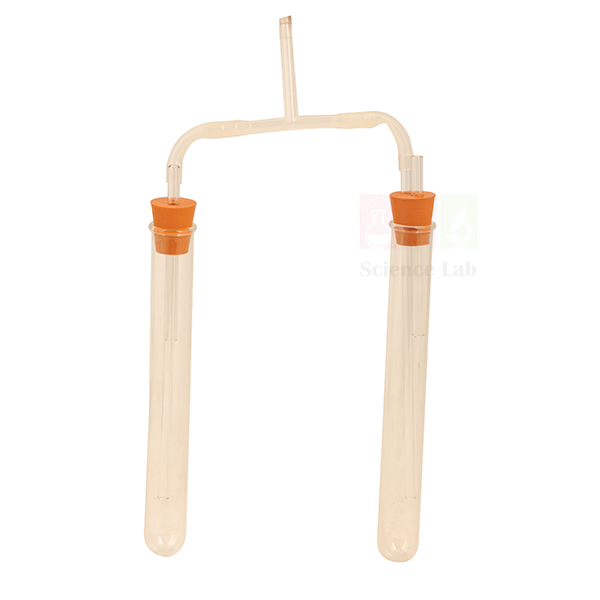
Respiration Apparatus
Respiration Apparatus (Product Code: SLE/BL/039) is a two-tube glass set-up used to compare inhaled and exhaled air in school biology lessons on respiration. It comprises two stoppered boiling tubes with one short and one long length of 5 mm glass tubing, joined by PVC tubing and a plastic T, and is listed for testing inhaled and exhaled air in small organisms. It is made by Jain Scientific Equipments Pvt Ltd (ScienceLab), an OEM manufacturer of biology lab equipment in India, at its own factory in Ambala.
Specifications
| Parameter | Detail |
|---|---|
| Tubes | Two boiling tubes, each with a stopper |
| Glass tubing | Two lengths, one short and one long, of 5 mm glass tubing |
| Connections | PVC tubing and plastic T |
| Purpose | Testing inhaled and exhaled air in small organisms |
| Product code | SLE/BL/039 |
| Manufacturer | Jain Scientific Equipments Pvt Ltd (ScienceLab) — OEM |
| Country of origin | India (made in Ambala, Haryana) |
What Is the Respiration Apparatus Used For?
Both tubes are part-filled with a carbon dioxide indicator such as limewater; in each stopper the long glass tube reaches below the liquid and the short one stays above it. The PVC tubing links the plastic T to the short tube of one boiling tube and the long tube of the other, so that air drawn in bubbles through the first tube on its way in and air breathed out bubbles through the second. Because exhaled air carries more carbon dioxide, the indicator in the "out" tube changes first — limewater turns milky, for example — giving a clear side-by-side comparison in a single lesson.
Before anyone breathes through the T-piece, the teacher should check which tube is which, since an assembly error can draw liquid towards the mouth. Breathe gently, use a clean mouthpiece for each person and rinse the tubes after the lesson. A standard item on any school lab instruments list, the apparatus also supports follow-on discussion of how the same comparison applies to other organisms that respire.
What to Specify When Ordering
- The number of sets — each has two stoppered boiling tubes, short and long 5 mm glass tubing, PVC tubing and a plastic T.
- Whether spare boiling tubes or bored stoppers should be quoted with the sets.
- Whether you need lime water or another carbon dioxide indicator, as none is listed with the apparatus.
OEM Manufacturer
Jain Scientific Equipments Private Limited, trading as ScienceLab from Ambala, Haryana, is the OEM (original equipment manufacturer) of the Respiration Apparatus and makes it at its own licensed factory at Saha, Ambala, India. Registered as an MSME under Udyam number UDYAM-HR-01-0003714, the company moves its overseas consignments under Importer-Exporter Code AAECJ8618A issued by the DGFT. Schools and dealers order factory-direct, and replacement glass tubing or stoppers can be requested from the maker — just ask us. Find out more on our company profile.
Related Biology Lab Equipment
Supplies and apparatus used with the respiration apparatus in the same practical:
- Lime Water — the indicator that turns milky with carbon dioxide
- Boiling Tube — spare tubes for replacements or extra sets
- Rubber stoppers with holes of different diameters — replacement bored stoppers
- Test Tube Stand (Wire Pattern) — keeps the two tubes upright during the test
- Respirometer — for measuring respiration rates quantitatively as a next step
Explore other respiration and physiology apparatus in the Biology Lab Equipment category.
Frequently Asked Questions
What parts make up the Respiration Apparatus?
The Respiration Apparatus comprises two boiling tubes, each with a stopper, and two lengths of 5 mm glass tubing, one short and one long, connected by PVC tubing and a plastic T. Together these let air be drawn in through one tube and breathed out through the other.
Is limewater or indicator supplied with the Respiration Apparatus?
No indicator is listed as part of the Respiration Apparatus. Lime Water is available separately in our range, and your syllabus may suggest another carbon dioxide indicator; mention it in your enquiry and we will add it to the quotation.
What diameter is the glass tubing of the Respiration Apparatus?
The glass tubing of the Respiration Apparatus is 5 mm. In use, the long length dips below the indicator liquid while the short length stays above it, so that air bubbles through the liquid in one direction only.
How should students breathe through the Respiration Apparatus?
Students should use the Respiration Apparatus only under teacher supervision: check the tube arrangement first, breathe gently and give each person a clean mouthpiece. Nobody should suck hard on the T-piece, because an assembly error can draw liquid towards the mouth.
Can I get spare tubes and stoppers for the Respiration Apparatus?
Boiling tubes and bored stoppers for the Respiration Apparatus are listed separately in our range, as shown above. For replacement 5 mm glass tubing, PVC tubing or plastic T-pieces, contact us and we will confirm what can be quoted.
Who manufactures the Respiration Apparatus?
Jain Scientific Equipments Pvt Ltd (ScienceLab) is the OEM manufacturer of the Respiration Apparatus (SLE/BL/039). It is made at the company's own licensed factory at Saha, Ambala, Haryana, India, and supplied factory-direct to schools, colleges, dealers and importers.
Do you supply the Respiration Apparatus in quantity and abroad?
Yes. ScienceLab supplies the Respiration Apparatus to schools, colleges and distributors in India and international markets. Share the number of sets and the delivery location on our contact page, and the quotation will come directly from the manufacturer.
Request a Quote
For a quotation on the Respiration Apparatus, reach us through the contact page or add it to the enquiry cart with the limewater and spares you need. Quotations come directly from the manufacturer.
Last updated: 24 September 2026
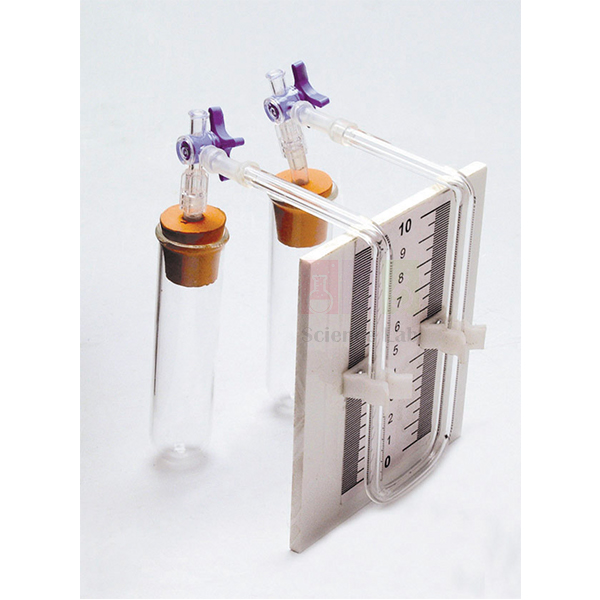
Respirometer
Respirometer (Product Code: SLE/BL/040) is a compact manometer apparatus used to compare the rates at which small organisms absorb or give off gases during respiration in school and college biology laboratories. Students set up two stoppered boiling tubes — one for the organisms, one acting as a control thermo-barometer — joined by three-way taps to a graduated manometer. It is made by Jain Scientific Equipments Pvt Ltd (ScienceLab), an OEM manufacturer, at its own factory in Ambala, India, among its biology lab equipment in India.
Specifications
| Parameter | Detail |
|---|---|
| Chambers | Two stoppered boiling tubes |
| Connection | Three-way taps to either limb of a graduated manometer |
| Experimental tube | Holds the organisms; fitted with a syringe for altering the manometer liquid level during set-up |
| Control tube | Acts as a control thermo-barometer |
| Organism support | Complete with wire baskets for supporting organisms |
| Working principle | CO2 given off by the respiring organisms is absorbed by potassium hydroxide in the experimental chamber, changing the liquid level in the manometer tube |
| Purpose | Comparing rates of absorption or evolution of gases by small organisms during respiration |
| Product code | SLE/BL/040 |
| Manufacturer | Jain Scientific Equipments Pvt Ltd (ScienceLab) — OEM |
| Country of origin | India (made in Ambala, Haryana) |
What Is the Respirometer Used For?
A typical practical places germinating seeds or small invertebrates such as woodlice on the wire basket of the experimental tube, above a layer of potassium hydroxide solution; the control tube is prepared the same way with inert material, such as glass beads, in place of living organisms. With the taps open, the syringe brings the manometer liquid to a starting level, then the taps are closed and timing begins. As the organisms take in oxygen and their carbon dioxide is absorbed, the gas volume in the experimental tube falls and the liquid moves along the graduated scale.
Readings taken at regular intervals give a rate that can be compared between species, temperatures or stages of germination. The thermo-barometer is what makes those comparisons fair: room temperature and air pressure act on both tubes equally, so only the organisms' gas exchange shows as a difference, and standing both tubes in one water bath helps further. Potassium hydroxide is corrosive, so wear eye protection, keep the organisms clear of the liquid and return live animals to their habitat — routine good practice for any biology lab setup in schools in India.
OEM Manufacturer
The Respirometer is built by Jain Scientific Equipments Private Limited, which trades as ScienceLab. The company is the OEM (original equipment manufacturer) of this apparatus and makes it at its own licensed factory at Saha, Ambala, Haryana, India, rather than buying it in from a trader. Schools, colleges, dealers and importers are supplied factory-direct, and if you later need replacement wire baskets or extra units for more benches, ask us — the request is handled by the manufacturer itself. More about the company is on our company profile.
Related Biology Lab Equipment
Chemicals and apparatus that complete a respiration-rate investigation:
- Potassium Hydroxide — the carbon dioxide absorbent for the experimental chamber
- Kit for Demonstrating Seed Respiration in Germination — a complementary seed respiration activity
- Water Bath — holds both tubes at a steady temperature during readings
- Volumeter Respirometer — an alternative respirometer design from the botany range
- Respiration Apparatus — a simpler qualitative test of inhaled and exhaled air
For more physiology apparatus, go to the Biology Lab Equipment category page.
Frequently Asked Questions
Who manufactures the Respirometer?
The Respirometer (SLE/BL/040) is manufactured by Jain Scientific Equipments Private Limited, trading as ScienceLab, which is the OEM and builds it at its own licensed factory at Saha, Ambala, Haryana, India. Quotations, repeat orders and spare-part requests go straight to the manufacturer.
Is potassium hydroxide supplied with the Respirometer?
No, potassium hydroxide is not listed as part of the Respirometer, which comes complete with wire baskets for supporting the organisms. The carbon dioxide absorbent can be ordered separately as Potassium Hydroxide from our chemical range.
What is the second tube of the Respirometer for?
The second boiling tube of the Respirometer acts as a control thermo-barometer. Because temperature and air-pressure changes affect both tubes equally, the difference shown on the graduated manometer reflects only the gas exchange of the organisms in the experimental tube.
What does the syringe on the Respirometer do?
The syringe fitted to the organism tube of the Respirometer alters the level of liquid in the manometer during set-up, so each run starts from a known reading before the three-way taps are closed and timing begins.
What is the scale range of the Respirometer's manometer?
The Respirometer's manometer is graduated, but its scale range and divisions are not stated in our product information. Please ask through the contact page and we will confirm the scale details for the units you are quoted.
Is a calibration certificate available for the Respirometer?
Calibration documentation for the Respirometer should be discussed with us before you order. Mention your requirement in the enquiry and we will advise what paperwork can be provided with the apparatus for your school, college or tender submission.
Can ScienceLab supply the Respirometer in bulk or for export?
Yes. ScienceLab supplies the Respirometer to schools, colleges, dealers and importers in India and international markets. Send the number of units, any reagents or water baths you need and the delivery location through the contact page for a factory-direct quotation.
Request a Quote
Quotations for the Respirometer come direct from the manufacturer. Write to us on the contact page with your quantity, or add the apparatus and its reagent to the enquiry cart.
Last updated: 24 September 2026
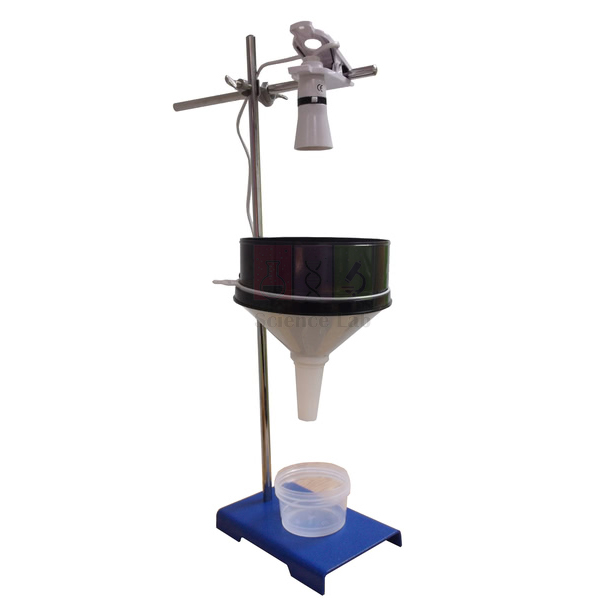
Tullgren Funnel
Tullgren Funnel (Product Code: SLE/BL/041) is a Tullgren-type extraction funnel used to drive small animals out of a soil or leaf-litter sample and into a collecting jar during ecology fieldwork and biology practicals. Schools and colleges add its 175mm funnel and 170mm sieve, 65mm deep, to their zoology lab equipment in India, with a 220V heating lamp held above the sample. It is manufactured by Jain Scientific Equipments Pvt Ltd (ScienceLab), an OEM manufacturer of biology lab equipment in India, at its own factory in Ambala.
Specifications
| Parameter | Detail |
|---|---|
| Funnel diameter | 175mm |
| Sieve diameter | 170mm |
| Sieve depth | 65mm |
| Meshes | Supplied with coarse and fine mesh |
| Sample support | Perforated plate |
| Mounting | Horizontal support rod and bosshead included |
| Heat source | 220V heating lamp held above the soil |
| Bulb required | Low wattage bulb: B22D, bayonet fitting 22mm diameter, 40 watt or less |
| Collection | Organisms are driven down through the funnel into a collecting jar |
| Product code | SLE/BL/041 |
| Manufacturer | Jain Scientific Equipments Pvt Ltd (ScienceLab) — OEM |
| Country of origin | India (made in Ambala, Haryana) |
What Is the Tullgren Funnel Used For?
Clamp the funnel to a stand with the supplied horizontal rod and bosshead, put a collecting jar under the spout, and spread the soil or leaf-litter sample on the perforated plate over the chosen mesh. Coarse mesh lets larger animals drop through freely, while fine mesh stops loose soil from falling into the jar with them. Switch on the lamp above the sample: as the surface warms and dries, mites, springtails, beetle larvae and other soil organisms move downwards and fall through the funnel. A little alcohol in the jar preserves specimens for counting; damp tissue keeps them alive for study and release.
Keep to a bulb of 40 watt or less as specified, because stronger heat can kill animals before they have time to move out. Position the lamp so it cannot touch the sample or any alcohol, and switch it off before handling the set-up. Running several funnels side by side lets a class compare habitats such as lawn, hedge and compost in one session, which makes this a practical centrepiece for an ecology science kit in India.
What to Specify When Ordering
- The number of funnels — one per group if the class will compare several habitats at once
- Whether you also need stands to take the supplied horizontal rod and bosshead
- A suitable low wattage B22D bayonet bulb of 40 watt or less for each funnel, and whether you want us to quote for bulbs
- Your mains voltage, since the heating lamp is specified at 220V
OEM Manufacturer
This funnel comes from Jain Scientific Equipments Private Limited, the company behind the ScienceLab name, which is the OEM (original equipment manufacturer) and produces it at its own licensed factory at Saha, Ambala, Haryana, India. Because the maker is also the seller, schools, colleges, dealers and importers deal directly with the factory for quotations, repeat batches and questions about spare meshes or fittings — just ask us. Read about the company on our company profile.
Related Biology Lab Equipment
Items that complete a soil-fauna extraction set-up:
- Retort Stand — a stand for mounting the funnel with the supplied rod and bosshead
- Garden Auger Soil — for collecting soil samples to load onto the sieve
- Quadrat — for choosing comparable sampling areas in the field
- Plastic Container with a Magnifying Glass Lid — for viewing extracted animals up close
- Stereo Binocular Microscope — for identifying mites, springtails and other small finds
Our Biology Lab Equipment category lists further fieldwork and laboratory items.
Frequently Asked Questions
What are the dimensions of the Tullgren Funnel?
The Tullgren Funnel has a funnel diameter of 175mm and a sieve diameter of 170mm, with a sieve depth of 65mm. That leaves room for a typical soil or leaf-litter sample spread over the coarse or fine mesh on the perforated plate.
Which bulb does the Tullgren Funnel need?
The Tullgren Funnel needs a low wattage bulb with a B22D bayonet fitting of 22mm diameter, rated at 40 watt or less, in its 220V heating lamp. Keeping to that rating warms the sample gently, so animals move down rather than dying in place.
Are a bulb and collecting jar included with the Tullgren Funnel?
The Tullgren Funnel is supplied with a horizontal support rod, a bosshead and coarse and fine mesh. Our product information states that a bulb is required but does not confirm that a bulb or jar is included, so please check with us when ordering.
Why does the Tullgren Funnel come with two meshes?
The Tullgren Funnel includes coarse and fine mesh so the sieve can match the sample: coarse mesh lets larger animals pass freely from crumbly material, while fine mesh holds back more loose soil and keeps the collecting jar cleaner for counting.
Can the Tullgren Funnel be used where the mains supply is not 220V?
The heating lamp for the Tullgren Funnel is specified at 220V. If your laboratory runs on a different mains voltage, contact us before ordering so we can advise on a suitable arrangement for your country or region.
How does the Tullgren Funnel differ from the Funnel Tullgren listing?
Both use the same heat-driven extraction principle. The Tullgren Funnel listing gives dimensions, a support rod, bosshead and two meshes, while Funnel Tullgren describes the method in more detail; compare both and ask us which suits your class.
Who manufactures the Tullgren Funnel?
Jain Scientific Equipments Private Limited, trading as ScienceLab, manufactures the Tullgren Funnel as the OEM at its own licensed factory at Saha, Ambala, Haryana, India. Schools, colleges, dealers and importers in India and international markets buy it direct from the manufacturer.
Request a Quote
Your quotation for the Tullgren Funnel comes straight from the manufacturer. Send your requirement through the contact page, or add the funnel with a stand and viewing equipment to the enquiry cart.
Last updated: 24 September 2026
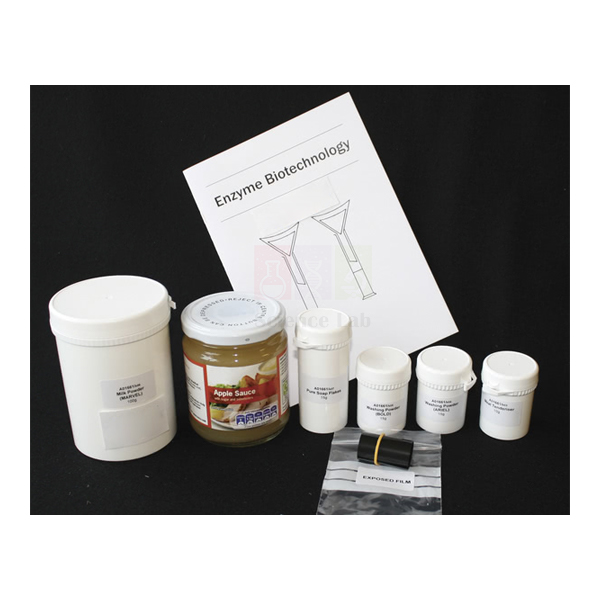
Enzyme Biotechnology Kit
Enzyme Biotechnology Kit (Product Code: SLE/BL/042) is a practical experiment kit used to show how industry uses enzymes, in senior secondary school and college biotechnology classes. Its four experiments cover enzymes in washing powders, pectinase in fruit juice production, rennet in cheese production and protease in meat tenderisers. It is supplied by Jain Scientific Equipments Pvt Ltd (ScienceLab), Ambala, India, as a biotechnology lab kit for schools and colleges.
Key Details
| Parameter | Detail |
|---|---|
| Type | Industrial enzyme experiment kit |
| Experiment 1 | Enzymes in washing powders |
| Experiment 2 | Demonstration of pectinase in fruit juice production |
| Experiment 3 | Rennet in cheese production |
| Experiment 4 | Protease in meat tenderisers |
| Learning focus | Use of enzymes by industry; enzyme-secreting micro-organisms have in most cases replaced more expensive traditional sources |
| Contents list | Available on request |
| Shelf life | Depends on the chemical, its grade and storage conditions — ask us for the expiry date of the batch you are quoted |
| Product code | SLE/BL/042 |
| Supplied by | Jain Scientific Equipments Pvt Ltd (ScienceLab), Ambala, India |
What Is the Enzyme Biotechnology Kit Used For?
Each experiment links a classroom test to a product students already know. With washing powders, they compare how biological detergent breaks down protein-based stains against a non-biological control. In the pectinase demonstration, fruit pulp treated with the enzyme releases more juice, and clearer juice, than untreated pulp. Rennet shows milk proteins clotting into curds — the first step in cheese making — and the meat tenderiser experiment shows a protease digesting a protein sample.
The set-ups make a good enzyme experiment kit for school coursework because variables such as temperature, enzyme concentration and time can each be changed and graphed. They also open a discussion of why industry now sources many enzymes from micro-organisms rather than from traditional sources such as animal tissue. Use a water bath to hold temperatures steady, measure volumes carefully for fair comparisons, and store the enzyme components as their labels direct when the kit arrives.
Supplier
Jain Scientific Equipments Private Limited, trading as ScienceLab in Ambala, Haryana, India, supplies the Enzyme Biotechnology Kit to schools, colleges and distributors, and can add the water baths, thermometers and glassware listed below to the same quotation. For vendor registration, the supplying company's GSTIN is 06AAECJ8618A1ZT and its Legal Entity Identifier (LEI) is 3358004HRD1JIVXKYX49. See our company profile for more.
Related Biology Lab Equipment
Reagents and apparatus that support the four enzyme experiments:
- Protease Enzyme (Dna Seperation) — an additional protease for extending the protein-digestion work
- Water Bath — keeps reaction tubes at a set temperature
- Digital Thermometer — for recording reaction temperatures
- Glass Measuring Cylinder — for measuring juice yield and reagent volumes
- Paper, Universal, pH 1-14 — for checking pH when testing its effect on enzyme activity
Find more biology kits and apparatus in the Biology Lab Equipment category.
Frequently Asked Questions
Which experiments does the Enzyme Biotechnology Kit cover?
The Enzyme Biotechnology Kit covers four industrial applications: enzymes in washing powders, a demonstration of pectinase in fruit juice production, rennet in cheese production and protease in meat tenderisers. Together they show students why industrial enzymes are a major growth area in biotechnology.
What is included in the Enzyme Biotechnology Kit?
A full contents list for the Enzyme Biotechnology Kit is not given on this page. Contact us and ScienceLab will send the contents list before you order, so you can see which glassware and apparatus your laboratory already has.
What is the shelf life of the enzymes in the Enzyme Biotechnology Kit?
Shelf life of the enzymes and reagents in the Enzyme Biotechnology Kit depends on the chemical, its grade and storage conditions; ask us for the expiry date of the batch you are quoted, and store each component as its label directs once the kit arrives.
How many students can use one Enzyme Biotechnology Kit?
The class size for one Enzyme Biotechnology Kit is not stated in our product details. Tell us how many groups you teach and how often the experiments run, and ScienceLab will advise how many kits to include in the quotation.
What extra equipment does the Enzyme Biotechnology Kit need?
Practicals with the Enzyme Biotechnology Kit usually need basic glassware, a way to hold temperatures steady, such as a water bath, and a thermometer. Check the contents list first so that you order only the apparatus your laboratory is missing.
Are replacement reagents available for the Enzyme Biotechnology Kit?
Replacement reagents for the Enzyme Biotechnology Kit are not listed separately on this page. Ask ScienceLab about refills for repeat classes; the expiry date of any batch supplied can be confirmed at the time of quotation.
Who supplies the Enzyme Biotechnology Kit?
The Enzyme Biotechnology Kit is supplied by Jain Scientific Equipments Pvt Ltd (ScienceLab), Ambala, Haryana, India. The company quotes it for schools, colleges and distributors in India and international markets, together with any water baths, thermometers or glassware needed for the experiments.
Request a Quote
Ask for pricing on the Enzyme Biotechnology Kit through our contact page, or add it to the enquiry cart with any extra glassware you need.
Last updated: 24 September 2026

Human Genetic Disorders Poster
Human Genetic Disorders Poster (Product Code: SLE/BL/054) is a wall chart used to show where disease-causing genes sit on the human chromosomes in school and college genetics lessons. Biology teachers use its detailed view of all 23 human chromosome pairs, based on discoveries from the Human Genome Project, printed on an 890mm W x 585mm H sheet. It is supplied by Jain Scientific Equipments Pvt Ltd (ScienceLab), Ambala, India, as part of a biology chart set for schools.
Specifications
| Parameter | Detail |
|---|---|
| Size | 890mm W x 585mm H |
| Chromosomes shown | All 23 human chromosome pairs, in detail |
| Gene locations | Genes that cause some of the most common genetic disorders discovered to date, as part of the Human Genome Project |
| Disorders shown include | Breast cancer, melanoma, deafness, muscular dystrophy, Parkinson's disease, Tay-Sachs disease, cystic fibrosis, colour blindness and many others |
| Additional illustrations | Detailed 3-D view of a cell, a chromosome and double-helix DNA |
| Karyotypes | Karyotypes representing Down's Syndrome and Turner's Syndrome |
| Finish and mounting | Not stated — confirm at enquiry |
| Product code | SLE/BL/054 |
| Supplied by | Jain Scientific Equipments Pvt Ltd (ScienceLab), Ambala, India |
What Is the Human Genetic Disorders Poster Used For?
On the wall of a biology room, the poster becomes a reference students return to throughout a genetics unit. Teachers can start at the cell illustration and zoom in — cell, chromosome, DNA double helix — so that students see a gene as a stretch of DNA at a fixed place on one chromosome. The disorder labels then show that conditions such as cystic fibrosis or muscular dystrophy trace back to specific locations, while the colour blindness entry leads naturally into sex-linked inheritance.
The two karyotypes make a good comparison exercise: students count and pair the chromosomes and spot what differs from a typical set — an extra copy of one chromosome in Down's Syndrome, and a missing sex chromosome in Turner's Syndrome. That distinction between single-gene and whole-chromosome disorders is a key idea in senior biology. Among biology teaching aids for schools in India, the poster works well beside DNA models and practical genetics kits; hang it at eye level and away from strong direct sunlight to keep the print clear.
Supplier
The Human Genetic Disorders Poster is supplied by Jain Scientific Equipments Private Limited, which trades as ScienceLab from Ambala, Haryana, India. The company sources teaching charts like this one alongside its laboratory apparatus, so a school or distributor can place posters, models and practical kits on a single quotation for delivery in India and international markets. Company details are on our company profile.
Related Biology Lab Equipment
Teaching resources that pair with this poster in a genetics unit:
- Visualizing Mitosis Poster — shows how chromosomes are copied and shared during cell division
- Fruit fly Genetics Kit — hands-on crosses for dominance, recessiveness and sex linkage
- DNA/Chromosome Staining Lab Activity — lets students see real chromosomes under the microscope
- Model, DNA — a three-dimensional companion to the double-helix illustration
- Mendelian Inheritance (Mendel's First) — the inheritance principle behind single-gene disorders
Other posters and teaching aids are listed under Biology Lab Equipment.
Frequently Asked Questions
How big is the Human Genetic Disorders Poster?
The Human Genetic Disorders Poster measures 890mm wide by 585mm high, a size that lets a class read the chromosome map and the disorder labels from the front rows when it is mounted at eye level on a biology-room wall.
Which disorders does the Human Genetic Disorders Poster show?
The Human Genetic Disorders Poster marks gene locations for conditions including breast cancer, melanoma, deafness, muscular dystrophy, Parkinson's disease, Tay-Sachs disease, cystic fibrosis and colour blindness, among many others, placed across the 23 human chromosome pairs.
Does the poster include karyotypes?
Yes. The Human Genetic Disorders Poster includes karyotypes representing Down's Syndrome and Turner's Syndrome, together with a detailed 3-D view of a cell, a chromosome and double-helix DNA, so whole-chromosome and single-gene disorders can be compared on one sheet.
Is the Human Genetic Disorders Poster laminated or framed?
The finish and mounting of the Human Genetic Disorders Poster are not stated in our product information. If your school needs a laminated or framed copy, ask through the contact page before ordering and we will confirm what can be supplied.
Which classes is the poster suitable for?
The Human Genetic Disorders Poster suits secondary and senior secondary biology and introductory college genetics, wherever chromosomes, genes, karyotypes and inherited disorders are taught. Teachers use it both as a lesson starter and as a revision reference on the classroom wall.
Who supplies the Human Genetic Disorders Poster?
The Human Genetic Disorders Poster is supplied by Jain Scientific Equipments Private Limited, trading as ScienceLab, in Ambala, Haryana, India. Schools, colleges and distributors in India and international markets can order it on its own or with other charts and models.
Request a Quote
To order the Human Genetic Disorders Poster, get in touch through our contact page with the number of copies, or place it in the enquiry cart alongside other charts and models.
Last updated: 24 September 2026

Breathing Fitness Health Lab
Breathing Fitness Health Lab (Product Code: SLE/BL/043) is a classroom investigation kit used to study the pulmonary system by measuring breath rate, breath volume, breath recovery, breath control, lung volume and the amount of CO2 in exhaled air in school biology and health lessons. It combines a breath control meter, lung and breath volume bags, 3 charts and a Teacher's Pack with activity plans. It is supplied by Jain Scientific Equipments Pvt Ltd (ScienceLab), Ambala, India, as a health education kit for schools.
Specifications
| Parameter | Detail |
|---|---|
| Measurements | Breath rate, breath volume, breath recovery, breath control, lung volume and the amount of CO2 in exhaled air |
| Meter | Breath control meter |
| Bags | Lung volume bag; breath volume bag and valve |
| Measuring aid | Metre tape |
| Consumables included | Mouth pieces and chemicals |
| Charts | 3 charts |
| Teacher support | Teacher's Pack with activity plans |
| Refills | Additional or replacement supplies sold separately |
| Shelf life of chemicals | Depends on the chemical, its grade and storage conditions — ask us for the expiry date of the batch you are quoted |
| Product code | SLE/BL/043 |
| Supplied by | Jain Scientific Equipments Pvt Ltd (ScienceLab), Ambala, India |
What Is the Breathing Fitness Health Lab Used For?
A typical lesson begins with resting measurements: students count their breath rate, use the breath volume bag and valve to capture the air moved in a normal breath, and use the lung volume bag to gauge lung volume. After a short burst of exercise they repeat the readings and time how long their breathing takes to settle — the breath recovery measure — which gives a simple, personal indicator of fitness. The breath control meter adds a separate measure, so students see more than one side of respiratory fitness.
Measuring the CO2 in exhaled air ties the physical readings back to cell respiration, and the charts and activity plans help teachers turn the class data into a discussion of exercise, smoking and lung health. Give each student their own mouth piece, wipe shared parts between users, and let anyone with asthma or a breathing condition sit out the forced-breath activities.
What to Specify When Ordering
- Number of complete kits for your class or year group
- Any additional or replacement supplies — mouth pieces, chemicals or bags — since these are sold separately
- Extra lung volume bags if several groups will measure at the same time
- Whether you need the chemical list and safety information before dispatch
Supplier
The Breathing Fitness Health Lab is supplied by Jain Scientific Equipments Private Limited, which trades as ScienceLab from Ambala, Haryana, India. Schools can order the kit, its separately sold refills and the physiology apparatus below in one quotation. For vendor registration, the supplying company holds Importer-Exporter Code AAECJ8618A (DGFT) and GSTIN 06AAECJ8618A1ZT. Learn more on our company profile.
Related Biology Lab Equipment
Items that extend or resupply the breathing and fitness activities:
- Lung Volume Bags — extra bags so more students can measure at once
- Peak Flow Meter — adds peak expiratory flow to the fitness measurements
- Spirometer — for recording lung volumes in more detail at senior level
- Stopwatch, Digital — for timing breath rate and recovery after exercise
- Human Respiratory System Model, 2-parts — shows the anatomy behind the measurements
Browse related physiology kits in the Biology Lab Equipment category.
Frequently Asked Questions
What can students measure with the Breathing Fitness Health Lab?
With the Breathing Fitness Health Lab, students measure breath rate, breath volume, breath recovery, breath control, lung volume and the amount of CO2 in exhaled air, so they can compare resting and post-exercise readings and link fitness to how the lungs work.
What comes in the Breathing Fitness Health Lab?
The Breathing Fitness Health Lab includes a breath control meter, a lung volume bag, a breath volume bag and valve, a metre tape, mouth pieces, chemicals, 3 charts and a Teacher's Pack with activity plans for running the activities.
Can extra mouth pieces and chemicals be bought for the Breathing Fitness Health Lab?
Yes. Additional or replacement supplies for the Breathing Fitness Health Lab are sold separately. Contact us with the items and quantities you need, such as mouth pieces, chemicals or bags, and they can be included in the same quotation as the kit.
Which chemicals are in the Breathing Fitness Health Lab, and how long do they keep?
The chemicals in the Breathing Fitness Health Lab are not named in our listing, so ask us for the list and safety information. Shelf life depends on the chemical, its grade and storage conditions; ask us for the expiry date of the batch you are quoted.
How many students can one Breathing Fitness Health Lab serve?
A class size for one Breathing Fitness Health Lab is not stated. Tell us how you plan to group students and ScienceLab will suggest how many kits or extra lung volume bags you need so every group can measure at the same time.
Who supplies the Breathing Fitness Health Lab?
The Breathing Fitness Health Lab is supplied by Jain Scientific Equipments Pvt Ltd (ScienceLab), Ambala, Haryana, India, to schools, colleges and distributors in India and international markets, along with its separately sold refills and related physiology apparatus.
What should a school include in a quotation request for the Breathing Fitness Health Lab?
A quotation request for the Breathing Fitness Health Lab should give product code SLE/BL/043, the number of kits, any extra supplies such as mouth pieces or bags, and the delivery address, so ScienceLab can price everything in one reply.
Request a Quote
For a quotation on the Breathing Fitness Health Lab and its refills, write to us via the contact page or add the items to your enquiry cart.
Last updated: 24 September 2026

Spirometer
Spirometer (Product Code: SLE/BL/044) is a recording spirometer used to measure tidal volume, respiratory rate, pulmonary ventilation, reserve volumes, vital capacity and oxygen consumption in college and senior school physiology laboratories. Its one-piece stainless steel tank holds a lightweight plastic float, calibrated 0 to 7 x 0.5 litres, that rises and falls with each breath to draw a trace on a kymograph or datalogger. It is supplied by Jain Scientific Equipments Pvt Ltd (ScienceLab), Ambala, India.
Specifications
| Parameter | Detail |
|---|---|
| Investigations | Tidal volumes, respiratory rate, pulmonary ventilation, reserve volumes, vital capacity; oxygen consumption for metabolic studies |
| Tank | One-piece stainless steel pressing |
| Outer case | Durable painted outer case |
| Float | Lightweight plastic, with metal counterpoise |
| Float calibration | 0 to 7 x 0.5 litres |
| Pen arm | Corresponds to approximately 0.5 litres |
| Subject connection | Simple lever control connects the subject either to atmosphere or to the float for recording |
| CO2 absorption | Container for soda lime crystals fitted |
| Breathing hoses | Two corrugated hoses, 0.8 m long |
| Accessories | Two mouthpieces and a nose clip |
| Airflow | Designed to offer minimum resistance to airflow |
| Recording | Kymograph or datalogger system required to record results |
| Soda lime crystals | Not supplied |
| Product code | SLE/BL/044 |
| Supplied by | Jain Scientific Equipments Pvt Ltd (ScienceLab), Ambala, India |
What Is the Spirometer Used For?
In a practical, the subject fits the nose clip, takes a mouthpiece and breathes to atmosphere through the lever valve until comfortable; the lever is then switched to the float and the trace begins. Quiet breathing gives tidal volume and respiratory rate, a maximal breath in and out gives vital capacity, and extra effort at the end of a normal breath reveals the reserve volumes. Multiplying tidal volume by breathing rate gives pulmonary ventilation, which students can compare at rest and after exercise.
With soda lime in the fitted container absorbing exhaled carbon dioxide, the gas volume in the tank falls steadily as oxygen is used, so the slope of the trace gives oxygen consumption for metabolic-rate work. Connect the kymograph or datalogger before starting, give each subject a clean mouthpiece, keep recordings short and stop at once if the subject feels dizzy. Because one instrument covers the full set of lung volume and ventilation practicals, it is common pharmacy college lab equipment as well as a senior biology staple.
What to Specify When Ordering
- Number of spirometers for your practical groups
- Whether you already have a kymograph or datalogger system, which is required to record results
- Soda lime crystals, which are not supplied with the instrument, if you plan oxygen-consumption work
- Any calibration paperwork your purchase file needs, so it can be discussed before quotation
Supplier
Jain Scientific Equipments Private Limited, trading as ScienceLab in Ambala, Haryana, India, supplies this recording spirometer to college physiology departments, senior schools and distributors. Recording equipment and soda lime are not part of the instrument, so tell us what your laboratory already has and the quotation can be matched to it. Our company profile gives more background.
Related Biology Lab Equipment
Equipment that complements the spirometer in respiratory physiology teaching:
- Breathing Fitness Health Lab — a class kit for simpler breathing and fitness measurements
- Peak Flow Meter — adds peak expiratory flow to lung-function work
- Lung Volume Bags — a quick comparison method for lung volume
- Lung Capacity Gauge — another way to demonstrate lung capacity
- Human Lung Model in Bell Jar — shows the breathing mechanism behind the readings
Explore more physiology apparatus in our Biology Lab Equipment range.
Frequently Asked Questions
What can be measured with the Spirometer?
The Spirometer measures tidal volumes, respiratory rate, pulmonary ventilation, reserve volumes and vital capacity. With soda lime in its fitted container, it also measures oxygen consumption, which makes it useful for metabolic-rate studies in college and senior school physiology practicals.
Is a recording device included with the Spirometer?
No recording device is included with the Spirometer; a kymograph or datalogger system is required to record results. Contact us if you need advice on connecting the spirometer to the recording equipment your laboratory already uses.
Are soda lime crystals supplied with the Spirometer?
No. The Spirometer has a container for soda lime crystals fitted to absorb exhaled carbon dioxide, but the crystals themselves are not supplied. Source them separately and replace them when exhausted so oxygen-consumption readings stay meaningful.
How is the Spirometer float calibrated?
The Spirometer float is calibrated 0 to 7 x 0.5 litres and carries a metal counterpoise, and the pen arm corresponds to approximately 0.5 litres. The float is made from lightweight plastic, in keeping with the design aim of minimum resistance to airflow.
Which breathing accessories come with the Spirometer?
The Spirometer comes with two corrugated breathing hoses 0.8 m long, two mouthpieces and a nose clip. Give each subject a clean mouthpiece and keep the nose clip on during recordings so that all exhaled air passes into the tank.
Is a calibration certificate available for the Spirometer?
Calibration documentation for the Spirometer is not described in our product details. Please ask ScienceLab before ordering, and we will confirm what calibration paperwork, if any, can be provided with the instrument for your purchase file.
Who supplies the Spirometer?
The Spirometer is supplied by Jain Scientific Equipments Pvt Ltd (ScienceLab), Ambala, Haryana, India, to colleges, schools and distributors in India and international markets. Send your quantity and recording set-up through the contact page for a matched quotation.
Request a Quote
For pricing on the Spirometer and suitable accessories, use our contact page or add it to the enquiry cart.
Last updated: 24 September 2026

HIV/AIDS Testing Kit, Simulated
HIV/AIDS Testing Kit, Simulated (Product Code: SLE/BL/045) is a classroom activity kit used to demonstrate the HIV test for AIDS with real laboratory techniques but simulated blood and reagents, in school and college biology and health lessons. It holds sufficient reagent and materials for a class of 30 students, with a teacher's guide, student notes, chemicals and equipment included. It is supplied by Jain Scientific Equipments Pvt Ltd (ScienceLab), Ambala, as a biology experiment kit for students, alongside its school biology lab equipment in India.
Key Details
| Parameter | Detail |
|---|---|
| Type | Simulated HIV test activity kit for teaching |
| Samples and reagents | Simulated blood and simulated reagents, described as safe in the hands of students and teachers |
| Class size | Sufficient reagent and materials for a class of 30 students |
| Included | Teacher's guide and students' notes, chemicals and equipment |
| Technique | Uses real laboratory techniques to demonstrate the HIV test |
| Learning outcomes | The body's immune system and the antigen/antibody reaction; what goes wrong when HIV infection occurs; the importance of safe blood for transfusion; how blood is screened and the disease diagnosed; prevention of spread |
| Diagnostic use | None — a teaching simulation, not a diagnostic test |
| Shelf life | Depends on the chemical, its grade and storage conditions — ask us for the expiry date of the batch you are quoted |
| Product code | SLE/BL/045 |
| Supplied by | Jain Scientific Equipments Pvt Ltd (ScienceLab), Ambala, India |
What Is the Simulated HIV/AIDS Testing Kit Used For?
The activity usually opens with the immune system: how antibodies recognise and bind to a specific antigen, and why a test can look for antibodies as evidence of infection. Students then work through the simulated test on a set of "patient" samples, following the same kind of step-by-step procedure a screening laboratory uses, and record which samples react. Because the blood and reagents are simulated, every student can take part directly rather than watch a demonstration.
The results lead into a discussion of what HIV does to the immune system, why blood transfusion — a life-saving practice given to millions of patients every month — depends on safe, screened blood, and how the spread of the disease can be prevented. It fits well in a health education kit collection for schools. Teachers should make clear that this is a simulation, set ground rules for discussing a sensitive topic respectfully, and still ask students to wear gloves and eye protection to build good laboratory habits.
Supplier
Jain Scientific Equipments Private Limited trades as ScienceLab from Ambala, Haryana, India, and supplies this simulated HIV/AIDS testing kit to schools, colleges and distributors. The same enquiry can include companion lessons, such as the simulated blood typing and immunity kits listed below. For company background, see our company profile.
Related Biology Lab Equipment
Other simulated-sample kits and teaching aids for health and immunity lessons:
- Blood Typing Kit, Simulated — blood grouping with artificial samples, a natural companion lesson on transfusion
- Teaching About Immunity Kit — extends the antigen/antibody topic
- Aids Virus Chart — wall chart to support the discussion of the virus
- Human Blood Cell Types Model — shows the blood cells involved in immunity
- Simulated Diabetes Testing — a further simulated clinical test for health units
Further kits for biology teaching are in the Biology Lab Equipment category.
Frequently Asked Questions
Does the HIV/AIDS Testing Kit, Simulated contain real blood?
No. The HIV/AIDS Testing Kit, Simulated uses simulated blood and simulated reagents, which our product details describe as safe in the hands of students and teachers, so every learner can carry out the test steps instead of watching a demonstration.
Can the HIV/AIDS Testing Kit, Simulated be used to test a person for HIV?
No. The HIV/AIDS Testing Kit, Simulated is an educational simulation that shows how a screening test works using simulated samples. It is not a diagnostic product and must never be used to test a real person or real blood.
How many students does one HIV/AIDS Testing Kit, Simulated cover?
One HIV/AIDS Testing Kit, Simulated contains sufficient reagent and materials to suit a class of 30 students. For larger year groups or repeat lessons, tell us the total number of students so the right number of kits can be quoted.
What is included in the HIV/AIDS Testing Kit, Simulated?
The HIV/AIDS Testing Kit, Simulated includes a teacher's guide, student notes, and the chemicals and equipment needed for the activity, including simulated blood and reagents. Ask us for the detailed component list if your purchase committee needs it before approval.
What is the shelf life of the HIV/AIDS Testing Kit, Simulated?
Shelf life of the reagents in the HIV/AIDS Testing Kit, Simulated depends on the chemical, its grade and storage conditions; ask us for the expiry date of the batch you are quoted so that you can plan the lesson date around it.
Can reagents be reordered for the HIV/AIDS Testing Kit, Simulated?
Refill availability for the HIV/AIDS Testing Kit, Simulated is not stated in our product details. Contact us with your class numbers and ScienceLab will advise on repeat supplies for further lessons.
Who supplies the HIV/AIDS Testing Kit, Simulated?
The HIV/AIDS Testing Kit, Simulated is supplied by Jain Scientific Equipments Pvt Ltd (ScienceLab), Ambala, Haryana, India, to schools, colleges and distributors in India and international markets, together with companion simulated-sample kits for health and immunity teaching.
Request a Quote
To price the HIV/AIDS Testing Kit, Simulated for your classes, send a request through our contact page or add it to the enquiry cart with any companion kits.
Last updated: 24 September 2026

Lung Volume Bags
Lung Volume Bags (Product Code: SLE/BL/046) are calibrated plastic bags used to measure how much air a student breathes out during respiration practicals in schools and colleges. The set holds four durable bags, each calibrated to 6 litres with the measurements clearly displayed on the outside, and it is intended for use with the Lung Volume Kit. They are supplied by Jain Scientific Equipments Pvt Ltd (ScienceLab), Ambala, India, for biology lab equipment in India.
Specifications
| Parameter | Detail |
|---|---|
| Product type | Calibrated lung volume bags |
| Calibration | Each bag calibrated to 6 litres |
| Scale | Measurements clearly displayed on the outside of the bags |
| Material | Durable plastic |
| Pack size | Pack of 4 bags (Set of 4) |
| Intended for | For use with the Lung Volume Kit |
| Product code | SLE/BL/046 |
| Supplied by | Jain Scientific Equipments Pvt Ltd (ScienceLab), Ambala, India |
What Are Lung Volume Bags Used For?
In a breathing practical, a student first exhales a normal, relaxed breath into an empty bag to estimate tidal volume, then takes the deepest breath possible and blows out fully into a fresh bag to estimate vital capacity. Because the graduations are printed on the bag itself, the class can compare results between students, before and after light exercise, or between sitting and standing, and plot the numbers in their notebooks.
With four bags in the set, a group can run repeat trials without waiting for one bag to be emptied. Squeeze each bag completely flat before a new reading so leftover air does not inflate the result, and hold it steady at eye level when reading the scale. The set fits a health education kit for school biology lessons in India as well as introductory physiology classes in colleges, where students compare lung volumes with measurements from a spirometer or peak flow meter.
Supplier
Lung Volume Bags are supplied by Jain Scientific Equipments Private Limited, a company that trades under the ScienceLab name from Ambala, Haryana, India. It supplies teaching laboratories in India and international markets with breathing and physiology apparatus, so replacement bag sets can be quoted together with the other items used in the same lesson. Our company profile gives more background on the business.
Related Biology Lab Equipment
Items that fit into the same lung capacity and breathing lesson:
- Spirometer — an alternative instrument for measuring breathing volumes alongside the bags
- Lung Capacity Gauge — a second method students can use to cross-check their bag readings
- Peak Flow Meter — adds a measure of how fast air leaves the lungs, not just how much
- Breathing Fitness Health Lab — a wider activity set on breathing and fitness
- Human Lung Model in Bell Jar — demonstrates the chest and diaphragm movement that drives each breath
See the full Biology Lab Equipment range for more respiration and physiology teaching items.
Frequently Asked Questions
What is in one pack of Lung Volume Bags?
One pack of Lung Volume Bags contains four durable plastic bags, each calibrated to 6 litres with the measurements clearly displayed on the outside. Other parts of the Lung Volume Kit are not listed as part of this pack, so ask us if you need them.
Can Lung Volume Bags be used without the Lung Volume Kit?
Lung Volume Bags are intended for the Lung Volume Kit, which they are packed for. Whether they will suit a different set-up depends on how air is delivered into the bag, so describe your arrangement to us before ordering.
How much air can each Lung Volume Bag measure?
Each Lung Volume Bag is calibrated to 6 litres. The scale on the outside lets students read smaller exhaled volumes, such as a relaxed tidal breath, as well as a full vital-capacity breath further up the range.
How should Lung Volume Bags be looked after?
Lung Volume Bags are made of durable plastic. After each reading, squeeze the bag completely flat, wipe the opening before the next student uses it, and store the set flat and dry so the printed measurements stay easy to read in later lessons.
Is a calibration certificate available for Lung Volume Bags?
Calibration documentation for Lung Volume Bags should be discussed with us at the enquiry stage. Tell us what your department or tender requires through the contact page and we will explain what paperwork can be offered with your order.
Who supplies Lung Volume Bags?
Lung Volume Bags are supplied by Jain Scientific Equipments Private Limited, which trades as ScienceLab from Ambala, Haryana, India. The company serves schools, colleges and distributors in India and international markets and can quote the bags together with spirometers and other breathing apparatus.
Request a Quote
For pricing, availability or bulk supply of Lung Volume Bags, contact us with the number of packs you need, or add the item to your enquiry cart.
Last updated: 24 September 2026

Peak Flow Meter
Peak Flow Meter (Product Code: SLE/BL/047) is a portable meter used to measure peak expiratory flow — how fast a person can blow air out of the lungs in one sharp breath — in school, college and health-science teaching laboratories. Each unit is individually calibrated, reads on a 60–800 scale and has an integral one-way valve to reduce the risk of cross-infection when a class shares it. It is supplied by Jain Scientific Equipments Pvt Ltd (ScienceLab), Ambala, as part of its range of biology lab equipment in India.
Specifications
| Parameter | Detail |
|---|---|
| Type | Portable peak flow meter |
| Scale | 60–800 |
| Calibration | Individually calibrated for high inter- and intra-device accuracy |
| Construction | Medical-grade construction |
| Hygiene feature | Integral one-way valve to reduce the risk of cross-infection |
| Mouthpieces | Not listed as part of the meter — disposable mouthpieces available separately |
| Product code | SLE/BL/047 |
| Supplied by | Jain Scientific Equipments Pvt Ltd (ScienceLab), Ambala, India |
What Is the Peak Flow Meter Used For?
For a class reading, the student stands up straight, returns the pointer to the bottom of the scale, takes the fullest breath possible, seals the lips around the mouthpiece and blows out as hard and fast as they can. Repeating this three times and recording the highest value gives a fair result. Students can then compare readings across the group, look for a link with height, or measure again after a short burst of activity.
Teachers often use the readings to open a discussion on why airways narrow in conditions such as asthma and how people monitor their own breathing, which makes the meter a practical addition to biology lab equipment for respiratory-system topics. Remind the class that school readings are for learning only and are not a medical check. Use a fresh mouthpiece for every student and store the meter safely between lessons so the scale and pointer stay undamaged.
What to Specify When Ordering
- Number of meters, for example one per practical group
- Packs of disposable mouthpieces, which are sold separately
- Whether you need the product datasheet with the scale units for worksheets
- Any calibration paperwork your institution requires, raised before quotation
Supplier
Jain Scientific Equipments Private Limited, which trades as ScienceLab from Ambala, Haryana, India, supplies this peak flow meter as a biology lab instruments supplier to schools, colleges and health-science training departments. Meters and their separately sold disposable mouthpieces can be quoted together in one reply. See the company profile for an overview.
Related Biology Lab Equipment
Useful additions for the same respiratory practical:
- Plastic Disposable Mouthpieces for Peak Flow Meter — so each student blows through a clean mouthpiece
- Spirometer — measures breathing volumes to set beside flow readings
- Lung Volume Bags — for collecting and comparing an exhaled breath
- Breathing Fitness Health Lab — a broader breathing and fitness activity set
More respiration and physiology items are listed in our Biology Lab Equipment category.
Frequently Asked Questions
Are mouthpieces included with the Peak Flow Meter?
Mouthpieces are not listed as part of the Peak Flow Meter. Disposable mouthpieces made for it are available separately as Plastic Disposable Mouthpieces for Peak Flow Meter, so each student can blow through a clean one during class readings.
What range does the Peak Flow Meter scale cover?
The Peak Flow Meter scale runs from 60 to 800. Our current listing does not state the scale units, so ask us for the product datasheet if you need them for a worksheet or practical record book.
What does the one-way valve on the Peak Flow Meter do?
The integral one-way valve on the Peak Flow Meter lets air flow out through the meter while stopping the user from drawing air back through it, which reduces the risk of cross-infection when a group shares one meter.
Can the Peak Flow Meter be used to diagnose a breathing problem?
No. In a school or college, the Peak Flow Meter is a teaching instrument for demonstrating lung function, and class readings are for learning only. Anyone with a breathing concern should see a doctor rather than rely on a classroom reading.
Is each Peak Flow Meter calibrated?
Yes. Every Peak Flow Meter is individually calibrated for high inter- and intra-device accuracy. If your institution needs a formal calibration certificate, raise it with us before ordering so ScienceLab can advise what documentation is possible.
Who supplies the Peak Flow Meter?
The Peak Flow Meter is supplied by Jain Scientific Equipments Pvt Ltd (ScienceLab), Ambala, Haryana, India, to schools, colleges, health-science departments and distributors in India and international markets, together with its separately sold disposable mouthpieces.
Can ScienceLab supply Peak Flow Meters for a whole class?
Yes. For a class set of Peak Flow Meters, send the number of meters, the mouthpiece packs you need and the delivery location, and ScienceLab will quote for supply within India or for export.
Request a Quote
To order the Peak Flow Meter or ask about quantity pricing, contact us or place it in your enquiry cart.
Last updated: 24 September 2026

Plastic Disposable Mouthpieces for Peak Flow Meter
Plastic Disposable Mouthpieces for Peak Flow Meter (Product Code: SLE/BL/048) are single-use white plastic mouthpieces used to fit a peak flow meter for each new student during breathing practicals in schools and colleges. They come in a pack of 15, so a class can give every participant a fresh piece instead of passing one mouthpiece along the bench. They are supplied by Jain Scientific Equipments Pvt Ltd (ScienceLab), Ambala, India, as a routine consumable for a health education kit in schools.
Specifications
| Parameter | Detail |
|---|---|
| Material | Plastic |
| Colour | White |
| Type | Disposable |
| Pack size | Pack of 15 |
| For use with | Peak Flow Meter |
| Product code | SLE/BL/048 |
| Supplied by | Jain Scientific Equipments Pvt Ltd (ScienceLab), Ambala, India |
What Are Peak Flow Meter Mouthpieces Used For?
Before the peak flow activity begins, hand each student a mouthpiece from the pack. The student fits it to the meter, takes their readings, then removes it and discards it before passing the meter on. Keeping an open pack at the bench lets the next person start straight away, so a whole class can record peak flow in a single lesson without long pauses between students.
When planning a practical, count one mouthpiece per student per session; larger classes will need more than one pack. Store unopened mouthpieces in a clean, closed container away from chemicals and dust until they are needed. They are a regular reorder item wherever a first aid training kit or breathing lesson in school uses the peak flow meter often.
Supplier
These mouthpieces are supplied by Jain Scientific Equipments Private Limited, the company behind the ScienceLab brand, based in Ambala, Haryana, India. It supplies them as a consumable for teaching use to schools, colleges and training institutions in India and international markets; the company profile has further details.
Related Biology Lab Equipment
Equipment used together with these mouthpieces:
- Peak Flow Meter — the meter these mouthpieces are intended for
- Spirometer — a further breathing measurement for the same class session
- Lung Volume Bags — lets students measure the volume of a breath as well as its speed
- Breathing Fitness Health Lab — an activity set linking breathing with fitness
Browse all items in Biology Lab Equipment.
Frequently Asked Questions
How many mouthpieces are in a pack?
Each pack of Plastic Disposable Mouthpieces for Peak Flow Meter holds 15 white plastic mouthpieces. For planning, count one mouthpiece per student per session; a larger class or several practical groups will need more than one pack.
Will these mouthpieces fit my existing peak flow meter?
These Plastic Disposable Mouthpieces are listed for use with the Peak Flow Meter we supply. If you already own a different meter, send its make and model through the contact page so we can check the fit before you order.
Can a disposable mouthpiece be reused?
No. Plastic Disposable Mouthpieces for Peak Flow Meter are disposable, so each one should be discarded once its student has finished taking readings, rather than being washed and passed to the next person in the class.
How should spare packs of mouthpieces be stored?
Keep unopened packs of Plastic Disposable Mouthpieces for Peak Flow Meter in a clean, dry, closed cupboard away from laboratory chemicals and dust, and open a new pack only when a breathing practical is about to begin.
Who supplies the Plastic Disposable Mouthpieces for Peak Flow Meter?
The Plastic Disposable Mouthpieces for Peak Flow Meter are supplied by Jain Scientific Equipments Private Limited, which trades as ScienceLab in Ambala, Haryana, India, and serves teaching laboratories in India and international markets.
Can a school order a term's supply of mouthpieces?
Yes. Schools can order several packs of Plastic Disposable Mouthpieces for Peak Flow Meter at once. Tell us the number of packs, whether you also need peak flow meters, and the delivery location in India or abroad for a quotation.
Request a Quote
For prices and stock of these mouthpieces, get in touch or add them to the enquiry cart together with the meter.
Last updated: 24 September 2026

Reaction Timer
Reaction Timer (Product Code: SLE/BL/049) is a classroom timing instrument used to measure how quickly a person responds to a stimulus in biology, physiology and physical education lessons. Students use it to record their response time to various stimuli, including light, sound and touch, and then compare how fast each sense triggers a reaction. It is supplied by Jain Scientific Equipments Pvt Ltd (ScienceLab), Ambala, India, among its biology teaching aids for schools and colleges.
Key Details
| Parameter | Detail |
|---|---|
| Type | Reaction timer for student investigations |
| Purpose | Measures a person's response time to a stimulus |
| Stimuli covered | Various stimuli, including light, sound and touch |
| Suitable for | School and college biology, human physiology and sports science classes |
| Product code | SLE/BL/049 |
| Supplied by | Jain Scientific Equipments Pvt Ltd (ScienceLab), Ambala, India |
What Is the Reaction Timer Used For?
Students usually work in pairs: one person runs the test while the other waits to respond as soon as they notice the signal. After several trials with a light, then a sound, then a touch stimulus, the class can calculate an average for each and ask which sense produces the quickest response. The same routine can compare the dominant and non-dominant hand, test the effect of a distraction, or look at results before and after a short spell of exercise.
The data lead naturally into a discussion of how a signal travels from a sense organ to the brain and out to a muscle, and why a reflex is faster than a decision. Because results differ so clearly between people, the timer also makes a good starting point for a science fair project kit in India on attention, practice or fatigue. Ask students to keep conditions the same between trials — same seat, same hand, same warning — so their comparisons are fair.
Supplier
The Reaction Timer is supplied by Jain Scientific Equipments Private Limited, trading as ScienceLab and located in Ambala, Haryana, India. The company equips teaching laboratories in India and international markets, and a department can order the timer with the sense-organ and physiology items used in the same unit on one quotation. Learn more on the company profile page.
Related Biology Lab Equipment
Items that pair well with reaction time investigations:
- Sight & Sound Health Lab — explores the sense organs whose signals the timer measures
- Tumble & Teach Exercise — quick classroom exercises for before-and-after reaction tests
- Stethoscope — records pulse changes in the same human physiology session
- Millisecond Timer — a general laboratory timer for other short-interval timing work
Find more human biology items in the Biology Lab Equipment section.
Frequently Asked Questions
Which stimuli can the Reaction Timer test?
The Reaction Timer measures a student's response time to various stimuli, including light, sound and touch. Running the same test with each stimulus lets a class compare which sense produces the quickest reaction and discuss why the results differ.
What display and power supply does the Reaction Timer use?
Display type and power supply for the Reaction Timer are not given in our current product information. Please ask through the contact page and we will share the datasheet for the model we quote before you place an order.
What age group is the Reaction Timer suitable for?
The Reaction Timer suits reaction-time activities from middle school to college. Younger classes can simply compare light, sound and touch responses, while senior students calculate averages, repeat trials and discuss nerve pathways and reflex arcs using the same data.
How should the Reaction Timer be looked after?
Keep the Reaction Timer on a dry bench away from water and chemicals, avoid dropping it, and store it in a cupboard between lessons. Check that it works before a practical so each pair of students can start testing straight away.
Is a calibration certificate available for the Reaction Timer?
If your department needs timing documentation for the Reaction Timer, mention it in your enquiry. We will discuss with you what can be provided for the specific unit quoted before you commit to the order.
Who supplies the Reaction Timer?
The Reaction Timer is supplied by Jain Scientific Equipments Private Limited, which trades as ScienceLab from Ambala, Haryana, India. Schools, colleges and distributors in India and international markets can ask for one unit or several timers for a whole class.
Request a Quote
To ask about pricing, contact us with the number of timers you need, or add the Reaction Timer to your enquiry cart.
Last updated: 24 September 2026

Simulated Diabetes Testing
Simulated Diabetes Testing (Product Code: SLE/BL/050) is a classroom investigation kit used to teach how diabetes is diagnosed, with students running a series of standard diagnostic tests on simulated blood and urine samples in school, college and health-science courses. Working from several patient medical histories, they reach a diagnosis, plan how to manage the condition and take a 'diabetic risk test' themselves. It is supplied by Jain Scientific Equipments Pvt Ltd (ScienceLab), Ambala, a biology lab equipment supplier in India.
Key Details
| Parameter | Detail |
|---|---|
| Type | Simulated diabetes diagnosis activity |
| Supplied as | Several patient medical histories with simulated blood and urine samples |
| Student tasks | Series of standard diagnostic tests, diagnosis, and a plan for managing the patient's condition |
| Class activity | A 'diabetic risk test' for students to assess their own potential for developing the disease |
| Topics covered | Types, causes, symptoms and treatment options of diabetes |
| Diagnostic use | None — a classroom simulation, not a medical test |
| Shelf life | Depends on the chemical, its grade and storage conditions — ask us for the expiry date of the batch you are quoted |
| Product code | SLE/BL/050 |
| Supplied by | Jain Scientific Equipments Pvt Ltd (ScienceLab), Ambala, India |
What Is Simulated Diabetes Testing Used For?
The teacher hands each group a patient history and the matching simulated samples. Groups carry out the tests, record their observations and compare the results with the symptoms and background in the history to decide whether the patient has diabetes, and of which type. Each group then drafts a management plan covering points such as diet, activity and treatment, and presents its reasoning to the class — turning a textbook chapter into applied problem-solving.
The lesson usually closes with the diabetic risk test, where students consider their own lifestyle and family factors. Because the samples are simulated, the whole activity can run in an ordinary classroom without real body fluids, which makes it a practical choice for a health education kit in school or an introductory biomedical course. Wear gloves and eye protection as for any wet practical, and follow the instructions supplied with the samples.
Supplier
Jain Scientific Equipments Private Limited, which trades as ScienceLab from Ambala, Haryana, India, supplies Simulated Diabetes Testing as part of its range of simulated-sample kits, working as a biology lab equipment supplier in India to schools, colleges and health-science courses. For vendor registration, the supplying company is registered under CIN U29309HR2020PTC087597 and GSTIN 06AAECJ8618A1ZT. Read the company profile for more about the business.
Related Biology Lab Equipment
Other simulated diagnostic and human biology resources that suit the same course:
- HIV/AIDS Testing Kit, Simulated — another simulated diagnostic testing exercise
- Blood Typing Kit, Simulated — blood group testing without real blood
- Benedicts Reagent (Test Of Glucose) — the classic reagent for showing how glucose is detected
- Systems of The Human Body Poster — shows the endocrine system alongside the other body systems
More teaching items are listed under Biology Lab Equipment.
Frequently Asked Questions
Does Simulated Diabetes Testing use real blood or urine?
No. Simulated Diabetes Testing uses simulated blood and urine samples, so students practise a series of standard diagnostic tests without handling real body fluids, and the activity can run in an ordinary classroom with gloves and eye protection.
What is supplied with Simulated Diabetes Testing, and how many students does it serve?
Simulated Diabetes Testing provides several patient medical histories with simulated blood and urine samples. Sample quantities and group numbers are not stated in our current listing, so contact us with your class size and ScienceLab will confirm what one set covers.
Is the diabetic risk test in Simulated Diabetes Testing a medical screening?
No. The diabetic risk test in Simulated Diabetes Testing is a classroom exercise that helps students think about lifestyle and family risk factors. It is not a medical screening, and anyone with a health concern should consult a doctor.
Is extra apparatus needed for Simulated Diabetes Testing?
Our listing for Simulated Diabetes Testing does not specify additional apparatus. Ask ScienceLab before ordering and we will tell you what, if anything, your laboratory should provide alongside the kit so the tests run smoothly on the day.
What is the shelf life of the Simulated Diabetes Testing samples?
Shelf life of the simulated samples and reagents in Simulated Diabetes Testing depends on the chemical, its grade and storage conditions; ask us for the expiry date of the batch you are quoted, and store the samples as directed on their packaging.
Who supplies Simulated Diabetes Testing?
Simulated Diabetes Testing is supplied by Jain Scientific Equipments Pvt Ltd (ScienceLab), Ambala, Haryana, India, to schools, colleges, health-science courses and distributors in India and international markets, alongside other simulated diagnostic kits for health teaching.
How do we request a quotation for Simulated Diabetes Testing?
To request a quotation for Simulated Diabetes Testing, share product code SLE/BL/050, the number of sets, the level of the class and the delivery location in India or abroad, and ScienceLab will respond with pricing and availability.
Request a Quote
For pricing on Simulated Diabetes Testing, contact us or add it to your enquiry cart.
Last updated: 24 September 2026

Teaching About Immunity Kit
Teaching About Immunity Kit (Product Code: SLE/BL/051) is a board-based demonstration kit used to show how the parts of the immune system work together in secondary and senior biology classes. Teachers and students move durable plastic pieces on a 30 x 40 inch demonstration board to act out antigen attack, antibody production and conditions such as AIDS, cancer and allergies. It is supplied by Jain Scientific Equipments Pvt Ltd (ScienceLab), Ambala, India, for school biology lab equipment in India.
Specifications
| Parameter | Detail |
|---|---|
| Type | Immune system demonstration kit |
| Demonstration board | 30 x 40 inch, with mounting legs |
| Pieces | Plastic pieces that will not break, chip, tear, peel or wear out |
| Cells and molecules represented | Phagocytes, monocytes, macrophages, T-cells, B-cells, plasma cells and antibodies; helper, killer, memory and suppression cells |
| Topics demonstrated | AIDS, cancer, vaccines, allergies, autoimmune reactions and more |
| Teaching material | Teacher's Guide with detailed lesson plans plus reproducible student worksheets |
| Product code | SLE/BL/051 |
| Supplied by | Jain Scientific Equipments Pvt Ltd (ScienceLab), Ambala, India |
What Is the Teaching About Immunity Kit Used For?
A typical lesson starts with an invading antigen placed on the board. Students move a phagocyte or monocyte to attack it, produce macrophages, and then bring in T-cells and B-cells. Cloning the T and B cells produces helper, killer, memory and suppression cells, while plasma cells release antibodies — so the class sees each stage as a physical step rather than a list to memorise. Replaying the sequence with memory cells already on the board shows why a vaccine leads to a faster response the second time.
The same pieces then model disease: removing helper cells to show how HIV weakens the whole defence, or turning the response against the body's own tissue to explain an autoimmune reaction. Invite students to the board to place the pieces themselves, since the kit is built for hands-on participation, and use the reproducible worksheets to record each scenario. It sits well beside a human biology model set in India when a department wants practical resources for the immunity chapter.
Supplier
This kit is supplied by Jain Scientific Equipments Private Limited, the Ambala, Haryana company that trades as ScienceLab and provides educational laboratories in India and international markets with biology teaching resources. Departments can order it together with slides, posters and simulated test kits on one quotation. Visit our company profile to find out more.
Related Biology Lab Equipment
Resources that support the same immunity and disease topic:
- Microslide Lesson Set – Immunity — microscope slides that let students see the tissues behind the board model
- HIV/Aids Testing Kit, Simulated — a practical follow-up to the AIDS demonstration
- Viruses & Bacteria Poster — illustrates the pathogens the immune system defends against
- Systems of The Human Body Poster — places the immune system among the other body systems
Explore the wider Biology Lab Equipment range.
Frequently Asked Questions
What comes with the Teaching About Immunity Kit?
The Teaching About Immunity Kit comes with a 30 x 40 inch demonstration board, mounting legs, the plastic immune-cell pieces and a Teacher's Guide containing detailed lesson plans plus reproducible student worksheets, so a teacher can run the lessons without preparing separate materials.
Which immune processes can the kit show?
With the Teaching About Immunity Kit a class can show antigen attack by a phagocyte or monocyte, macrophage production, T-cells, B-cells, plasma cells and antibodies, and cloning into helper, killer, memory and suppression cells, plus AIDS, cancer, vaccines, allergies and autoimmune reactions.
Does the demonstration board need to be fixed to a wall?
No wall fixing is needed for the Teaching About Immunity Kit, because mounting legs are included so the demonstration board can stand at the front of the class. If you would prefer another mounting arrangement, ask us about the options before ordering.
Will the pieces survive regular student handling?
Yes. The plastic pieces of the Teaching About Immunity Kit are described as pieces that will not break, chip, tear, peel or wear out, which suits repeated student handling. Keep them together in a box between lessons so none go missing.
Can the student worksheets be photocopied?
Yes. The student worksheets in the Teaching About Immunity Kit's Teacher's Guide are reproducible, so a school can copy them for each class. The Guide also sets out detailed lesson plans that follow the pieces used on the board.
Who supplies the Teaching About Immunity Kit?
The Teaching About Immunity Kit is supplied by Jain Scientific Equipments Private Limited, trading as ScienceLab, from Ambala, Haryana, India. Schools, colleges and distributors in India and international markets can request a quotation for one kit or for several classrooms.
Request a Quote
To order the Teaching About Immunity Kit, contact us with the number of kits and your delivery location, or add it to your enquiry cart.
Last updated: 24 September 2026

Tumble & Teach Exercise
Tumble & Teach Exercise (Product Code: SLE/BL/052) is an inflatable activity cube used to lead quick exercise breaks in classrooms, gyms and outdoor sessions. A teacher or student rolls it to pick one of a variety of basic exercises — from stretching and running to good old jumping jacks — and it measures approx 18cm square when inflated. It is supplied by Jain Scientific Equipments Pvt Ltd (ScienceLab), Ambala, India, as a simple addition to a health education kit for schools.
Specifications
| Parameter | Detail |
|---|---|
| Type | Inflatable Tumble 'n Teach exercise cube |
| Size when inflated | Approx 18cm square |
| Activities | A variety of basic exercises, from stretching and running to jumping jacks |
| Where to use | Classroom, gym or outdoors |
| Product code | SLE/BL/052 |
| Supplied by | Jain Scientific Equipments Pvt Ltd (ScienceLab), Ambala, India |
What Is the Tumble & Teach Exercise Cube Used For?
Teachers use the cube as a quick warm-up at the start of a PE period or as a short movement break between desk-based lessons, when a few minutes of activity helps students refocus. Let a different student roll it each time so the whole group takes part, and set a count or a time for each exercise so the session keeps its pace.
In biology, the cube is a handy way to raise the heart rate before a practical on circulation or breathing. Students take their resting pulse, complete two or three rolls of exercises, and measure again to see how quickly the body responds and recovers — a hands-on complement to biology lab equipment in schools in India such as a stethoscope or a peak flow meter. Clear a safe space before each roll, and keep the cube away from sharp edges when it is inflated.
Supplier
Tumble & Teach Exercise is supplied by Jain Scientific Equipments Private Limited, known by its brand name ScienceLab and based in Ambala, Haryana, India. The company serves schools and colleges in India and international markets, and can add this cube to an order for physiology or health-education items — the company profile has more details.
Related Biology Lab Equipment
Items for exercise and body-response lessons:
- Tumble & Teach Substance Abuse — a companion cube for health discussion rather than movement
- Stethoscope — lets students hear their heartbeat change after exercising
- Reaction Timer — compares response times before and after activity
- Breathing Fitness Health Lab — follows up with measurements of breathing and fitness
Browse all Biology Lab Equipment.
Frequently Asked Questions
How big is the Tumble & Teach Exercise cube?
The Tumble & Teach Exercise cube measures approx 18cm square once inflated, which is large enough for a whole class to see which exercise has come up and small enough to toss safely around a classroom or gym.
Which exercises are on the cube?
The Tumble & Teach Exercise cube features a variety of basic exercises, from stretching and running to jumping jacks. For the exact wording on every face before ordering, ask us through the contact page and we will share the full list.
Can the cube be used outdoors?
Yes. The Tumble & Teach Exercise cube is suitable for the classroom, the gym or outdoors. Keep it away from sharp objects and rough ground, and bring it back inside after use so it stays clean and inflated for the next lesson.
How can the cube support a science lesson?
The Tumble & Teach Exercise cube helps a biology lesson by raising students' heart and breathing rates before they measure pulse or breathing, so each group collects clear before-and-after data for a practical on circulation or respiration.
Who supplies the Tumble & Teach Exercise cube?
The Tumble & Teach Exercise cube is supplied by Jain Scientific Equipments Private Limited, which trades as ScienceLab from Ambala, Haryana, India, and serves schools, colleges and distributors in India and international markets.
Can schools order several cubes at once?
Yes. Schools can order several Tumble & Teach Exercise cubes in one enquiry. State the number of cubes, whether you also want the Substance Abuse discussion cube, and your delivery location in India or abroad for a quotation.
Request a Quote
For prices on Tumble & Teach Exercise, contact us or use the enquiry cart to list it with your other health-education items.
Last updated: 24 September 2026

Tumble & Teach Substance Abuse
Tumble & Teach Substance Abuse (Product Code: SLE/BL/053) is an inflatable discussion cube used to open serious conversations about tobacco, alcohol and drugs in health, life-skills and counselling sessions. Teachers and counsellors use it as an ice-breaker in one-to-one situations or as a discussion tool for an entire class, and it measures approx 18cm square when inflated. It is supplied by Jain Scientific Equipments Pvt Ltd (ScienceLab), Ambala, a biology lab equipment supplier in India, among its biology teaching aids for schools.
Specifications
| Parameter | Detail |
|---|---|
| Type | Inflatable discussion cube |
| Size when inflated | Approx 18cm square |
| Subjects | Use and abuse of tobacco, alcohol and drugs |
| Effects discussed | On family and friends, school or work situations, and the body — physically and mentally |
| Settings | Ice-breaker in one-to-one situations or discussion tool for the entire class |
| Product code | SLE/BL/053 |
| Supplied by | Jain Scientific Equipments Pvt Ltd (ScienceLab), Ambala, India |
What Is the Substance Abuse Discussion Cube Used For?
Talking about substance use is difficult for many students, and a cube gives the conversation a neutral starting point. The student who rolls it responds to the theme that comes up — for example how a habit might change friendships, affect schoolwork, or harm health — and others add their views. Because the topic is chosen by the roll rather than by the teacher, students often open up more readily than in a question-and-answer session.
School counsellors use the same cube one-to-one to ease into a sensitive conversation. Set ground rules first: no one has to share personal experiences, and everyone listens respectfully. Close the session by telling students where they can go for help. The cube fits naturally into a health education kit for secondary classes in India and pairs well with anatomy resources that show what tobacco and alcohol do inside the body.
Supplier
This cube is supplied by Jain Scientific Equipments Private Limited, which does business as ScienceLab in Ambala, Haryana, India, and provides teaching resources to institutions in India and international markets. Schools can order it alongside anatomy models and posters for the same health unit. More about the company is on its profile page.
Related Biology Lab Equipment
Resources that support the same health and anti-substance-abuse lesson:
- Effects of Smoking Model — shows the physical damage that tobacco causes
- Human Lung Model in Bell Jar — explains the breathing system that smoking affects
- Systems of The Human Body Poster — a reference for the organs and systems under discussion
- Tumble & Teach Exercise — a companion cube that promotes healthy activity
See more in the Biology Lab Equipment category.
Frequently Asked Questions
Which topics does the Tumble & Teach Substance Abuse cube raise?
The Tumble & Teach Substance Abuse cube raises how the use and abuse of tobacco, alcohol and drugs can affect family and friends, school or work situations, and a person's body, both physically and mentally, giving each roll a clear discussion theme.
Is the cube meant for a whole class or for individual sessions?
Both. The Tumble & Teach Substance Abuse cube is intended as an ice-breaker in one-to-one situations, such as a counselling session, and as a discussion tool for an entire class, so the same cube serves teachers and school counsellors.
What size is the cube?
The Tumble & Teach Substance Abuse cube measures approx 18cm square once inflated, a size that is easy to pass around a circle of students or roll across a table during a one-to-one conversation.
Which age group is the cube suited to?
The right age for the Tumble & Teach Substance Abuse cube should be judged by the teacher or counsellor, because the subject is serious. If you would like to see the wording on each face before ordering, ask us through the contact page.
How do we keep the cube in good condition?
Check the Tumble & Teach Substance Abuse cube for punctures before each session, keep it out of strong sun and away from sharp objects, and store it with your health or counselling resources so it is ready for the next group.
Who supplies the Tumble & Teach Substance Abuse cube?
The Tumble & Teach Substance Abuse cube is supplied by Jain Scientific Equipments Private Limited, trading as ScienceLab, from Ambala, Haryana, India. Institutions in India and international markets can order it on its own or together with the Tumble & Teach Exercise cube.
Request a Quote
For pricing on Tumble & Teach Substance Abuse, contact us with the quantity you need, or add it to your enquiry cart.
Last updated: 24 September 2026

Systems of The Human Body Poster
Systems of The Human Body Poster (Product Code: SLE/BL/055) is a wall chart used to compare all the major human body systems side by side in school and college anatomy and biology lessons. Teachers use its 890mm W x 585mm H sheet, which presents skeletal, muscular, circulatory, nervous and other systems from distinct anatomical perspectives in a clear, concise format. It is supplied by Jain Scientific Equipments Pvt Ltd (ScienceLab), Ambala, India, as a core sheet in a biology chart set for schools.
Specifications
| Parameter | Detail |
|---|---|
| Type | Human anatomy wall poster |
| Dimensions | 890mm W x 585mm H |
| Systems shown | Skeletal, muscular and integumentary; circulatory and immune; respiratory; digestive and urinary; endocrine; nervous; reproductive |
| Presentation | Unique anatomical perspectives of each major system in a clear, concise format for contrast and comparison |
| Product code | SLE/BL/055 |
| Supplied by | Jain Scientific Equipments Pvt Ltd (ScienceLab), Ambala, India |
What Is the Human Body Systems Poster Used For?
Mounted on the wall of a biology room, the poster gives students a constant overview of how the body fits together while individual chapters zoom in on one system at a time. Teachers can use it to revise the whole syllabus in a single lesson: point to a system, ask for its main organs and job, then ask how it depends on its neighbours — for instance how the circulatory and respiratory systems share the work of delivering oxygen, or how the nervous and endocrine systems both send signals.
The side-by-side layout suits comparison tasks, such as asking groups to trace a meal through the digestive and urinary systems or to list which systems protect the body. Like other biology teaching aids used in schools in India, it is most useful alongside hands-on models: pair it with a human skeleton model so students can move from the flat view on the poster to a three-dimensional structure. Hang it at eye level and away from direct sunlight so the colours stay clear.
Supplier
The poster is supplied by Jain Scientific Equipments Private Limited, which trades as ScienceLab and is based in Ambala, Haryana, India, serving schools, colleges and distributors in India and international markets. For institutional and tender buyers completing vendor registration, the supplying company's details are GSTIN 06AAECJ8618A1ZT and LEI 3358004HRD1JIVXKYX49. Read more on our company profile.
Related Biology Lab Equipment
Charts and models that extend a human body systems lesson:
- Viruses & Bacteria Poster — shows the microbes the immune system defends against
- Human Genetic Disorders Poster — a companion chart on inherited conditions
- Human Cardiac Beat And Blood Circulation — brings the circulatory system to life in three dimensions
- Human Brain Model, 4 Parts — a closer look at the centre of the nervous system
- Human Male and Female Urogenital Systems Model — detail for the urinary and reproductive sections
View the complete Biology Lab Equipment range.
Frequently Asked Questions
Which body systems does the Systems of The Human Body Poster cover?
The Systems of The Human Body Poster covers skeletal, muscular and integumentary, circulatory and immune, respiratory, digestive and urinary, endocrine, nervous and reproductive systems, each shown from its own anatomical perspective in a clear, concise layout for side-by-side comparison.
How large is the poster?
The Systems of The Human Body Poster measures 890mm wide by 585mm high, large enough to read from the front rows of a classroom and to act as a whole-syllabus reference on the wall of a biology room.
Is the Systems of The Human Body Poster laminated?
A laminated finish is not stated for the Systems of The Human Body Poster in our product information. Please ask through the contact page before ordering and we will confirm the finish of the copies you are quoted.
Which students is the poster aimed at?
The Systems of The Human Body Poster suits secondary school biology and introductory anatomy teaching in colleges, nursing and allied health courses, where students need an overview of how the body systems relate before studying each one in detail.
Who supplies the Systems of The Human Body Poster?
The Systems of The Human Body Poster is supplied by Jain Scientific Equipments Private Limited, which trades as ScienceLab from Ambala, Haryana, India. Its vendor registration details for institutional buyers are listed in the Supplier section of this page.
Can we order the poster with other biology posters?
Yes. The Systems of The Human Body Poster can be quoted together with other biology posters, models and kits. List the titles and number of copies, plus your delivery location in India or abroad, and we will send one combined quotation.
Request a Quote
For pricing on the Systems of The Human Body Poster, contact us or add it to the enquiry cart with any other charts you need.
Last updated: 24 September 2026

Sight & Sound Health Lab
Sight & Sound Health Lab (Product Code: SLE/BL/056) is a senses investigation kit used to explore the structure and function of sight and hearing in school biology and health lessons, and belongs to our range of biology lab equipment in India. Students work with a vision disk, pinhole viewer, lenses, eye chart, masks, flashlight and rubber balls, guided by an extensive pack of activities and a Teacher's Guide. It is supplied by Jain Scientific Equipments Pvt Ltd (ScienceLab), Ambala, India, as a science kit for students in India and overseas.
Specifications
| Parameter | Detail |
|---|---|
| Type | Senses investigation kit (sight and sound) |
| Kit contents | Vision disk, pinhole viewer, lenses, eye chart, masks, flashlight, rubber balls, extensive pack of activities, Teacher's Guide |
| Topics | How a lens affects vision, measuring field of vision, capturing sound waves |
| Suitable for | School biology and health lessons on the eye and ear |
| Product code | SLE/BL/056 |
| Supplied by | Jain Scientific Equipments Pvt Ltd (ScienceLab), Ambala, India |
What Is the Sight & Sound Health Lab Used For?
Working through the activity pack, students look through the lenses to see how each one changes what they see, which leads into how the lens of the eye focuses light and why some people need glasses. The vision disk is used to measure field of vision, and the eye chart gives partners a simple way to check how clearly each of them can read at a distance. The pinhole viewer shows how an image forms when light passes through a small opening.
For the hearing half of the lab, students explore how the ear captures sound waves and how the shape of the outer ear helps collect them. The Teacher's Guide sets out each investigation so the kit can run as a single lesson or over several sessions. Many teachers show an eye model alongside these activities, while the hearing tasks double as a simple sound wave experiment kit for school science classes in India. Wipe the masks and viewers between users.
Supplier
This kit is supplied by Jain Scientific Equipments Private Limited, operating as ScienceLab in Ambala, Haryana, India, with customers in India and international markets. Schools can add eye and ear models, or companion health labs, to the same quotation. Find out more on the company profile.
Related Biology Lab Equipment
Items that support the same senses topic:
- Human Eye Model — shows the eye structures behind the vision activities
- Human Ear Model — explains how sound is collected and passed inward
- Reaction Timer — measures how quickly students respond to what they see and hear
- Breathing Fitness Health Lab — a companion health lab on breathing and fitness
Browse other human biology resources in Biology Lab Equipment.
Frequently Asked Questions
What does the Sight & Sound Health Lab contain?
The Sight & Sound Health Lab contains a vision disk, pinhole viewer, lenses, eye chart, masks, flashlight, rubber balls, an extensive pack of activities and a Teacher's Guide, giving a class the listed materials for its sight and hearing investigations.
Which topics can students investigate with the kit?
With the Sight & Sound Health Lab, students investigate how a lens affects vision, measure their field of vision and learn how sound waves are captured, linking each activity to the structure and function of the eye and the ear.
Are batteries supplied for the flashlight?
Battery details for the flashlight in the Sight & Sound Health Lab are not given in our product information. Please check with us before ordering so you know whether to buy batteries separately.
How many students can use one kit?
The group size for one Sight & Sound Health Lab is not stated in our product information. Share your class size and how you plan to run the activities, and we will advise how many kits a school should order.
Can lost or damaged parts be replaced?
If a part of the Sight & Sound Health Lab is lost or damaged, contact us with the part name, such as a lens or the eye chart, and we will let you know what can be supplied as a replacement.
Who supplies the Sight & Sound Health Lab?
The Sight & Sound Health Lab is supplied by Jain Scientific Equipments Private Limited, trading as ScienceLab, from Ambala, Haryana, India. Schools and distributors in India and international markets can request a quotation for one kit or for several schools.
Request a Quote
For pricing on the Sight & Sound Health Lab, contact us with the number of kits per school, or add it to your enquiry cart.
Last updated: 24 September 2026

Stethoscope
Stethoscope (Product Code: SLE/BL/057) is a basic medical stethoscope with a single diaphragm head, used to listen to the pulse and to breathing in school and college biology and health lessons. Students work in pairs to hear heartbeats and breath sounds for themselves, which makes circulation and respiration topics easier to grasp than from a textbook alone. It is supplied by Jain Scientific Equipments Pvt Ltd (ScienceLab), Ambala, India, as part of its biology lab equipment in India.
Specifications
| Parameter | Detail |
|---|---|
| Type | Basic medical stethoscope |
| Chest piece | Single diaphragm head |
| Used for | Listening to pulse and breathing |
| Offered for | School and college biology and health education teaching |
| Product code | SLE/BL/057 |
| Supplied by | Jain Scientific Equipments Pvt Ltd (ScienceLab), Ambala, India |
What Is the Stethoscope Used For?
Working in pairs, one student places the diaphragm gently on their partner's chest while the other sits still and breathes normally. They count heartbeats for a set time, then listen at different points on the chest and back to hear air moving in and out of the lungs. Repeating the count after a minute of light exercise shows how quickly the heart rate rises and how long it takes to settle, giving the class real data for a graph.
The stethoscope also fits a health education kit for schools in India, where students learn what normal heart and breath sounds are like before studying the heart and lungs in more detail. Before each use, fit the earpieces so they point slightly forward into the ears, and ask for a quiet room so faint sounds are easier to pick out. Wipe the earpieces and diaphragm clean between students.
Supplier
The Stethoscope is supplied by Jain Scientific Equipments Private Limited, which trades under the ScienceLab brand from Ambala, Haryana, India, and provides it for teaching use to institutions in India and international markets. See the company profile for more about the company.
Related Biology Lab Equipment
Useful alongside the stethoscope in heart and breathing lessons:
- Human Heart Model — shows the chambers and valves whose action students can hear
- Human Cardiac Beat And Blood Circulation — demonstrates the heartbeat and blood flow in the same lesson
- Tumble & Teach Exercise — quick exercises to raise the pulse before listening again
- Peak Flow Meter — adds a breathing measurement to the listening activity
More items are available in the Biology Lab Equipment category.
Frequently Asked Questions
What kind of chest piece does the Stethoscope have?
The Stethoscope has a single diaphragm head. With only one chest piece, students simply place the diaphragm gently on the chest or back and listen, without switching between sides during a class practical.
What can students listen to with the Stethoscope?
Students use the Stethoscope to listen to the pulse (heartbeat) and to breathing sounds. Counting heartbeats before and after light exercise, and listening at several points on the back, gives a class real data for circulation and respiration lessons.
Is this Stethoscope intended for clinical practice?
This Stethoscope is a basic stethoscope offered here for teaching in school and college labs. If you need an instrument for clinical work, please discuss your requirements with us through the contact page before ordering.
How should the Stethoscope be looked after?
Wipe the earpieces and diaphragm of the Stethoscope clean between students and let them dry before the next user. Store it loosely coiled in a drawer or case, away from heat and sharp tools, so the tubing is not kinked.
What are the tubing length and materials of the Stethoscope?
Tubing length and materials for the Stethoscope are not listed in our current product information. Please ask through the contact page and we will confirm these details for the stethoscopes you are quoted.
Who supplies the Stethoscope?
The Stethoscope is supplied by Jain Scientific Equipments Private Limited, which trades as ScienceLab from Ambala, Haryana, India, to schools, colleges and distributors in India and international markets. A class set is often quoted at one stethoscope per pair of students.
Request a Quote
For prices or a class set of stethoscopes, contact us or add this item to your enquiry cart.
Last updated: 24 September 2026

Visking Tubing Clips
Visking Tubing Clips (Product Code: SLE/BL/058) are single-size plastic clips used to seal the ends of dialysis membrane tubing for osmosis, diffusion and dialysis work in school, college and research laboratories. They suit most situations where membranes of up to 40mm flat width are used (to Size 7), are reusable and autoclavable, and come in a pack of 10. They are supplied by Jain Scientific Equipments Pvt Ltd (ScienceLab), Ambala, India, as a practical part of an osmosis experiment kit for schools.
Specifications
| Parameter | Detail |
|---|---|
| Type | Single-size plastic tubing clip, designed to meet the general needs of tubing users |
| Membrane compatibility | Membranes up to 40mm flat width (to Size 7) |
| Overall length when closed | 53mm |
| Width | 11mm |
| Thickness | 6mm |
| Reuse | Reusable and autoclavable |
| Pack size | Pack of 10 |
| Product code | SLE/BL/058 |
| Supplied by | Jain Scientific Equipments Pvt Ltd (ScienceLab), Ambala, India |
What Are Visking Tubing Clips Used For?
The classic use is making a sealed membrane bag for osmosis and diffusion experiments. Students soak a length of visking tubing until it softens, fold over one end and close it with a clip, fill the bag with a sugar or starch solution, then fold and clip the other end. The bag is placed in a beaker of water or a different solution, and changes in mass, volume or colour show which molecules have passed through the membrane — a simple model of a cell membrane or of absorption in the gut.
The same approach works for dialysis demonstrations in chemistry and for separating small molecules from large ones in introductory biochemistry, so the clips earn a place among cell biology equipment in India's teaching labs. For a leak-free seal, fold the tubing end neatly before clipping and check the bag over a sink before immersing it. After the practical, rinse the clips, autoclave them if your lab requires it, and store the full pack together for the next class.
Supplier
Visking Tubing Clips are supplied by Jain Scientific Equipments Private Limited, which trades as ScienceLab in Ambala, Haryana, India, and equips laboratories in India and international markets. The clips can be quoted together with dialysis tubing and beakers, so a membrane practical is covered by one order. The company profile describes the business in more detail.
Related Biology Lab Equipment
Items used with these clips in membrane experiments:
- Visking Tubing, 30m — the dialysis tubing the clips close off
- Visualising Osmosis & Diffusion Investigation — a structured investigation built around the same principles
- Osmosis Simulation Activity Model — helps students picture what happens at the membrane
- Glass Beaker — holds the solution in which the tubing bag is placed
See the full Biology Lab Equipment range.
Frequently Asked Questions
Which tubing sizes do Visking Tubing Clips fit?
Visking Tubing Clips are a single size designed for membranes of up to 40mm flat width (to Size 7), which covers most dialysis tubing used in teaching labs, so one pack serves several tubing sizes without separate clips for each.
How many clips are in a pack?
Each pack of Visking Tubing Clips contains 10 clips. Because a sealed membrane bag needs one clip at each end, a single pack closes up to five bags at the same time, enough for several groups in one osmosis practical.
What are the dimensions of Visking Tubing Clips?
Each of the Visking Tubing Clips has an overall length of 53mm when closed, a width of 11mm and a thickness of 6mm, a compact size that lets a filled tubing bag sit in a beaker without the clip getting in the way.
Can Visking Tubing Clips be autoclaved and reused?
Yes. Visking Tubing Clips are reusable and autoclavable, so they can be rinsed, autoclaved where your laboratory requires it, and used again, rather than being thrown away after each osmosis or dialysis practical.
Will the clips fit the Visking Tubing you supply?
Yes. The Visking Tubing, 30m that we supply has a flat width within the limit these Visking Tubing Clips are designed for, so the clips and tubing can be ordered together for membrane experiments.
Who supplies Visking Tubing Clips?
Visking Tubing Clips are supplied by Jain Scientific Equipments Private Limited, which trades as ScienceLab from Ambala, Haryana, India. Colleges, schools and distributors in India and international markets can order several packs, with or without tubing, on one quotation.
Request a Quote
For pricing on Visking Tubing Clips, contact us with the number of packs, or add them to your enquiry cart with the tubing.
Last updated: 24 September 2026

Visking Tubing, 30m
Visking Tubing, 30m (Product Code: SLE/BL/059) is a seamless viscose cellulose dialysis membrane used to separate small molecules from large ones in osmosis, model-gut and dialysis experiments in school, college and research laboratories. It has a flat width of 25mm (Size 2) and a molecular weight cut-off of 12000–14000, and it is supplied flat packed on a reel. It is supplied by Jain Scientific Equipments Pvt Ltd (ScienceLab), Ambala, a biology lab equipment supplier in India, as cell biology equipment.
Specifications
| Parameter | Detail |
|---|---|
| Material | Seamless viscose cellulose |
| Membrane type | RC dialysis tubular membrane |
| Molecular weight cut-off (MWCO) | 12000–14000 |
| Flat width | 25mm |
| Size | 2 |
| Length | 30m |
| Packing | Supplied flat packed on a reel |
| Product code | SLE/BL/059 |
| Supplied by | Jain Scientific Equipments Pvt Ltd (ScienceLab), Ambala, India |
What Is Visking Tubing Used For?
In school biology the tubing is widely used as a model gut. Students fill a length with a mixture of starch and the enzyme amylase, close both ends, and stand it in warm water. Testing the surrounding water over time shows that sugar produced by digestion passes through the membrane while the undigested starch stays inside — a clear link between digestion and absorption that makes it a staple companion to an enzyme experiment kit in school. The same tubing is used for osmosis work, where a bag of sugar solution gains mass as water moves in.
In college and research labs, the 12000–14000 cut-off makes it useful for dialysis, such as removing salts or small molecules from a protein sample. Cut only the length you need from the reel, soak it in water until it softens, and rub the end between your fingers to open the seamless tube. Close the ends with knots or clips, and handle the membrane with clean gloves so it is not contaminated.
Supplier
This tubing is supplied by Jain Scientific Equipments Private Limited, the company behind the ScienceLab name in Ambala, Haryana, India, which supplies laboratories in India and international markets. Buyers completing vendor registration can use the supplying company's CIN U29309HR2020PTC087597 and GSTIN 06AAECJ8618A1ZT. Details are on our company profile.
Related Biology Lab Equipment
Items used together with dialysis tubing:
- Visking Tubing Clips — reusable clips for sealing the tubing ends
- Visualising Osmosis & Diffusion Investigation — a guided investigation of the same membrane processes
- Enzyme Biotechnology Kit — enzyme work that can be extended with a tubing model gut
- Glass Beaker — holds the water or solution around the tubing bag
Browse the complete Biology Lab Equipment range.
Frequently Asked Questions
What does the molecular weight cut-off of Visking Tubing, 30m mean?
A molecular weight cut-off of 12000–14000 means Visking Tubing, 30m retains molecules much larger than that size, such as starch and most proteins, while water, salts, sugars and other small molecules can pass through the membrane.
How wide is Visking Tubing, 30m?
Visking Tubing, 30m has a flat width of 25mm and is designated Size 2. Once softened and opened, the seamless tube forms a narrow membrane bag that suits beaker-scale osmosis and model-gut experiments in teaching laboratories.
How is Visking Tubing, 30m packed?
Visking Tubing, 30m is supplied as a single 30m length, flat packed on a reel, so a technician can cut exactly the length each practical needs and keep the rest of the reel sealed and clean for later classes.
How is the tubing prepared before use?
Before use, soak a cut piece of Visking Tubing, 30m in water until it softens, then rub the end between your fingers to open the seamless tube. For research dialysis, follow your laboratory's own membrane preparation procedure.
How are the ends of the tubing sealed?
The ends of Visking Tubing, 30m can be closed by tying a knot in the softened membrane or by using Visking Tubing Clips, which are reusable and designed for this range of flat widths.
How should a reel of Visking Tubing, 30m be stored?
Store the Visking Tubing, 30m reel dry, sealed and away from heat and dust, and handle the membrane with clean hands or gloves when cutting pieces so the surface is not contaminated before an experiment.
Who supplies Visking Tubing, 30m?
Visking Tubing, 30m is supplied by Jain Scientific Equipments Private Limited, which trades as ScienceLab from Ambala, Haryana, India. The company serves laboratories in India and international markets and can quote several reels together with tubing clips.
Request a Quote
For prices on Visking Tubing, 30m, contact us with the number of reels, or add it to your enquiry cart.
Last updated: 24 September 2026

Viruses & Bacteria Poster
Viruses & Bacteria Poster (Product Code: SLE/BL/060) is a laminated wall chart used to help students identify the most prevalent viruses and bacteria and understand how they cause harm to humans in biology and microbiology lessons. Teachers rely on its detailed illustrations and photographs, printed on an 890mm W x 585mm H sheet that suits busy classrooms. It is supplied by Jain Scientific Equipments Pvt Ltd (ScienceLab), Ambala, a biology lab equipment supplier in India, as a visual companion to a microbiology teaching kit.
Specifications
| Parameter | Detail |
|---|---|
| Type | Microbiology wall poster |
| Dimensions | 890mm W x 585mm H |
| Finish | Laminated |
| Content | The most prevalent viruses and bacteria, shown with detailed illustrations and photographs |
| Learning focus | How to identify these agents and how they cause harm to humans |
| Product code | SLE/BL/060 |
| Supplied by | Jain Scientific Equipments Pvt Ltd (ScienceLab), Ambala, India |
What Is the Viruses & Bacteria Poster Used For?
Viruses and bacteria are too small to see without a microscope, so a well-illustrated chart gives students a reference point before they meet them in practical work. Teachers use the poster to explain the difference between the two groups — living cells versus particles that need a host — and to discuss how each one enters the body and causes illness. It is a natural backdrop for lessons on hand-washing, vaccination and the sensible use of antibiotics.
In the lab, students can compare the photographs with prepared microscope slides of bacteria to practise recognising shapes, then return to the poster to connect each organism with the harm it does. Because the surface is laminated, it can be wiped clean and suits a busy practical room or a microbiology prep area, making it a sensible addition to microbiology lab equipment in India's schools and colleges. Mount it where the whole class can see it and where it will not be splashed.
Supplier
The Viruses & Bacteria Poster is supplied by Jain Scientific Equipments Private Limited, whose trading name is ScienceLab, based in Ambala, Haryana, India. The company serves schools, colleges and institutes in India and international markets, and can combine this chart with prepared slides and other posters in one order — visit the company profile to learn more.
Related Biology Lab Equipment
Resources for the same microbes and disease topic:
- Bacteria slide Set of 12 — prepared slides for viewing real bacterial forms
- Microslide Harmful Bacteria — focuses on disease-causing species
- Microslide Helpful Bacteria — balances the lesson with bacteria that benefit people
- Teaching About Immunity Kit — shows how the body fights back against infecting agents
- Systems of The Human Body Poster — a companion chart of the body systems microbes affect
Explore more in Biology Lab Equipment.
Frequently Asked Questions
Is the Viruses & Bacteria Poster laminated?
Yes. The Viruses & Bacteria Poster is laminated, so its surface can be wiped with a damp cloth. That makes it suitable for classroom walls, microbiology prep rooms and practical labs where an unprotected paper chart would soon mark.
What size is the Viruses & Bacteria Poster?
The Viruses & Bacteria Poster measures 890mm wide by 585mm high, a size that lets the whole class see the illustrations and photographs from their seats when the chart is mounted at eye level.
Which viruses and bacteria are included on the poster?
The Viruses & Bacteria Poster covers the most prevalent viruses and bacteria affecting people, shown with detailed illustrations and photographs. For the full list of organisms on the chart, ask us through the contact page and we will share it before you order.
What will students learn from the poster?
From the Viruses & Bacteria Poster, students learn how to identify common viruses and bacteria and how these agents cause harm to humans, which supports lessons on hand-washing, vaccination and the sensible use of antibiotics.
Is the poster suitable for college teaching?
Yes. The Viruses & Bacteria Poster works for secondary school biology as well as introductory microbiology, nursing and allied health classes, where students need a clear visual reference before examining prepared slides of bacteria.
Who supplies the Viruses & Bacteria Poster?
The Viruses & Bacteria Poster is supplied by Jain Scientific Equipments Private Limited, which trades as ScienceLab from Ambala, Haryana, India, and can be quoted with prepared slides and other posters for delivery in India and international markets.
Request a Quote
For prices on the Viruses & Bacteria Poster, contact us with the number of copies, or add it to your enquiry cart.
Last updated: 24 September 2026

Biological Microscope 1
Biological Microscope 1 (Product Code: SCL201/01) is a binocular biological microscope used to examine cells, tissues and microorganisms on slides in school, college and research laboratories. Students, researchers, scientists, veterinarians and medical professionals use it to carry out experiments at magnifications of over 400 times, viewed through three plan objectives with illumination and optimised contrast. It is supplied by Jain Scientific Equipments Pvt Ltd (ScienceLab), Ambala, a biology lab equipment supplier in India, to buyers equipping biology labs at home and abroad.
Specifications
| Parameter | Detail |
|---|---|
| Type | Binocular biological microscope |
| Magnification | Over 400x |
| Objectives | Three, plan type for better image quality |
| Eyepiece | Included (eyepiece power not listed — ask us) |
| Illumination | Included |
| Image | Optimum clarity with optimised contrast |
| Finish | Scratch-resistant, superior finish |
| Design | Ergonomic |
| Typical users | Medical professionals, researchers, scientists, students and veterinarians |
| Product code | SCL201/01 |
| Supplied by | Jain Scientific Equipments Pvt Ltd (ScienceLab), Ambala, India |
What Is the Biological Microscope Used For?
In a teaching lab this compound microscope is used to study prepared slides of stained cells, tissue sections, blood smears and microorganisms. Begin on the lowest-power objective to find and centre the specimen, then turn to higher power for detail, adjusting focus and light at each step. The binocular head lets students keep both eyes open, which reduces fatigue during long practicals and drawing exercises.
Plan objectives keep the image flat from the centre to the edge of the field, which helps when scanning a whole smear or counting cells, and the optimised contrast lets pale, unstained samples stand out. Research, clinical and veterinary users rely on the same features for routine sample checks. After each session, lower the stage, return the lowest-power objective to position, switch off the illumination and cover the microscope against dust.
Supplier
Biological Microscope 1 is supplied by Jain Scientific Equipments Private Limited, which trades as ScienceLab from Ambala, Haryana, India. The company sources this microscope for schools, colleges, research laboratories and dealers in India and international markets, and can quote it together with prepared slides, a microscope camera and other biology lab equipment in one order. Read more on the company profile.
Related Biology Lab Equipment
Items that complete a microscopy workstation:
- Binocular Biological Microscope, LED — a binocular model with LED lighting to compare
- Binocular Biological Microscope — another binocular option for the same class level
- Microscope Digital Camera, 3MP — for capturing and projecting what students see
- Bacteria slide Set of 12 — prepared specimens for microbiology practicals
- Basic Botany Slide (Set of 25) — plant tissue slides for botany practicals
Browse more in Biology Lab Equipment.
Frequently Asked Questions
What magnification does Biological Microscope 1 reach?
Biological Microscope 1 reaches a magnification of over 400 times. The individual eyepiece and objective powers are not given in our current listing, so please contact us for the full datasheet before comparing it with other binocular microscopes.
How many objectives does Biological Microscope 1 have?
Biological Microscope 1 has three objectives of the plan type, which keep the image flat and sharp across the field of view. This matters when students scan a complete smear or count cells rather than looking only at the centre of the slide.
Is Biological Microscope 1 monocular or binocular?
Biological Microscope 1 is binocular, so users view the specimen with both eyes. Binocular viewing reduces eye strain in long practical sessions compared with a single-eyepiece monocular model, and it suits students who must observe and draw specimens.
Who supplies Biological Microscope 1?
Biological Microscope 1 is supplied by Jain Scientific Equipments Pvt Ltd, which trades as ScienceLab from Ambala, Haryana, India. The company sources this microscope for schools, colleges, research laboratories and dealers, and quotes it directly to buyers in India and international markets.
Can a camera be connected to Biological Microscope 1?
Camera compatibility is not stated for Biological Microscope 1. Tell us which camera you plan to use, such as the Microscope Digital Camera, 3MP, and we will check the fit with you before you order so that both items work together.
Is a calibration certificate or warranty provided with Biological Microscope 1?
Calibration certificate availability and warranty terms for Biological Microscope 1 are discussed at the quotation stage rather than fixed on this page. Please contact us with your requirements and we will confirm what can be provided for your order.
Can you supply Biological Microscope 1 for a full teaching lab?
Yes, Biological Microscope 1 can be quoted in class-set quantities. Share the number of microscopes, the user group and your delivery location in India or abroad, and we will prepare a quotation that can also include slides and accessories.
Request a Quote
For pricing on Biological Microscope 1, contact us or add it to your enquiry cart with any slides or accessories you need, and ScienceLab will send a quotation.
Last updated: 24 September 2026