- Physics Lab Equipment
- Chemistry Lab Equipment
- Biology Lab Equipment
- Anatomical Lab Equipment
- Learning
- Educational Lab Equipment
- Magnets
- Agriculture
- Astronomy
- Earth Science
- Geography Lab Equipment
- Safety Lab Coat
- Laboratory
- Meteorological
- Electricity & Magnetism
- Heat
- School Lab Equipment
- Lab Glassware
- Science Lab Equipment
- Tvet Lab Equipment
- Robotics Kits Supplier and Manufacturer for Schools India
- Math Lab Equipment Manufacturers and Exporters in Ambala
- STEM Kits Manufacturers and Supplier India
- Engineering Lab Equipment
- Hospital Lab Equipment
- Water, Sanitation & Hygiene Supplies
- Cold Chain, Solar & Communication Equipment
- Nutrition
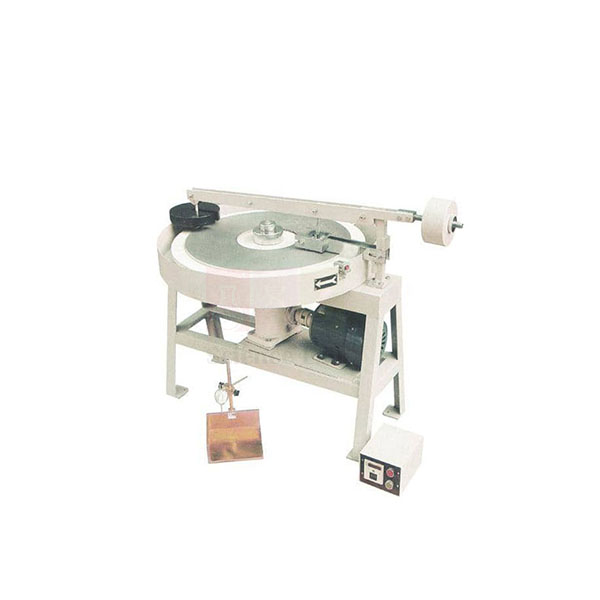
Tile abrasion testing machine
Tile abrasion testing machine (Product Code: SLE/CE/102) is a rotating grinding-path machine used to measure the wear resistance of floor and paving tiles pressed under a set load against an abrasive-strewn track, in civil engineering and building materials laboratories. Tile makers' quality labs and engineering colleges use it for abrasion tests, with the grinding path turning at 30 ±1 revolutions per minute and a counter-balanced lever applying the load. It is made by Jain Scientific Equipments Pvt Ltd (ScienceLab), an OEM manufacturer, at its own factory in Ambala, India.
Specifications
| Parameter | Detail |
|---|---|
| Grinding path | Replaceable grinding path fitted onto a disc rotating on its vertical axis |
| Speed | 30 ±1 revolutions per minute |
| Specimen holding | Bracket holds the tile specimen against the grinding path |
| Loading | Counter-balanced lever; one 7.5 kg weight supplied |
| Abrasive charging | Funnel for spreading abrasive powder on the grinding path |
| Enclosure | Circular tray around the rotating disc and grinding path |
| Counter | Automatic pre-set revolution counter (supplied) |
| Not included | Abrasive powder and thickness gauge |
| Power supply | 230 V, single phase, AC |
| Product code | SLE/CE/102 |
| Manufacturer | Jain Scientific Equipments Pvt Ltd (ScienceLab) — OEM |
| Country of origin | India (made in Ambala, Haryana) |
What Is the Tile Abrasion Tester Used For?
Floor tiles in corridors, factories and public buildings must resist the scouring of grit carried on shoes and wheels, and this machine reproduces that wear in a controlled way. The tile is clamped in the bracket, loaded through the counter-balanced lever with the 7.5 kg weight, and pressed onto the grinding path while abrasive powder is fed through the funnel. The counter is preset so the disc stops after the required number of revolutions.
Wear is found by measuring the tile's thickness before and after the run with a thickness gauge, which you add separately. Spread the abrasive evenly, clean the tray between specimens and replace the grinding path when it becomes worn. The machine is useful engineering lab equipment for building materials courses as well as for factory quality checks on tiles.
What to Specify When Ordering
- Number of machines required
- Whether you need abrasive powder, which is not included (ask us)
- Whether a thickness gauge for measuring tile wear is required, as it is not included
- Any spare grinding paths or extra weights (ask us)
OEM Manufacturer
The Tile abrasion testing machine is produced by Jain Scientific Equipments Private Limited, which trades as ScienceLab, acting as the OEM. The disc drive, grinding path, lever loading and tray are manufactured and assembled at the company's own licensed factory at Saha, Ambala, Haryana, India.
Tile manufacturers, colleges, testing laboratories, dealers and importers buy direct from the factory, and replacement grinding paths or repeat machines can be discussed with the manufacturer itself. Visit the ScienceLab profile for company details.
Related Civil Engineering Lab Equipment
Other surface wear and friction tests used on flooring and paving materials:
- Wide Wheel Abrasion Testing Machine — an abrasion test for paving blocks and flags
- Dorry Abrasion Testing Machine — sand-fed disc test for stone specimens
- Skid Resistance And Friction Tester — measures the slip resistance of finished surfaces
Browse the complete Civil Engineering Lab Equipment range.
Frequently Asked Questions
At what speed does the Tile abrasion testing machine run?
The grinding path of the Tile abrasion testing machine revolves at 30 ±1 revolutions per minute. It is a replaceable path fitted on a disc that rotates on its vertical axis, enclosed by a circular tray that contains the abrasive.
How is the load applied in the Tile abrasion testing machine?
The Tile abrasion testing machine applies load through a counter-balanced lever that presses the tile, held in a bracket, against the grinding path. One 7.5 kg weight is supplied with the machine for loading the specimen.
What is not included with the Tile abrasion testing machine?
The Tile abrasion testing machine is supplied without abrasive powder and without a thickness gauge. It comes complete with an automatic pre-set revolution counter and one 7.5 kg weight; ask us if you need the other items quoted.
How is tile wear measured after testing on the Tile abrasion testing machine?
After a run on the Tile abrasion testing machine, wear is measured with a thickness gauge by comparing the tile's thickness before and after abrasion. The gauge is not part of the supply, so add one to your enquiry if needed.
What power supply does the Tile abrasion testing machine need?
The Tile abrasion testing machine is suitable for operation on a 230 V, single phase, AC supply. Mention your local mains supply in the enquiry if it differs, so we can discuss it before quoting.
Who manufactures the Tile abrasion testing machine?
The Tile abrasion testing machine is manufactured by Jain Scientific Equipments Pvt Ltd (ScienceLab) as the OEM, at its own licensed factory in Saha, Ambala, Haryana, India. Quotations and spare-part queries are handled by the manufacturer directly.
Request a Quote
To receive a price for the Tile abrasion testing machine (SLE/CE/102), send your quantity and any accessories needed through our contact page, or add it to the enquiry cart. Quotes come direct from the manufacturer for India and international markets.
Last updated: 24 September 2026
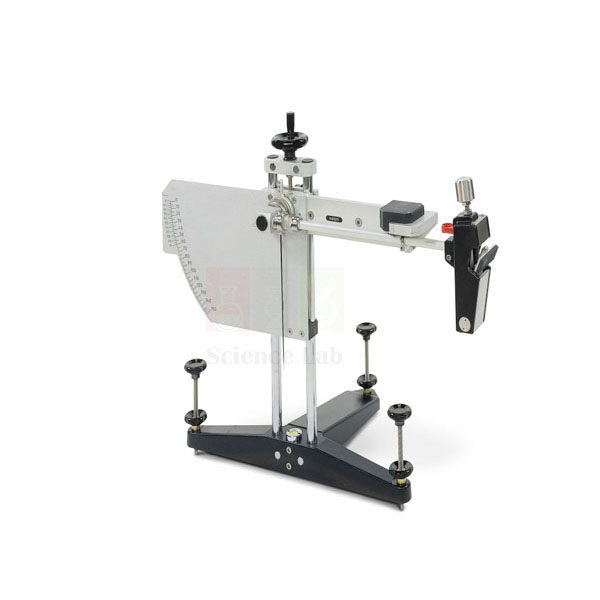
Skid Resistance And Friction Tester
Skid Resistance And Friction Tester (Product Code: SLE/CE/103) is a swinging-arm friction tester used to measure the surface friction and skid resistance of roads, footways, floors and polished aggregate specimens, on site and in civil engineering laboratories. Highway labs and engineering colleges use it for field checks and for polished stone value tests on curved specimens from accelerated polishing, using its additional scale and six rubber sliders. It is made by Jain Scientific Equipments Pvt Ltd (ScienceLab), an OEM manufacturer, at its own factory in Ambala, India.
Specifications
| Parameter | Detail |
|---|---|
| Application | Surface friction measurement on site and in the laboratory; polished stone value tests on curved specimens from accelerated polishing |
| Rocker weight | 1500 ±30 g |
| Rocking centre to centre of gravity | 410 ±5 mm |
| Dimensions listed (with base plate) | 700 × 360 × 70 mm |
| Thermometer | −10 to +110 °C |
| Supplied with | Additional scale for polished stone value specimens; 6 rubber sliders; 1 litre washing bottle for surface wetting; tool set with case for machine assembly; thermometer |
| Product code | SLE/CE/103 |
| Manufacturer | Jain Scientific Equipments Pvt Ltd (ScienceLab) — OEM |
| Country of origin | India (made in Ambala, Haryana) |
What Is the Skid Resistance Tester Used For?
A road, ramp or floor that feels grippy when dry can become dangerous when wet, so engineers measure friction on a wetted surface. The arm carrying a rubber slider is released and swings down so that the slider sweeps across the test surface; the more friction the surface offers, the less the arm rises on the far side, and the pointer records a skid resistance value on the scale. The surface is wetted from the 1 litre washing bottle and its temperature is noted with the thermometer, since rubber behaviour changes with temperature.
In the laboratory, curved aggregate specimens that have been through an accelerated polishing machine are clamped and tested with the additional scale to give the polished stone value, which shows how quickly a road stone will lose its grip under traffic. Check the slider edge before each series and change sliders when worn. The tester is useful engineering lab equipment in India for highway courses and pavement survey teams.
What to Specify When Ordering
- Number of testers required for laboratory or site teams
- Any spare rubber sliders beyond the 6 supplied (ask us)
- Whether an accelerated polishing machine is needed to prepare polished stone value specimens
OEM Manufacturer
ScienceLab, the brand of Jain Scientific Equipments Private Limited, is the original equipment manufacturer of this Skid Resistance And Friction Tester. It is made and assembled at the company's own licensed factory at Saha, Ambala, Haryana, India, and shipped factory-direct.
Institutional buyers completing vendor forms can use GSTIN 06AAECJ8618A1ZT and LEI 3358004HRD1JIVXKYX49. Colleges, highway laboratories, dealers and importers can take up spare sliders or repeat orders with the manufacturer itself; more is on the ScienceLab profile.
Related Civil Engineering Lab Equipment
These items support pavement surface and aggregate polishing tests:
- Accelerated Polishing Machine — prepares the curved polished specimens for the PSV test
- Straight Edge (3 meter) — checks surface regularity on the same pavement
- Travelling Beam Device — for surveying road surface evenness
- Tile abrasion testing machine — measures wear of flooring tiles whose slip resistance is also tested
See all Civil Engineering Lab Equipment.
Frequently Asked Questions
What is supplied with the Skid Resistance And Friction Tester?
The Skid Resistance And Friction Tester is supplied with an additional scale for polished stone value specimens, 6 rubber sliders, a 1 litre washing bottle for wetting the surface, a tool set with case for assembling the machine, and a thermometer reading −10 to +110 °C.
Can the Skid Resistance And Friction Tester be used on site?
Yes. The Skid Resistance And Friction Tester is suitable for both site and laboratory applications, so it can measure the friction of roads, footways and floors in place, and of prepared specimens on the bench.
What is the polished stone value scale on the Skid Resistance And Friction Tester?
The additional scale on the Skid Resistance And Friction Tester is used when testing curved aggregate specimens taken from accelerated polishing tests. The reading gives the polished stone value, which indicates how well a road stone keeps its grip as traffic polishes it.
What are the key pendulum dimensions of the Skid Resistance And Friction Tester?
The Skid Resistance And Friction Tester has a rocker weight of 1500 ±30 g, and the distance between its rocking centre and centre of gravity is 410 ±5 mm. The dimensions listed with its base plate are 700 × 360 × 70 mm.
Who manufactures the Skid Resistance And Friction Tester?
The Skid Resistance And Friction Tester is manufactured by Jain Scientific Equipments Pvt Ltd (ScienceLab) as the OEM, at its own licensed factory in Saha, Ambala, Haryana, India. Quotations and spare-slider questions go directly to the manufacturer.
Is a calibration certificate available for the Skid Resistance And Friction Tester?
Calibration-certificate availability for the Skid Resistance And Friction Tester is not stated in its listing. Please discuss your requirement with us through the contact page before ordering, and mention the test method you follow.
Request a Quote
Request a quotation for the Skid Resistance And Friction Tester (SLE/CE/103) through our contact page, or add it to the enquiry cart. Prices come direct from the manufacturer for buyers in India and international markets.
Last updated: 24 September 2026
326.jpg)
Core Drilling Machine (Motorised)
Core Drilling Machine (Motorised) (Product Code: SLE/CE/104) is an electric core drill used to cut cylindrical cores from hardened concrete, masonry and rock for strength testing and structural inspection in civil engineering laboratories and on construction sites. Testing labs, consultants and engineering colleges use it with core bits from 25 mm to 150 mm in diameter, driven by a 2800 W motor running at 840 rpm without load. It is supplied by Jain Scientific Equipments Pvt Ltd (ScienceLab), Ambala, India.
Specifications
| Parameter | Detail |
|---|---|
| Bit capacity | 25 mm to 150 mm diameter |
| Max. bit diameter (as listed) | Ø50 mm / 100 mm / 150 mm |
| Rated voltage | ~220 V / 50 Hz |
| Power input | 2800 W |
| No-load speed | 840 rpm |
| Spindle thread | 1 1/4″ UNC (male) |
| Protection | Friction clutch and overload current protection for the motor |
| Gearing | High-strength gear for long periods of continuous drilling |
| Water swivel | Externally set water swivel seal for easy replacement when worn |
| Build | Compact and light, designed for safe, smooth and stable drilling |
| Product code | SLE/CE/104 |
| Supplied by | Jain Scientific Equipments Pvt Ltd (ScienceLab), Ambala, India |
What Is the Motorised Core Drill Used For?
Cores drilled from an existing slab, beam, column or pavement are the most direct way to check the strength and quality of concrete in a finished structure. The drill cuts an annular groove with a hollow core bit, and the cylinder left inside is broken off and taken to the laboratory for compression testing, density or depth checks. Water fed through the swivel cools the bit and flushes out cutting slurry while the drill runs.
Choose the bit diameter to suit the aggregate size and the test you plan, from 25 mm for small checks to 150 mm for larger cores. Keep the water supply steady, feed the bit gently rather than forcing it, and let the friction clutch slip if the bit binds. Replace the swivel seal once it starts to leak. As a laboratory instruments supplier in India, we quote this drill to colleges and testing labs alongside the equipment used to test the cores.
What to Specify When Ordering
- Number of drilling machines required
- Core bit diameters you need within the 25–150 mm capacity (ask us about bits)
- Confirmation that your site or lab supply is ~220 V / 50 Hz
- Any spare water swivel seals (ask us)
Supplier
Jain Scientific Equipments Private Limited, trading as ScienceLab, supplies the Core Drilling Machine (Motorised) as part of its civil engineering testing range for institutions, laboratories and contractors. The company sources the drill and handles enquiries, quotations and dispatch from Ambala, Haryana, for buyers across India and international markets. Read more about the company on the ScienceLab company profile.
Related Civil Engineering Lab Equipment
Items commonly used before and after coring a concrete structure:
- Core Drilling Machine (Petrol) — an alternative for sites without mains power
- Concrete cover meter — helps locate reinforcement before choosing where to drill
- Automatic digital compression testing machine — for crushing the extracted cores
- Ultrasonic Pulse Velocity Tester — non-destructive testing to guide core locations
Browse the full Civil Engineering Lab Equipment range.
Frequently Asked Questions
What core bit sizes can the Core Drilling Machine (Motorised) take?
The Core Drilling Machine (Motorised) has a bit capacity of 25 mm to 150 mm diameter, and its maximum bit diameter is listed as Ø50 mm / 100 mm / 150 mm. The spindle has a 1 1/4″ UNC male thread for fitting the core bit.
What power does the Core Drilling Machine (Motorised) need?
The Core Drilling Machine (Motorised) is rated for ~220 V / 50 Hz with a power input of 2800 W, and its no-load speed is 840 rpm. Check that your site generator or laboratory supply can deliver this load before drilling.
How is the motor of the Core Drilling Machine (Motorised) protected?
The Core Drilling Machine (Motorised) is equipped with a friction clutch and overload current protection to protect the motor. If the bit jams in hard aggregate or steel, the clutch slips instead of passing the full shock to the gearbox and motor.
Are core bits included with the Core Drilling Machine (Motorised)?
The listing for the Core Drilling Machine (Motorised) does not state which core bits are included. Please tell us the diameters you need through our contact page, and the quotation will state exactly what is supplied.
Who supplies the Core Drilling Machine (Motorised)?
The Core Drilling Machine (Motorised) is supplied by Jain Scientific Equipments Pvt Ltd (ScienceLab), Ambala, Haryana, India. The company sources it for engineering colleges, testing laboratories and contractors and quotes it to buyers in India and international markets.
Request a Quote
To get a price for the Core Drilling Machine (Motorised) (SLE/CE/104), send the quantity and bit sizes you need through our contact page, or add it to the enquiry cart. We quote to buyers in India and international markets.
Last updated: 24 September 2026
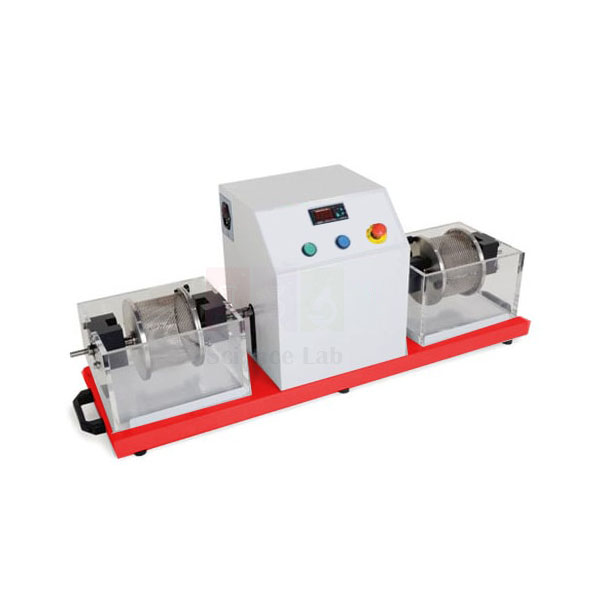
Slake Durability Test Apparatus
Slake Durability Test Apparatus (Product Code: SLE/CE/105) is a motorised drum-tumbling apparatus used to measure how well shale and similar soft rocks resist breaking down during wetting and drying cycles, in civil engineering, geotechnical and geology laboratories. Rock mechanics labs and engineering colleges use it to assess material for embankments and other construction work; its drive turns two or four 2.00 mm mesh drums at 20 rpm through water. It is made by Jain Scientific Equipments Pvt Ltd (ScienceLab), an OEM manufacturer, at its own factory in Ambala, India.
Specifications
| Parameter | Detail |
|---|---|
| Drive unit | Motorised drive mounted on a baseplate |
| Drums driven | Two or four drums |
| Drum speed | 20 rpm |
| Test drums | 2.00 mm mesh, 140 mm diameter × 100 mm long |
| Water level | Tank assemblies filled with water to 20 mm below the drum axis |
| Test cycle | Samples tumbled in the mesh drums through water and oven-dried, for two cycles |
| Result | Slake durability index, calculated from the sample's dry mass before and after the cycles |
| Product code | SLE/CE/105 |
| Manufacturer | Jain Scientific Equipments Pvt Ltd (ScienceLab) — OEM |
| Country of origin | India (made in Ambala, Haryana) |
What Is the Slake Durability Apparatus Used For?
Some rocks look sound when freshly excavated but crumble once they are exposed to rain and sun, which can undermine embankments, cuttings and fills. The slake durability test simulates this weathering. Oven-dried rock lumps are weighed and placed in a mesh drum, the drum turns at 20 rpm in its water tank with the water 20 mm below the axis, and fragments smaller than the 2.00 mm mesh wash out. The retained material is oven-dried and weighed, and the cycle is repeated a second time.
The change in dry mass across the two cycles gives the slake durability index, a simple figure for comparing how different shales and mudstones will behave in service. Running four drums lets a class or lab test several samples together. Brush the mesh clean after each test so the openings stay clear, and use a suitable laboratory oven for the drying stages.
What to Specify When Ordering
- Whether you need the drive set up for two drums or four drums
- Number of spare 2.00 mm mesh test drums (ask us)
- Whether a laboratory oven for the drying stages is also required
OEM Manufacturer
This Slake Durability Test Apparatus is manufactured by Jain Scientific Equipments Private Limited, whose trading name is ScienceLab, as the OEM. The drive unit, baseplate, tanks and mesh drums are produced at the company's own licensed factory at Saha, Ambala, Haryana, India.
Universities, geotechnical laboratories, dealers and importers order direct from the maker, which means extra drums or repeat units can be discussed with the factory itself. More company information is on the ScienceLab profile page.
Related Civil Engineering Lab Equipment
Rock testing laboratories often use these alongside the slake durability test:
- Digital Point Load Test Apparatus — measures rock strength on irregular lumps or cores
- Oven, 43 litre — a laboratory oven for drying samples between cycles
- Moisture Tins — for holding and weighing samples during drying
- Dorry Abrasion Testing Machine — assesses the abrasion resistance of harder stone
View all Civil Engineering Lab Equipment.
Frequently Asked Questions
How many drums can the Slake Durability Test Apparatus run?
The Slake Durability Test Apparatus has a motorised drive unit on a baseplate that can rotate two or four drums at a speed of 20 rpm. Four drums let a laboratory test several rock samples at the same time.
What size are the drums of the Slake Durability Test Apparatus?
The test drums of the Slake Durability Test Apparatus are made from 2.00 mm mesh and measure 140 mm in diameter by 100 mm long. Rock fragments smaller than the mesh wash out through the drum during tumbling.
How much water goes into the Slake Durability Test Apparatus tanks?
The tank assemblies of the Slake Durability Test Apparatus are filled with water to a level 20 mm below the drum axis. The drums therefore turn partly submerged, so the sample is repeatedly wetted as it tumbles.
What rocks is the Slake Durability Test Apparatus used for?
The Slake Durability Test Apparatus is used for shale and similar soft rocks that are used in embankments and other construction applications. The test simulates weathering to show their abrasion resistance during wetting and drying cycles.
Who manufactures the Slake Durability Test Apparatus?
The Slake Durability Test Apparatus is manufactured by Jain Scientific Equipments Pvt Ltd (ScienceLab) as the OEM, at its own licensed factory in Saha, Ambala, Haryana, India. Quotations and spare-drum questions are handled by the manufacturer directly.
What should a quotation request for the Slake Durability Test Apparatus include?
A quotation request for the Slake Durability Test Apparatus should state the two-drum or four-drum set-up, the number of units, any spare drums and the delivery location. Send it through our contact page or the enquiry cart.
Request a Quote
For a price on the Slake Durability Test Apparatus (SLE/CE/105), send your drum configuration and quantity via our contact page, or add it to the enquiry cart. Quotations come direct from the manufacturer for India and international markets.
Last updated: 24 September 2026
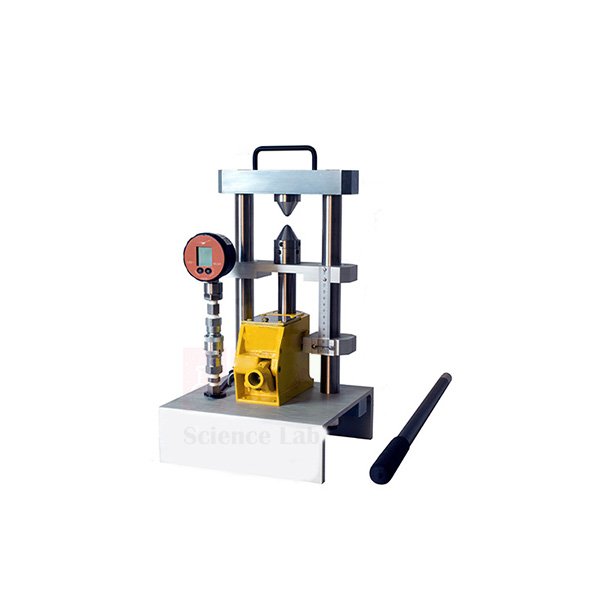
Digital Point Load Test Apparatus
Digital Point Load Test Apparatus (Product Code: SLE/CE/106) is a rock-strength testing frame used to split core and lump specimens between two conical platens and record the failure load in rock mechanics and civil engineering laboratories. Engineering colleges and geotechnical labs use it for quick strength-index testing, and its 60 kN hand-pump load frame adjusts for samples up to 102 mm in diameter. It is made by Jain Scientific Equipments Pvt Ltd (ScienceLab), an OEM and engineering lab equipment manufacturer, at its own factory in Ambala, India.
Specifications
| Parameter | Detail |
|---|---|
| Load frame capacity | 60 kN |
| Loading system | Hydraulic loading ram driven by a hand pump |
| Platens | Conical platens |
| Platen distance measurement | Ruler assembled on the frame for direct reading before and after the test |
| Specimen size | Adjustable frame for samples up to 102 mm diameter |
| Load sensing | Pressure transducer connected to a digital display unit |
| Load range | 0–60 kN |
| Digital display | 2 x 16 characters |
| Resolution | 32 000 divisions |
| Accuracy | ± 1% |
| Load pacer | Included |
| Measurement units | Load in kN and stress in MPa |
| Data output | Serial port for PC connection |
| Product code | SLE/CE/106 |
| Manufacturer | Jain Scientific Equipments Pvt Ltd (ScienceLab) — OEM |
| Country of origin | India (made in Ambala, Haryana) |
What Is the Point Load Test Apparatus Used For?
The point load test is a fast way to estimate the strength of rock without cutting and grinding specimens to precise shapes. A core or lump is seated between the conical platens, the hand pump drives the hydraulic ram until the specimen splits, and the peak load together with the platen separation is used to work out the point load strength index. Students see rock failure within minutes, and site-investigation labs use the result to screen cores before slower compressive-strength testing.
For consistent results, note the platen gap on the frame-mounted ruler before loading and again after failure, and use the load pacer to keep the loading rate steady. The display shows load in kN or stress in MPa, and the serial port lets readings pass to a PC for lab reports — useful where engineering lab equipment in India is shared by large student batches.
What to Specify When Ordering
- Quantity of apparatus per laboratory and the delivery location.
- The largest specimen you will test (the frame adjusts for samples up to 102 mm diameter).
- Whether you will log results on a PC through the serial port, so we can confirm connection requirements.
- Any spare conical platens you want quoted with the apparatus.
OEM Manufacturer
ScienceLab is the trading name of Jain Scientific Equipments Private Limited, the OEM (original equipment manufacturer) of this Digital Point Load Test Apparatus. The apparatus is made and assembled at the company's own licensed factory at Saha, Ambala, Haryana, India, so buyers deal with the manufacturer rather than a trader.
Engineering colleges, polytechnics, testing laboratories, dealers and importers in India and international markets are supplied factory-direct. If you need spare platens or a repeat order later, ask us and the manufacturer handles it directly. Learn more on the ScienceLab company profile.
Related Civil Engineering Lab Equipment
Rock and aggregate test programmes usually pair the point load test with the following apparatus:
- Slake Durability Test Apparatus — checks how weak rocks resist wetting and drying, alongside strength-index results.
- Core Drilling Machine (Motorised) — extracts cores that can then be tested in the point load frame.
- Automatic Digital Compression Testing Machine — for full compressive-strength tests on prepared specimens.
- Aggregate Crushing Value Apparatus — assesses crushed rock intended for road and concrete aggregate.
Browse the complete Civil Engineering Lab Equipment range for soil, concrete, cement and rock testing.
Frequently Asked Questions
What does the Digital Point Load Test Apparatus measure?
The Digital Point Load Test Apparatus measures the load at which a rock specimen fails between two conical platens, over a 0–60 kN range, while a ruler on the frame gives the platen distance before and after the test for calculating the strength index.
What specimen size can the Digital Point Load Test Apparatus test?
The Digital Point Load Test Apparatus has an adjustable frame that accepts samples up to 102 mm in diameter. If your cores or lumps are larger, contact us with their dimensions before ordering so we can advise on suitability.
How accurate is the digital readout?
The Digital Point Load Test Apparatus reads load through a pressure transducer with ± 1% accuracy and a resolution of 32 000 divisions, shown on a 2 x 16 character display in kN or MPa, with a load pacer to help keep loading steady.
Can the Digital Point Load Test Apparatus connect to a computer?
Yes. The Digital Point Load Test Apparatus has a serial port for PC connection, so readings can be transferred for record keeping and lab reports. Tell us which computer setup you use when requesting a quote so we can confirm the connection details.
Who manufactures the Digital Point Load Test Apparatus?
The Digital Point Load Test Apparatus is manufactured by Jain Scientific Equipments Pvt Ltd (ScienceLab), an OEM that makes it at its own licensed factory at Saha, Ambala, Haryana, India, and supplies it factory-direct to colleges, laboratories, dealers and importers.
Is a calibration certificate available for this apparatus?
Calibration-certificate availability for the Digital Point Load Test Apparatus should be discussed with us before you order. Share your documentation requirement through our contact page and we will confirm what can be provided with your quotation.
What should a quotation request for the point load tester include?
A quotation request for the Digital Point Load Test Apparatus should state the quantity, the largest specimen size you test, whether PC connection is needed and the delivery location in India or abroad, so the manufacturer can quote accurately.
Request a Quote
To order the Digital Point Load Test Apparatus, send your requirement through our contact page or add it to the enquiry cart. Quotations come direct from the manufacturer for single units, college laboratory set-ups and export orders.
Last updated: 24 September 2026
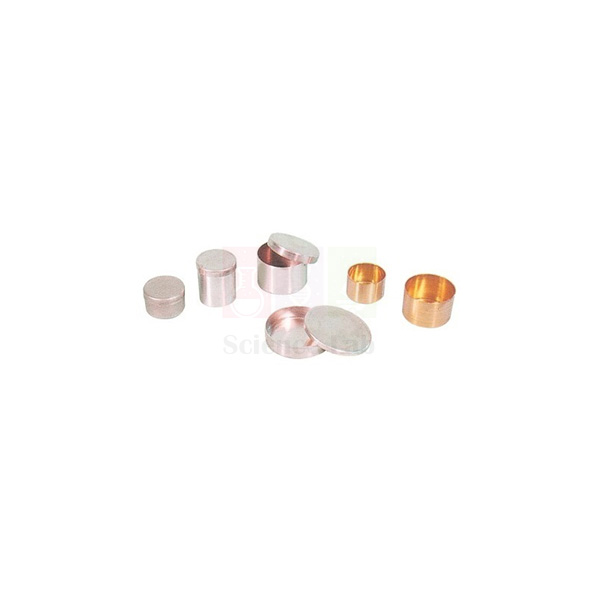
Moisture Tins
Moisture Tins (Product Code: SLE/CE/107) are small metal sample containers used to determine the moisture content of soil and other materials by weighing and oven drying in civil engineering and soil mechanics laboratories. Geotechnical labs, colleges and site laboratories use them in sets, choosing aluminium or stainless steel in five diameters from 25 mm to 100 mm. They are made by Jain Scientific Equipments Pvt Ltd (ScienceLab), an OEM and technical educational equipment manufacturer, at its own factory in Ambala, India.
Specifications
| Parameter | Detail |
|---|---|
| Purpose | Determining the moisture content of soil and other materials |
| Material | Aluminium or stainless steel |
| Sizes available | 25 mm, 50 mm, 75 mm, 80 mm and 100 mm diameter |
| Product code | SLE/CE/107 |
| Manufacturer | Jain Scientific Equipments Pvt Ltd (ScienceLab) — OEM |
| Country of origin | India (made in Ambala, Haryana) |
What Is the Moisture Tin Used For?
Moisture content is one of the most frequently measured soil properties, and the oven-drying method depends on a clean, numbered container. The empty tin is weighed, the wet sample is added and weighed, and the tin goes into a drying oven until the mass stops changing. After cooling it is weighed again, and the water lost divided by the dry soil mass gives the moisture content as a percentage.
Students meet this step in liquid limit and plastic limit tests, compaction tests and field density work with core cutters. Mark each tin and record its empty mass before use; smaller 25 mm and 50 mm tins suit the few grams taken in limit tests, while 80 mm and 100 mm tins hold larger or coarser samples. Colleges usually buy them in quantity, as routine lab equipment for college soil laboratories in India, so that several groups can dry samples at the same time.
What to Specify When Ordering
- Diameter: 25, 50, 75, 80 or 100 mm (several sizes can be combined in one order).
- Material: aluminium or stainless steel.
- Quantity required for each size, based on the number of student groups or daily samples.
- Delivery location, for freight planning within India or for export.
OEM Manufacturer
Jain Scientific Equipments Private Limited, trading as ScienceLab, is the OEM (original equipment manufacturer) of these Moisture Tins. ScienceLab is the trading name of the company (CIN U29309HR2020PTC087597), and the tins are produced at its licensed factory at 449, HSIIDC Industrial Area, Saha, Ambala, Haryana (Factory Licence AMB-ONLINE-CHD-J-414).
Because the tins come straight from the manufacturer, soil laboratories, engineering colleges, dealers and importers in India and international markets can order mixed sizes factory-direct, and add matching tins to an existing set later — just ask us. More about the company is on the ScienceLab company profile.
Related Civil Engineering Lab Equipment
A moisture content determination also needs drying, weighing and cooling equipment, and moisture tins are used in several soil tests:
- Oven, 43 litre — dries the filled tins to constant mass.
- Compact Balance — weighs small tins before and after drying.
- Vacuum Desiccator — lets dried samples cool without picking up moisture from the air.
- Liquid limit devices (Casagrande) — a consistency-limit test whose samples go into moisture tins.
- Core cutters — field density sampling that also calls for a moisture content check.
See the full Civil Engineering Lab Equipment range for more soil testing apparatus.
Frequently Asked Questions
What sizes do the Moisture Tins come in?
Moisture Tins are available in 25 mm, 50 mm, 75 mm, 80 mm and 100 mm diameters, so a laboratory can match the tin to the sample quantity each soil test needs and keep several sizes on hand for different procedures.
What materials are the Moisture Tins made from?
Moisture Tins are made from aluminium or stainless steel. Aluminium tins are light to handle in large numbers, while stainless steel gives a harder-wearing option; state which material you prefer when you ask for a quotation.
How are Moisture Tins used to find soil moisture content?
Moisture Tins are weighed empty, weighed again with the wet sample, then oven dried until the mass is constant and reweighed after cooling. The water lost divided by the dry soil mass, multiplied by 100, gives the moisture content in percent.
Can Moisture Tins be used for materials other than soil?
Yes. Moisture Tins are intended for determining the moisture content of soil and other materials, so the same containers can be used for other granular samples that are dried and weighed in a civil engineering or materials laboratory.
Who manufactures the Moisture Tins?
The Moisture Tins are manufactured by Jain Scientific Equipments Pvt Ltd (ScienceLab), which makes them as the OEM at its own licensed factory at Saha, Ambala, Haryana, India, and supplies them factory-direct to laboratories, colleges, dealers and importers.
What should a quotation request for Moisture Tins include?
A quotation request for Moisture Tins should list the diameters needed, aluminium or stainless steel, the quantity for each size and the delivery location in India or abroad, so the manufacturer can quote a complete set in one reply.
Request a Quote
Send your Moisture Tins requirement through our contact page or add the item to the enquiry cart. You receive the quotation directly from the manufacturer, whether you need one size for a single lab or mixed sets for several institutions.
Last updated: 24 September 2026
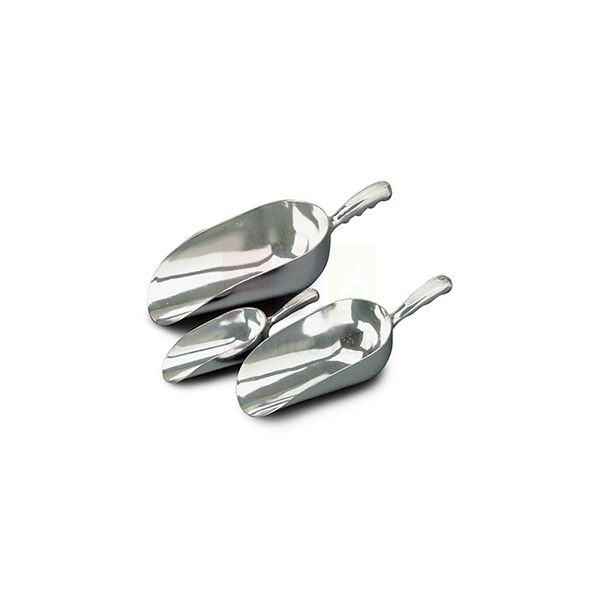
Scoops
Scoops (Product Code: SLE/CE/108) are hand scoops used to transfer soil, sand, aggregate and cement between bags, sample dividers, sieves, measures and moulds in civil engineering and materials testing laboratories. College and site labs keep several sizes, from 325 cc for small portions up to 5000 cc for bulk aggregate, in stainless steel or aluminium. They are made by Jain Scientific Equipments Pvt Ltd (ScienceLab), an OEM lab equipment manufacturer in India, at its own factory in Ambala.
Specifications
| Parameter | Detail |
|---|---|
| Capacities available | 325 cc, 500 cc, 1000 cc, 2000 cc and 5000 cc |
| Material of construction | Stainless steel or aluminium |
| Product code | SLE/CE/108 |
| Manufacturer | Jain Scientific Equipments Pvt Ltd (ScienceLab) — OEM |
| Country of origin | India (made in Ambala, Haryana) |
What Is the Laboratory Scoop Used For?
In soil, concrete and highway testing, a sample is handled many times: from the sack or stockpile into a sample divider, then into sieves, measures, moulds and drying trays. A scoop keeps that handling tidy and helps avoid losing fine particles, which can change test results. The 325 cc and 500 cc sizes suit cement, sand and fine soil portions, while the 2000 cc and 5000 cc sizes move coarse aggregate quickly, for example when filling a cylindrical measure for bulk density.
Keep separate scoops for cement and for soil so that one material does not contaminate the next test, and clean and dry each scoop after use. Stainless steel suits wet samples and frequent washing, while aluminium keeps the larger sizes light. Scoops are easy to leave off a lab equipment list, so colleges often order them together with sieves, measures and sample dividers.
What to Specify When Ordering
- Capacity: 325, 500, 1000, 2000 or 5000 cc (sizes can be mixed).
- Material: stainless steel or aluminium.
- Quantity for each size, based on the number of test benches or student groups.
- Other apparatus you want quoted at the same time, such as sieves or measures.
OEM Manufacturer
These Scoops are produced by Jain Scientific Equipments Private Limited, the company behind the ScienceLab name, acting as OEM (original equipment manufacturer) at its own licensed factory at Saha, Ambala, Haryana, India. They are not bought in from a trader: the same company that makes them issues your quotation.
Soil and concrete laboratories, engineering colleges, dealers and importers in India and international markets order them factory-direct, and matching sizes for a repeat order can be requested from the manufacturer at any time — just ask us. Read more on the ScienceLab company profile.
Related Civil Engineering Lab Equipment
Scoops are used with the apparatus that holds, divides and measures samples:
- Riffle Sample Divider — splits a scooped bulk sample into representative halves.
- Test Sieves — receive the divided sample for grading.
- Cylindrical Measures — filled with aggregate by scoop for bulk density checks.
- Bulk density of cement — a cement test where small scoops are handy for filling.
- Moisture Tins — hold scooped soil portions for oven drying.
Explore the full Civil Engineering Lab Equipment range for soil, aggregate and concrete testing.
Frequently Asked Questions
What capacities are the Scoops available in?
The Scoops are available in 325 cc, 500 cc, 1000 cc, 2000 cc and 5000 cc capacities, so a laboratory can use small sizes for cement and fine soil portions and the larger sizes for coarse aggregate batches.
What are the Scoops made of?
The Scoops are made of stainless steel or aluminium. Stainless steel is a good match for wet samples and regular washing, while aluminium keeps the bigger scoops lighter to handle; mention your preferred material when you enquire.
Which scoop size should a civil engineering lab choose?
Most civil engineering labs keep more than one size of Scoops: 325 cc or 500 cc for cement and fine material, 1000 cc or 2000 cc for general soil work, and 5000 cc for bulk aggregate. Tell us which tests you run and we can suggest a mix.
How should Scoops be looked after between tests?
Scoops should be emptied fully, cleaned and dried after every use so that residue from one sample does not enter the next. Keeping separate scoops for cement and soil further reduces the risk of contaminating test samples.
Who manufactures the Scoops?
The Scoops are manufactured by Jain Scientific Equipments Pvt Ltd (ScienceLab), an OEM that makes them at its own licensed factory at Saha, Ambala, Haryana, India, and supplies them factory-direct to laboratories, colleges, dealers and importers.
Can Scoops be ordered in bulk for several laboratories?
Yes. Scoops can be ordered in mixed capacities and materials for several laboratories, dealers or institutional orders. Share the sizes, quantities and delivery location in India or abroad, and the manufacturer will prepare a single quotation.
Request a Quote
For a price on Scoops, write to us through the contact page or place them in the enquiry cart with any other items you need. The quotation is prepared directly by the manufacturer.
Last updated: 24 September 2026
30.jpg)
Water Bath (6 Holes)
Water Bath (6 Holes) (Product Code: SLE/CE/109) is a double-walled, thermostatically controlled water bath used to hold flasks, bottles and small containers at a set temperature up to 100 °C in civil engineering, chemistry and materials testing laboratories. Its six openings with 75 mm concentric-ring lids let several samples be conditioned side by side over a stainless steel inner tank. It is made by Jain Scientific Equipments Pvt Ltd (ScienceLab), an OEM manufacturer, at its own factory in Ambala, India.
Specifications
| Parameter | Detail |
|---|---|
| Number of holes | 6 (this listing); 4-hole and 12-hole versions are also listed |
| Lid | Concentric rings, 75 mm diameter |
| Temperature range | +5 to 100 °C (as listed) |
| Temperature controller | Thermostatic rotary knob |
| Display | LED display |
| Construction | Double walled |
| Inner material | Stainless steel |
| External material | Powder coated GI sheet |
| Power supply | 220 V, 50 Hz |
| Product code | SLE/CE/109 |
| Manufacturer | Jain Scientific Equipments Pvt Ltd (ScienceLab) — OEM |
| Country of origin | India (made in Ambala, Haryana) |
What Is the 6-Hole Water Bath Used For?
Many civil engineering and materials tests require a sample, bottle or solution to reach a known temperature before a reading is taken. A multi-hole water bath does this gently and evenly: specific gravity bottles can be brought to test temperature, and bitumen or other samples conditioned before physical tests. The concentric rings let each opening be reduced to suit smaller vessels, and unused openings stay covered to limit heat loss and evaporation.
Fill the tank with water before switching on, set the rotary thermostat and watch the LED display while the bath settles; a separate thermometer in the water confirms the actual temperature. Distilled water helps reduce scale on the stainless steel tank, which should be drained and wiped dry after use. When planning a water bath for a lab in India or abroad, the six-hole size sits between the 4-hole and 12-hole versions, trading capacity against bench space.
What to Specify When Ordering
- Number of holes: 6 for this listing, or ask about the 4-hole and 12-hole versions.
- The working temperature your tests need, within the listed +5 to 100 °C range.
- Your mains supply, since the bath is listed for 220 V, 50 Hz.
- Quantity and delivery location in India or abroad.
OEM Manufacturer
The Water Bath (6 Holes) is manufactured by Jain Scientific Equipments Private Limited, which trades as ScienceLab and is the OEM (original equipment manufacturer) for this model. The double-walled bath is made and assembled at the company's own licensed factory at Saha, Ambala, Haryana, India.
Schools, colleges, testing laboratories, dealers and importers in India and international markets buy it factory-direct. Replacement concentric rings or additional baths for an existing lab can be requested from the manufacturer itself — ask us. The ScienceLab company profile has more about the company.
Related Civil Engineering Lab Equipment
These items are often used with, or instead of, a multi-hole water bath:
- Specific Gravity Bottles — brought to test temperature in the bath before weighing.
- Digital Thermometer — an independent check of the water temperature.
- Kinematic Viscometer Bath — a dedicated bath for viscosity testing of bitumen and oils.
- Circulating water bath with cooler unit — the choice when tests need temperatures below room temperature.
See the full Civil Engineering Lab Equipment range, or compare other models in the Water Bath category.
Frequently Asked Questions
How many holes does the Water Bath (6 Holes) have?
The Water Bath (6 Holes) has six openings, each closed by concentric rings of 75 mm diameter that can be removed to fit different vessels. Four-hole and twelve-hole versions are also listed, so ask us if another size suits your lab better.
What temperature range does the Water Bath (6 Holes) cover?
The Water Bath (6 Holes) is listed for +5 to 100 °C, set with a thermostatic rotary knob and shown on an LED display. For a heating-only bath the lower figure is normally read as 5 °C above room temperature, so confirm low set points with us.
What is the Water Bath (6 Holes) made of?
The Water Bath (6 Holes) has double-walled construction with a stainless steel inner tank that holds the water and an outer body of powder coated GI sheet, a combination suited to daily use on laboratory benches.
What power supply does the Water Bath (6 Holes) need?
The Water Bath (6 Holes) is listed for a 220 V, 50 Hz power supply. If your laboratory or export destination uses different mains, mention it in your enquiry so the manufacturer can advise before you order.
Who manufactures the Water Bath (6 Holes)?
The Water Bath (6 Holes) is manufactured by Jain Scientific Equipments Pvt Ltd (ScienceLab), the OEM, at its own licensed factory at Saha, Ambala, Haryana, India, and is supplied factory-direct to schools, colleges, laboratories, dealers and importers.
Is a calibration certificate available for the Water Bath (6 Holes)?
Calibration-certificate availability for the Water Bath (6 Holes) should be discussed with us before ordering. Explain your documentation needs through the contact page and we will confirm what can accompany your quotation.
Request a Quote
Ask for a quotation for the Water Bath (6 Holes) through our contact page, or add it to the enquiry cart together with bottles or thermometers. Quotes come direct from the manufacturer.
Last updated: 24 September 2026