- Physics Lab Equipment
- Chemistry Lab Equipment
- Biology Lab Equipment
- Anatomical Lab Equipment
- Learning
- Educational Lab Equipment
- Magnets
- Agriculture
- Astronomy
- Earth Science
- Geography Lab Equipment
- Safety Lab Coat
- Laboratory
- Meteorological
- Electricity & Magnetism
- Heat
- School Lab Equipment
- Lab Glassware
- Science Lab Equipment
- Tvet Lab Equipment
- Robotics Kits Supplier and Manufacturer for Schools India
- Math Lab Equipment Manufacturers and Exporters in Ambala
- STEM Kits Manufacturers and Supplier India
- Engineering Lab Equipment
- Hospital Lab Equipment
- Water, Sanitation & Hygiene Supplies
- Cold Chain, Solar & Communication Equipment
- Nutrition
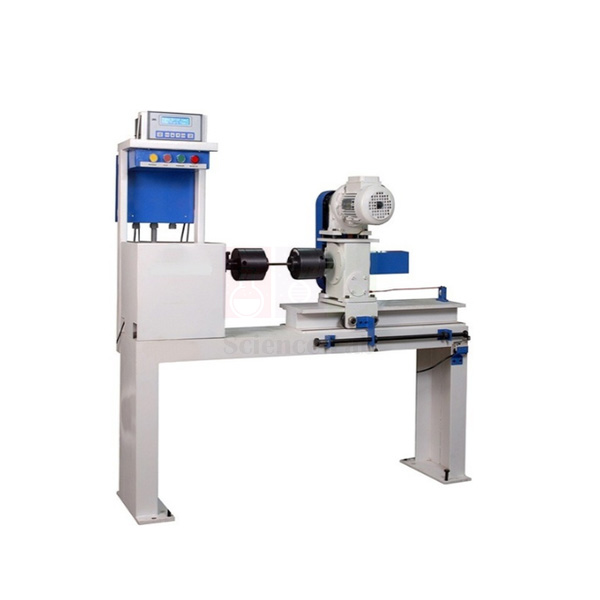
Digital Torsion Testing Machine
Digital Torsion Testing Machine (Product Code: SLE/CE/110) is a motorised test machine used to twist round and flat bar specimens while recording torque and angle of twist, in strength of materials and civil engineering laboratories. Engineering colleges use it to study torsional strength and shear behaviour, and it is listed in five capacities from 100 Nm to 2000 Nm with ± 1% torque accuracy. It is made by Jain Scientific Equipments Pvt Ltd (ScienceLab), an OEM producing lab equipment for technical institutes, at its own factory in Ambala, India.
Specifications
| Parameter | Detail |
|---|---|
| Torque measurement | Torque cell; one range with high resolution throughout |
| Angle of twist measurement | Rotary encoder, read to 0.1 degree |
| Drive | Geared motor applying torque to the specimen through a gear box |
| Display | Torque and angle of twist on the LCD of the Data Acquisition System (DAS) |
| PC connection | Facility to connect the DAS panel to a PC |
| Torque accuracy | ± 1% from 4% to 100% of machine capacity |
| Maximum torque capacity | 100, 200, 500, 1000 or 2000 Nm |
| Torque resolution | 0.01, 0.02, 0.05, 0.1 or 0.2 Nm (same model order) |
| Distance between grips | 0–400, 0–450, 0–500, 0–600 or 0–1000 mm (same model order) |
| Torsion speed and direction | 1.5 RPM, with reverse |
| Grips for round bars | 4–50 mm diameter |
| Grips for flat bars | 2–60 mm (thickness and width, as listed) |
| Power supply | 3 phase, 440 V, 50 Hz, AC motor (rating to be confirmed at quotation) |
| Product code | SLE/CE/110 |
| Manufacturer | Jain Scientific Equipments Pvt Ltd (ScienceLab) — OEM |
| Country of origin | India (made in Ambala, Haryana) |
What Is the Torsion Testing Machine Used For?
In a torsion test the specimen is clamped at both ends and one grip is turned slowly by the geared motor while the torque cell measures the resisting torque and the encoder tracks the angle of twist. Plotting torque against angle shows the elastic region, the onset of yielding and the maximum torque before fracture, from which students work out the modulus of rigidity and torsional strength. It connects classroom theory on shafts and twisting members with real material behaviour.
Choose a capacity so that the expected failure torque falls between 4% and 100% of the machine rating, the band in which the ± 1% accuracy applies. Measure specimen diameter or thickness before clamping, set the grip spacing to suit the specimen length, and connect the DAS panel to a PC when you want to keep torque-angle records for reports. The machine needs a 3 phase, 440 V supply, so check the laboratory wiring in advance.
What to Specify When Ordering
- Maximum torque capacity: 100, 200, 500, 1000 or 2000 Nm, matched to your strongest specimen.
- Specimen types: round bars of 4–50 mm diameter and/or flat bars in the 2–60 mm range.
- Grip spacing you need (up to 1000 mm on the largest listed model).
- Whether you will connect the DAS panel to a PC, and that a 3 phase, 440 V supply is available.
OEM Manufacturer
ScienceLab is the trading name of Jain Scientific Equipments Private Limited, the OEM (original equipment manufacturer) of the Digital Torsion Testing Machine. The machine is built at the company's own licensed factory at Saha, Ambala, Haryana, India, so colleges deal directly with the maker rather than a reseller.
Universities, polytechnics, testing laboratories, dealers and importers in India and international markets are supplied factory-direct, and questions about grips, spare parts or additional machines go straight to the manufacturer — just ask us. The ScienceLab company profile explains more about the company.
Related Civil Engineering Lab Equipment
A strength of materials laboratory usually runs torsion tests alongside these machines and tools:
- Tensile strength testing machine — measures tensile strength and elongation of the same bar materials.
- Impact Testing Machine-Digital — adds toughness results to the materials comparison.
- Flexure Testing Machine Digital — covers bending strength of beam and prism specimens.
- Caliper Vernier (Metal) — for measuring specimen diameter and thickness before each test.
Find more apparatus in Civil Engineering Lab Equipment and in Materials Testing and Properties.
Frequently Asked Questions
What torque capacities does the Digital Torsion Testing Machine come in?
The Digital Torsion Testing Machine is listed with maximum torque capacities of 100, 200, 500, 1000 and 2000 Nm, with torque resolution from 0.01 Nm on the smallest model to 0.2 Nm on the largest. Choose the capacity that suits your strongest specimens.
How accurate is the Digital Torsion Testing Machine?
The Digital Torsion Testing Machine measures torque with a torque cell to ± 1% accuracy between 4% and 100% of machine capacity, and reads the angle of twist through a rotary encoder to 0.1 degree, both shown on the DAS display.
What specimens can the Digital Torsion Testing Machine grip?
The Digital Torsion Testing Machine has grips for round bars of 4–50 mm diameter and for flat bars in the 2–60 mm range, with a distance between grips of up to 400 mm on the smallest model and up to 1000 mm on the largest.
Can torsion test data be saved to a computer?
Yes. The Digital Torsion Testing Machine has a facility for connecting its Data Acquisition System panel to a PC, while the LCD on the panel shows torque and angle of twist live during the test. Tell us your PC setup when you request a quote.
What power supply does the Digital Torsion Testing Machine need?
The Digital Torsion Testing Machine runs on a 3 phase, 440 V, 50 Hz supply through an AC motor. The motor rating is not stated in the current listing, so ask us to confirm it for the capacity you choose before planning the installation.
Who manufactures the Digital Torsion Testing Machine?
The Digital Torsion Testing Machine is manufactured by Jain Scientific Equipments Pvt Ltd (ScienceLab), the OEM, at its own licensed factory at Saha, Ambala, Haryana, India, and supplied factory-direct to colleges, laboratories, dealers and importers.
Is a calibration certificate available with the torsion testing machine?
Calibration-certificate availability for the Digital Torsion Testing Machine should be discussed with us before ordering. Send your documentation requirement through the contact page and we will confirm what can be supplied with the quotation.
Request a Quote
Request a quotation for the Digital Torsion Testing Machine through our contact page or the enquiry cart, stating the capacity and specimen sizes you need. The quotation comes straight from the manufacturer.
Last updated: 24 September 2026
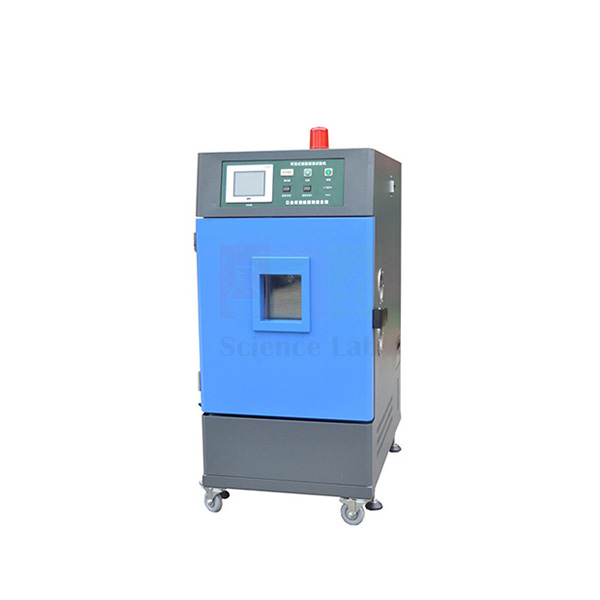
Humidity Chamber
Humidity Chamber (Product Code: SLE/CE/111) is a temperature- and humidity-controlled cabinet used to keep specimens and materials at a set relative humidity for conditioning and observation in civil engineering, materials and research laboratories. Testing labs and colleges rely on it when conditions must stay steady over long periods; it creates humidity by steam injection, cools with a hermetically sealed compressor and has a 112 L base capacity. It is supplied by Jain Scientific Equipments Pvt Ltd (ScienceLab), Ambala, India.
Specifications
| Parameter | Detail |
|---|---|
| Capacity | 112 L (4 cu ft) |
| Inner size options (W x D x H) | 455 x 410 x 610 mm, 505 x 415 x 830 mm, 570 x 550 x 875 mm, 650 x 580 x 900 mm |
| Humidity | 55% to 90% RH, ± 5% |
| Humidity range at cool temperatures | 5% above ambient, from 55% to 95% RH, ± 3% RH |
| Humidity creation | Steam injection |
| Humidity controller | Digital humidity indicator-cum-controller |
| Temperature control | Microprocessor-based digital temperature controller cum indicator; PID control with Pt 100 sensor; automatic |
| Temperature range | To be confirmed at quotation (not clearly stated in the current listing) |
| Air circulation | Forced convection type, with precision air ducting for positive air flow |
| Cooling | Hermetically sealed compressor with CFC-free refrigerant |
| Inner chamber | Highly polished stainless steel sheet, with stainless steel adjustable shelves |
| Outer body | Mild steel, powder coated |
| Insulation | PUF insulation between inner and outer walls to limit thermal loss |
| Doors | Two doors: inner full-length transparent door, and double-walled main door with sturdy hinges and magnetic gasket |
| Electric supply | 220/230 V AC, 50/60 Hz |
| Product code | SLE/CE/111 |
| Supplied by | Jain Scientific Equipments Pvt Ltd (ScienceLab), Ambala, India |
What Is the Humidity Chamber Used For?
Many construction and engineering materials change their behaviour as they gain or lose moisture, so specimens often have to be held at a known humidity before, or during, a test. A humidity chamber provides that controlled atmosphere: steam injection raises the relative humidity, the compressor and forced-convection ducting keep temperature and air movement steady across the shelves, and the digital controllers hold the set points automatically. Typical uses include conditioning cement, mortar and other building material specimens and observing how samples respond to damp conditions over time.
Let the chamber stabilise at its set points before loading, and leave space between items on the adjustable shelves so air can circulate. The inner transparent door lets you inspect specimens without fully disturbing the conditions, and the magnetic gasket on the main door should be kept clean for a good seal. When adding lab equipment for research or teaching, check your 220/230 V AC supply and the floor space needed for the inner size you choose.
What to Specify When Ordering
- Inner size: 455 x 410 x 610, 505 x 415 x 830, 570 x 550 x 875 or 650 x 580 x 900 mm.
- The humidity and temperature set points your tests need, so we can confirm suitability.
- Your electric supply (the chamber is listed for 220/230 V AC, 50/60 Hz).
- Quantity and delivery location in India or abroad.
Supplier
ScienceLab is the trading name of Jain Scientific Equipments Private Limited, which supplies this Humidity Chamber to colleges, research institutions, testing laboratories, dealers and importers in India and international markets. One enquiry covers the chamber together with the specimen moulds and curing equipment a civil engineering laboratory usually needs.
For vendor registration, the supplying company holds Importer-Exporter Code AAECJ8618A (DGFT) and GSTIN 06AAECJ8618A1ZT. More about the company is on the ScienceLab company profile.
Related Civil Engineering Lab Equipment
These items are commonly used with a humidity chamber in materials and concrete laboratories:
- Cement curing bench-type cabinet — a dedicated moist-curing cabinet for cement specimens.
- Accelerated Curing Tank — for water-based accelerated curing of concrete cubes.
- Concrete Cube Mould — casts the specimens that are later conditioned and tested.
- Oven, 43 litre — for drying samples when a test calls for dry rather than humid conditions.
Browse the full Civil Engineering Lab Equipment range for curing, conditioning and testing apparatus.
Frequently Asked Questions
What humidity range does the Humidity Chamber provide?
The Humidity Chamber is listed for 55% to 90% RH with ± 5% tolerance, and for 55% to 95% RH at ± 3% RH at cool temperatures, starting from 5% above ambient. Humidity is created by steam injection and held by a digital indicator-cum-controller.
What sizes is the Humidity Chamber available in?
The Humidity Chamber has a listed capacity of 112 L (4 cu ft), and inner sizes (W x D x H) of 455 x 410 x 610 mm, 505 x 415 x 830 mm, 570 x 550 x 875 mm and 650 x 580 x 900 mm are offered.
What temperature range does the Humidity Chamber cover?
The temperature range of the Humidity Chamber is not clearly stated in the current listing, so please ask us to confirm it for the model you choose. Temperature is held automatically by a microprocessor-based PID controller with a Pt 100 sensor.
How does the Humidity Chamber keep conditions uniform?
The Humidity Chamber uses forced convection with precision air ducting for positive air flow, PUF insulation between its walls, a hermetically sealed compressor with CFC-free refrigerant and a double-walled main door with magnetic gasket to hold conditions steady.
Who supplies the Humidity Chamber?
The Humidity Chamber is supplied by Jain Scientific Equipments Pvt Ltd (ScienceLab), Ambala, India, to colleges, research institutions, testing laboratories, dealers and importers in India and international markets, with quotations issued on request.
Is a calibration certificate available for the Humidity Chamber?
Calibration-certificate availability for the Humidity Chamber should be discussed with us before ordering. Share your documentation needs through the contact page and we will confirm what can be provided with the quotation.
Request a Quote
To receive a quotation for the Humidity Chamber, contact us through the contact page or add it to the enquiry cart, mentioning the inner size and set points you require.
Last updated: 24 September 2026
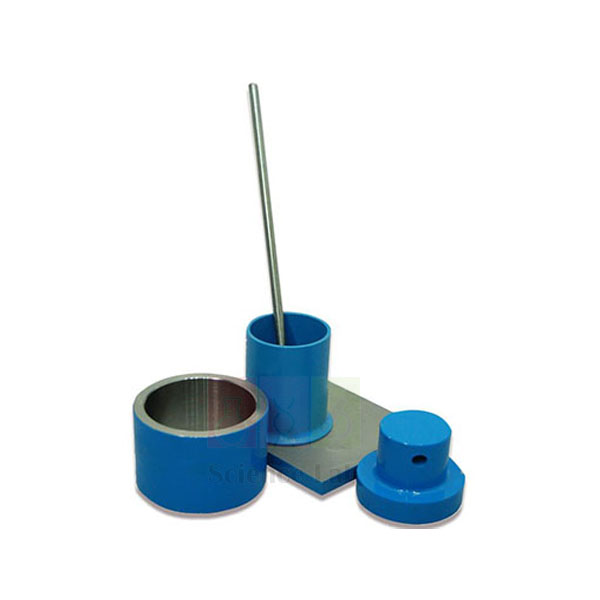
Aggregate Crushing Value Apparatus.
Aggregate Crushing Value Apparatus (Product Code: SLE/AG/01) is a steel cylinder-and-plunger test set used to measure the relative resistance of coarse aggregate to crushing under a gradually applied compressive load in civil engineering laboratories. Polytechnics and highway labs use this engineering lab equipment to compare stone sources; its 150 mm cylinder takes a 148 mm plunger, with base plate, metal measure and tamping rod included. It is made by Jain Scientific Equipments Pvt Ltd (ScienceLab), an OEM manufacturer, at its own factory in Ambala, India.
Specifications
| Parameter | Detail |
|---|---|
| Test purpose | Relative measure of the resistance of an aggregate to crushing under a gradually applied compressive load |
| Set consists of | Steel cylinder, plunger, base plate, cylindrical measure and tamping rod |
| Cylinder | M.S. cylindrical container, 150 mm ± 0.5 mm dia x 130 mm to 140 mm high |
| Base plate | 200 to 230 mm square x 6 mm thick |
| Plunger | 148 mm ± 0.5 mm dia x 100 to 115 mm high |
| Metal measure | 1 no., 115 ± 0.5 mm dia x 180 ± 0.5 mm high |
| Tamping rod | 16 mm dia x 600 mm long, both ends rounded |
| Construction | All parts powder coated or galvanized steel, heat treated and ground before manufacturing for durability |
| Product code | SLE/AG/01 |
| Manufacturer | Jain Scientific Equipments Pvt Ltd (ScienceLab) — OEM |
| Country of origin | India (made in Ambala, Haryana) |
What Is the Aggregate Crushing Value Apparatus Used For?
The metal measure is filled with prepared aggregate to fix the quantity used for each test. That aggregate is placed in the cylinder in layers, each compacted with the tamping rod, and the plunger is seated level on the surface. The assembly on its base plate goes into a compression testing machine and the load is applied steadily as your test method sets out. After unloading, the crushed material is sieved and the fines are weighed; fines as a percentage of the original sample mass give the crushing value, so a lower figure means a tougher aggregate.
Because the set is simple and robust, it is common lab equipment for technical institutes where students run the test in groups. Use the same measure and tamping routine for every sample so results can be compared, keep the cylinder bore and plunger face free of grit so the plunger does not bind, and wipe all parts dry after cleaning.
OEM Manufacturer
ScienceLab is the trading name of Jain Scientific Equipments Private Limited, the OEM (original equipment manufacturer) of this crushing value set. The apparatus is made at the company's own licensed factory at Saha, Ambala, Haryana, India, rather than bought in from a trader, and it is supplied factory-direct to colleges, testing laboratories, dealers and importers. If you later need a replacement plunger or tamping rod, ask us and the request goes straight to the maker. Read more on the ScienceLab company profile.
Related Civil Engineering Lab Equipment
A crushing value test depends on a representative dry sample, a loading machine and careful sieving. These items fit the same workflow:
- Automatic digital compression testing machine — a compression machine of the kind used to apply the gradually increasing load to the cylinder and plunger.
- Aggregate Impact Tester — a companion toughness test in which a falling hammer strikes the aggregate instead of a slow load.
- Riffle Sample Divider — reduces a large field sample to a representative portion before it goes into the measure.
- Test Sieves — for separating the fines produced by crushing so they can be weighed.
- Oven, 43 litre — dries the aggregate before testing so moisture does not distort the result.
For more aggregate, concrete and soil testing apparatus, browse the Civil Engineering Lab Equipment category.
Frequently Asked Questions
What is included with the Aggregate Crushing Value Apparatus?
The Aggregate Crushing Value Apparatus consists of a steel cylinder, a plunger, a base plate, one cylindrical metal measure of 115 ± 0.5 mm dia x 180 ± 0.5 mm high, and a tamping rod 16 mm in diameter and 600 mm long with both ends rounded.
Is a compression testing machine supplied with the Aggregate Crushing Value Apparatus?
No. The Aggregate Crushing Value Apparatus is the cylinder, plunger and accessories only; the load is applied with a separate compression testing machine. If you need help matching the set to the machine in your laboratory, contact us before ordering.
How do the cylinder and plunger of the Aggregate Crushing Value Apparatus fit together?
The cylinder of the Aggregate Crushing Value Apparatus is 150 mm ± 0.5 mm in diameter and the plunger is 148 mm ± 0.5 mm, so the plunger slides inside the cylinder and bears evenly on the compacted aggregate during loading.
How should the Aggregate Crushing Value Apparatus be looked after?
Brush all fines out of the Aggregate Crushing Value Apparatus after each test, wash off any mud, dry every part fully and store the plunger beside the cylinder so that its face and the cylinder bore are not knocked or scratched.
Who manufactures the Aggregate Crushing Value Apparatus?
The Aggregate Crushing Value Apparatus is manufactured by Jain Scientific Equipments Pvt Ltd (ScienceLab), the OEM, at its own licensed factory at Saha, Ambala, Haryana, India. Quotations, repeat orders and replacement-part requests are handled directly by the manufacturer.
Can a calibration or inspection certificate be provided with the Aggregate Crushing Value Apparatus?
Please discuss documentation for the Aggregate Crushing Value Apparatus with us through our contact page before ordering. We will confirm what can be supplied with your specific order rather than promise a document in advance.
What should a quotation request for the Aggregate Crushing Value Apparatus include?
Give the product code SLE/AG/01, the number of sets, the delivery address in India or abroad and any tender specification the Aggregate Crushing Value Apparatus must match, so the dimensions can be checked against your requirement.
Request a Quote
For pricing and availability, send your requirement through our contact page or add this apparatus to the enquiry cart with the other items for your material testing lab. Quotations come directly from ScienceLab as the manufacturer.
Last updated: 24 September 2026
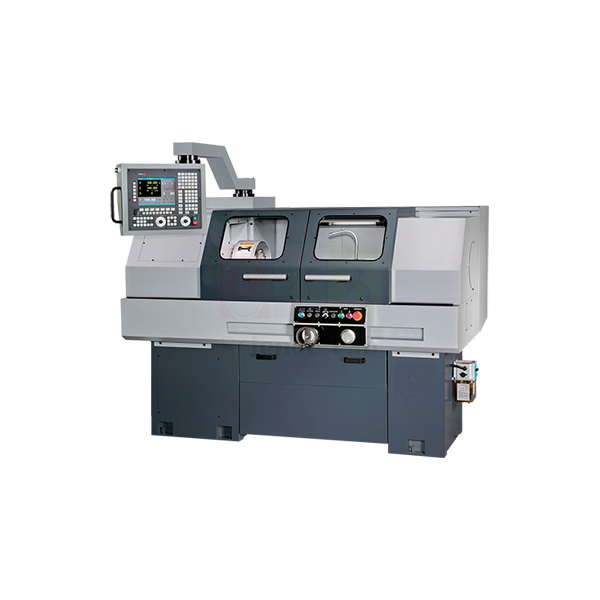
CNC Lathe Machine
CNC Lathe Machine (Product Code: SLE/MCE/01) is a compact slant-bed CNC lathe used to teach and practise programmed turning of small components in engineering college workshops, polytechnics and technical training centres. Its design replicates industrial machine features — cast iron bed, precision-grade ground ball screws, LM guideways and servo motors — around an 8-station programmable turret and a 100 mm chuck. It is supplied by Jain Scientific Equipments Pvt Ltd (ScienceLab), Ambala, India.
Specifications
| Parameter | Detail |
|---|---|
| Machine type | Compact industrial slant bed lathe with programmable turret |
| Construction features | Cast iron bed, precision-grade ground ball screws, LM guideways, servo motors, coolant system, AC panel cooler for the control box, full machine guard |
| Chuck capacity | 100 mm |
| Maximum turning diameter | 80 mm |
| Maximum turning length | 190 mm |
| Positioning accuracy | 0.01 mm |
| Hole through spindle | 20 mm |
| Spindle speed range | 150–4000 RPM |
| Spindle motor | 3.7 kW |
| Turret stations | 8 |
| X/Z axis travel | 95 / 210 mm |
| Rapid traverse X/Z | 5000 mm/min |
| Feed rate | 0–5000 mm/min |
| Tailstock | Base stroke 170 mm; stroke 40 mm; diameter 35 mm |
| Product code | SLE/MCE/01 |
| Supplied by | Jain Scientific Equipments Pvt Ltd (ScienceLab), Ambala, India |
What Is the CNC Lathe Used For?
A CNC lathe turns a rotating workpiece against cutting tools that move under program control, so students learn to write part programs, set tool offsets and run jobs rather than turn handwheels. On this machine the 8-station turret indexes between tools automatically, allowing a sequence of operations such as facing, turning and grooving on bar stock held in the 100 mm chuck. Workpieces up to 80 mm in diameter and 190 mm long fit the working envelope.
Because the machine copies the construction of production lathes, skills learned on it carry over to industry. The full guard and coolant system support safe, clean training sessions, and the AC panel cooler protects the control box in hot workshops. For technical institutes planning a CNC section, confirm the power supply, tooling and programming software with us before installation.
What to Specify When Ordering
- The workpiece sizes you will teach with (the listed maximum is 80 mm diameter and 190 mm length).
- The power supply available in your workshop, since it is not stated in the current listing.
- Tool holders and cutting tools you want included for the 8-station turret.
- The CNC programming or simulation software your syllabus uses, so compatibility can be checked.
- Quantity and delivery location in India or abroad.
Supplier
ScienceLab is the trading name of Jain Scientific Equipments Private Limited, which supplies this CNC Lathe Machine to engineering colleges, polytechnics, ITIs, skill-development centres, dealers and importers in India and international markets. Institutions can source workshop machines and laboratory apparatus through one supplier and one quotation.
Our team can discuss installation space, power and training requirements while preparing your offer. Read more on the ScienceLab company profile.
Related Workshop Machine Tools
A machining workshop usually pairs CNC turning with these machines and tools:
- CNC milling Machine — adds programmed milling so students cover both main CNC processes.
- Universal Milling Machine — conventional milling practice before moving to CNC.
- Tool And Cutter Grinding Machine — keeps workshop cutting tools sharp.
- Caliper Vernier (Metal) — checks turned diameters and lengths against the drawing.
See all Workshop Machine Tools for drilling, milling, pressing and welding machines.
Frequently Asked Questions
What size of workpiece can the CNC Lathe Machine turn?
The CNC Lathe Machine has a maximum turning diameter of 80 mm and a maximum turning length of 190 mm, with a 100 mm chuck and a 20 mm hole through the spindle, which suits small training components and bar work.
How many tools does the CNC Lathe Machine hold?
The CNC Lathe Machine has an 8-station programmable turret, so eight tools can be mounted and called up automatically by the part program. Tell us which tool holders and tools you need included when you request a quotation.
How precise is the CNC Lathe Machine?
The CNC Lathe Machine is listed with 0.01 mm positioning accuracy, using precision-grade ground ball screws, LM guideways and servo motors, with 5000 mm/min rapid traverse on X and Z and a programmable feed rate of 0–5000 mm/min.
Is the CNC Lathe Machine suitable for student training?
Yes. The CNC Lathe Machine is a compact slant-bed lathe whose design replicates industrial features, with a full machine guard and coolant system, making it suitable for colleges, polytechnics and training centres that teach CNC programming and operation.
What power supply does the CNC Lathe Machine need?
The CNC Lathe Machine listing gives a 3.7 kW spindle motor but does not state the supply voltage or phase. Please ask us to confirm the electrical requirement before you plan the installation in your workshop.
Who supplies the CNC Lathe Machine?
The CNC Lathe Machine is supplied by Jain Scientific Equipments Pvt Ltd (ScienceLab), Ambala, India, to engineering colleges, polytechnics, training centres, dealers and importers in India and international markets.
Request a Quote
Ask for a CNC Lathe Machine quotation through our contact page or add it to the enquiry cart, listing the tooling, software and quantity you need.
Last updated: 24 September 2026
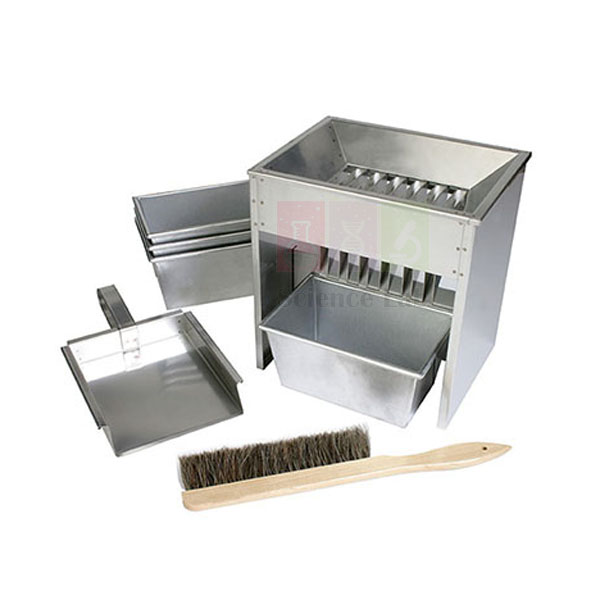
Sample Splitter
Sample Splitter (Product Code: SLE/AG/02) is a hopper-fed sample divider used to reduce test samples that are too large in volume to be handled conveniently in aggregate and soil testing laboratories. Site labs and engineering colleges choose it for bulky material, because its 30 litre clam shell hopper takes anything from sand sizes up to 108 mm. It is made by Jain Scientific Equipments Pvt Ltd (ScienceLab), an OEM lab equipment manufacturer in India, at its own factory in Ambala.
Specifications
| Parameter | Detail |
|---|---|
| Purpose | Reduction of test samples too large in volume to be conveniently handled |
| Material size handled | Any material from sand sizes up to 108 mm dia. |
| Hopper | Clam shell hopper, 30 litres capacity |
| Supplied with | Two collecting pans |
| Finish | Totally cadmium plated for rust protection |
| Construction | Very sturdily constructed |
| Product code | SLE/AG/02 |
| Manufacturer | Jain Scientific Equipments Pvt Ltd (ScienceLab) — OEM |
| Country of origin | India (made in Ambala, Haryana) |
What Is the Sample Splitter Used For?
The bulk sample is mixed and spread evenly in the clam shell hopper while it is closed. Opening the hopper releases the load in one even stream, and the splitter divides it into two halves, each caught in its own collecting pan. One pan is set aside and the other is passed through again until the portion is about the size the test method asks for. Splitting this way keeps the grading of the smaller portion close to that of the original stockpile, which is far more reliable than scooping material off the surface of a bag.
Colleges setting up a highway or concrete materials course usually buy a splitter early, since sieve analysis, specific gravity and crushing tests all start from a reduced sample. Load the hopper evenly across its full width, and empty both pans completely between passes so that no fines are lost.
OEM Manufacturer
Jain Scientific Equipments Private Limited, which trades as ScienceLab, is the original equipment manufacturer (OEM) of this Sample Splitter. The unit is built at the company's own licensed factory at Saha, Ambala, Haryana, India, and dispatched from there to laboratories, contractors, dealers and importers. Because you deal with the maker directly, questions about the hopper, the pans or a repeat order are answered by the people who build the splitter. Company background is on the ScienceLab profile page.
Related Civil Engineering Lab Equipment
Once a bulk sample has been reduced, these items carry the work forward:
- Riffle Sample Divider — a chute-type divider offered in sizes from 7 mm to 75 mm for smaller or finer portions.
- Test Sieves — for grading the reduced portion by particle size.
- Electromagnetic Digital Sieve Shaker — gives a vertical sieving motion designed for sand and aggregates.
- Aggregate Crushing Value Apparatus — a strength test that needs a representative coarse aggregate portion.
- Scoops — stainless steel or aluminium scoops for loading and handling the sample.
Other aggregate, concrete and soil testing products are listed in the Civil Engineering Lab Equipment category.
Frequently Asked Questions
What particle sizes can the Sample Splitter handle?
The Sample Splitter handles any material from sand sizes up to 108 mm diameter, so a single unit can reduce fine sand as well as coarse aggregate and crushed stone samples collected from a stockpile or site.
How much material does the Sample Splitter hopper hold?
The clam shell hopper of the Sample Splitter has a capacity of 30 litres. Larger stockpile samples can be reduced in more than one batch, provided every batch is split in the same way.
What is supplied with the Sample Splitter?
The Sample Splitter is supplied complete with two collecting pans, one for each half of the divided sample, so the retained half can be passed through the splitter again straight away.
Will the Sample Splitter rust in a wet site laboratory?
The Sample Splitter is totally cadmium plated for rust protection and very sturdily constructed. Even so, brush out damp material after use and store the unit dry so that the plated finish stays in good condition.
Should I choose the Sample Splitter or the Riffle Sample Divider?
The Sample Splitter suits bulky samples, with its 30 litre hopper and material up to 108 mm, while the Riffle Sample Divider is offered in a range of sizes for smaller portions. If unsure, tell us your material and sample sizes.
Who manufactures the Sample Splitter?
The Sample Splitter is manufactured by Jain Scientific Equipments Pvt Ltd (ScienceLab), the OEM, at its own licensed factory in Saha, Ambala, Haryana, India, and is supplied factory-direct to laboratories, contractors, dealers and importers.
Can you supply several Sample Splitters for a project or tender?
Yes. ScienceLab quotes Sample Splitters in quantity for institutions, contractors and dealers across India and international markets; share the number of units and the delivery location for a consolidated quotation from the manufacturer.
Request a Quote
Send your enquiry for the Sample Splitter through our contact form, or add it to the enquiry cart with the rest of your aggregate testing list. Your quotation comes direct from the manufacturer.
Last updated: 24 September 2026
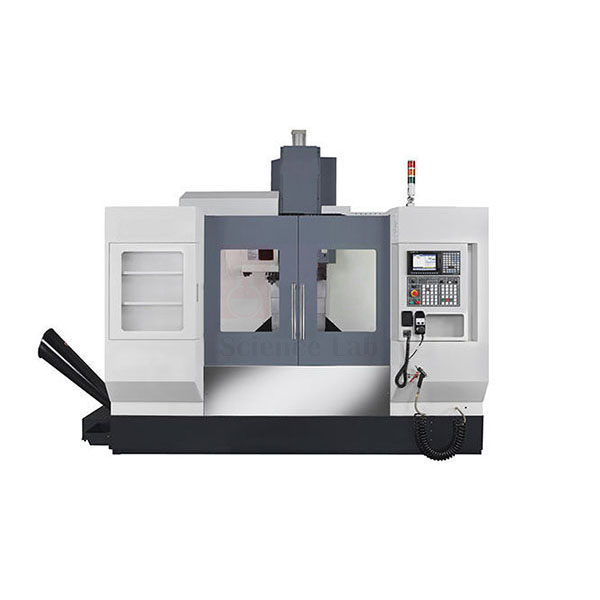
CNC milling Machine
CNC milling Machine (Product Code: SLE/MCE/02) is a three-axis, vertical-spindle CNC milling machine used to cut faces, slots, pockets and contours in metal parts under program control in engineering college workshops, CAD/CAM laboratories and industrial training centres. Its 500 x 400 x 300 mm X/Y/Z travel, 650 x 400 mm table rated for 300 kg and 48 m/min rapid traverse give trainees experience on a production-size machine. It is supplied by Jain Scientific Equipments Pvt Ltd (ScienceLab), Ambala, India.
Specifications
| Parameter | Detail |
|---|---|
| Power source | 200–240 VAC, 50–60 Hz, 3-phase |
| Controlled axes | 3 axes, all 3 simultaneously controllable |
| Control features | High Response Velocity (HRV); 512 kbyte part program storage; 200 registerable programs |
| Operation panel | 10.4 inch colour LCD |
| I/O interface | RS-232C |
| X-axis travel (table, longitudinal) | 500 mm |
| Y-axis travel (saddle, cross) | 400 mm |
| Z-axis travel (spindle head, vertical) | 300 mm |
| Table working space (X x Y) | 650 x 400 mm |
| Workpiece mass capacity | 300 kg (uniform load) |
| Table working surface | 3 T-slots, size 14 mm, pitch 125 mm |
| Rapid traverse rate | 48 m/min (X, Y, Z) |
| Feedrate | 30000 mm/min |
| Machine height | 2236 mm |
| Floor space | 1615 x 2040 mm |
| Mass of machine | Approx. 2000 kg |
| Accessories | Automatic oil lubricating system, working lamp, air blow for chips, 3-colour signal lamp, tool holder locking device, tool setting stand, touch probe, tool length switch for automatic measurement, LED illumination, coolant unit with chip flush |
| Power requirement (as listed with accessories) | 200 VAC +10 to -15%, 3-phase, 50 Hz, 16 kVA |
| Product code | SLE/MCE/02 |
| Supplied by | Jain Scientific Equipments Pvt Ltd (ScienceLab), Ambala, India |
What Is the CNC Milling Machine Used For?
On a CNC milling machine the table, saddle and spindle head move together under program control, so a rotating cutter can produce flat faces, slots, pockets, holes and curved profiles that would take much longer by hand. Trainees write or import part programs, store them in the control (up to 200 programs in 512 kbyte) or transfer them through the RS-232C interface, then set work offsets and run the job while watching the 10.4 inch colour display.
The touch probe and tool length switch automate workpiece and tool measurement, a practical skill in modern machine shops, while the coolant unit with chip flush and air blow keep the cutting area clear. With a mass of about 2000 kg and a 1615 x 2040 mm footprint, the machine needs a planned location, floor access for delivery and a 3-phase supply of the listed rating.
What to Specify When Ordering
- Your 3-phase supply, checked against the listed 200–240 VAC, 50–60 Hz and 16 kVA requirement.
- Installation space and access for a machine of approx. 2000 kg and 2236 mm height.
- Tool holders and cutters you want included with the machine.
- How programs will be prepared and transferred (CAD/CAM software, RS-232C).
- Quantity and delivery location in India or abroad.
Supplier
Jain Scientific Equipments Private Limited, trading as ScienceLab, supplies the CNC milling Machine to engineering colleges, polytechnics, industrial training institutes, dealers and importers in India and international markets, alongside other workshop machines and laboratory apparatus.
For vendor registration by institutional and tender buyers, the supplying company is registered under GSTIN 06AAECJ8618A1ZT and holds LEI 3358004HRD1JIVXKYX49. See the ScienceLab company profile for more.
Related Workshop Machine Tools
A CNC or production workshop typically adds these machines around a machining centre:
- CNC Lathe Machine — covers CNC turning to complete the training programme.
- Universal Milling Machine — conventional milling for basic practice and simple jobs.
- Tool And Cutter Grinding Machine — resharpens milling cutters used on the machine.
- Radial Drill Machine — handles large-diameter drilling and tapping on heavy parts.
Browse all Workshop Machine Tools for the rest of the range.
Frequently Asked Questions
What is the working range of the CNC milling Machine?
The CNC milling Machine has 500 mm X, 400 mm Y and 300 mm Z travel, a 650 x 400 mm table working space with three 14 mm T-slots at 125 mm pitch, and takes workpieces up to 300 kg as a uniform load.
What control features does the CNC milling Machine have?
The CNC milling Machine has 3-axis simultaneous control with High Response Velocity, 512 kbyte part program storage for up to 200 registerable programs, a 10.4 inch colour LCD operation panel and an RS-232C interface for transferring programs.
Which accessories are listed with the CNC milling Machine?
The CNC milling Machine lists automatic oil lubrication, working lamp, air blow for chips, 3-colour signal lamp, tool holder locking device, tool setting stand, touch probe, tool length switch, LED illumination and a coolant unit with chip flush.
What power supply does the CNC milling Machine need?
The CNC milling Machine needs a 3-phase supply: 200–240 VAC, 50–60 Hz, with the accessory listing giving 200 VAC +10 to -15% and 16 kVA. Have your electrician check the supply and confirm details with us before installation.
How much space does the CNC milling Machine occupy?
The CNC milling Machine needs a floor space of 1615 x 2040 mm, stands 2236 mm high and weighs approximately 2000 kg, so plan the installation position, floor loading and delivery access before the machine arrives.
Who supplies the CNC milling Machine?
The CNC milling Machine is supplied by Jain Scientific Equipments Pvt Ltd (ScienceLab), Ambala, India, to engineering colleges, training institutes, dealers and importers in India and international markets, with quotations provided on request.
Request a Quote
For a CNC milling Machine quotation, use our contact page or add the machine to the enquiry cart, including your power supply, tooling and delivery details.
Last updated: 24 September 2026
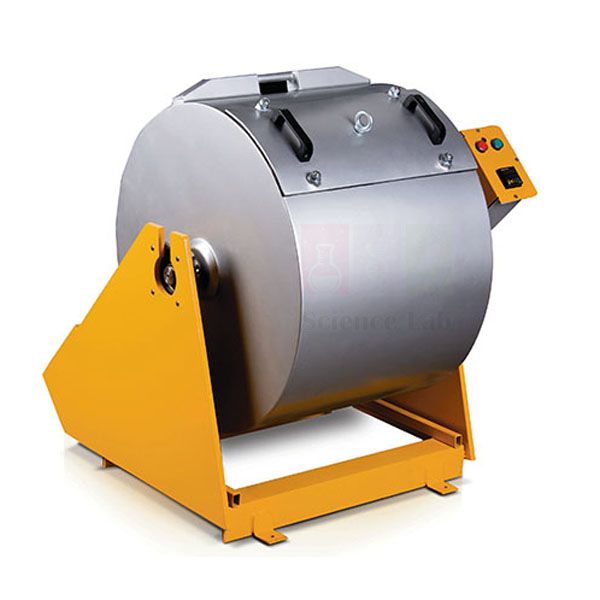
Los Angeles Abrasion Testing Machine
Los Angeles Abrasion Testing Machine (Product Code: SLE/AG/03) is a motor-driven rotating drum used to measure the resistance of coarse aggregate to abrasion and impact in highway and civil engineering laboratories. Road research labs, colleges and quarries run it with a charge of twelve hardened steel balls of about 48 mm, the drum turning at 30–33 rpm through a heavy reduction gear. It is made by Jain Scientific Equipments Pvt Ltd (ScienceLab), an OEM engineering lab equipment manufacturer, at its own factory in Ambala, India.
Specifications
| Parameter | Detail |
|---|---|
| Drum | Hollow cylinder mounted horizontally on a sturdy frame, running on ball bearings |
| Charging opening | Opening closed with a dust-tight cover for charging and discharging the drum |
| Internal shelf | Detachable shelf extending throughout the inside length of the drum; catches the abrasive charge and stops it falling on the cover |
| Drive | Electric motor through a heavy reduction gear |
| Drum speed | 30–33 rpm |
| Revolution counter | Fitted to the frame |
| Abrasive charge | Set of twelve hardened steel balls, approximately 48 mm dia. |
| Collection tray | Supplied, for collecting the material at the end of the test |
| Electrical supply | 440 V, 3 phase, 50 cycles, A.C. |
| Product code | SLE/AG/03 |
| Manufacturer | Jain Scientific Equipments Pvt Ltd (ScienceLab) — OEM |
| Country of origin | India (made in Ambala, Haryana) |
What Is the Los Angeles Abrasion Machine Used For?
A dried, graded sample is weighed and loaded through the charging opening together with the number of steel balls your test method specifies for that grading. With the dust-tight cover closed, the drum runs for the required number of revolutions, read from the counter. On every turn the internal shelf lifts the stones and balls and drops them across the drum, combining impact with grinding. The contents are then emptied into the collection tray, the balls removed and the material sieved; the loss in mass as a percentage of the starting mass is reported as the abrasion value.
Because the test gives a single, easily compared number, the machine sits alongside other test and measurement instruments in India's highway and materials labs as a routine acceptance check for road and concrete aggregate. Keep the shelf fixings tight, check that the cover closes dust-tight before each run so fines are not lost, and inspect the balls periodically for wear.
OEM Manufacturer
ScienceLab is the trading name of Jain Scientific Equipments Private Limited, the OEM (original equipment manufacturer) of this Los Angeles machine. It is fabricated and assembled at the company's own licensed factory at Saha, Ambala, Haryana, India, and supplied factory-direct to engineering colleges, highway laboratories, dealers and importers. Buying from the maker means a request for replacement steel balls or a spare shelf reaches the same people who built the machine, so simply ask us. The ScienceLab company profile has more about the business.
Related Civil Engineering Lab Equipment
Laboratories that run the Los Angeles test usually also need:
- Digital Los Angles Abrasion Testing Machine — the version with an electronic control unit and an automatic counter that stops at a preset count.
- Devel Attrition Tester — a wear test using twin inclined cylinders, for comparing results by a second method.
- Aggregate Impact Tester — measures toughness under hammer blows, completing the aggregate strength picture.
- Sample Splitter — divides the bulk stockpile sample down to a representative portion for grading.
- Test Sieves — for grading the charge before the run and sieving it afterwards.
The full range of aggregate and road material testing items is in the Civil Engineering Lab Equipment category.
Frequently Asked Questions
Is the steel ball charge included with the Los Angeles Abrasion Testing Machine?
Yes. The Los Angeles Abrasion Testing Machine comes complete with an abrasive charge of twelve hardened steel balls of approximately 48 mm diameter, plus a tray for collecting the material at the end of the test.
What electrical supply does the Los Angeles Abrasion Testing Machine need?
The Los Angeles Abrasion Testing Machine is built for a 440 V, 3 phase, 50 cycles A.C. supply. If your laboratory has a different supply, contact us before ordering so the requirement can be discussed with the manufacturer.
How are revolutions controlled on the Los Angeles Abrasion Testing Machine?
The drum of the Los Angeles Abrasion Testing Machine turns at 30–33 rpm through a heavy reduction gear, and a revolution counter fitted to the frame shows the completed turns so the operator can stop the run at the required count.
Why does the Los Angeles Abrasion Testing Machine drum have an internal shelf?
The detachable shelf runs the full inside length of the Los Angeles Abrasion Testing Machine drum. It catches the abrasive charge on each revolution, lifting and dropping it with the stones, and stops the balls from falling onto the cover.
How does this Los Angeles Abrasion Testing Machine differ from the digital model?
This Los Angeles Abrasion Testing Machine uses a revolution counter on the frame, while the Digital Los Angles Abrasion Testing Machine has an electronic control unit and an automatic counter that stops at a preset count. Choose according to how you want runs controlled.
Who manufactures the Los Angeles Abrasion Testing Machine?
The Los Angeles Abrasion Testing Machine is manufactured by Jain Scientific Equipments Pvt Ltd (ScienceLab), the OEM, and assembled at its own licensed factory at Saha, Ambala, Haryana, India. Quotations and spare-part enquiries go directly to the manufacturer.
Is a calibration certificate available for the Los Angeles Abrasion Testing Machine?
Please raise any calibration or inspection document requirement for the Los Angeles Abrasion Testing Machine through our contact page before ordering, and we will confirm what can be provided with your particular order.
What details help us quote for the Los Angeles Abrasion Testing Machine?
Send the product code SLE/AG/03, the quantity, the delivery location and your site power supply, plus any tender document the Los Angeles Abrasion Testing Machine must follow; the quotation then comes straight from the manufacturer.
Request a Quote
Request pricing via our contact page, or place the machine in the enquiry cart along with the other equipment for your highway materials lab. As the manufacturer, ScienceLab quotes you directly.
Last updated: 24 September 2026
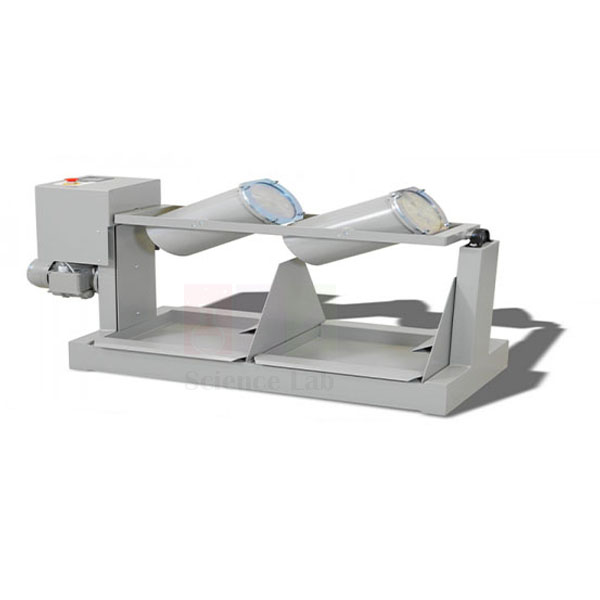
Devel Attrition Tester
Devel Attrition Tester (Product Code: SLE/AG/04) is a twin-cylinder rotating machine used to measure how much coarse aggregate wears away by attrition in road and civil engineering laboratories. Known in many specifications as the Deval test, it suits road research labs, quarries and colleges, and its two hollow cylinders, set at an angle on one shaft, let two samples run together. It is made by Jain Scientific Equipments Pvt Ltd (ScienceLab), an OEM technical educational equipment manufacturer, at its own factory in Ambala, India.
Specifications
| Parameter | Detail |
|---|---|
| Cylinders | Two hollow cylinders, closed at one end and provided with fitting covers |
| Mounting | Cylinders mounted on a shaft, inclined to the axis of rotation of the shaft |
| Drive | Motor through a reduction gear |
| Shaft speed | 30–33 RPM |
| Revolution counter | Provided |
| Abrasive charge | 12 nos. hardened steel balls of 48 mm dia. |
| Electrical supply | 440 Volts, three phase, 50 cycles, A.C. |
| Product code | SLE/AG/04 |
| Manufacturer | Jain Scientific Equipments Pvt Ltd (ScienceLab) — OEM |
| Country of origin | India (made in Ambala, Haryana) |
What Is the Devel Attrition Tester Used For?
A weighed, graded aggregate sample is placed in a cylinder together with the steel balls the test method calls for, and the fitting cover is secured. Because each cylinder sits at an angle to the shaft, the contents slide from end to end as well as tumbling on every revolution, so the stones grind against one another rather than simply falling. After the set number of revolutions, read from the counter, the sample is removed, sieved and reweighed, and the material lost is expressed as a percentage of the original mass.
With two cylinders on the same shaft, a class can compare two aggregates, or run a duplicate, in a single session, which makes the tester practical engineering educational equipment in India's polytechnics and colleges where lab time is limited. Before each run, check that both covers are tight and that the cylinders are loaded evenly to keep the shaft balanced.
OEM Manufacturer
Jain Scientific Equipments Private Limited trades as ScienceLab and is the OEM (original equipment manufacturer) behind this Devel Attrition Tester. The tester is built at the company's own licensed factory at Saha, Ambala, Haryana, India, and goes factory-direct to polytechnics, road laboratories, dealers and importers, with no trading intermediary in between. For a second set of steel balls or other parts later on, ask us and the manufacturer will respond itself. Learn more on our company profile.
Related Civil Engineering Lab Equipment
These products belong to the same aggregate durability workflow:
- Los Angeles Abrasion Testing Machine — a single-drum abrasion and impact test often specified alongside or instead of the attrition test.
- Dorry Abrasion Testing Machine — a rotating-disc test with sand fed from conical hoppers, giving another view of wear resistance.
- Riffle Sample Divider — splits the field sample into representative portions for each cylinder.
- Test Sieves — for grading the sample beforehand and sieving out the worn fines afterwards.
- Oven, 43 litre — brings samples to a dry state before the starting and final weighings.
More equipment of this type is listed in the Civil Engineering Lab Equipment category.
Frequently Asked Questions
How is the Devel Attrition Tester different from the Los Angeles abrasion machine?
The Devel Attrition Tester uses two hollow cylinders set at an angle on a rotating shaft, while the Los Angeles machine uses one horizontal drum with an internal shelf. The two methods load the stone differently, so check which one your specification names.
Are the steel balls supplied with the Devel Attrition Tester?
Yes. The Devel Attrition Tester comes complete with an abrasive charge of 12 hardened steel balls of 48 mm diameter, so it is ready to run once the aggregate sample has been prepared and weighed.
Can the Devel Attrition Tester run two samples at once?
Yes. Both cylinders of the Devel Attrition Tester are mounted on the same shaft and turn together, so two samples, or a duplicate of one sample, can run in a single session, provided each cylinder is loaded as the method requires.
What power supply does the Devel Attrition Tester need?
The motor of the Devel Attrition Tester is suitable for 440 Volts, three phase, 50 cycles A.C. supply. Discuss any other supply with us through the contact page before ordering so the manufacturer can advise.
How should the Devel Attrition Tester be maintained?
Empty and brush out both cylinders of the Devel Attrition Tester after every test, keep the reduction gear lubricated, and check that the fitting covers close firmly so that no fines escape during a run.
Who manufactures the Devel Attrition Tester?
The Devel Attrition Tester is manufactured by Jain Scientific Equipments Pvt Ltd (ScienceLab), the OEM, at its own licensed factory at Saha, Ambala, Haryana, India. Replacement steel balls or other parts can be requested directly from the manufacturer; just ask us.
Do you ship the Devel Attrition Tester outside India?
Yes. ScienceLab supplies the Devel Attrition Tester to laboratories in India and international markets. Include the destination and quantity with your enquiry so that packing and shipping can be quoted by the manufacturer.
Request a Quote
To receive a quotation direct from the manufacturer, write to us from the contact page or add the tester to the enquiry cart and submit your list in one go.
Last updated: 24 September 2026