- Physics Lab Equipment
- Chemistry Lab Equipment
- Biology Lab Equipment
- Anatomical Lab Equipment
- Learning
- Educational Lab Equipment
- Magnets
- Agriculture
- Astronomy
- Earth Science
- Geography Lab Equipment
- Safety Lab Coat
- Laboratory
- Meteorological
- Electricity & Magnetism
- Heat
- School Lab Equipment
- Lab Glassware
- Science Lab Equipment
- Tvet Lab Equipment
- Robotics Kits Supplier and Manufacturer for Schools India
- Math Lab Equipment Manufacturers and Exporters in Ambala
- STEM Kits Manufacturers and Supplier India
- Engineering Lab Equipment
- Hospital Lab Equipment
- Water, Sanitation & Hygiene Supplies
- Cold Chain, Solar & Communication Equipment
- Nutrition
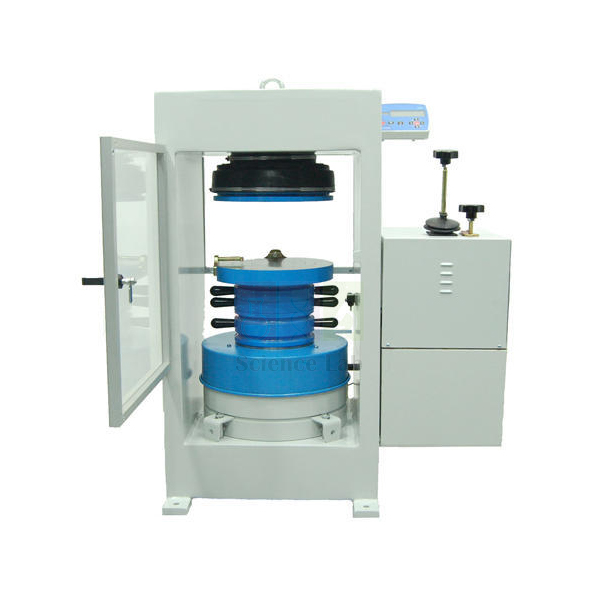
Automatic digital compression testing machine
Automatic digital compression testing machine (Product Code: SLE/CE/01) is a hydraulic load frame with a digital controller used to crush hardened concrete specimens and record their compressive strength in civil engineering and materials testing laboratories. It is offered in 2000 kN and 3000 kN capacities, and once the specimen parameters are entered a single press of the start button runs the complete automatic test cycle. This engineering lab equipment is supplied by Jain Scientific Equipments Pvt Ltd (ScienceLab), Ambala, India.
Specifications
| Parameter | Detail |
|---|---|
| Capacity | 2000 kN or 3000 kN |
| Test cycle | Fully automatic with standard rapid approach; closed-loop digital readout |
| Control system | Graphical LCD data acquisition and control system with menu-driven software |
| Load rate control | 1 kN/s to 20 kN/s; control accuracy listed as ±5 |
| Load accuracy | Class 1 from 10% of full range |
| Live display | Load vs time plot and instantaneous load rate |
| Data storage | Up to 256 tests |
| Output | RS 232 port for printer or PC |
| PC software | For test control and advanced report printout (confirm inclusion in your quotation) |
| Main parts | Load frame, power pack, data acquisition and control system |
| Power | 750 W |
| Oil capacity | 20 L |
| Upper and lower platen diameter | 300 mm |
| Piston diameter | 250 mm or 300 mm, depending on version |
| Maximum piston movement | 50 mm |
| Horizontal clearance | 360 mm or 425 mm, depending on version |
| Maximum vertical clearance between platens | 340 mm |
| Maximum working pressure | 410 bar |
| Platen surface roughness | ≤ 3.2 µm (loading and auxiliary platens) |
| Dimensions (W x L x H) | 810 x 500 x 970 mm |
| Weight | 795 kg or 1095 kg, depending on version |
| Product code | SLE/CE/01 |
| Supplied by | Jain Scientific Equipments Pvt Ltd (ScienceLab), Ambala, India |
What Is the Compression Testing Machine Used For?
The machine determines the compressive strength of concrete cubes and cylinders after they have been cast and cured. The operator enters the specimen details, presses start, and the controller closes the gap quickly before loading the specimen at the selected rate until it fails. The load-versus-time curve and the live load rate stay on screen, and each result is stored in memory for later printing or transfer to a PC over RS 232.
For consistent results, centre each specimen on the 300 mm platen, wipe the platens clean between tests and check that the specimen fits within the 340 mm vertical clearance. Given a weight of up to 1095 kg, plan a level, rigid floor before delivery. Laboratories buying test and measurement instruments in India for concrete quality control, college practicals or project-site labs use this class of machine as their main strength tester.
What to Specify When Ordering
- Capacity: 2000 kN or 3000 kN.
- The specimen shapes and sizes you will test, so the set-up and clearances can be confirmed.
- Whether you need the RS 232 printer or PC connection and the PC software.
- Your mains supply details and the delivery city or port.
Supplier
Jain Scientific Equipments Private Limited trades as ScienceLab and supplies this compression testing machine from Ambala, Haryana, to engineering colleges, polytechnics, construction material laboratories and dealers in India and international markets. The company sources the machine for your order and remains your single point of contact for the quotation, dispatch documents and after-sales questions such as spare parts — just ask us. More about the company is on the ScienceLab company profile.
Related Civil Engineering Lab Equipment
These items complete a concrete strength-testing set-up around the compression machine:
- Concrete Cube Mould — casts the cube specimens that the machine crushes.
- Cylindrical Mould — forms cylinder specimens for compressive testing.
- Accelerated Curing Tank — cures cubes before early strength testing.
- Flexure Testing Machine Digital — adds flexural tests on beams, kerbs and pavers.
- Longitudinal Compressometer — measures cylinder strain during compression.
See the complete Civil Engineering Lab Equipment range for concrete, cement, soil and aggregate testing.
Frequently Asked Questions
What capacities is the Automatic digital compression testing machine available in?
The Automatic digital compression testing machine is listed in 2000 kN and 3000 kN capacities. Both use a 750 W power pack, 20 L of oil and 300 mm platens, while piston diameter, horizontal clearance and weight differ between the two versions.
How is the loading rate controlled on this compression testing machine?
The loading rate of the Automatic digital compression testing machine is set in its menu-driven software and held by closed-loop control between 1 kN/s and 20 kN/s, with control accuracy listed as ±5. The instantaneous rate is displayed throughout the test.
Can the machine store and print test results?
Yes. The Automatic digital compression testing machine stores up to 256 tests and has an RS 232 output for a printer or PC. PC software for test control and advanced report printout is listed with the machine, so please confirm it in your quotation.
Who supplies the Automatic digital compression testing machine?
Jain Scientific Equipments Pvt Ltd (ScienceLab) of Ambala, Haryana, India supplies the Automatic digital compression testing machine to colleges, testing laboratories and dealers in India and international markets, and handles quotations, dispatch and after-sales queries directly.
Is a calibration certificate available with the machine?
Calibration-certificate availability for the Automatic digital compression testing machine should be discussed with us before you order. Tell us what your laboratory or client requires through the contact page and we will confirm what can be provided.
How much space does the compression testing machine need?
The Automatic digital compression testing machine measures 810 x 500 x 970 mm (W x L x H) and weighs 795 kg or 1095 kg depending on version, so it needs a level, rigid floor and clear access for handling. Ask us for packed dimensions before shipping.
What details does a quotation request need?
To quote the Automatic digital compression testing machine we need the capacity (2000 kN or 3000 kN), the quantity, the delivery city or port, and whether you want the printer or PC connection and software. Send these details through our contact page or the enquiry cart.
Request a Quote
For price and availability of the Automatic digital compression testing machine, write to us through the contact page or add it to your enquiry cart together with the other concrete testing items you need. Institutional, dealer and export enquiries are all welcome.
Last updated: 24 September 2026
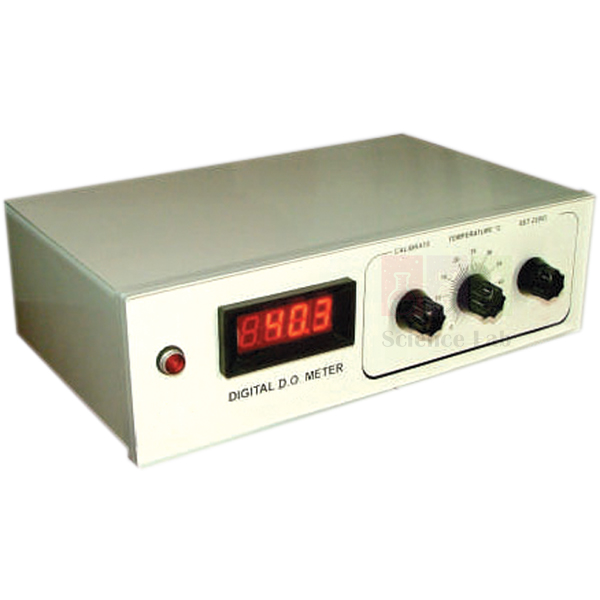
Digital Dissolved Oxygen Meter
Digital Dissolved Oxygen Meter (Product Code: SLE/LI/05) is a table-model instrument used to measure the oxygen dissolved in water, an index of the biological and physical processes taking place in it, in environmental, microbiology and teaching laboratories. It reads 0 to 20.0 ppm with 0.1 ppm resolution through an amperometric gold/silver membrane probe, with temperature compensation from 0 °C to 50 °C. It is made by Jain Scientific Equipments Pvt Ltd (ScienceLab), an OEM manufacturer, at its own factory in Ambala, India.
Specifications
| Parameter | Detail |
|---|---|
| Range (DO) | 0 to 20.0 ppm |
| Resolution (DO) | 0.1 ppm |
| Accuracy (DO) | 0.1 ppm + 1 count |
| Sensor | Amperometric gold/silver membrane DO probe |
| Temperature compensation | 0 °C to 50 °C |
| Manual compensation (DO) | +3% |
| Display | 3½ digit LED |
| Model | Table model |
| Power | 230 V AC, 50 Hz |
| Weight | 2 kg |
| Product code | SLE/LI/05 |
| Manufacturer | Jain Scientific Equipments Pvt Ltd (ScienceLab) — OEM |
| Country of origin | India (made in Ambala, Haryana) |
What Is a Dissolved Oxygen Meter Used For?
Dissolved oxygen is one of the clearest signs of water health: fish and aerobic microbes need it, and organic pollution uses it up. Laboratories use a dissolved oxygen meter in India for river and lake surveys, effluent treatment monitoring, aquaculture tanks and the BOD test, where the oxygen in sealed BOD bottles is measured before and after incubation. Environmental engineering, microbiology and zoology departments also use it in practical classes.
Keep the probe membrane clean, moist and free of trapped air bubbles, and move the probe gently or stir the sample so fresh water keeps reaching the membrane. Note the sample temperature, since oxygen solubility changes with it. Rinse the probe with distilled water after use.
OEM Manufacturer
Jain Scientific Equipments Private Limited, trading as ScienceLab, is the OEM (original equipment manufacturer) of this Digital Dissolved Oxygen Meter and supplies it factory-direct to universities, environmental laboratories, water-treatment teams, dealers and importers. The company is incorporated under CIN U29309HR2020PTC087597, and its works at 449, HSIIDC Industrial Area, Saha, Ambala operates under Factory Licence AMB-ONLINE-CHD-J-414. Probes, spare parts and repeat orders can be requested from the manufacturer directly. Read more on our profile page.
Related Laboratory Instruments
Items that complete a water-quality bench:
- BOD Bottles with Penny Head Stopper — sealed bottles for BOD incubation and DO readings.
- Water And Soil Analysis Kit — adds pH, conductivity, TDS, ORP and temperature readings.
- pH mV and Temperature Meter — for pH and temperature checks alongside DO.
- Magnetic Stirrer — keeps the sample moving gently past the probe.
See all Laboratory Instruments for more analytical equipment.
Frequently Asked Questions
What range and resolution does the Digital Dissolved Oxygen Meter have?
The Digital Dissolved Oxygen Meter (SLE/LI/05) measures dissolved oxygen from 0 to 20.0 ppm with a resolution of 0.1 ppm and a listed accuracy of 0.1 ppm + 1 count, shown on a 3½ digit LED display.
What type of probe does the Digital Dissolved Oxygen Meter use?
The Digital Dissolved Oxygen Meter uses an amperometric DO probe with a gold/silver membrane sensor. Keeping the membrane clean, moist and free of trapped air bubbles helps the probe give stable readings.
Does the Digital Dissolved Oxygen Meter compensate for temperature?
Yes. The Digital Dissolved Oxygen Meter has temperature compensation from 0 °C to 50 °C, because the amount of oxygen water can hold changes with temperature; a manual DO compensation of +3% is also listed.
Can the Digital Dissolved Oxygen Meter be used for BOD testing?
Yes. The Digital Dissolved Oxygen Meter can measure the dissolved oxygen in BOD bottles before and after incubation, which is how biochemical oxygen demand is worked out. BOD bottles and an incubator are ordered separately.
Is the Digital Dissolved Oxygen Meter portable?
The Digital Dissolved Oxygen Meter is a table model weighing 2 kg and powered from 230 V AC, 50 Hz mains, so it suits laboratory benches; water samples collected in the field are brought back to the lab for measurement.
Who manufactures the Digital Dissolved Oxygen Meter?
Jain Scientific Equipments Pvt Ltd (ScienceLab) is the OEM manufacturer of the Digital Dissolved Oxygen Meter, producing it at its licensed factory at Saha, Ambala, Haryana, India, and supplying it directly to laboratories, dealers and importers in India and international markets.
What does a Digital Dissolved Oxygen Meter quotation need?
For a Digital Dissolved Oxygen Meter quotation, send the number of meters, any related items such as BOD bottles, and the delivery destination. Use our contact page or the enquiry cart to share the details.
Request a Quote
Quotations for the Digital Dissolved Oxygen Meter (SLE/LI/05) are issued directly by the manufacturer. Contact us through the contact page or add the meter to the enquiry cart.
Last updated: 24 September 2026
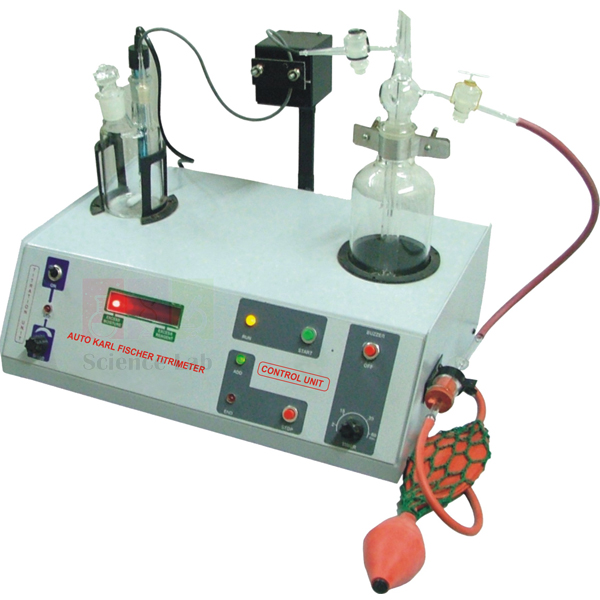
Auto Karl Fischer Titrimeter
Auto Karl Fischer Titrimeter (Product Code: SLE/LI/06) is an automatic titration instrument used to determine the water content of liquids and solids by Karl Fischer titration in pharmaceutical, chemical, food and teaching laboratories. It handles samples containing 1 to 50 mg of water, with 0.05 ml KF reagent dispensing from an auto-zero burette and a dual platinum electrode to sense the end point. It is made by Jain Scientific Equipments Pvt Ltd (ScienceLab), an OEM manufacturer, at its own factory in Ambala, India.
Specifications
| Parameter | Detail |
|---|---|
| Sample size | 1–50 mg of water |
| KF dispensing | 0.05 ml |
| Burette | Auto zero burette |
| Electrode | Dual platinum electrode |
| Stirring | Inbuilt stirrer |
| Timer | Adjustable |
| Status indication | RUN, ADD and END shown in auto mode |
| Display | Array of 10 LEDs in line |
| Power | 230 V AC ± 10%, 50 Hz |
| Size | 435 x 305 x 150 mm |
| Weight | 5 kg (approx.) |
| Accessories | Supplied with other accessories (confirm the list with your quotation) |
| Product code | SLE/LI/06 |
| Manufacturer | Jain Scientific Equipments Pvt Ltd (ScienceLab) — OEM |
| Country of origin | India (made in Ambala, Haryana) |
What Is a Karl Fischer Titrimeter Used For?
Karl Fischer titration measures water specifically: iodine in the KF reagent reacts with water in the sample, and once all the water is used up, excess iodine changes the signal at the dual platinum electrode to mark the end point. Pharmaceutical QC teams use it for moisture in drugs and excipients, chemical plants for solvents and raw materials, and food and oil laboratories for product quality; it is also a standard Karl Fischer titrator for teaching labs in India.
Keep the titration vessel closed so room humidity does not enter, and standardise the reagent before a series of samples. Choose a sample weight that brings the expected water content into the 1 to 50 mg range. Follow the RUN, ADD and END lights in auto mode, and use the adjustable timer to confirm a stable end point.
What to Specify When Ordering
- The typical water content and sample weights you test, so we can confirm they suit the 1–50 mg range
- The accessory list you expect with the unit
- Whether you want KF reagent quoted with the instrument
- The number of units and the delivery destination
OEM Manufacturer
ScienceLab is the trading name of Jain Scientific Equipments Private Limited, the OEM (original equipment manufacturer) of the Auto Karl Fischer Titrimeter. It is built at the company's own licensed factory at Saha, Ambala, Haryana, India, rather than sourced through a trader, and supplied factory-direct to pharmaceutical units, colleges, testing laboratories, dealers and importers. Electrodes, burette parts and repeat orders are handled by the manufacturer itself, so ask us whenever you need them. Visit our company profile for more.
Related Laboratory Instruments
Items that support moisture determination:
- Analytical Balance — for weighing samples accurately before titration.
- Moisture Analyser — a loss-on-drying alternative for routine moisture checks.
- Bottle Top Dispenser — for dispensing solvent into the titration vessel.
- Glass Bottle, for Liquid Reagents Narrow Mouth — for closed storage of solvents and reagents.
Explore more in Laboratory Instruments.
Frequently Asked Questions
What sample range does the Auto Karl Fischer Titrimeter handle?
The Auto Karl Fischer Titrimeter (SLE/LI/06) is designed for samples containing 1 to 50 mg of water, with KF reagent dispensing of 0.05 ml, so choose a sample weight that brings the expected water content into that range.
How does the Auto Karl Fischer Titrimeter detect the end point?
The Auto Karl Fischer Titrimeter senses the end point with a dual platinum electrode while the inbuilt stirrer mixes the sample. In auto mode its line of 10 LEDs shows RUN, ADD and END so the operator can follow the titration.
Is Karl Fischer reagent included with the Auto Karl Fischer Titrimeter?
Karl Fischer reagent is not listed as included with the Auto Karl Fischer Titrimeter; ask us if you want it quoted. Shelf life depends on the chemical, its grade and storage conditions, so ask us for the expiry date of the batch you are quoted.
How big is the Auto Karl Fischer Titrimeter and what power does it need?
The Auto Karl Fischer Titrimeter measures 435 x 305 x 150 mm, weighs about 5 kg and runs on 230 V AC ± 10%, 50 Hz, so it fits on a standard laboratory bench next to the balance used for weighing samples.
Who manufactures the Auto Karl Fischer Titrimeter?
Jain Scientific Equipments Pvt Ltd (ScienceLab) is the OEM manufacturer of the Auto Karl Fischer Titrimeter, building it at its own licensed factory at Saha, Ambala, Haryana, India, and supplying it directly to laboratories, dealers and importers.
Is a calibration certificate available for the Auto Karl Fischer Titrimeter?
Whether a calibration certificate can accompany the Auto Karl Fischer Titrimeter should be discussed with us before ordering. Please mention it in your enquiry through our contact page together with your sample details.
Request a Quote
The manufacturer quotes the Auto Karl Fischer Titrimeter (SLE/LI/06) directly. Send your requirement through the contact page or add it to the enquiry cart, mentioning whether reagent should be included.
Last updated: 24 September 2026
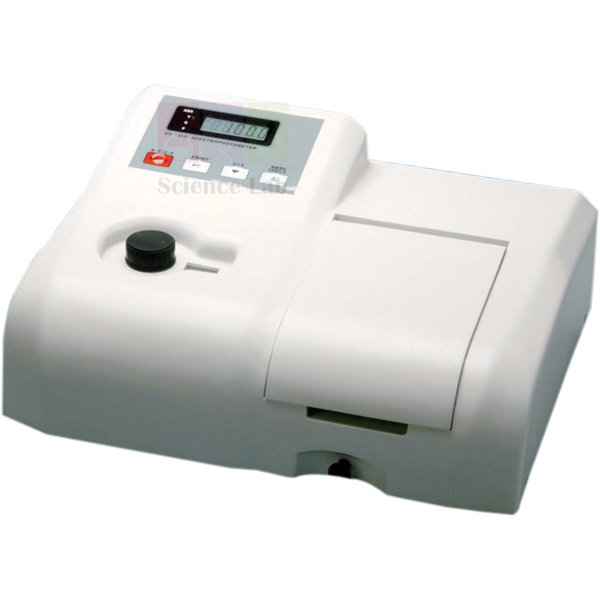
Single Beam Microprocessor UV-VIS Spectrophotometer
Single Beam Microprocessor UV-VIS Spectrophotometer (Product Code: SLE/LI/07) is a benchtop optical instrument used to measure the absorbance, percentage transmission and concentration of solutions from 195 to 1000 nm in college, research and quality-control laboratories. Chemistry, biochemistry and pharmacy departments rely on it for quantitative analysis, and it pairs a tungsten halogen lamp with a deuterium lamp so both the ultraviolet and visible regions are covered. This UV visible spectrophotometer is supplied by Jain Scientific Equipments Pvt Ltd (ScienceLab), Ambala, India.
Specifications
| Parameter | Detail |
|---|---|
| Wavelength range | 195 to 1000 nm |
| Measurement modes | Absorbance, % transmission and automatic concentration |
| Wavelength selection | Manual wavelength calibration and selection |
| Light sources | Tungsten halogen lamp and deuterium (D2) lamp |
| Optics | Complete mirror optics with a 1200 grooves/mm grating |
| Spectral bandwidth | 2 nm |
| Wavelength accuracy | ± 0.5 nm |
| Wavelength repeatability | ± 0.3 nm |
| Resolution | 0.1 nm |
| Photometric range | %T: 0 to 100%; Abs: 0 to 1.999; Conc.: 0 to 1999; K-factor: 0 to 1999 |
| Photometric accuracy | ± 0.005 Abs at 1.0 Abs; a second figure of ± 0.010 Abs is also listed — confirm its reference point with your quotation |
| Stray light | Less than 0.1% Abs at 320 nm |
| Readability | ± 1 count |
| Detector | Wide-range silicon photodiode |
| Sample holder | 4-position adjustable holder with selector control, for 10 mm path length cuvettes |
| Cuvettes provided | Set of 2 quartz and 4 glass cuvettes |
| Display | Single-line LCD |
| Keyboard | 4 keys, soft-touch membrane type |
| Interfaces | RS-232C serial interface; printer interface |
| Software | Included |
| Power | 230 V ± 10%, 50 Hz AC |
| Dimensions (L x B x H) | 420 x 350 x 240 mm (approx.) |
| Weight | 10 kg (approx.) |
| Product code | SLE/LI/07 |
| Supplied by | Jain Scientific Equipments Pvt Ltd (ScienceLab), Ambala, India |
What Is the UV-VIS Spectrophotometer Used For?
The UV-VIS spectrophotometer is used for Beer-Lambert law experiments, building calibration curves and estimating the concentration of coloured or UV-absorbing compounds. Typical teaching work includes absorbance of biomolecules in the ultraviolet region, dye and colour analysis in the visible region, and reaction kinetics followed as a change in absorbance over time. The concentration and K-factor modes let students read results directly once a standard has been measured.
Use the quartz cuvettes for readings in the ultraviolet range, because ordinary glass absorbs UV light; the glass cuvettes suit visible-range work. Let the lamps warm up, zero the instrument with a solvent blank, and wipe the cuvette faces with lint-free tissue before every reading. The RS-232C port and included software allow readings to be transferred to a computer, which helps analytical lab instruments fit into record-keeping routines.
What to Specify When Ordering
- The mains supply at your site — the listed unit runs on 230 V ± 10%, 50 Hz AC.
- Whether you need spare cuvettes in addition to the supplied set of 2 quartz and 4 glass cuvettes.
- Whether a printer or computer connection is planned, so the RS-232C and printer interfaces can be discussed.
- Quantity per laboratory and the delivery city or country.
Supplier
Jain Scientific Equipments Private Limited trades under the ScienceLab name and supplies this spectrophotometer from Ambala, Haryana, to schools, colleges, research institutes, dealers and importers. Analytical instruments like this one can be added to the same order as other teaching-lab items, so a department deals with a single supplier for its bench equipment. Read more about the company on our company profile.
Related Laboratory Instruments
These items support photometric analysis and sample preparation alongside the spectrophotometer:
- Digital Photo Colorimeter 5 Filters — a filter-based option for visible-range colour measurements in school labs.
- Ultra Violet/Visible (UV/VIS) Spectrophotometer — another UV-VIS model to compare before ordering.
- Volumetric Flask — for making up standard solutions for calibration curves.
- Bottle Top Dispenser — repeat dispensing of solvent or reagent when many samples are prepared.
See the full Laboratory Instruments range for more bench instruments.
Frequently Asked Questions
What is the wavelength range of the Single Beam Microprocessor UV-VIS Spectrophotometer?
The Single Beam Microprocessor UV-VIS Spectrophotometer covers 195 to 1000 nm using a tungsten halogen lamp and a deuterium lamp. It offers a 2 nm spectral bandwidth, 0.1 nm resolution and ± 0.5 nm wavelength accuracy for both ultraviolet and visible measurements.
Which cuvettes come with the UV-VIS spectrophotometer?
The Single Beam Microprocessor UV-VIS Spectrophotometer is provided with a set of 2 quartz and 4 glass cuvettes for a 10 mm path length. The 4-position sample holder takes these cuvettes; use the quartz ones for ultraviolet readings. Ask us if extra cuvettes should be quoted.
Can this spectrophotometer be connected to a computer or printer?
Yes. The Single Beam Microprocessor UV-VIS Spectrophotometer has an RS-232C serial interface and a printer interface, and software is included. Mention your computer set-up when you request a quotation so the connection requirements can be discussed before dispatch.
Who supplies the Single Beam Microprocessor UV-VIS Spectrophotometer?
The Single Beam Microprocessor UV-VIS Spectrophotometer is supplied by Jain Scientific Equipments Pvt Ltd (ScienceLab), Ambala, Haryana, India. The company supplies laboratory instruments to schools, colleges, institutions, dealers and importers in India and international markets.
Is a calibration certificate available with the spectrophotometer?
Calibration-certificate availability for the Single Beam Microprocessor UV-VIS Spectrophotometer should be discussed with us before ordering. The instrument itself provides manual wavelength calibration, and we will confirm what documentation accompanies the unit you are quoted. Please ask through our contact page.
What power supply and bench space does the UV-VIS spectrophotometer need?
The Single Beam Microprocessor UV-VIS Spectrophotometer runs on 230 V ± 10%, 50 Hz AC. It measures about 420 x 350 x 240 mm and weighs approximately 10 kg, so a standard laboratory bench close to a mains socket is sufficient.
What should a quotation request for this spectrophotometer include?
A quotation request for the Single Beam Microprocessor UV-VIS Spectrophotometer should state the quantity, delivery city or country, any spare cuvettes needed and whether the instrument is for a teaching, research or industrial laboratory. Send these details through our contact page for a quick reply.
Request a Quote
For a quotation on the Single Beam Microprocessor UV-VIS Spectrophotometer, send your quantity and delivery location through our contact page, or add it to the enquiry cart together with the other laboratory instruments you need.
Last updated: 24 September 2026
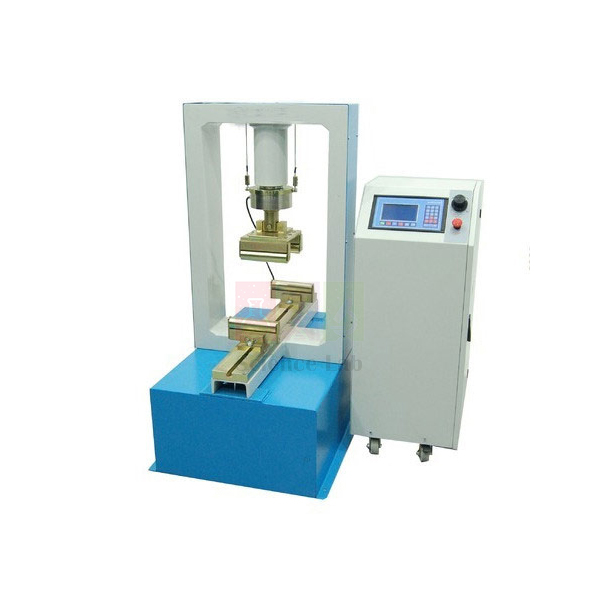
Flexure Testing Machine Digital
Flexure Testing Machine Digital (Product Code: SLE/CE/02) is an automatic, digitally controlled load frame used to measure the flexural and transverse strength of concrete beams, kerbs, flagstones and interlocking pavers in civil engineering laboratories. It comes with a 100 kN or 200 kN welded steel frame and a dual-stage power pack that loads specimens at 1 kN/s to 20 kN/s. It is supplied by Jain Scientific Equipments Pvt Ltd (ScienceLab), Ambala, India, for college and quality-control labs.
Specifications
| Parameter | Detail |
|---|---|
| Frame capacity | 100 kN or 200 kN |
| Tests | Flexural test on standard concrete beams; transverse test on kerbs and flagstones; indirect tensile test on concrete and interlocking pavers |
| Test cycle | Automatic with standard rapid approach; closed-loop digital readout; one-button start after entering specimen parameters |
| Control system | Graphical LCD data acquisition and control system, menu-driven software |
| Load rate control | 1 kN/s to 20 kN/s; control accuracy listed as ±5 |
| Load accuracy | Class 1 from 10% of full range |
| Live display | Load vs time plot and instantaneous load rate |
| Data storage | Up to 256 tests |
| Frame construction | Welded steel fabrication with the ram fitted to the upper crosshead; designed for minimum deflection at maximum load |
| Load measurement | Load cell |
| Piston stroke | 75 mm and 100 mm, with safety limit switch |
| Piston return | By dead weight |
| Power pack | Dual-stage: high-delivery low-pressure pump for rapid approach, low-delivery high-pressure radial piston pump for testing; maximum pressure valve against overloading |
| Power | 750 W |
| Oil capacity | 25 litres |
| Fast approach speed | 60–100 mm/min |
| Product code | SLE/CE/02 |
| Supplied by | Jain Scientific Equipments Pvt Ltd (ScienceLab), Ambala, India |
What Is the Digital Flexure Testing Machine Used For?
Pavement slabs, kerbs and beams fail in bending long before they crush, so their flexural strength matters as much as cube strength. With the right accessory fitted to the frame, this machine loads a beam in bending, a kerb or flagstone transversely, or a paver in indirect tension, and the controller holds the chosen rate until failure while plotting load against time.
The power pack uses a low-pressure pump to bring the ram quickly onto the specimen and then switches to a high-pressure radial piston pump for the test itself, which keeps loading smooth and quiet. Because the ram returns under dead weight rather than by pumped pressure, the load cell reading is not disturbed. Laboratories looking for engineering lab equipment in India can also link the frame to a compatible compression testing machine as a second frame.
What to Specify When Ordering
- Frame capacity: 100 kN or 200 kN.
- The tests you will run (beams, kerbs, flagstones, pavers) so the matching accessories can be quoted.
- Whether the frame will work alone or as a second frame on a compression machine you already own.
- Quantity and delivery city or port.
Supplier
This flexure testing machine is supplied by Jain Scientific Equipments Private Limited, the company that trades as ScienceLab from Ambala, Haryana. ScienceLab sources the machine and its test accessories for civil engineering departments, road and building material laboratories and dealers in India and international markets, and coordinates quotation, packing and dispatch in one place. Questions about spare parts or accessories later on can also be sent to us. Read more on the ScienceLab company profile.
Related Civil Engineering Lab Equipment
Items commonly used with a flexure frame in the same concrete testing workflow:
- Beam Mould — casts the concrete beams tested in flexure.
- Vibrating Table — compacts concrete in beam moulds before curing.
- Automatic digital compression testing machine — compressive strength tests alongside flexural ones.
- Flexure Testing Machine Manual — a proving-ring alternative for mortar prisms.
Browse all Civil Engineering Lab Equipment for concrete, cement and aggregate testing.
Frequently Asked Questions
Which tests can the Flexure Testing Machine Digital perform?
The Flexure Testing Machine Digital runs flexural tests on standard concrete beams, transverse tests on kerbs and flagstones, and indirect tensile tests on concrete and interlocking pavers. Each test needs its own accessory fitted to the frame, so tell us which tests you plan.
What frame capacities are available?
The Flexure Testing Machine Digital is offered with a 100 kN or a 200 kN frame. Both are welded steel assemblies with the ram in the upper crosshead, load-cell measurement and dead-weight piston return; piston stroke is listed as 75 mm and 100 mm.
Can the flexure frame be connected to a compression testing machine?
Yes, the frame of the Flexure Testing Machine Digital is designed to be connected to a compatible compression testing machine as a second frame. Tell us the make and model of your existing machine so compatibility can be confirmed before you order.
Are the flexural and transverse test accessories included?
The Flexure Testing Machine Digital frame accepts the accessories for flexural and transverse tests, but the set supplied depends on the specimens you test. List your beam, kerb, flagstone or paver sizes in the enquiry and the quotation will state exactly what is included.
Who supplies the Flexure Testing Machine Digital?
Jain Scientific Equipments Pvt Ltd (ScienceLab), based in Ambala, Haryana, India, supplies the Flexure Testing Machine Digital to engineering colleges, material testing laboratories and dealers in India and international markets, handling quotations and dispatch directly.
Is a calibration certificate provided?
Calibration-certificate availability for the Flexure Testing Machine Digital should be discussed with us before ordering. Share your laboratory's requirement through the contact page and we will confirm what documentation can accompany the machine.
What power pack does the machine use?
The Flexure Testing Machine Digital uses a quiet 750 W dual-stage power pack holding 25 litres of oil, with a fast approach speed of 60–100 mm/min and a maximum pressure valve that protects the frame from overloading.
Request a Quote
To receive a quotation for the Flexure Testing Machine Digital, send the frame capacity, required accessories and quantity through the contact page, or add the machine to the enquiry cart with the rest of your concrete lab list.
Last updated: 24 September 2026
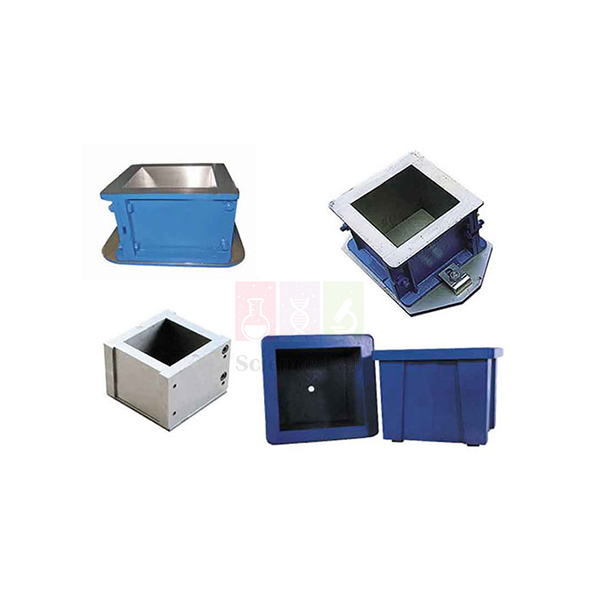
Concrete Cube Mould
Concrete Cube Mould (Product Code: SLE/CE/03) is a machined metal mould used to cast concrete, mortar and cement cube specimens for compressive strength testing in civil engineering laboratories. It is made in sizes from 50 mm to 150 mm in cast iron or mild steel, and every mould comes complete with its base plate, with metric faces machined flat to ±0.2 mm. It is made by Jain Scientific Equipments Pvt Ltd (ScienceLab), an OEM engineering lab equipment manufacturer, at its own factory in Ambala, India.
Specifications
| Parameter | Detail |
|---|---|
| Cube sizes | 50 mm, 70.6 mm, 75 mm, 100 mm and 150 mm (metric); inch-size moulds also listed |
| Materials | Cast iron (concrete and mortar moulds); mild steel (three gang cement mould) |
| Face flatness, metric moulds | Machined flat to ±0.2 mm and finished to within 0.2 mm |
| Face flatness, inch moulds | Machined flat to ±0.01 in, finished to within 0.01 in |
| Base plate | Supplied with every mould (loose base plate on the three gang 70.6 mm mould) |
| Standards referenced | BS and IS patterns |
| Product code | SLE/CE/03 |
| Manufacturer | Jain Scientific Equipments Pvt Ltd (ScienceLab) — OEM |
| Country of origin | India (made in Ambala, Haryana) |
Available versions:
- 50 mm single gang cube mould, cast iron, for mortar
- 70.6 mm three gang cube mould, mild steel, for cement, with loose base plate
- 75 mm single gang cube mould
- 100 mm light weight cube mould
- 100 mm clamp type four-part cube mould (8.5 kg)
- 150 mm light weight cube mould (8 kg)
- 150 mm clamp type four-part cube mould (18 kg)
- 150 mm clamp type two-part cube mould (16 kg)
What Is the Concrete Cube Mould Used For?
Cube moulds turn a fresh batch of concrete or mortar into identical test specimens. The mould is assembled on its base plate, lightly oiled inside, filled in layers and compacted by hand rod or on a vibrating table, then struck off level. After initial setting the sides are released, the cube is cured, and it is finally crushed in a compression testing machine to report strength.
The 150 mm and 100 mm moulds suit concrete, while the 70.6 mm three gang mould casts three cement mortar cubes at once and the 50 mm cast iron mould is intended for mortar. Clamp type moulds open into two or four parts for easy stripping; light weight versions are easier to carry between site and lab. Clean and dry each mould after use to keep the machined faces true.
What to Specify When Ordering
- Cube size: 50, 70.6, 75, 100 or 150 mm, or an inch size.
- Type: light weight, clamp type four-part, clamp type two-part, single gang or three gang.
- Material preference where options exist (cast iron or mild steel).
- Number of moulds per size, matched to how many cubes you cast per batch.
OEM Manufacturer
ScienceLab is the trading name of Jain Scientific Equipments Private Limited, the OEM (original equipment manufacturer) of these cube moulds. The moulds are machined and assembled at the company's own licensed factory at Saha, Ambala, Haryana, India, not bought in from a trader, and go factory-direct to engineering colleges, polytechnics, testing laboratories, contractors, dealers and importers.
Because the manufacturer handles your order itself, replacement base plates or clamps and repeat orders in matching sizes can be arranged with the same team — just ask us. For vendor records, the company is a registered MSME with manufacturing as its major activity (Udyam UDYAM-HR-01-0003714) and exports under Importer-Exporter Code AAECJ8618A issued by DGFT. See the ScienceLab company profile.
Related Civil Engineering Lab Equipment
Equipment used before and after casting cubes:
- Vibrating Table — compacts concrete in the moulds without hand rodding.
- Tamping Bar — for hand compaction of each layer.
- Accelerated Curing Tank — holds 150 mm and 70.6 mm cube moulds for accelerated curing.
- Automatic digital compression testing machine — crushes the cured cubes.
More concrete, cement and soil testing items are in the Civil Engineering Lab Equipment category.
Frequently Asked Questions
What sizes of Concrete Cube Mould are available?
The Concrete Cube Mould is available in 50 mm, 70.6 mm, 75 mm, 100 mm and 150 mm metric sizes, with inch-size moulds also listed. The 100 mm and 150 mm sizes come in light weight and clamp type versions; tell us the size and type you need.
Is the base plate included with the cube mould?
Yes. Every Concrete Cube Mould is supplied complete with its base plate, so it is ready to fill on arrival. The 70.6 mm three gang mild steel mould for cement is supplied with a loose base plate that separates from the mould body.
How accurately are the cube mould faces machined?
On metric Concrete Cube Moulds the faces are machined flat to ±0.2 mm and finished to within 0.2 mm. On inch-size moulds the faces are machined flat to ±0.01 in, which keeps specimen dimensions consistent from cube to cube.
Should I choose a clamp type or a light weight cube mould?
Clamp type Concrete Cube Moulds open into four or two parts (8.5 kg for 100 mm; 18 kg or 16 kg for 150 mm) for easy stripping, while the 150 mm light weight mould weighs 8 kg and is easier to carry between site and laboratory.
Who manufactures the Concrete Cube Mould?
The Concrete Cube Mould is manufactured by Jain Scientific Equipments Pvt Ltd (ScienceLab) as the OEM, at its own licensed factory at Saha, Ambala, Haryana, India. Quotations, repeat orders and replacement parts are handled directly by the manufacturer.
Which standards do the cube moulds follow?
The Concrete Cube Mould range is made to BS and IS patterns. Please state the exact standard your laboratory or project specification follows when you enquire, so the correct size and pattern is confirmed in the quotation.
Can cube moulds be ordered in bulk or for export?
Yes, Concrete Cube Moulds are supplied in quantity to institutions, contractors, dealers and importers in India and international markets. List each size, type and quantity on the contact page and the quotation comes straight from the manufacturer.
Request a Quote
Ask for a factory-direct quotation on the Concrete Cube Mould through the contact page, or add the sizes you need to the enquiry cart. Quotes come directly from the manufacturer in Ambala.
Last updated: 24 September 2026
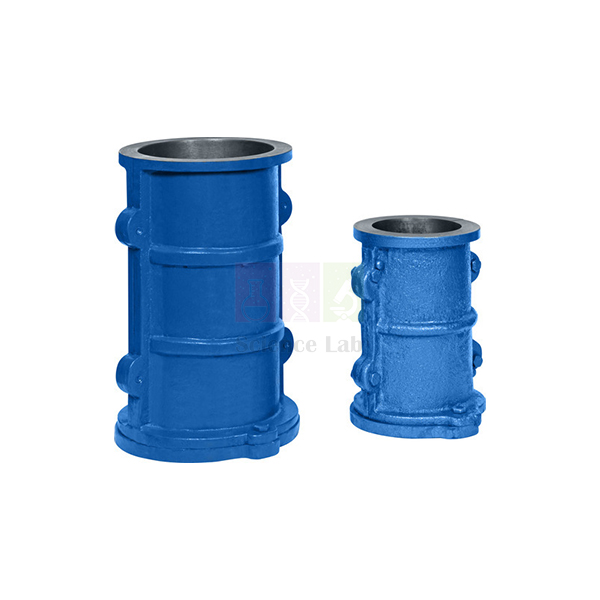
Cylindrical Mould
Cylindrical Mould (Product Code: SLE/CE/04) is a cast iron mould, split vertically into two halves, used to cast cylindrical concrete specimens for strength testing in civil engineering and construction material laboratories. Five sizes run from 100 mm dia x 200 mm to 300 mm dia x 600 mm, with the mean internal diameter held within ±0.2 mm and base and top plates machined flat to ±0.03 mm. The mould is made by Jain Scientific Equipments Pvt Ltd (ScienceLab), an OEM manufacturer of lab equipment for technical institutes, at its own factory in Ambala, India.
Specifications
| Parameter | Detail |
|---|---|
| Material | Cast iron |
| Construction | Split vertically into two parts |
| Sizes (dia x height) | 100 x 200 mm; 150 x 150 mm; 150 x 300 mm; 160 x 320 mm; 300 x 600 mm |
| Mean internal diameter tolerance | Within ±0.2 mm |
| Height tolerance | Within ±1 mm |
| Ends | Machined to a ±0.05 tolerance |
| Base plate and top plate | Machined flat to ±0.03 mm |
| Product code | SLE/CE/04 |
| Manufacturer | Jain Scientific Equipments Pvt Ltd (ScienceLab) — OEM |
| Country of origin | India (made in Ambala, Haryana) |
What Is the Cylindrical Mould Used For?
Where a specification calls for cylinders instead of cubes, this mould produces them. The two halves are clamped together on the base plate, the inside is lightly oiled, and fresh concrete is placed and compacted in layers before the top is finished level. Once the concrete has set, the halves are separated so the cylinder comes out without chipping its edges, ready for curing and then compression or other strength tests.
The 150 x 300 mm and 100 x 200 mm sizes give the usual height-to-diameter ratio of two, the 150 x 150 mm mould gives a short cylinder, and the large 300 x 600 mm mould suits concrete made with bigger aggregate. Keep the machined joint faces clean so the halves close tightly and the specimen stays true to size.
What to Specify When Ordering
- Size (dia x height): 100 x 200, 150 x 150, 150 x 300, 160 x 320 or 300 x 600 mm.
- Number of moulds per size, based on how many cylinders you cast per batch.
- The test standard your project follows, so the right size is confirmed.
OEM Manufacturer
Jain Scientific Equipments Private Limited, trading as ScienceLab, is the original equipment manufacturer (OEM) of this cylindrical mould. Casting halves, base plates and top plates are machined and assembled at the company's own licensed factory at Saha, Ambala, Haryana, India, and the finished moulds are shipped factory-direct to colleges, polytechnics, commercial testing laboratories, dealers and importers.
Dealing with the maker means one contact for quotations, repeat orders in matching sizes and replacement parts — ask us about the part you need. Learn more on the ScienceLab company profile.
Related Civil Engineering Lab Equipment
Items that work with concrete cylinders:
- Automatic digital compression testing machine — tests the cured cylinders to failure.
- Longitudinal Compressometer — records axial strain on a cylinder under load.
- Lateral Extensometer — measures lateral strain during the same test.
- Vibrating Table — compacts concrete in the mould.
Explore the full Civil Engineering Lab Equipment range.
Frequently Asked Questions
What sizes of Cylindrical Mould are available?
The Cylindrical Mould is made in five sizes (diameter x height): 100 x 200 mm, 150 x 150 mm, 150 x 300 mm, 160 x 320 mm and 300 x 600 mm. State the size and quantity you need so we can prepare the quotation.
Why is the cylindrical mould split into two parts?
The Cylindrical Mould is split vertically into two halves so the hardened concrete cylinder can be released by opening the mould instead of pushing it out, which protects the specimen's edges and surfaces before curing and testing.
What dimensional tolerances does the mould hold?
The Cylindrical Mould keeps its mean internal diameter within ±0.2 mm and its height within ±1 mm, with the ends machined to a ±0.05 tolerance and the base and top plates machined flat to ±0.03 mm.
What material is the Cylindrical Mould made from?
The Cylindrical Mould is made of cast iron, a rigid material that holds its shape during compaction. Clean the mould and apply a thin film of oil after use to protect the machined surfaces from rust between casts.
Who manufactures the Cylindrical Mould?
The Cylindrical Mould is manufactured by Jain Scientific Equipments Pvt Ltd (ScienceLab), the OEM, at its own licensed factory at Saha, Ambala, Haryana, India, and is supplied factory-direct to institutions, laboratories, dealers and importers.
Are the base plate and top plate included?
The Cylindrical Mould specification covers a base plate and a top plate, each machined flat to ±0.03 mm. Please confirm plate inclusion for your chosen size when you request a quotation through the contact page.
Can cylindrical moulds be supplied in bulk or for export?
Yes, the Cylindrical Mould can be ordered in quantity by colleges, contractors, dealers and importers in India and international markets. Send each size and quantity, plus the delivery city or port, and the manufacturer will quote directly.
Request a Quote
Request a factory-direct quotation for the Cylindrical Mould via the contact page, or place the sizes you need in the enquiry cart. Quotations come straight from the manufacturer.
Last updated: 24 September 2026

Beam Mould
Beam Mould (Product Code: SLE/CE/05) is a four-plate metal mould used to cast rectangular concrete beams for flexural strength testing in civil engineering laboratories. It is made in cast iron or mild steel in five sizes from 100 x 100 x 500 mm to 150 x 150 x 750 mm, each supplied complete with a base plate and with faces machined flat to ±0.2 mm. The mould is produced by Jain Scientific Equipments Pvt Ltd (ScienceLab), an OEM technical educational equipment manufacturer, at its own factory in Ambala, India.
Specifications
| Parameter | Detail |
|---|---|
| Material | Cast iron or mild steel |
| Construction | Four plates assembled together on a base plate |
| Base plate | Supplied with each mould |
| Face accuracy | Machined flat to ±0.2 mm and finished in size to 0.2 mm |
| Sizes (internal) | 100 x 100 x 500 mm; 100 x 150 x 600 mm; 150 x 150 x 600 mm; 150 x 150 x 700 mm; 150 x 150 x 750 mm |
| Product code | SLE/CE/05 |
| Manufacturer | Jain Scientific Equipments Pvt Ltd (ScienceLab) — OEM |
| Country of origin | India (made in Ambala, Haryana) |
What Is the Beam Mould Used For?
Concrete for pavements, slabs and precast units is judged on how well it resists bending, and that is measured on beam specimens. The four side plates are assembled on the base plate, the inner faces are lightly oiled, and concrete is placed in layers and compacted on a vibrating table or with a poker vibrator. The surface is then struck off with a straight edge.
After setting, the plates are released one by one so the beam can be lifted out without cracking, then cured and broken in a flexure testing machine. The 100 x 100 x 500 mm size suits smaller aggregate and student practicals, while the 150 x 150 mm sections in 600, 700 or 750 mm lengths cover larger aggregate and project testing. Clean the joint faces after every use so the mould closes square.
What to Specify When Ordering
- Beam size, from the five listed sizes.
- Material: cast iron or mild steel.
- Number of moulds per size, based on beams cast per batch.
- The flexural test standard your laboratory follows.
OEM Manufacturer
ScienceLab is the brand of Jain Scientific Equipments Private Limited, the OEM (original equipment manufacturer) of this beam mould. Plates are cut, machined and assembled at the company's own licensed factory at Saha, Ambala, Haryana, India, so buyers deal with the maker rather than a trading intermediary. Moulds are dispatched factory-direct to engineering colleges, material testing laboratories, contractors, dealers and importers.
If a plate or base plate is lost or damaged later, or you need more moulds in the same size, contact the manufacturer directly and ask us about it. Company background is on the ScienceLab company profile.
Related Civil Engineering Lab Equipment
Items used to cast and test concrete beams:
- Flexure Testing Machine Digital — tests the cured beams in flexure.
- Vibrating Table — compacts concrete in the beam mould.
- Poker Vibrator — an alternative way to compact fresh concrete.
- Straight Edge — strikes off and levels the top surface.
See every item in Civil Engineering Lab Equipment.
Frequently Asked Questions
What sizes of Beam Mould are available?
The Beam Mould is made in five internal sizes: 100 x 100 x 500 mm, 100 x 150 x 600 mm, 150 x 150 x 600 mm, 150 x 150 x 700 mm and 150 x 150 x 750 mm. Tell us the size your test method specifies.
Is the Beam Mould made of cast iron or mild steel?
The Beam Mould is available in cast iron or mild steel. Both are rigid enough to hold the beam shape during compaction; mention your preference in the enquiry and we will confirm which material is offered in your chosen size.
How is the beam removed from the mould?
The Beam Mould is made of four plates assembled on a base plate. Once the concrete has set, the plates are loosened and removed one at a time so the beam can be lifted out without damage to its edges.
How accurate are the Beam Mould faces?
The faces of the Beam Mould are machined flat to ±0.2 mm and finished in size to 0.2 mm, giving beams with consistent cross-sections so that flexural results from different specimens can be compared.
Who manufactures the Beam Mould?
The Beam Mould is manufactured by Jain Scientific Equipments Pvt Ltd (ScienceLab), the OEM, at its own licensed factory at Saha, Ambala, Haryana, India. Quotations, repeat orders and replacement plates are handled directly by the manufacturer.
Can Beam Moulds be ordered in bulk or for export?
Yes, the Beam Mould is supplied in quantity to institutions, contractors, dealers and importers in India and international markets. Send sizes, material and quantities through the contact page for a factory-direct quotation.
Request a Quote
For a quotation on the Beam Mould, use the contact page or add it to the enquiry cart with the sizes you need. You receive the quote directly from the manufacturer.
Last updated: 24 September 2026