- Physics Lab Equipment
- Chemistry Lab Equipment
- Biology Lab Equipment
- Anatomical Lab Equipment
- Learning
- Educational Lab Equipment
- Magnets
- Agriculture
- Astronomy
- Earth Science
- Geography Lab Equipment
- Safety Lab Coat
- Laboratory
- Meteorological
- Electricity & Magnetism
- Heat
- School Lab Equipment
- Lab Glassware
- Science Lab Equipment
- Tvet Lab Equipment
- Robotics Kits Supplier and Manufacturer for Schools India
- Math Lab Equipment Manufacturers and Exporters in Ambala
- STEM Kits Manufacturers and Supplier India
- Engineering Lab Equipment
- Hospital Lab Equipment
- Water, Sanitation & Hygiene Supplies
- Cold Chain, Solar & Communication Equipment
- Nutrition
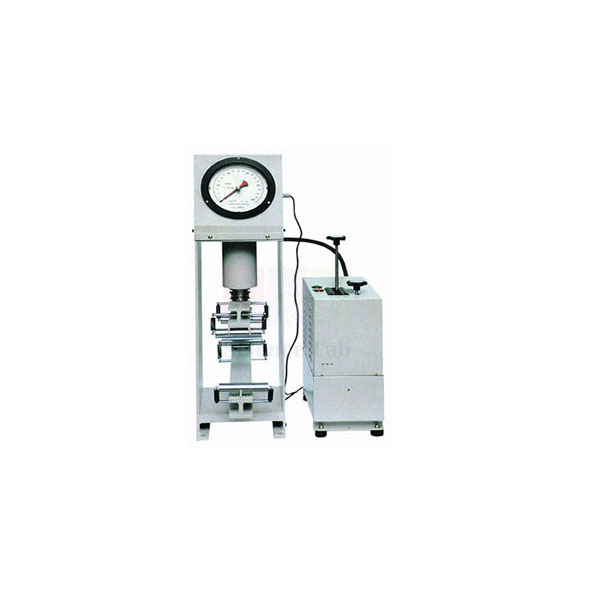
Flexure Testing Machine Manual
Flexure Testing Machine Manual (Product Code: SLE/CE/06) is a motorised mechanical tester used to determine the flexural strength of 40 x 40 x 160 mm mortar prisms by single-point loading in cement and concrete laboratories. Load is applied through a three-roller attachment at 4 to 6 kg/s and read on a proving ring fitted with a sensitive dial gauge, so no electronics are needed to take a reading. It is made by Jain Scientific Equipments Pvt Ltd (ScienceLab), an OEM TVET lab equipment manufacturer, at its own factory in Ambala, India.
Specifications
| Parameter | Detail |
|---|---|
| Capacity | 500 kN (as listed; confirm the proving ring range for your specimens) |
| Type | Motorised, mechanical unit |
| Specimen | 40 x 40 x 160 mm mortar prisms |
| Loading method | Single-point loading for flexural strength |
| Rate of loading | Speed adjusted so load increases at 4 to 6 kg/s |
| Flexure attachment | Supplied; two 10 mm diameter support rollers spaced 100 mm apart, plus a third 10 mm roller equidistant from them that transmits load to the opposite face of the prism |
| Load measurement | Proving ring with sensitive dial gauge |
| Power supply | 230 V, single phase, 50 cycles AC |
| Product code | SLE/CE/06 |
| Manufacturer | Jain Scientific Equipments Pvt Ltd (ScienceLab) — OEM |
| Country of origin | India (made in Ambala, Haryana) |
What Is the Mortar Flexure Testing Machine Used For?
Cement and mortar are graded partly on flexural strength, measured on small prisms. The prism is laid across the two lower rollers, the third roller is brought down onto its centre, and the motor drives the load up at a steady rate until the prism snaps. The operator notes the dial gauge reading at failure and converts it to load for that proving ring, from which flexural strength is worked out.
Because the machine is purely mechanical, it suits polytechnic and university practicals where students should see how load, deflection and strength relate. Keep the rollers clean and free of mortar crumbs, set the loading speed before each series, and handle the proving ring and dial gauge with care, since they carry the measurement.
OEM Manufacturer
This flexure testing machine is built by Jain Scientific Equipments Private Limited, which trades as ScienceLab and is the OEM (original equipment manufacturer). The frame, drive and roller attachment are made and assembled at the company's own licensed factory at Saha, Ambala, Haryana, India, and each machine is supplied factory-direct to engineering colleges, cement and construction laboratories, dealers and importers.
Ordering from the manufacturer means spares such as rollers, repeat units and technical questions are dealt with by the people who build the machine — ask us. Company details are on the ScienceLab company profile.
Related Civil Engineering Lab Equipment
Other equipment for the mortar prism test sequence:
- Prism Mould Three Gang — casts three 40 x 40 x 160 mm prisms at a time.
- Jolting Apparatus — compacts mortar in the prism mould.
- Cement curing bench-type cabinet — keeps specimens humid while they cure.
- Flexure Testing Machine Digital — automatic frames for concrete beams, kerbs and pavers.
Browse the whole Civil Engineering Lab Equipment range.
Frequently Asked Questions
What specimen does the Flexure Testing Machine Manual test?
The Flexure Testing Machine Manual tests 40 x 40 x 160 mm mortar prisms for flexural strength by single-point loading. The prism rests on two 10 mm rollers 100 mm apart while a third roller loads it at the centre of the opposite face.
How is load measured on this flexure machine?
On the Flexure Testing Machine Manual, load is measured with a proving ring fitted with a sensitive dial gauge. The dial reading at failure is converted to load for that ring, so the machine needs no electronic display.
Is the Flexure Testing Machine Manual motor driven?
Yes. Despite the word manual in its name, the Flexure Testing Machine Manual is a motorised mechanical unit; the speed is adjusted so the load on the specimen rises at 4 to 6 kg/s. The load itself is read by eye on the proving ring dial gauge.
What power supply does the machine need?
The Flexure Testing Machine Manual runs on a 230 V, single phase, 50 cycles AC supply. If your laboratory uses a different mains supply, mention it in your enquiry so we can confirm what can be offered.
Who manufactures the Flexure Testing Machine Manual?
The Flexure Testing Machine Manual is manufactured by Jain Scientific Equipments Pvt Ltd (ScienceLab), the OEM, at its own licensed factory at Saha, Ambala, Haryana, India, and is supplied factory-direct to institutions, laboratories, dealers and importers.
Is a calibration certificate available for the proving ring?
Calibration-certificate availability for the proving ring on the Flexure Testing Machine Manual should be discussed with us before ordering. Tell us your laboratory's requirement through the contact page and we will confirm what can be supplied.
Request a Quote
Ask for a quotation on the Flexure Testing Machine Manual through the contact page, or add it to the enquiry cart. Quotations come directly from the manufacturer, and bulk orders for colleges or dealers are welcome.
Last updated: 24 September 2026
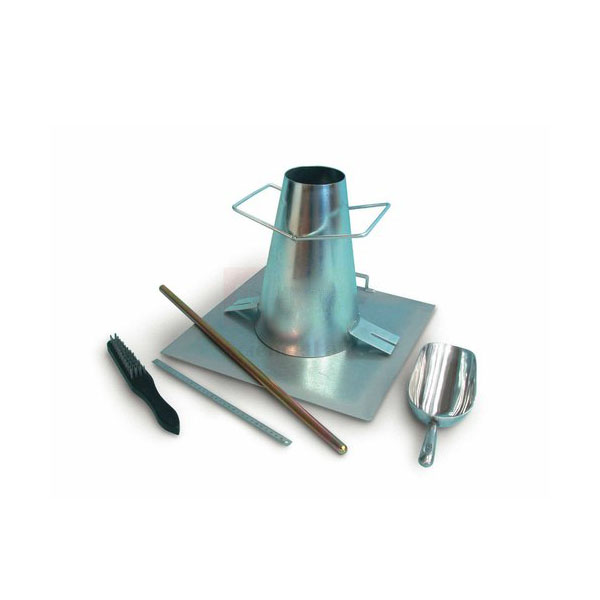
Slump Test Apparatus
Slump Test Apparatus (Product Code: SLE/CE/07) is a slump cone set used to measure the workability of fresh concrete on construction sites and in civil engineering laboratories. The cone measures 200 mm across the base, 100 mm across the top and 300 mm in height; it clamps to a base plate with a lifting handle and comes with a 16 mm x 600 mm steel rod graduated in millimetres. The set is supplied by Jain Scientific Equipments Pvt Ltd (ScienceLab), Ambala, India, a laboratory equipment supplier in India for colleges and site labs.
Specifications
| Parameter | Detail |
|---|---|
| Slump cone (internal) | 200 mm base diameter, 100 mm top diameter, 300 mm height |
| Cone fixing | Foot pieces fix to clamps on the base plate |
| Base plate | With lifting handle for easy transport |
| Graduated rod | One steel rod, 16 mm diameter x 600 mm long, rounded at both ends, graduated in mm |
| Product code | SLE/CE/07 |
| Supplied by | Jain Scientific Equipments Pvt Ltd (ScienceLab), Ambala, India |
What Is the Slump Cone Used For?
The slump test is the quickest check that a concrete batch has the consistency the mix design intended. The cone is clamped to the dampened base plate, filled in layers, and each layer is rodded with the rounded end of the steel rod before the top is struck off. The cone is then lifted straight up, and the drop of the concrete below the cone height is measured with the millimetre graduations on the rod.
The shape of the slumped concrete also tells you something: an even drop shows a cohesive mix, while a sheared or collapsed heap points to a lean or over-wet batch. Carry the set by the base-plate handle, and wash cone, plate and rod before the concrete hardens on them. For very stiff mixes, a Vee Bee or compaction factor test gives more useful readings.
Supplier
Jain Scientific Equipments Private Limited, known by its trading name ScienceLab, supplies this slump test set from Ambala, Haryana, to schools of engineering, ready-mix and site laboratories, contractors and dealers across India and international markets. The company sources the set to your order and remains your contact for quotations, spare rods or cones and repeat orders — just ask. For vendor registration, the supplying company's details are GSTIN 06AAECJ8618A1ZT and LEI 3358004HRD1JIVXKYX49. More on the ScienceLab company profile.
Related Civil Engineering Lab Equipment
Other items used for fresh-concrete workability testing:
- Scoops — for filling the cone with fresh concrete.
- Vee Bee Consistometer — measures workability of stiffer mixes.
- Compaction Factor Test Apparatus — another workability method for low-slump concrete.
- K-Slump Tester — in-situ readings that can be correlated with the slump test.
Find more in Civil Engineering Lab Equipment.
Frequently Asked Questions
What are the dimensions of the slump cone?
The cone in the Slump Test Apparatus has internal dimensions of 200 mm diameter at the base, 100 mm diameter at the top and 300 mm height. Its foot pieces fix to clamps on the base plate so the cone stays put while it is filled.
What is included in the Slump Test Apparatus?
The Slump Test Apparatus includes the slump cone, a base plate with clamps and a lifting handle, and one steel rod of 16 mm diameter and 600 mm length, rounded at both ends and graduated in millimetres. Other tools such as scoops are ordered separately.
How is the slump value read?
With the Slump Test Apparatus, the slump is read after lifting the cone: the rod's millimetre graduations measure how far the concrete has dropped below the original 300 mm cone height, giving a direct reading without a separate ruler.
Who supplies the Slump Test Apparatus?
Jain Scientific Equipments Pvt Ltd (ScienceLab), Ambala, Haryana, India supplies the Slump Test Apparatus to colleges, site and ready-mix laboratories, contractors and dealers in India and international markets, and handles quotations and dispatch directly.
Can spare rods or cones be ordered separately?
Spare parts for the Slump Test Apparatus, such as an extra graduated rod or cone, can be requested through the contact page. Tell us what you need and the quantity so availability can be confirmed.
Is the Slump Test Apparatus available in bulk for institutions?
Yes, the Slump Test Apparatus can be quoted in quantity for engineering colleges, polytechnics, contractors and dealers, including export orders. Send the number of sets and the delivery city or port with your enquiry.
Request a Quote
For a quotation on the Slump Test Apparatus, contact us through the contact page or add it to the enquiry cart along with any other workability testing items.
Last updated: 24 September 2026
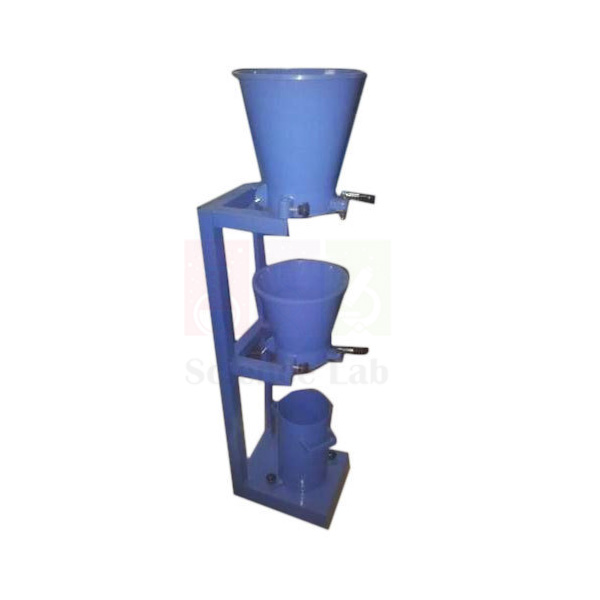
Compaction Factor Test Apparatus
Compaction Factor Test Apparatus (Product Code: SLE/CE/08) is a concrete workability test set used to compare how densely fresh concrete packs under its own weight with how it packs when fully compacted, in civil engineering laboratories and site labs. It is particularly suited to low-workability mixes, and the listed set includes trowels, a 15.2 cm hand scoop, a 1.6 cm x 61 cm rod rounded at one end and a balance. It is made by Jain Scientific Equipments Pvt Ltd (ScienceLab), an OEM supplier of engineering educational equipments in India, at its own factory in Ambala.
Specifications
| Parameter | Detail |
|---|---|
| Trowels | Included in the listed set |
| Hand scoop | 15.2 cm long |
| Rod | Steel or other suitable material, 1.6 cm diameter, 61 cm long, rounded at one end |
| Balance | Included in the listed set, for weighing the concrete |
| Scope of supply | Confirm the complete scope, including the main test assembly, in your quotation |
| Product code | SLE/CE/08 |
| Manufacturer | Jain Scientific Equipments Pvt Ltd (ScienceLab) — OEM |
| Country of origin | India (made in Ambala, Haryana) |
What Is the Compaction Factor Apparatus Used For?
Stiff concrete for pavements, precast units or heavily vibrated sections often shows almost no slump, so the slump cone cannot tell one mix from another. The compaction factor test solves this by letting the concrete fall under gravity into a container, weighing it, and then weighing the same container filled with fully compacted concrete. The ratio of the two weights is the compaction factor: the closer it is to one, the more workable the mix.
The hand scoop loads the concrete, the trowels strike off the surplus level with the container rim, the rod compacts the concrete for the full-compaction reading, and the balance provides both weights. Keep all surfaces clean and damp but free of standing water, and complete each test promptly so the concrete does not stiffen between steps.
OEM Manufacturer
Jain Scientific Equipments Private Limited, which trades as ScienceLab, is the OEM (original equipment manufacturer) of this compaction factor test apparatus. It is produced at the company's own licensed factory at Saha, Ambala, Haryana, India, and supplied factory-direct to engineering colleges, polytechnics, construction laboratories, dealers and importers rather than through a chain of traders.
Working with the maker keeps things simple after delivery too: questions about replacement scoops, rods or other parts and repeat orders go straight to the manufacturer — ask us. See the ScienceLab company profile for more.
Related Civil Engineering Lab Equipment
Other workability tests often run alongside compaction factor:
- Slump Test Apparatus — the standard check for medium and high workability.
- Vee Bee Consistometer — times vibration for very stiff mixes.
- Flow Table — measures the flow of fresh mortar.
- Scoops — spare scoops in several capacities for sampling.
See the complete Civil Engineering Lab Equipment range.
Frequently Asked Questions
What does the Compaction Factor Test Apparatus measure?
The Compaction Factor Test Apparatus measures the workability of fresh concrete as the ratio between the weight of concrete compacted under its own falling weight and the weight of the same volume fully compacted. Values closer to one indicate a more workable mix.
What is included with the Compaction Factor Test Apparatus?
The listed set for the Compaction Factor Test Apparatus includes trowels, a 15.2 cm hand scoop, a 1.6 cm x 61 cm rod rounded at one end, and a balance. Please confirm the complete scope of supply, including the main test assembly, in your quotation.
What is the rod in the set used for?
The rod in the Compaction Factor Test Apparatus, 1.6 cm in diameter and 61 cm long with one rounded end, is used to compact the concrete fully for the second weighing. It is made of steel or another suitable material.
When should I use compaction factor instead of a slump test?
The Compaction Factor Test Apparatus is the better choice for low-workability concrete that shows little or no slump, because it still separates mixes by how well they compact. For medium and high workability, the slump test is usually quicker.
Who manufactures the Compaction Factor Test Apparatus?
The Compaction Factor Test Apparatus is manufactured by Jain Scientific Equipments Pvt Ltd (ScienceLab), the OEM, at its own licensed factory at Saha, Ambala, Haryana, India, and supplied factory-direct to institutions, laboratories, dealers and importers.
What should I include in a quotation request?
For the Compaction Factor Test Apparatus, tell us the number of sets, the delivery city or port, and any standard your laboratory follows so the scope of supply can be confirmed. Send details through the contact page.
Request a Quote
Request a factory-direct price for the Compaction Factor Test Apparatus on the contact page, or add it to the enquiry cart. The quotation comes straight from the manufacturer in Ambala.
Last updated: 24 September 2026
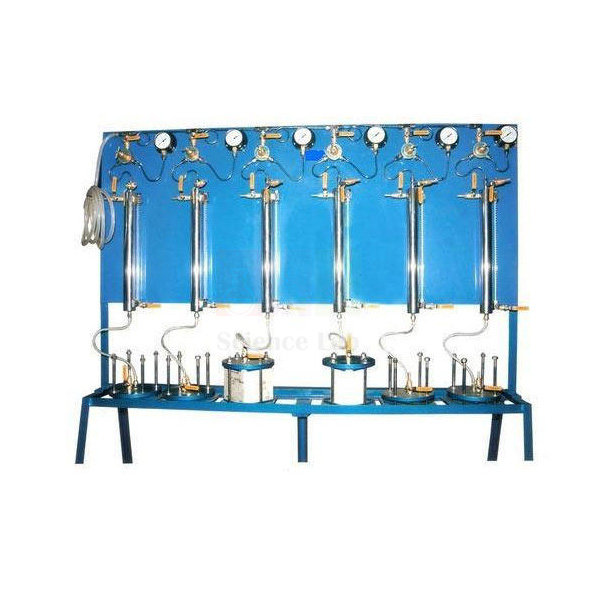
Concrete Permeability Test Apparatus
Concrete Permeability Test Apparatus (Product Code: SLE/CE/09) is a pressure-cell test unit used to determine how deep water penetrates into concrete and mortar specimens under pressure, a key durability check in civil engineering and material testing laboratories. It is offered in 3-cell and 1-cell models for 100 mm and 150 mm cubes and for 100, 150 and 300 mm cylinders, and accepts specimens cast in the lab or cores cut from existing structures. It is made by Jain Scientific Equipments Pvt Ltd (ScienceLab), an OEM laboratory equipment manufacturer in India, at its own factory in Ambala.
Specifications
| Parameter | Detail |
|---|---|
| Test | Depth of penetration of water under pressure in concrete specimens |
| Specimen clamping | Between two flanges with special circular gaskets |
| Specimen shapes | Cubic, cylindrical or prismatic; edge length or diameter not less than 150 mm for this clamping method |
| Specimen sources | Mortar and concrete specimens cast in the laboratory, or cores cut from existing structures |
| Models | 3 cell for 100 mm cube; 3 cell for 100 mm cylinder; 3 cell for 150 mm cube; 1 cell for 150 mm cylinder; 1 cell for 300 mm cylinder; 3 cell for 150 mm cube as per DIN standard |
| Product code | SLE/CE/09 |
| Manufacturer | Jain Scientific Equipments Pvt Ltd (ScienceLab) — OEM |
| Country of origin | India (made in Ambala, Haryana) |
What Is the Concrete Permeability Apparatus Used For?
A mix is designed not only for strength but for durability in the conditions at the site, and resistance to water flow is one of the most important durability properties. In this test the specimen is sealed between two flanges with circular gaskets, water under pressure is applied to one face for the period your method specifies, and the specimen is then split to measure how far the water has travelled.
Three-cell models let a laboratory run a set of three specimens together, while the single-cell models take the larger 150 mm and 300 mm cylinders. Because cores from existing structures can be tested as well as laboratory-cast specimens, the apparatus serves both mix-design research and condition surveys. Seat each specimen squarely on its gasket so water can only enter through the test face.
What to Specify When Ordering
- Model: number of cells (1 or 3) and specimen type and size.
- Whether you need the version for 150 mm cubes as per DIN standard.
- Whether you will test laboratory-cast specimens, site cores or both.
- Quantity and delivery city or port.
OEM Manufacturer
This permeability apparatus is manufactured by Jain Scientific Equipments Private Limited, which trades as ScienceLab and is the OEM (original equipment manufacturer). It is built at the company's own licensed factory at Saha, Ambala, Haryana, India, and shipped factory-direct to engineering colleges, research and quality-control laboratories, dealers and importers.
Buying from the manufacturer gives you one point of contact for choosing the right cell configuration, for replacement gaskets or other parts, and for adding cells later — ask us. Read more on the ScienceLab company profile.
Related Civil Engineering Lab Equipment
Equipment for preparing specimens and assessing concrete durability:
- Concrete Cube Mould — casts the cube specimens for the cells.
- Cylindrical Mould — casts cylinder specimens in matching sizes.
- Core Drilling Machine (Motorised) — cuts cores from existing structures.
- Rapid Chloride Permeability Tester — assesses resistance to chloride ion penetration.
- Initial Surface Absorption Test Apparatus — measures water absorption at the concrete surface.
Browse all Civil Engineering Lab Equipment.
Frequently Asked Questions
What does the Concrete Permeability Test Apparatus measure?
The Concrete Permeability Test Apparatus measures the depth to which water under pressure penetrates a concrete or mortar specimen. Lower penetration indicates concrete that better resists water flow, an important durability property.
Which models of the permeability apparatus are available?
The Concrete Permeability Test Apparatus comes as 3-cell models for 100 mm cubes, 100 mm cylinders and 150 mm cubes (including a DIN version), and as 1-cell models for 150 mm and 300 mm cylinders. Choose by specimen type and how many you test at once.
What specimens can be tested?
The Concrete Permeability Test Apparatus takes cubic, cylindrical or prismatic specimens clamped between two flanges with circular gaskets; the clamping method is described for an edge or diameter of at least 150 mm. Confirm your specimen size so the right model is quoted.
Can cores from existing structures be tested?
Yes. The Concrete Permeability Test Apparatus accepts mortar and concrete specimens cast in the laboratory as well as cores cut from existing structures, so it can be used for new mix designs and for checking concrete already in service.
Who manufactures the Concrete Permeability Test Apparatus?
The Concrete Permeability Test Apparatus is manufactured by Jain Scientific Equipments Pvt Ltd (ScienceLab), the OEM, at its own licensed factory at Saha, Ambala, Haryana, India, and is supplied factory-direct to institutions, laboratories, dealers and importers.
What details do you need for a quotation?
To quote the Concrete Permeability Test Apparatus we need the model (number of cells and specimen size), whether the DIN version is required, the quantity and the delivery city or port. Send these through the contact page.
Request a Quote
Get a quotation for the Concrete Permeability Test Apparatus direct from the manufacturer via the contact page, or add your chosen model to the enquiry cart.
Last updated: 24 September 2026
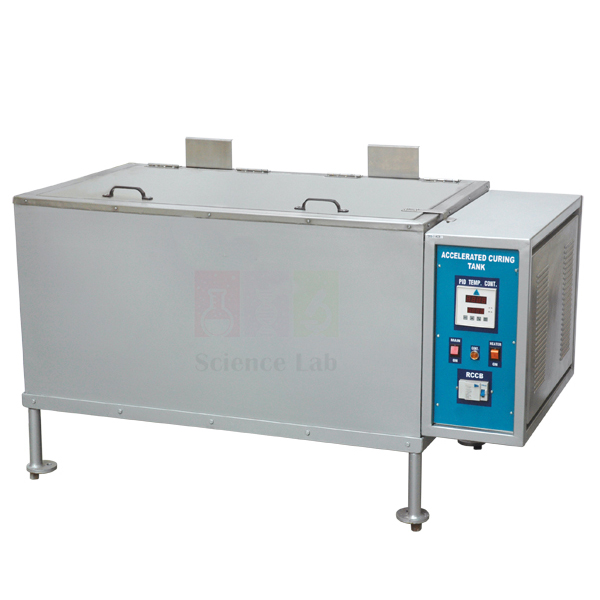
Accelerated Curing Tank
Accelerated Curing Tank (Product Code: SLE/CE/10) is an insulated, temperature-controlled curing tank used for hot water or steam curing of concrete cubes in accelerated strength testing, in civil engineering and concrete quality-control laboratories. It holds 150 mm or 70.6 mm cube moulds on two removable racks, from 6/12 up to 36/72 moulds by model, and controls curing at 35 °C or 100 °C ± 2 °C for concrete or 27 °C ± 2 °C for grey cement. It is made by Jain Scientific Equipments Pvt Ltd (ScienceLab), an OEM scientific equipment manufacturer, at its own factory in Ambala, India.
Specifications
| Parameter | Detail |
|---|---|
| Mould size accepted | 150 mm or 70.6 mm cube moulds |
| Capacity by model | 6/12, 12/24, 24/48 or 36/72 moulds (150 mm / 70.6 mm) |
| Curing temperature, concrete | Controlled at 35 °C or 100 °C ± 2 °C |
| Curing temperature, grey cement | Controlled at 27 °C ± 2 °C |
| Temperature note | Set temperature is held except for the 15 minutes after freshly made specimens are immersed |
| Heating and cooling | Immersion heater under normal conditions; refrigeration system for grey cement curing |
| Curing modes | Hot water curing or steam curing |
| Cycle | 24 hour cycle from time of mixing |
| Programmer | Electronic; controls up to four test cycles with different thermal gradients and curing times for a fully automatic curing cycle |
| Printer | 28 column thermal printer on the control panel |
| Construction | Stainless steel interior; fully insulated; hinged lid |
| Fitted equipment | Heater, thermostat and re-circulating pump; pump, drain valves and electrical equipment housed in a compartment at one end |
| Racks | Two removable racks allowing free water circulation around each mould |
| Product code | SLE/CE/10 |
| Manufacturer | Jain Scientific Equipments Pvt Ltd (ScienceLab) — OEM |
| Country of origin | India (made in Ambala, Haryana) |
What Is the Accelerated Curing Tank Used For?
Waiting weeks for normally cured cubes slows down mix approval and site decisions. Accelerated curing shortens that wait: freshly cast cubes, still in their moulds, are placed on the racks in hot water or steam at a controlled temperature, and after the 24 hour cycle from mixing they are tested so that the concrete's later strength can be judged much sooner.
The electronic programmer stores up to four cycles with their own heating gradients and curing times, and the thermal printer records each run for the lab file. With the refrigeration system the same tank can hold grey cement specimens at 27 °C. Keep the racks loosely loaded so water circulates around every mould, and drain and clean the stainless steel interior regularly.
What to Specify When Ordering
- Capacity: 6/12, 12/24, 24/48 or 36/72 moulds.
- Cube size you cure most: 150 mm or 70.6 mm.
- Curing duty: concrete at 35 °C or 100 °C, grey cement at 27 °C, or both.
- Your mains supply details and the delivery city or port.
OEM Manufacturer
ScienceLab, the trading name of Jain Scientific Equipments Private Limited, is the OEM (original equipment manufacturer) of this accelerated curing tank. The tank is fabricated and assembled at the company's own licensed factory at Saha, Ambala, Haryana, India, and delivered factory-direct to engineering colleges, ready-mix and precast plants' laboratories, dealers and importers.
Since you deal with the maker, questions on sizing, replacement racks, heaters or pumps and repeat orders are answered by the team that builds the tank — ask us. More about the company is on the ScienceLab company profile.
Related Civil Engineering Lab Equipment
Items used before and after accelerated curing:
- Concrete Cube Mould — 150 mm and 70.6 mm moulds that sit on the tank racks.
- Automatic digital compression testing machine — tests the cured cubes.
- Cement curing bench-type cabinet — humid curing for cement specimens.
- Circulating water bath with cooler unit — conditions specimens at a set temperature.
Explore the full Civil Engineering Lab Equipment range.
Frequently Asked Questions
How many cube moulds does the Accelerated Curing Tank hold?
The Accelerated Curing Tank is made in four capacities: 6/12, 12/24, 24/48 and 36/72 moulds, where the first figure is for 150 mm cube moulds and the second for 70.6 mm moulds. The largest model cures up to 36 or 72 moulds in one go.
What curing temperatures can the tank hold?
The Accelerated Curing Tank controls concrete curing at 35 °C or 100 °C ± 2 °C and grey cement curing at 27 °C ± 2 °C. The set temperature is maintained throughout the cycle except for the 15 minutes after fresh specimens are immersed.
Can the Accelerated Curing Tank be used for grey cement?
Yes. Besides the immersion heater used for concrete, the Accelerated Curing Tank has a refrigeration system that holds grey cement specimens at 27 °C ± 2 °C, so one tank covers both duties.
What does the electronic programmer do?
The programmer on the Accelerated Curing Tank controls up to four test cycles, each with its own thermal gradient and curing time to a defined temperature, running the curing cycle automatically. A 28 column thermal printer on the control panel prints the record.
Who manufactures the Accelerated Curing Tank?
The Accelerated Curing Tank is manufactured by Jain Scientific Equipments Pvt Ltd (ScienceLab), the OEM, at its own licensed factory at Saha, Ambala, Haryana, India, and supplied factory-direct to colleges, laboratories, dealers and importers.
How is the tank built?
The Accelerated Curing Tank has a stainless steel interior, full insulation and a hinged lid, with heater, thermostat and re-circulating pump. The pump, drain valves and electrical equipment sit in a compartment at one end, and two removable racks let water flow around each mould.
Request a Quote
For a factory-direct quotation on the Accelerated Curing Tank, send the capacity and curing duty you need through the contact page, or add it to the enquiry cart. The quote comes straight from the manufacturer.
Last updated: 24 September 2026
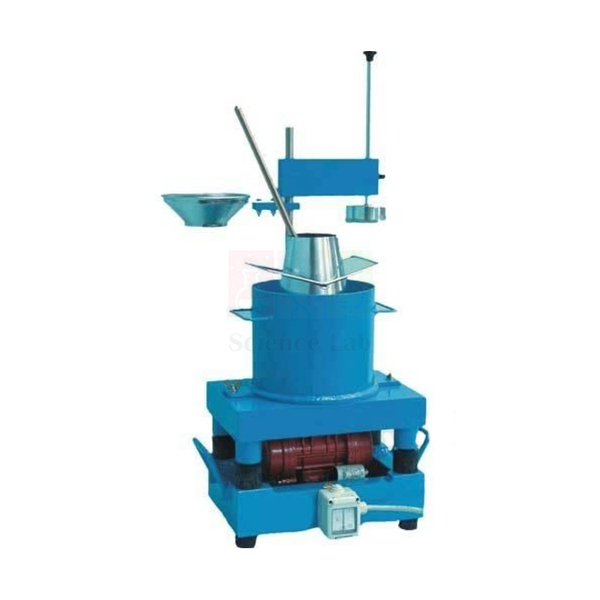
Vee Bee Consistometer
Vee Bee Consistometer (Product Code: SLE/CE/11) is a vibration-based workability tester used to measure the consistency of fresh concrete in Vee Bee degrees (seconds) in civil engineering and concrete technology laboratories. The set combines a 380 x 260 mm vibrating table with a sheet metal container, a slump cone, a swivel arm carrying a funnel and acrylic disc, and a 16 mm x 600 mm graduated tamping rod. It is built by Jain Scientific Equipments Pvt Ltd (ScienceLab), an OEM supplier of engineering lab equipment in India, at its own factory in Ambala.
Specifications
| Parameter | Detail |
|---|---|
| Measurement | Workability in Vee Bee degrees: time in seconds of vibration until fresh concrete contacts the entire face of the acrylic disc; slump in mm |
| Vibrating table | 380 mm long x 260 mm wide, on elastic supports about 305 mm above the floor, with start/stop switch, cord and plug |
| Container | Sheet metal, with lifting handles; fixes to the vibrating table |
| Swivel arm | Telescopes into a holder fixed to the base; carries funnel and guide; detachable from the vibrating table |
| Slump cone | Open at both ends, with lifting handles |
| Tamping rod | 16 mm diameter x 600 mm long, rounded at both ends; scale divisions record slump in mm |
| Acrylic disc | Included for reading the Vee Bee time |
| Product code | SLE/CE/11 |
| Manufacturer | Jain Scientific Equipments Pvt Ltd (ScienceLab) — OEM |
| Country of origin | India (made in Ambala, Haryana) |
What Is the Vee Bee Consistometer Used For?
Very stiff concrete barely slumps, so the Vee Bee test measures how much vibration it takes to remould it. A slump cone is filled and rodded inside the container on the table, then lifted away; the slump can be read on the graduated rod. The swivel arm lowers the transparent acrylic disc onto the concrete, the table is switched on, and the operator times how long it takes for concrete to cover the whole underside of the disc.
That time in seconds is the Vee Bee value: a longer time means a stiffer, less workable mix. The test suits dry mixes for pavements, precast work and roller-compacted concrete. Stand the table on a level floor, make sure the container is fixed firmly before vibrating, and wipe the disc clean after each test so the contact line stays easy to see.
OEM Manufacturer
Jain Scientific Equipments Private Limited, trading as ScienceLab, is the OEM (original equipment manufacturer) of this Vee Bee consistometer and supplies it factory-direct to engineering colleges, polytechnics, construction laboratories, dealers and importers. The table, container, swivel arm and cone are made and assembled at the company's own factory, licensed under Factory Licence AMB-ONLINE-CHD-J-414, at 449, HSIIDC Industrial Area, Saha, Ambala, Haryana, India; the company is incorporated under CIN U29309HR2020PTC087597.
Spare cones, discs or rods and repeat orders are handled by the manufacturer itself — ask us for what you need. See the ScienceLab company profile.
Related Civil Engineering Lab Equipment
Other workability tests and tools for the same concrete lab:
- Slump Test Apparatus — for medium and high workability mixes.
- Compaction Factor Test Apparatus — another method for low-workability concrete.
- Tamping Rod — a spare rod for rodding the cone.
- Flow Table — measures the spread of more fluid mixes.
Browse the full Civil Engineering Lab Equipment range.
Frequently Asked Questions
What does the Vee Bee Consistometer measure?
The Vee Bee Consistometer measures concrete workability in Vee Bee degrees, the time in seconds of vibration needed for fresh concrete to flow out and contact the entire face of the acrylic disc. It also allows the slump to be read on the graduated rod.
What is included with the Vee Bee Consistometer?
The Vee Bee Consistometer includes a 380 x 260 mm vibrating table with switch, cord and plug, a sheet metal container, a holder and swivel arm with funnel and guide, an acrylic disc, a slump cone with handles, and a 16 mm x 600 mm tamping rod.
How is the vibrating table mounted?
The vibrating table of the Vee Bee Consistometer measures 380 mm by 260 mm and rests on elastic supports about 305 mm above the floor. The container fixes to the table top, and the swivel arm can be detached when not in use.
Which concrete is the Vee Bee test suited to?
The Vee Bee Consistometer is best suited to stiff, low-workability concrete such as mixes for pavements and precast units, where the slump is too small to separate one mix from another. For fluid mixes, a slump or flow test is more useful.
Who manufactures the Vee Bee Consistometer?
The Vee Bee Consistometer is manufactured by Jain Scientific Equipments Pvt Ltd (ScienceLab), the OEM, at its own licensed factory at Saha, Ambala, Haryana, India, and is supplied factory-direct to institutions, laboratories, dealers and importers.
What electrical supply does the vibrating table need?
The Vee Bee Consistometer's vibrating table comes with a start/stop switch, cord and plug. Tell us the mains voltage and plug type used in your laboratory through the contact page so the correct electrical fitting can be confirmed.
Request a Quote
Request a quotation for the Vee Bee Consistometer through the contact page or add it to the enquiry cart. Quotations come direct from the manufacturer, including for bulk and export orders.
Last updated: 24 September 2026
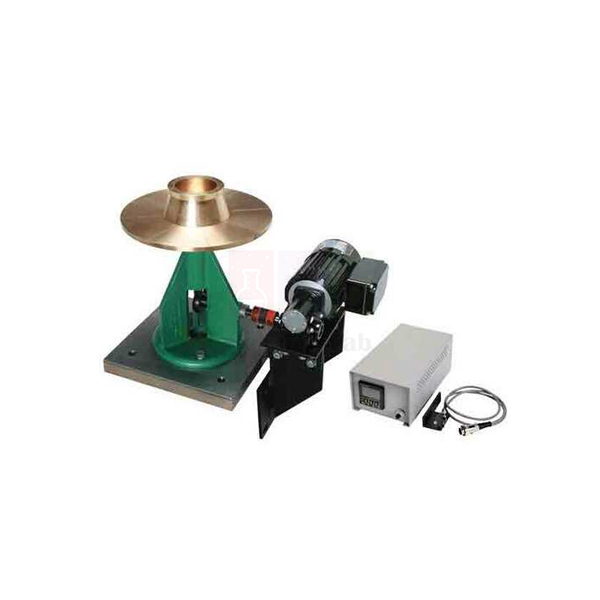
Flow Table
Flow Table (Product Code: SLE/CE/12) is a drop table with a conical mould used to measure the flow, or consistency, of fresh mortar in cement and civil engineering laboratories. It comes in manual and motorized versions, with a 254 mm or 300 mm table, a cone of 100 mm base and 70 mm top diameter, and a drop height of 12.7 mm or 10 mm. It is made by Jain Scientific Equipments Pvt Ltd (ScienceLab), an OEM maker of lab equipments for technical institutes, at its own factory in Ambala, India.
Specifications
| Parameter | Detail |
|---|---|
| Versions | Manual and motorized |
| Table diameter | 254 mm or 300 mm |
| Cone base / top diameter | 100.0 mm / 70.0 mm |
| Cone height | 50.0 mm or 60.0 mm |
| Drop height | 12.7 mm or 10.0 mm |
| Dimensions, manual | 260 x 260 x 270 mm |
| Dimensions, motorized | 470 x 360 x 350 mm |
| Weight (approx.) | Manual 13 kg; motorized 36 kg |
| Power (motorized) | 180 W |
| Product code | SLE/CE/12 |
| Manufacturer | Jain Scientific Equipments Pvt Ltd (ScienceLab) — OEM |
| Country of origin | India (made in Ambala, Haryana) |
What Is the Flow Table Used For?
The flow test tells you whether a mortar has the right water content for its job. The cone is placed at the centre of the table, filled with fresh mortar and tamped, then struck off and lifted clear. The table is raised and dropped a set number of times through the fixed drop height, and the diameter of the spread mortar is measured to give its flow.
The compact manual table weighs about 13 kg and suits teaching labs, while the 180 W motorized version keeps the drop rate uniform for routine testing. Choose the 254 mm or 300 mm table to match the method your laboratory follows, set the unit on a firm, level bench, and wipe the table top and cone clean and dry between tests.
What to Specify When Ordering
- Version: manual or motorized.
- Table diameter: 254 mm or 300 mm (with the matching cone height and drop height).
- For the motorized version, your mains supply details.
- Quantity and delivery city or port.
OEM Manufacturer
ScienceLab is the trading name of Jain Scientific Equipments Private Limited, which is the OEM (original equipment manufacturer) of this flow table. Tables, cones and drive mechanisms are produced at the company's own licensed factory at Saha, Ambala, Haryana, India, and each unit is supplied factory-direct to cement and concrete laboratories, colleges, dealers and importers instead of through resellers.
Spare cones and other parts, as well as repeat units, are arranged by the manufacturer — just ask us. Company information is on the ScienceLab company profile.
Related Civil Engineering Lab Equipment
Other items for mortar and cement testing:
- Flow tables for mortar and building lime — an alternative flow table model with digital drop counter.
- Vicat Needle Apparatus With Dashpot — checks cement paste consistency and setting time.
- Prism Mould Three Gang — casts mortar prisms for strength tests.
- Scoops — for handling fresh mortar samples.
See all items in Civil Engineering Lab Equipment.
Frequently Asked Questions
What does the Flow Table measure?
The Flow Table measures the flow of fresh mortar: after the cone is lifted, the table is dropped a set number of times and the spread diameter of the mortar is measured. The result shows whether the mix has the intended consistency.
What is the difference between the manual and motorized Flow Table?
The manual Flow Table measures 260 x 260 x 270 mm and weighs about 13 kg. The motorized Flow Table measures 470 x 360 x 350 mm, weighs about 36 kg and uses 180 W, giving a uniform drop rate for routine testing.
What are the cone dimensions?
The cone supplied with the Flow Table has a base diameter of 100.0 mm and a top diameter of 70.0 mm, with a height of 50.0 mm or 60.0 mm depending on the table version you choose.
Which table diameter and drop height should I choose?
The Flow Table is listed with a 254 mm or 300 mm table and a drop height of 12.7 mm or 10.0 mm. Choose the combination your test method specifies, and tell us that method when you enquire so the right version is quoted.
Who manufactures the Flow Table?
The Flow Table is manufactured by Jain Scientific Equipments Pvt Ltd (ScienceLab), the OEM, at its own licensed factory at Saha, Ambala, Haryana, India, and supplied factory-direct to institutions, laboratories, dealers and importers.
Can the Flow Table be ordered in bulk or for export?
Yes, the Flow Table can be supplied in quantity to colleges, testing laboratories, dealers and importers in India and international markets. Send the version, table size, quantity and delivery city or port through the contact page.
Request a Quote
For a quotation straight from the manufacturer, contact us about the Flow Table through the contact page or add it to the enquiry cart.
Last updated: 24 September 2026
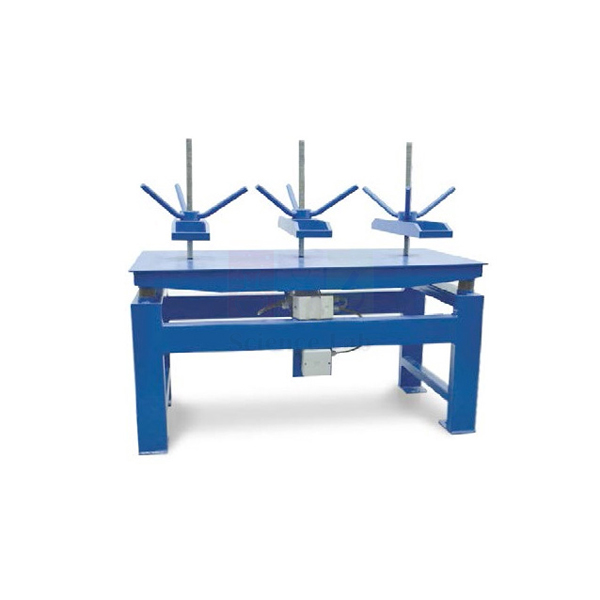
Vibrating Table
Vibrating Table (Product Code: SLE/CE/13) is a motor-driven vibration table used to compact fresh concrete in test moulds in civil engineering laboratories and site labs. Its 500 x 500 mm top carries up to 140 kg, and a speed regulation handle sets the frequency anywhere from 2600 to 3600 vibrations per minute. The table is made by Jain Scientific Equipments Pvt Ltd (ScienceLab), an OEM scientific lab equipment manufacturer in Ambala, at its own factory in India.
Specifications
| Parameter | Detail |
|---|---|
| Table top | 500 x 500 mm, with stops along the edges so moulds cannot walk off during vibration |
| Load capacity | 140 kg |
| Vibration frequency | Adjustable from a maximum of 3600 down to 2600 vibrations per minute |
| Drive | Motor with variable pitch pulley, housed in a cabinet |
| Vibration mechanism | Off-balance masses rotating on the shaft of a vibrator clamped to the underside of the table top |
| Controls | Switch for starting the motor; speed regulation handle for increasing or decreasing frequency |
| Mould holding | Cross arm adjustable on a vertical rod at the centre of the table |
| Power supply | 230 V AC, single phase, 50 cycles |
| Product code | SLE/CE/13 |
| Manufacturer | Jain Scientific Equipments Pvt Ltd (ScienceLab) — OEM |
| Country of origin | India (made in Ambala, Haryana) |
What Is the Vibrating Table Used For?
Trapped air weakens concrete specimens and makes test results scatter, so moulds are vibrated rather than only hand-rodded. Filled cube, cylinder or beam moulds are set on the table, held down by the cross arm on the central rod, and the motor is started; vibration continues until the concrete surface settles and air bubbles stop rising.
Stiffer mixes need more energy, which is why the frequency can be turned up towards 3600 vibrations per minute, while more fluid mixes are compacted at the lower end to avoid segregation. Keep the total load within 140 kg, check that the cross arm is tight before switching on, and scrape off spilt concrete before it hardens on the table top.
OEM Manufacturer
This vibrating table is built by Jain Scientific Equipments Private Limited, trading as ScienceLab, as the OEM (original equipment manufacturer). Frame, table top, drive cabinet and vibrator assembly are made and put together at the company's own licensed factory at Saha, Ambala, Haryana, India, and each table is supplied factory-direct to colleges, construction and precast laboratories, dealers and importers.
Because you buy from the maker, spares such as the pulley or vibrator parts and repeat orders are handled by the same team — ask us. Find out more on the ScienceLab company profile.
Related Civil Engineering Lab Equipment
Moulds and compaction tools used with the table:
- Concrete Cube Mould — cube specimens compacted on the table.
- Cylindrical Mould — cylinder specimens for strength tests.
- Beam Mould — beam specimens for flexural tests.
- Poker Vibrator — internal compaction when many specimens are cast.
Browse all Civil Engineering Lab Equipment.
Frequently Asked Questions
What load can the Vibrating Table carry?
The Vibrating Table is designed to carry a load of 140 kg on its 500 x 500 mm top. Spread moulds evenly across the table and keep the combined weight of moulds and concrete within this limit.
What vibration frequency does the Vibrating Table give?
The Vibrating Table runs between a maximum of 3600 and a minimum of 2600 vibrations per minute. A speed regulation handle acting on the variable pitch pulley increases or decreases the frequency to suit the mix.
How are moulds held in place during vibration?
On the Vibrating Table, stops along the edges of the table top prevent moulds from walking off, and a cross arm adjustable on a vertical rod at the centre of the table holds the moulds down while the table runs.
How does the Vibrating Table produce vibration?
The Vibrating Table uses off-balance masses rotating on the shaft of a vibrator clamped to the underside of the top. The shaft is driven by a motor with a variable pitch pulley housed in a cabinet, started by a switch.
What power supply does the Vibrating Table need?
The Vibrating Table operates on 230 V AC, single phase, 50 cycles. If your site or laboratory uses a different supply, mention it on the contact page so we can confirm what can be offered.
Who manufactures the Vibrating Table?
The Vibrating Table is manufactured by Jain Scientific Equipments Pvt Ltd (ScienceLab), the OEM, at its own licensed factory at Saha, Ambala, Haryana, India, and supplied factory-direct to institutions, laboratories, dealers and importers.
Request a Quote
Ask for a factory-direct quotation on the Vibrating Table through the contact page, or add it to the enquiry cart along with your moulds. Bulk and export enquiries are welcome.
Last updated: 24 September 2026