- Physics Lab Equipment
- Chemistry Lab Equipment
- Biology Lab Equipment
- Anatomical Lab Equipment
- Learning
- Educational Lab Equipment
- Magnets
- Agriculture
- Astronomy
- Earth Science
- Geography Lab Equipment
- Safety Lab Coat
- Laboratory
- Meteorological
- Electricity & Magnetism
- Heat
- School Lab Equipment
- Lab Glassware
- Science Lab Equipment
- Tvet Lab Equipment
- Robotics Kits Supplier and Manufacturer for Schools India
- Math Lab Equipment Manufacturers and Exporters in Ambala
- STEM Kits Manufacturers and Supplier India
- Engineering Lab Equipment
- Hospital Lab Equipment
- Water, Sanitation & Hygiene Supplies
- Cold Chain, Solar & Communication Equipment
- Nutrition
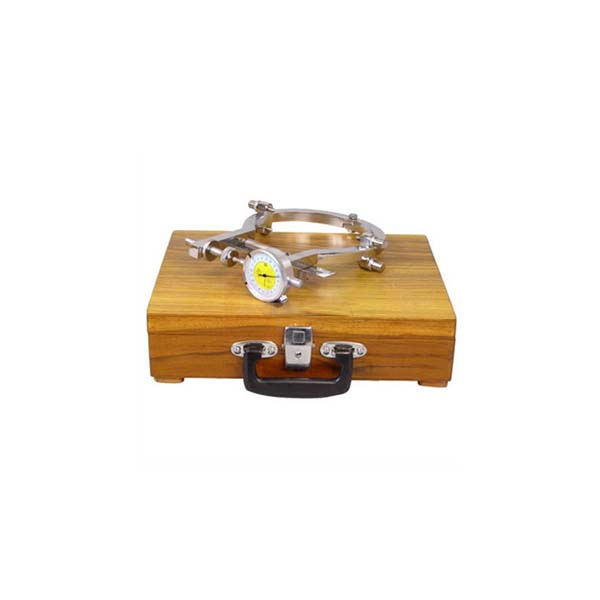
Lateral Extensometer
Lateral Extensometer (Product Code: SLE/CE/22) is a hinged strain-measuring frame used to measure the lateral extension of a concrete specimen under compressive load in materials testing laboratories. Built from two movable frames pivoted at one end, it shows sideways movement on a 0.002 mm dial gauge so that students and engineers can pair lateral readings with axial strain. Jain Scientific Equipments Pvt Ltd (ScienceLab) manufactures it as the OEM at its own factory in Ambala, India.
Specifications
| Parameter | Detail |
|---|---|
| Frames | Two movable frames pivoted at one end |
| Fixing | Fixed to the specimen with tightening screws |
| Dial gauge | 0.002 mm × 5 mm; indicates the lateral extension |
| Gauge contact | Dial gauge tip rests on an anvil |
| Zero setting | By adjusting the anvil screw |
| Case | Supplied in a wooden carrying case |
| Product code | SLE/CE/22 |
| Manufacturer | Jain Scientific Equipments Pvt Ltd (ScienceLab) — OEM |
| Country of origin | India (made in Ambala, Haryana) |
What Is the Lateral Extensometer Used For?
When a concrete specimen is squeezed along its axis it also bulges slightly sideways. The two frames of the lateral extensometer are screwed to the specimen and hinge apart as it expands, and the dial gauge records that movement. Comparing lateral strain with longitudinal strain from a compressometer gives Poisson's ratio, a key input in structural analysis.
Fix the frames with the tightening screws, check they are not touching the machine platens, then zero the gauge with the anvil screw before loading. Take readings at the same load steps used for the compressometer so the two data sets line up. It is a practical test and measuring instrument in India for concrete technology and strength-of-materials practicals.
OEM Manufacturer
Jain Scientific Equipments Private Limited trades as ScienceLab and is the OEM (original equipment manufacturer) of this Lateral Extensometer, producing it at the company's own licensed factory at Saha, Ambala, Haryana, India. Laboratories, colleges, dealers and importers buy it factory-direct, which keeps quotations, repeat orders and spare-part questions with the manufacturer itself. If a component needs replacing, ask us. Company information is on the ScienceLab company profile.
Related Civil Engineering Lab Equipment
Lateral strain readings are normally taken alongside axial strain on the same loaded specimen, so these items are commonly ordered together.
- Longitudinal Compressometer — measures axial strain for the Poisson's ratio calculation.
- Automatic digital compression testing machine — loads the specimen in compression.
- Cylindrical Mould — for casting cylinder specimens.
- Tamping Rod — for compacting concrete in the moulds.
Find more concrete and materials testing apparatus in the Civil Engineering Lab Equipment category.
Frequently Asked Questions
What does the Lateral Extensometer measure?
The Lateral Extensometer measures the lateral (sideways) extension of a concrete specimen as it is loaded in compression. Its reading, taken with axial strain from a compressometer, is used to calculate the Poisson's ratio of the concrete.
How is the Lateral Extensometer attached to the specimen?
The Lateral Extensometer is fixed to the specimen with tightening screws. Its two movable frames are pivoted at one end, so they open as the specimen expands sideways and the dial gauge records that movement.
What reading does the Lateral Extensometer dial gauge give?
The Lateral Extensometer uses a dial gauge of 0.002 mm × 5 mm to indicate lateral extension. The gauge tip rests on an anvil, and the zero is set by adjusting the anvil screw before loading begins.
Can the Lateral Extensometer be used with a compressometer?
Yes. The Lateral Extensometer is normally used together with a longitudinal compressometer on the same specimen, so lateral and axial strains are recorded at the same load steps for a Poisson's ratio determination.
Who manufactures the Lateral Extensometer?
The Lateral Extensometer is manufactured by Jain Scientific Equipments Pvt Ltd (ScienceLab), the OEM, at its own licensed factory at Saha, Ambala, Haryana, India. Quotations and spare-part enquiries are handled by the manufacturer directly.
How is the Lateral Extensometer supplied?
The Lateral Extensometer is supplied in a wooden carrying case that protects the frames and dial gauge. Keep it in the case between tests and give the specimen size you test when you request a quotation through the contact page.
Request a Quote
Send your enquiry for the Lateral Extensometer (SLE/CE/22) through the contact page or the enquiry cart. The quotation comes direct from the manufacturer, Jain Scientific Equipments Pvt Ltd (ScienceLab), Ambala, India.
Last updated: 24 September 2026
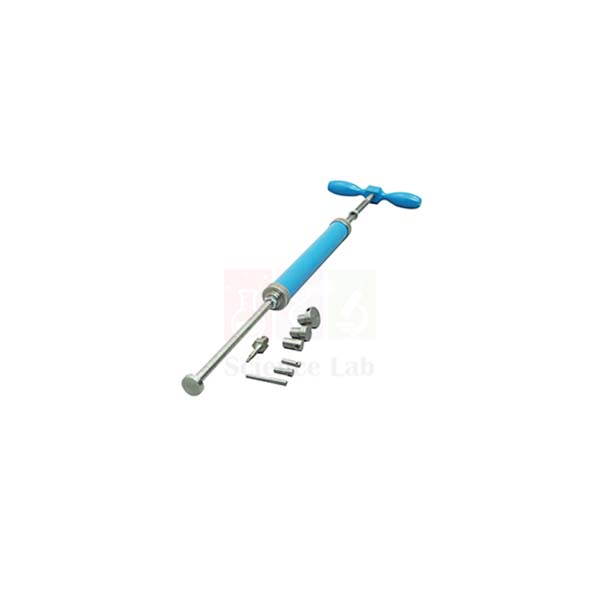
Concrete Penetrometer Spring Type
Concrete Penetrometer Spring Type (Product Code: SLE/CE/23) is a spring-loaded penetration device used to find the rate of hardening of mortar sieved from fresh concrete in concrete testing laboratories and on site. Technicians press one of its six interchangeable needles 25 mm into the mortar and read the force from a sliding ring on the graduated stem. Jain Scientific Equipments Pvt Ltd (ScienceLab) makes it as the OEM at its own factory in Ambala, India, as part of its engineering lab equipment in India range.
Specifications
| Parameter | Detail |
|---|---|
| Application | Rate of hardening of mortar sieved from concrete |
| Operating principle | Spring-loaded device; the force needed to penetrate the mortar by 25 mm is shown by a sliding ring on the graduated stem |
| Load scale | Graduated 1 to 100 daN (the listing also gives a stem graduated 0–70 kg × 1 kg; the scale fitted is confirmed on the quotation) |
| Penetration needles | Six, interchangeable; bearing areas listed as approx. 645–650, 323–325, 160, 65, 32 and 16 mm² |
| Needle shank marking | Every 12.5 mm |
| Weight (approx.) | 5 kg |
| Supplied with | Carrying case |
| Product code | SLE/CE/23 |
| Manufacturer | Jain Scientific Equipments Pvt Ltd (ScienceLab) — OEM |
| Country of origin | India (made in Ambala, Haryana) |
What Is the Concrete Penetrometer Used For?
Mortar is sieved out of a fresh concrete sample and placed in a container. At regular intervals a needle is pushed into the mortar to a depth of 25 mm — two of the 12.5 mm marks on the shank — and the sliding ring records the force reached. Dividing that force by the needle area gives penetration resistance, and plotting it against elapsed time shows how quickly the concrete is setting.
Start with the largest needle while the mortar is soft and change to smaller needles as it stiffens, so the force stays within the scale. Reset the sliding ring before each reading and wipe the needle clean. The results help plan finishing, formwork removal and the effect of admixtures in hot or cold weather.
What to Specify When Ordering
- The load scale you need: 1–100 daN, or a stem graduated 0–70 kg × 1 kg.
- The number of penetrometers for your laboratory or site teams.
- Any sieve needed to separate mortar from the concrete sample, and other setting-time equipment to quote together.
OEM Manufacturer
ScienceLab is the trading name of Jain Scientific Equipments Private Limited (CIN U29309HR2020PTC087597), the OEM of the Concrete Penetrometer Spring Type. The penetrometer is produced at the company's licensed factory at 449, HSIIDC Industrial Area, Saha, Ambala (Factory Licence AMB-ONLINE-CHD-J-414), and supplied factory-direct to laboratories, contractors' site labs, colleges, dealers and importers. For spare needles or a repeat order, ask us. The ScienceLab company profile gives more background on the company.
Related Civil Engineering Lab Equipment
Setting-time work on concrete and cement draws on several other items from the same range.
- Pocket Concrete Penetrometer — a compact alternative for quick setting checks.
- Test Sieves — for separating mortar from the concrete sample.
- Vicat Needle Apparatus With Dashpot — setting time of cement paste.
- Bleeding Of Freshly Mixed Concrete — another test on the fresh concrete sample.
- Slump Test Apparatus — workability check before setting tests begin.
Browse the Civil Engineering Lab Equipment range for more fresh and hardened concrete apparatus.
Frequently Asked Questions
What is the Concrete Penetrometer Spring Type used for?
The Concrete Penetrometer Spring Type is used to find the rate of hardening of mortar sieved from fresh concrete. It measures the force needed to push a needle 25 mm into the mortar at intervals, showing how the setting of the concrete progresses.
How many needles come with the Concrete Penetrometer Spring Type?
The Concrete Penetrometer Spring Type is supplied with six interchangeable penetration needles, with bearing areas listed as approximately 645–650, 323–325, 160, 65, 32 and 16 mm². The needle shanks are marked at every 12.5 mm.
How is the reading taken on the Concrete Penetrometer Spring Type?
On the Concrete Penetrometer Spring Type, the needle is pressed 25 mm into the mortar and a sliding ring on the graduated stem stops at the maximum force reached. Penetration resistance is that force divided by the needle area.
Which load scale does the Concrete Penetrometer Spring Type have?
The Concrete Penetrometer Spring Type is listed with a spring scale graduated from 1 to 100 daN, and the listing also mentions a stem graduated 0–70 kg × 1 kg. Confirm the scale you need in your enquiry.
Who manufactures the Concrete Penetrometer Spring Type?
Jain Scientific Equipments Pvt Ltd (ScienceLab) manufactures the Concrete Penetrometer Spring Type as the OEM at its licensed factory at Saha, Ambala, Haryana, India, and supplies it directly to laboratories, institutions, dealers and importers.
Is a calibration certificate available for the Concrete Penetrometer Spring Type?
Ask us before ordering: whether a calibration certificate can be provided for the Concrete Penetrometer Spring Type is confirmed case by case. Note the requirement in your enquiry through the contact page and it will be answered in the quotation.
What is supplied with the Concrete Penetrometer Spring Type?
The Concrete Penetrometer Spring Type comes complete with its six interchangeable needles and a carrying case, and weighs approximately 5 kg. The case keeps the spring device and needles together for site and laboratory use.
Request a Quote
For a quotation on the Concrete Penetrometer Spring Type (SLE/CE/23), send your scale preference, quantity and delivery location via the contact page or the enquiry cart. Quotes come direct from the manufacturer, Jain Scientific Equipments Pvt Ltd (ScienceLab).
Last updated: 24 September 2026
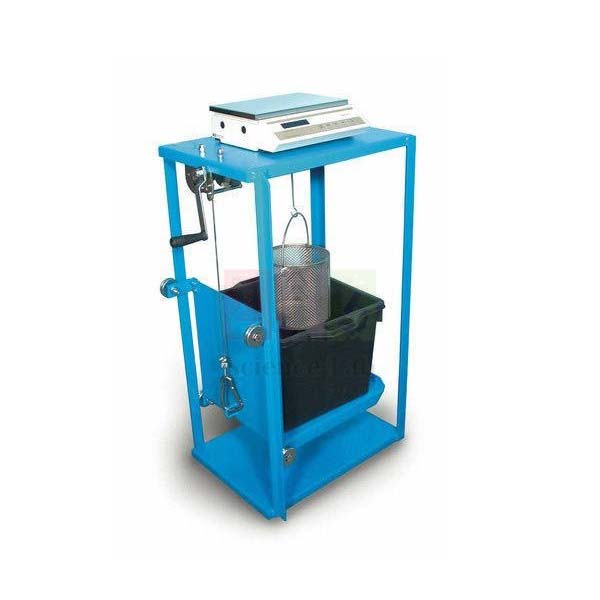
Buoyancy Balance
Buoyancy Balance (Product Code: SLE/CE/24) is a weighing system used to determine the density of concrete by weighing a specimen in air and then in water, in civil engineering and materials testing laboratories. Its rigid support frame carries a platform-mounted water tank that a mechanical lifting device raises to immerse the specimen hanging below the balance. The system is developed and made by Jain Scientific Equipments Pvt Ltd (ScienceLab), an OEM manufacturer, at its own factory in Ambala, India.
Key Details
| Parameter | Detail |
|---|---|
| Method | Sample weighed in air and in water to calculate the density of concrete |
| Frame | Rigid support frame |
| Water tank | Mounted on a platform |
| Lifting | Mechanical lifting device raises the water tank through the frame height |
| Specimen position | Suspended below the balance, which is fixed on a cradle |
| Balance use | The balance supplied can also be used as a standard weighing device |
| Product code | SLE/CE/24 |
| Manufacturer | Jain Scientific Equipments Pvt Ltd (ScienceLab) — OEM |
| Country of origin | India (made in Ambala, Haryana) |
What Is the Buoyancy Balance Used For?
The buoyancy method relies on Archimedes' principle: a specimen weighs less in water than in air by the weight of water it displaces. From the two weighings the laboratory calculates the specimen volume and then its density, without needing to measure an irregular shape with callipers.
Because the water tank is lifted up to the specimen rather than the specimen being lowered by hand, the sample stays steady and the reading settles quickly. Check that no air bubbles cling to the specimen and note the water temperature for each test. When the frame is not in use for density work, the balance serves as an everyday laboratory weighing device, a space-saving arrangement for labs sourcing test and measurement instruments in India.
OEM Manufacturer
ScienceLab, the trading name of Jain Scientific Equipments Private Limited, developed this buoyancy balance system and is its OEM. The frame, tank platform and lifting arrangement are built at the company's own licensed factory at Saha, Ambala, Haryana, India, and the complete system is supplied factory-direct to engineering colleges, testing laboratories, dealers and importers. Ask us about replacement parts or matching units for a second test bay. Background is on the ScienceLab company profile.
Related Civil Engineering Lab Equipment
These items are used before, during or alongside buoyancy weighing of concrete and aggregate samples.
- Buoyancy Balance Apparatus — a related listing of the buoyancy weighing system to compare before ordering.
- Density Basket — for holding aggregate samples under water.
- Specific Gravity And Water Absorption of Aggregates — a related density test on aggregates.
- Concrete Cube Mould — for casting concrete specimens.
- Cylindrical Measures — for bulk density measurements.
See the full Civil Engineering Lab Equipment range for density, strength and durability testing.
Frequently Asked Questions
What is the Buoyancy Balance used for?
The Buoyancy Balance is used to find the density of concrete. A specimen is weighed in air and then in water, and the difference between the two weights gives its volume, from which density is calculated without measuring the specimen shape.
How does the Buoyancy Balance immerse the specimen?
The Buoyancy Balance uses a mechanical lifting device to raise the platform-mounted water tank through the frame height. The specimen, suspended below the balance on its cradle, is immersed smoothly without being lowered or disturbed by hand.
Can the Buoyancy Balance be used for ordinary weighing?
Yes. The balance supplied with the Buoyancy Balance can also be used as a standard weighing device, giving the laboratory a versatile weighing system for routine work when density tests are not running.
What is the capacity of the Buoyancy Balance?
The balance capacity and readability for the Buoyancy Balance are not stated in this listing. Tell us your maximum specimen weight and required resolution through the contact page, and the manufacturer will confirm a suitable configuration in the quotation.
Who manufactures the Buoyancy Balance?
The Buoyancy Balance system is developed and manufactured by Jain Scientific Equipments Pvt Ltd (ScienceLab) as the OEM at its licensed factory at Saha, Ambala, Haryana, India, and supplied directly to institutions, dealers and importers.
What should a Buoyancy Balance quotation request include?
A Buoyancy Balance quotation request should state the product code SLE/CE/24, the specimen types and weights you test, the quantity and the delivery location. Use the contact page or the enquiry cart to send it.
Request a Quote
To order the Buoyancy Balance (SLE/CE/24), send your specimen details and quantity through the contact page or the enquiry cart. Quotations come directly from the manufacturer, Jain Scientific Equipments Pvt Ltd (ScienceLab), Ambala.
Last updated: 24 September 2026
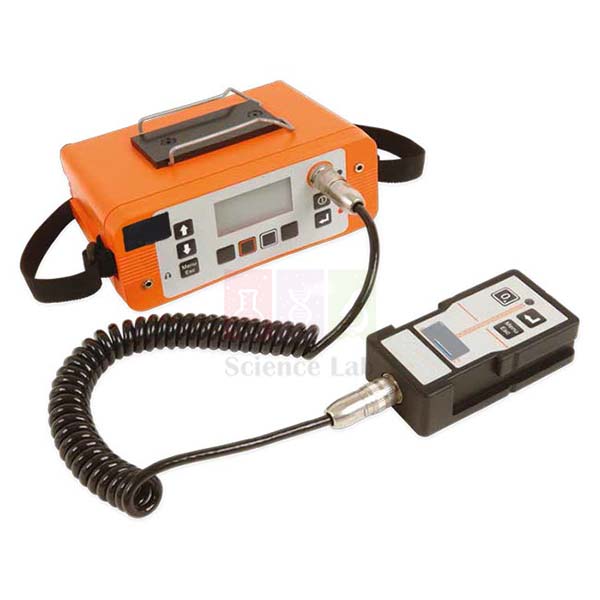
Concrete cover meter
Concrete cover meter (Product Code: SLE/CE/25) is a portable pulse-induction instrument used to locate reinforcing bars and measure the concrete cover over them during structural surveys and in civil engineering laboratories. Site engineers, testing labs and colleges use it for non-destructive checks; its standard search head identifies a 40 mm diameter bar up to about 95 mm deep. It is supplied by Jain Scientific Equipments Pvt Ltd (ScienceLab), Ambala, India.
Specifications
| Parameter | Detail |
|---|---|
| Measuring technique | Pulse induction |
| Case | Rugged, waterproof IP65 case with probe storage |
| Power | Rechargeable battery pack; can be charged inside or outside the gauge |
| Standard search head | Identifies 40 mm dia. bar up to 95 mm depth (approx.) and 8 mm dia. bar up to 70 mm depth (approx.) |
| Sensing area | 120 × 60 mm |
| Supplied complete with | Main unit, standard search head, PC cable, battery pack and charger, shoulder strap, earphone, carry case and instruction manual |
| Product code | SLE/CE/25 |
| Supplied by | Jain Scientific Equipments Pvt Ltd (ScienceLab), Ambala, India |
What Is the Concrete Cover Meter Used For?
Concrete cover — the depth of concrete between the surface and the nearest reinforcing bar — protects steel from corrosion and fire, so engineers check it on new work and during condition surveys. The cover meter also maps where bars run before core drilling, chasing or fixing anchors, so reinforcement is not cut by mistake.
Scan slowly across the expected bar direction and mark the peaks on the surface. The listed ranges show why bar size matters: a thin 8 mm bar is detectable only to about 70 mm, while a 40 mm bar can be found to about 95 mm. The earphone helps on noisy sites and the PC cable moves readings to a computer for reporting. Among test and measurement instruments in India, it is a standard tool for durability audits.
Supplier
Jain Scientific Equipments Private Limited, which trades as ScienceLab, supplies this concrete cover meter from Ambala, Haryana, to engineering colleges, testing laboratories, consultants, dealers and importers. The company sources the instrument and handles the quotation, packing and dispatch for buyers in India and international markets. Ask us before ordering if you need a spare battery pack or other accessories, and availability will be confirmed in the quotation. Company details are on the ScienceLab company profile.
Related Civil Engineering Lab Equipment
Cover measurement is usually one part of a wider non-destructive assessment of a concrete structure.
- Concrete Test Hammer — rebound testing of surface hardness.
- Ultrasonic Pulse Velocity Tester — checks internal quality and uniformity.
- Crack Measuring Microscope — measures crack widths found during the survey.
- Core Drilling Machine (Motorised) — for taking cores clear of located bars.
- Cementometer Moisture Meter — for moisture checks on concrete and screeds.
More field and laboratory testing equipment is listed under Civil Engineering Lab Equipment.
Frequently Asked Questions
What does the Concrete cover meter measure?
The Concrete cover meter locates steel reinforcing bars inside concrete and measures the cover, meaning the depth of concrete above each bar. It uses the pulse induction technique, so the check is non-destructive and needs no drilling.
How deep can the Concrete cover meter detect bars?
With its standard search head, the Concrete cover meter identifies a 40 mm diameter bar up to about 95 mm deep and an 8 mm bar up to about 70 mm deep. The search head has a sensing area of 120 × 60 mm.
What is supplied with the Concrete cover meter?
The Concrete cover meter comes with the main unit, standard search head, PC cable, battery pack and charger, shoulder strap, earphone, carry case and instruction manual, so it is ready for site surveys straight out of the case.
Is the Concrete cover meter suitable for site use?
Yes. The Concrete cover meter has a rugged, waterproof IP65 case with probe storage, a shoulder strap and a rechargeable battery pack that can be charged inside or outside the gauge, which suits work away from the laboratory.
Who supplies the Concrete cover meter?
The Concrete cover meter is supplied by Jain Scientific Equipments Pvt Ltd (ScienceLab), Ambala, Haryana, India, to laboratories, colleges, consultants, dealers and importers in India and international markets.
Is a calibration certificate available for the Concrete cover meter?
For the Concrete cover meter, calibration-certificate availability is confirmed on request rather than assumed. Raise it with us before you order through the contact page, and the reply will come with your quotation.
Request a Quote
For a quotation on the Concrete cover meter (SLE/CE/25), send your quantity and delivery location through the contact page or add it to the enquiry cart. Jain Scientific Equipments Pvt Ltd (ScienceLab) will reply with a quotation and supply details.
Last updated: 24 September 2026
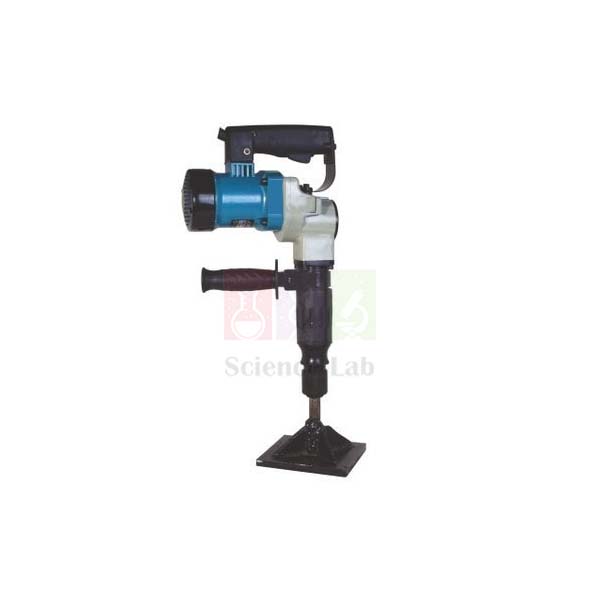
DLC Vibrating Hammer For Concrete Mould
DLC Vibrating Hammer For Concrete Mould (Product Code: SLE/CE/26) is a vibratory compaction hammer used to compact concrete samples in moulds, including dry lean concrete (DLC) specimens, in highway and civil engineering laboratories. Road-materials labs choose it because vibratory compaction is generally much faster than impact hammering; the unit comes with one tamping foot and one shank. The hammer is supplied by Jain Scientific Equipments Pvt Ltd (ScienceLab), Ambala, India.
Specifications
| Parameter | Detail |
|---|---|
| Application | Compaction of concrete samples in a mould |
| Dimensions | 290 × 255 × 350 mm |
| Weight (approx.) | 6 kg |
| Supplied with | 1 tamping foot and 1 shank |
| Compaction speed | Generally much faster than compaction by impact hammering |
| Product code | SLE/CE/26 |
| Supplied by | Jain Scientific Equipments Pvt Ltd (ScienceLab), Ambala, India |
What Is the DLC Vibrating Hammer Used For?
Dry lean concrete is a stiff, low-water mix used as a sub-base under rigid pavements. It is too dry to consolidate properly by rodding, so laboratories compact DLC cubes or cylinders with a vibrating hammer fitted with a tamping foot, working in layers until each layer is dense and its surface closes.
Hold the hammer upright with the tamping foot flat on the concrete, move it steadily across the layer and avoid resting it against the mould walls. Check the foot and shank for wear before each batch, since a worn foot leaves uneven layers. At about 6 kg the hammer is manageable for repeated specimen making, a practical point for engineering lab equipment in India used by student groups.
Supplier
ScienceLab is the trading name of Jain Scientific Equipments Private Limited, which supplies the DLC Vibrating Hammer For Concrete Mould from Ambala, Haryana, India. The company sources the hammer with its tamping foot and shank and delivers it to highway laboratories, engineering colleges, contractors, dealers and importers. Ask us about a spare tamping foot or shank when you request your quotation. Further company information is on the ScienceLab company profile.
Related Civil Engineering Lab Equipment
A vibrating hammer is one part of the specimen-making workflow; these moulds and compaction tools are used with or instead of it.
- Concrete Cube Mould — moulds for the compacted cube specimens.
- Cylindrical Mould — for cylinder specimens.
- Vibrating Table — an alternative way to compact concrete in moulds.
- Poker Vibrator — internal vibration for larger pours.
- Tamping Bar — for manual compaction where vibration is not specified.
Find further moulds, compaction tools and testing machines under Civil Engineering Lab Equipment.
Frequently Asked Questions
What is the DLC Vibrating Hammer For Concrete Mould used for?
The DLC Vibrating Hammer For Concrete Mould is used to compact concrete samples in a mould, especially stiff dry lean concrete that cannot be compacted properly by rodding. It produces dense specimens for later strength testing.
What accessories come with the DLC Vibrating Hammer For Concrete Mould?
The DLC Vibrating Hammer For Concrete Mould is supplied with one tamping foot and one shank. If your test programme needs a different foot size or spares, mention it in the enquiry so it can be checked before quoting.
What are the size and weight of the DLC Vibrating Hammer For Concrete Mould?
The DLC Vibrating Hammer For Concrete Mould measures 290 × 255 × 350 mm and weighs approximately 6 kg, so one technician can handle it comfortably while compacting several specimens in a session.
Why use the DLC Vibrating Hammer For Concrete Mould instead of hand compaction?
The DLC Vibrating Hammer For Concrete Mould is generally a much faster method than impact hammering, and vibration consolidates dry, harsh mixes more evenly. That gives more consistent specimens and saves time when many moulds are filled.
What power supply does the DLC Vibrating Hammer For Concrete Mould need?
The electrical rating of the DLC Vibrating Hammer For Concrete Mould is not stated in this listing. Tell us your local supply voltage through the contact page and the details will be confirmed with your quotation.
Who supplies the DLC Vibrating Hammer For Concrete Mould?
The DLC Vibrating Hammer For Concrete Mould is supplied by Jain Scientific Equipments Pvt Ltd (ScienceLab), Ambala, Haryana, India, to laboratories, colleges, contractors, dealers and importers in India and international markets.
Request a Quote
Request a quotation for the DLC Vibrating Hammer For Concrete Mould (SLE/CE/26) through the contact page or the enquiry cart, stating quantity and supply voltage. Jain Scientific Equipments Pvt Ltd (ScienceLab) will reply with a quotation and delivery details.
Last updated: 24 September 2026
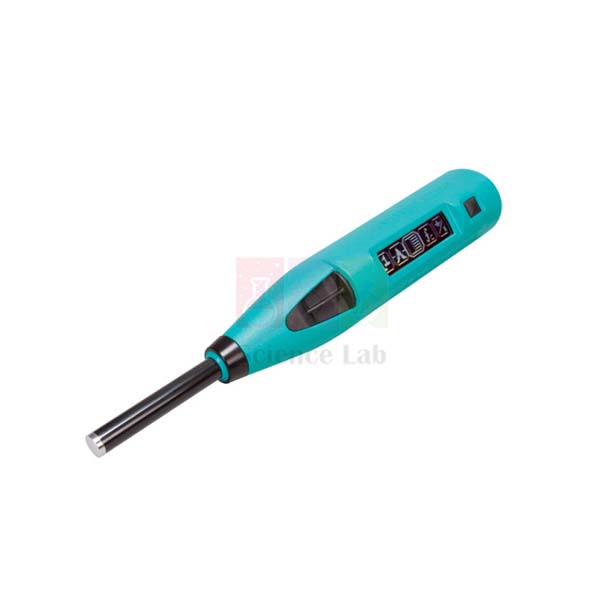
Concrete Test Hammer
Concrete Test Hammer (Product Code: SLE/CE/27) is a rebound-type hammer used to assess the surface hardness and estimate the compressive strength of hardened concrete without damaging it, in structural surveys and civil engineering laboratories. With an impact energy of 2.207 Nm and a measurement range of 10 to 70 N/mm², it gives engineers, testing labs and students a quick screening tool. This rebound hammer is supplied by Jain Scientific Equipments Pvt Ltd (ScienceLab), Ambala, India.
Specifications
| Parameter | Detail |
|---|---|
| Impact energy | 2.207 Nm |
| Measurement range | 10 to 70 N/mm² |
| Case | Aluminium; 190 × 100 × 350 mm |
| Weight (approx.) | 1.5 kg |
| Supplied with | Carrying case, grinding stone and instruction manual |
| Product code | SLE/CE/27 |
| Supplied by | Jain Scientific Equipments Pvt Ltd (ScienceLab), Ambala, India |
What Is the Concrete Test Hammer Used For?
A spring-driven mass inside the hammer strikes the concrete through a plunger and rebounds; the rebound value depends on surface hardness, which is correlated with compressive strength. Engineers use it to check uniformity across slabs, beams and columns, to find weak zones and to decide where cores should be taken.
Smooth the test spot with the grinding stone, hold the hammer at right angles to the surface and take a group of readings at each location, avoiding honeycombed areas and exposed aggregate. Treat the results as an estimate and confirm critical areas with cores or cube tests. It is a widely used test and measuring instrument in India for quick condition surveys.
Supplier
Jain Scientific Equipments Private Limited, trading as ScienceLab, supplies the Concrete Test Hammer from Ambala, Haryana, India, to testing laboratories, engineering colleges, consultants, dealers and importers. For vendor registration, the supplying company is registered with Importer-Exporter Code AAECJ8618A (DGFT) and GSTIN 06AAECJ8618A1ZT. Quotations, packing and dispatch are handled by the company for buyers in India and international markets. See the ScienceLab company profile for more.
Related Civil Engineering Lab Equipment
Rebound testing is usually combined with other non-destructive and laboratory tests to build a full picture of concrete quality.
- Concrete Test Hammer Schmidt Hammer N-Type — an N-type rebound hammer listed separately.
- Ultrasonic Pulse Velocity Tester — assesses internal quality alongside surface hardness.
- Concrete cover meter — locates reinforcement before testing or coring.
- Automatic digital compression testing machine — for cube tests that confirm rebound estimates.
- Core Drilling Machine (Motorised) — for extracting cores from suspect areas.
Explore all Civil Engineering Lab Equipment for non-destructive and laboratory concrete testing.
Frequently Asked Questions
What does the Concrete Test Hammer measure?
The Concrete Test Hammer measures the rebound of a spring-driven mass from the concrete surface. The rebound value reflects surface hardness and is used to estimate compressive strength and check uniformity without damaging the structure.
What is the measurement range of the Concrete Test Hammer?
The Concrete Test Hammer covers a measurement range of 10 to 70 N/mm² and has an impact energy of 2.207 Nm, which suits routine assessment of hardened concrete in buildings, bridges and precast elements.
What is supplied with the Concrete Test Hammer?
The Concrete Test Hammer comes with a carrying case, a grinding stone and an instruction manual. Its aluminium case measures 190 × 100 × 350 mm, and the listed weight is approximately 1.5 kg.
What is the grinding stone for on the Concrete Test Hammer?
The grinding stone supplied with the Concrete Test Hammer smooths rough or dusty concrete at each test spot. A flat, clean surface gives more consistent rebound readings than laitance, trowel marks or loose particles.
Who supplies the Concrete Test Hammer?
The Concrete Test Hammer is supplied by Jain Scientific Equipments Pvt Ltd (ScienceLab), Ambala, Haryana, India, to testing laboratories, colleges, consultants, dealers and importers in India and international markets.
Is a calibration certificate available for the Concrete Test Hammer?
Whether the Concrete Test Hammer can be supplied with a calibration certificate is something to discuss with us before ordering. Mention it when you send your enquiry through the contact page so the quotation can address it.
Request a Quote
To request a quotation for the Concrete Test Hammer (SLE/CE/27), use the contact page or add it to the enquiry cart. Jain Scientific Equipments Pvt Ltd (ScienceLab) will send quotation and supply details.
Last updated: 24 September 2026
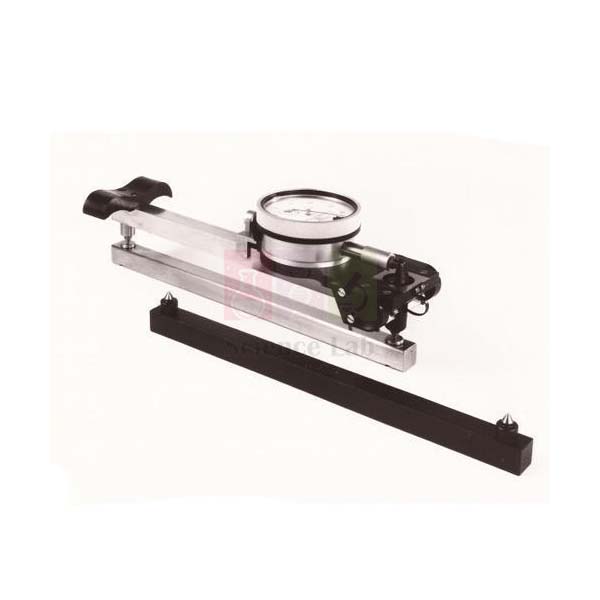
Demountable Mechanical Strain Gauge
Demountable Mechanical Strain Gauge (Product Code: SLE/CE/28) is a portable strain gauge used to measure length variation between fixed points on concrete and other structural specimens in materials testing laboratories and field monitoring. It is listed with 100 mm and 300 mm measuring bases, each with a 5 mm range, and a digital gauge of 0.001 mm resolution with PC output. The gauge is produced by Jain Scientific Equipments Pvt Ltd (ScienceLab) as the OEM at its own Ambala factory in India.
Specifications
| Parameter | Detail |
|---|---|
| Purpose | Measurement of length variation |
| Measuring base | 100 mm × 5 mm range, or 300 mm × 5 mm range |
| Gauge | Digital, 0.001 mm resolution |
| Data output | Output for PC connection (special cable required, listed as an accessory) |
| Dimensions | 300 × 400 × 110 mm |
| Weight (approx.) | 2.1 kg |
| Product code | SLE/CE/28 |
| Manufacturer | Jain Scientific Equipments Pvt Ltd (ScienceLab) — OEM |
| Country of origin | India (made in Ambala, Haryana) |
What Is the Demountable Strain Gauge Used For?
A demountable strain gauge is not left on the specimen. Pairs of reference points are fixed to the surface at the measuring-base spacing, and the gauge is placed on them each time a reading is needed, so one instrument can monitor many locations over weeks or months. Typical uses include shrinkage and creep of concrete, strain in beams during load tests and movement across cracks.
Choose the 100 mm base for small specimens or closely spaced points and the 300 mm base for averaging strain over coarser concrete. Take every reading with the same hand pressure and record the temperature. The 0.001 mm digital gauge with PC output makes it a useful option among digital measuring instruments in India for student projects and research.
What to Specify When Ordering
- Measuring base: 100 mm or 300 mm (each with a 5 mm range).
- Whether you need the special cable for PC connection.
- The number of gauges for your monitoring programme.
OEM Manufacturer
ScienceLab is the trading name of Jain Scientific Equipments Private Limited, the OEM that makes the Demountable Mechanical Strain Gauge at its own licensed factory at Saha, Ambala, Haryana, India. Research groups, engineering colleges, testing laboratories, dealers and importers are supplied factory-direct, so questions on base length, the PC cable or replacement parts go to the manufacturer. Just ask us. Details of the company appear on the ScienceLab company profile.
Related Civil Engineering Lab Equipment
Strain and length-change measurements tie in with specimen casting, loading and crack inspection.
- Volume Change Apparatus — length change of cast specimens in a comparator.
- Length Comparator Digital — bench measurement of specimen length.
- Beam Mould — for casting beam specimens to instrument.
- Flexure Testing Machine Digital — loads beams while strain is recorded.
- Crack Measuring Microscope — measures crack widths near gauge points.
Discover further measuring and testing apparatus in Civil Engineering Lab Equipment.
Frequently Asked Questions
What is the Demountable Mechanical Strain Gauge used for?
The Demountable Mechanical Strain Gauge is used to measure length variation between fixed reference points on concrete and other structural specimens. Because it is removed after each reading, one gauge can monitor many locations over a long test.
Which measuring bases are available for the Demountable Mechanical Strain Gauge?
The Demountable Mechanical Strain Gauge is listed with a 100 mm measuring base and a 300 mm measuring base, each with a 5 mm range. State which base you need when you request a quotation.
What resolution does the Demountable Mechanical Strain Gauge have?
The Demountable Mechanical Strain Gauge uses a digital gauge with 0.001 mm resolution and an output for PC connection, so readings can be transferred to a computer rather than written down by hand.
Is the PC cable included with the Demountable Mechanical Strain Gauge?
The PC connection on the Demountable Mechanical Strain Gauge needs a special cable, which is listed as an accessory. Ask for it in your enquiry if you plan to log readings on a computer.
What are the size and weight of the Demountable Mechanical Strain Gauge?
The Demountable Mechanical Strain Gauge measures 300 × 400 × 110 mm and weighs approximately 2.1 kg, making it easy to carry between laboratory specimens and field monitoring points.
Who manufactures the Demountable Mechanical Strain Gauge?
The Demountable Mechanical Strain Gauge is manufactured by Jain Scientific Equipments Pvt Ltd (ScienceLab) as the OEM at its licensed factory at Saha, Ambala, Haryana, India, and supplied directly to institutions, dealers and importers.
Request a Quote
For a quotation on the Demountable Mechanical Strain Gauge (SLE/CE/28), send your measuring base, cable requirement and quantity via the contact page or the enquiry cart. The manufacturer, Jain Scientific Equipments Pvt Ltd (ScienceLab), replies with the quotation directly.
Last updated: 24 September 2026
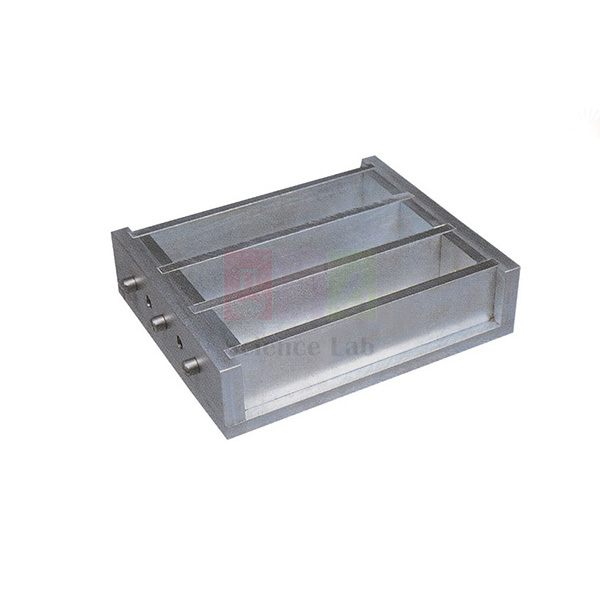
Prism Mould Three Gang
Prism Mould Three Gang (Product Code: SLE/CE/29) is a three-compartment mould used to cast mortar prism specimens for strength testing of cement and mortar in civil engineering laboratories. It casts three 40.1 × 40 × 160 mm prisms at once, comes complete with base, and every part carries an identification number so it goes back together correctly. Jain Scientific Equipments Pvt Ltd (ScienceLab) makes it as the OEM at its own factory in Ambala, India.
Specifications
| Parameter | Detail |
|---|---|
| Compartments | Three (three-gang) |
| Size | 40.1 × 40 × 160 mm |
| Base | Supplied complete with base |
| Assembly | All parts marked with an identification number for correct assembly |
| Product code | SLE/CE/29 |
| Manufacturer | Jain Scientific Equipments Pvt Ltd (ScienceLab) — OEM |
| Country of origin | India (made in Ambala, Haryana) |
What Is the Three Gang Prism Mould Used For?
Mortar prisms are the standard specimen for many cement strength tests: each prism is broken in flexure, and the two halves are then crushed in compression, so one three-gang mould yields a full set of results from a single mix. The mortar is placed in layers and compacted, often on a jolting apparatus, then struck off level and cured before demoulding.
Clean and lightly oil the inner faces before each casting, and reassemble the parts by their identification numbers so the compartments stay square and the prisms come out to size. Tighten the mould evenly on its base to stop mortar leaking at the joints. A well-kept mould is a long-term asset, which is why labs buy from an engineering lab equipment manufacturer that can supply matching repeat units.
OEM Manufacturer
Jain Scientific Equipments Private Limited, trading as ScienceLab, is the OEM of the Prism Mould Three Gang and produces it at its licensed factory at Saha, Ambala, Haryana, India. The moulds are supplied factory-direct to cement and concrete laboratories, engineering colleges, dealers and importers, so extra moulds for a larger testing programme can be ordered from the same source. For replacement parts, ask us. Learn more on the ScienceLab company profile.
Related Civil Engineering Lab Equipment
Casting, compacting, curing and testing mortar prisms uses several other items from the same range.
- Jolting Apparatus — compacts mortar in the prism mould.
- Laboratory digital planetary mixer — mixes the mortar before casting.
- Cement curing bench-type cabinet — cures the prisms before demoulding.
- Flexure Testing Machine Manual — for flexural strength testing.
- Straight Edge — strikes off surplus mortar level with the mould.
See the whole Civil Engineering Lab Equipment range for cement, mortar and concrete testing.
Frequently Asked Questions
What is the Prism Mould Three Gang used for?
The Prism Mould Three Gang is used to cast three mortar prisms at a time for cement and mortar strength testing. The prisms are typically broken in flexure and their halves tested in compression, giving a complete result set from one mix.
What size prisms does the Prism Mould Three Gang cast?
The Prism Mould Three Gang is listed with a size of 40.1 × 40 × 160 mm for each prism. If your test method needs a particular tolerance, mention it in the enquiry so it can be confirmed.
Is a base included with the Prism Mould Three Gang?
Yes. The Prism Mould Three Gang is supplied complete with its base, so the three compartments can be assembled, filled and compacted without buying a separate base plate.
How is the Prism Mould Three Gang assembled correctly?
Every part of the Prism Mould Three Gang is marked with an identification number. Matching the numbered parts during reassembly keeps each compartment square and the prisms true to size after every cleaning.
Who manufactures the Prism Mould Three Gang?
The Prism Mould Three Gang is manufactured by Jain Scientific Equipments Pvt Ltd (ScienceLab) as the OEM at its own licensed factory at Saha, Ambala, Haryana, India, and supplied factory-direct to laboratories, dealers and importers.
How should the Prism Mould Three Gang be maintained?
Clean the Prism Mould Three Gang soon after demoulding, remove hardened mortar from the joints, and apply a thin coat of release oil before storage. This protects the faces and keeps the numbered parts fitting together properly.
Request a Quote
To order the Prism Mould Three Gang (SLE/CE/29), send the number of moulds and delivery details through the contact page or the enquiry cart. Every quotation is prepared by the manufacturer itself, Jain Scientific Equipments Pvt Ltd (ScienceLab), Ambala.
Last updated: 24 September 2026