- Physics Lab Equipment
- Chemistry Lab Equipment
- Biology Lab Equipment
- Anatomical Lab Equipment
- Learning
- Educational Lab Equipment
- Magnets
- Agriculture
- Astronomy
- Earth Science
- Geography Lab Equipment
- Safety Lab Coat
- Laboratory
- Meteorological
- Electricity & Magnetism
- Heat
- School Lab Equipment
- Lab Glassware
- Science Lab Equipment
- Tvet Lab Equipment
- Robotics Kits Supplier and Manufacturer for Schools India
- Math Lab Equipment Manufacturers and Exporters in Ambala
- STEM Kits Manufacturers and Supplier India
- Engineering Lab Equipment
- Hospital Lab Equipment
- Water, Sanitation & Hygiene Supplies
- Cold Chain, Solar & Communication Equipment
- Nutrition
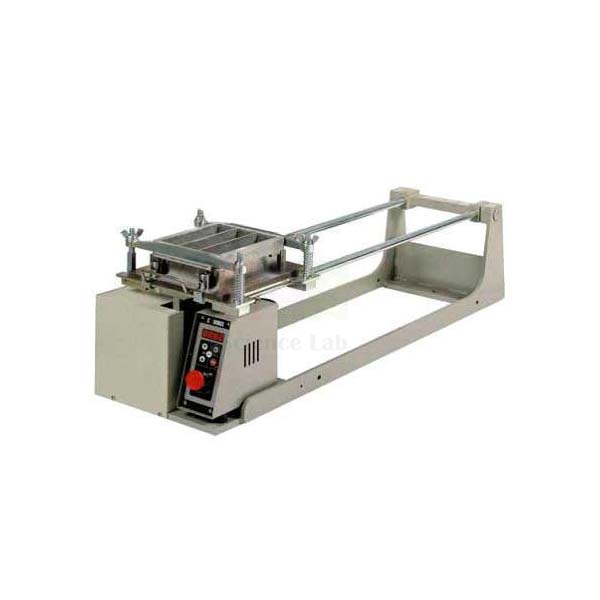
Jolting Apparatus
Jolting Apparatus (Product Code: SLE/CE/46) is a motor-driven compaction machine used to compact cement mortar test prisms in a three-compartment mould in cement and civil engineering laboratories. Materials-testing labs choose it because a cam turning at 60 rev/min lifts and drops the table, and a micro-switch stroke counter stops the machine automatically after 60 jolts. It is made by Jain Scientific Equipments Pvt Ltd (ScienceLab), an OEM and engineering lab equipment manufacturer, at its own factory in Ambala, India.
Specifications
| Parameter | Detail |
|---|---|
| Table and arms | Rectangular table rigidly connected by two support arms to a spindle |
| Spindle distance | 800 mm horizontal distance from the centre of the table |
| Drive | Cam connected to a motor and gearbox through a V-belt and pulleys |
| Cam speed | 60 rev/min |
| Drop action | Table is raised by the cam and allowed to fall freely onto a stop; a projecting lug with a plane face is provided on the table, with a stop with a rounded upper surface beneath it |
| Jolt control | Stroke counter with micro-switch stops the machine after 60 jolts |
| Mould mounting | Locating pins for the mould compartments; mould and hopper clamp rigidly to the table |
| Supplied with | Mould and hopper |
| Mould | Steel mould with base plate, three compartments, each 40 × 40 × 160 mm internal |
| Other listed accessory | Apparatus for de-moulding the specimen |
| Optional | Digital preset counter (extra-cost option) |
| Power supply | 230 V, single phase, AC |
| Product code | SLE/CE/46 |
| Manufacturer | Jain Scientific Equipments Pvt Ltd (ScienceLab) — OEM |
| Country of origin | India (made in Ambala, Haryana) |
What Is the Jolting Apparatus Used For?
Freshly mixed cement mortar is placed in the three-compartment 40 × 40 × 160 mm mould with the hopper fitted on top, and the jolting apparatus compacts it by repeatedly lifting the table and letting it fall onto the stop. Because the cam speed and jolt count are fixed by the machine, every set of prisms receives the same compaction effort, which removes the operator-to-operator variation of hand tamping. The compacted prisms are then cured and tested for flexural and compressive strength.
It is a core item of lab equipment for technical institutes that teach cement and concrete technology, as well as for plant and project quality-control labs. Before each session, clamp the mould and hopper firmly, keep the lug and the rounded stop free of mortar so each fall ends cleanly, and confirm that the counter halts the table at 60 jolts. Use the de-moulding apparatus to release the prisms without chipping their edges.
What to Specify When Ordering
- Number of jolting units, and whether the optional digital preset counter is required
- Number of additional three-compartment steel moulds (40 × 40 × 160 mm) for casting several batches in a day
- Whether the apparatus for de-moulding the specimen should be included in the quotation
- Confirmation that a 230 V single-phase AC supply is available where the machine will stand
OEM Manufacturer
ScienceLab is the trading name of Jain Scientific Equipments Private Limited, and the Jolting Apparatus is one of the cement-testing machines the company builds as the original equipment manufacturer. It is fabricated and assembled at the company’s own licensed factory at Saha, Ambala, Haryana, so buyers deal with the maker rather than a trading house.
Colleges, testing laboratories, dealers and importers are supplied factory-direct, and questions about replacement moulds or stroke-counter spares go straight to the people who build the machine — just ask us. More background is on the ScienceLab company profile.
Related Civil Engineering Lab Equipment
These items from the same range complete the mortar-prism workflow around the jolting apparatus:
- Prism Mould Three Gang — an additional three-gang prism mould for casting more sets of specimens
- Straight Edge — for striking off surplus mortar level with the top of the mould
- Cement curing bench-type cabinet — humid, temperature-controlled storage for prisms after casting
- Circulating water bath with cooler unit — water curing of 40 × 40 × 160 mm cement specimens at a set temperature
- Cement samplers — for drawing the cement sample from bulk storage before mixing
Browse the full Civil Engineering Lab Equipment category for concrete, cement, soil and aggregate testing apparatus.
Frequently Asked Questions
What is included with the Jolting Apparatus?
The Jolting Apparatus (SLE/CE/46) is supplied complete with a mould and hopper. The listed mould is a steel mould with base plate and three compartments, each 40 × 40 × 160 mm internally; an apparatus for de-moulding the specimen is also listed, so mention it in your enquiry.
How many jolts does the Jolting Apparatus apply?
The Jolting Apparatus applies 60 jolts per cycle. Its cam turns at 60 rev/min, and a stroke counter fitted with a micro-switch stops the machine automatically after the 60th jolt, so each mould receives the same compaction. A digital preset counter can be added as an optional extra.
What power supply does the Jolting Apparatus need?
The Jolting Apparatus runs on a 230 V, single-phase AC supply, with the motor driving the cam through a gearbox, V-belt and pulleys. If your laboratory or export destination uses a different supply, state it when you request a quotation.
Who manufactures the Jolting Apparatus?
The Jolting Apparatus is manufactured by Jain Scientific Equipments Pvt Ltd (ScienceLab) as the OEM, at its own factory at Saha, Ambala, Haryana, India. Buyers deal directly with the manufacturer for quotations, repeat orders and replacement moulds.
Is a calibration certificate available for the Jolting Apparatus?
Calibration-certificate availability for the Jolting Apparatus should be discussed with us before ordering. Tell us which checks your laboratory needs, such as jolt count or cam speed, through the contact page and we will confirm what can be provided.
Can the Jolting Apparatus be supplied for export?
Yes. The Jolting Apparatus is supplied to laboratories in India and international markets. For an export enquiry, give the quantity, the destination and the electrical supply at site, and the quotation will come directly from the manufacturer.
Request a Quote
For a quotation on the Jolting Apparatus (SLE/CE/46), send your quantity and any optional items through the contact page or add the product to the enquiry cart. Quotes come direct from the manufacturer.
Last updated: 24 September 2026
599.jpg)
Tensile Strength Tester (Electrically Operated)
Tensile Strength Tester (Electrically Operated) (Product Code: SLE/CE/47) is a double-lever testing machine used to measure the tensile strength of cement mortar briquettes in cement and building-materials laboratories. Engineering colleges and testing labs use it for its 900 kg capacity and a micro-switch that stops the machine the instant the briquette fails. It is produced by Jain Scientific Equipments Pvt Ltd (ScienceLab), an OEM manufacturer, at its own factory in Ambala, India.
Specifications
| Parameter | Detail |
|---|---|
| Loading system | Friction-free double lever system; load applied by a sliding weight on the top lever |
| Capacity | 900 kg |
| Load at failure | Tensile load read accurately to 0.5 kg |
| Zero setting | Marker on the sliding weight for returning it to the zero position |
| Operation | Briquette is fixed in the jaws and the machine is switched on; the sliding weight travels along the calibrated lever, applying tension to the specimen |
| Automatic stop | Micro-switch stops the machine instantly on failure of the briquette |
| Power supply | 230 V, 50 Hz (50 cycles), single phase, AC |
| Supplied with | One brass briquette mould and one base plate |
| Product code | SLE/CE/47 |
| Manufacturer | Jain Scientific Equipments Pvt Ltd (ScienceLab) — OEM |
| Country of origin | India (made in Ambala, Haryana) |
What Is the Cement Briquette Tensile Strength Tester Used For?
The tester measures direct tensile strength on mortar briquettes cast in the brass briquette mould. After the briquette is clamped in the jaws and the machine is switched on, the sliding weight moves steadily along the top lever, and the double lever multiplies its effect so that tension on the specimen rises smoothly until it breaks. The lever arrangement therefore lets a moving weight build up loads to the full 900 kg capacity.
In cement technology practicals, students cast briquettes, cure them for different periods and compare the failure loads to see how strength develops with age. As engineering lab equipment in India for diploma and degree courses, it is simple to operate: reset the sliding weight to zero with its marker before each test, keep the jaws free of mortar crumbs so the briquette sits centrally, and read the load as soon as the micro-switch stops the machine.
What to Specify When Ordering
- Number of testers required for the laboratory
- Number of additional brass briquette moulds and base plates for casting several specimens per mix
- Confirmation that a 230 V, 50 Hz single-phase AC supply is available at the bench
OEM Manufacturer
The Tensile Strength Tester is built by Jain Scientific Equipments Private Limited, which trades as ScienceLab and is the original equipment manufacturer of this machine. It is manufactured and assembled at the company’s licensed factory at Saha, Ambala, Haryana, and dispatched factory-direct to colleges, polytechnics, dealers and importers.
The company is incorporated under CIN U29309HR2020PTC087597, and its production premises at 449, HSIIDC Industrial Area, Saha, Ambala hold Factory Licence AMB-ONLINE-CHD-J-414. Company details are on the ScienceLab profile page.
Related Civil Engineering Lab Equipment
Laboratories setting up briquette tensile testing usually add these items from the same range:
- Vicat Needle Apparatus With Dashpot — for finding cement paste consistency when working out mixing water
- Cement curing bench-type cabinet — keeps briquettes in humid, temperature-controlled conditions before testing
- Circulating water bath with cooler unit — for water curing of cement specimens at a controlled temperature
- Cement samplers — for taking a representative sample from bulk cement stock
See the complete Civil Engineering Lab Equipment category for other cement, concrete and soil testing machines.
Frequently Asked Questions
What is the capacity of the Tensile Strength Tester (Electrically Operated)?
The Tensile Strength Tester (Electrically Operated) has a capacity of 900 kg, applied through a friction-free double lever system by a sliding weight on the top lever. The tensile load at the moment of briquette failure is read accurately to 0.5 kg.
What comes with the Tensile Strength Tester?
The Tensile Strength Tester (SLE/CE/47) is supplied complete with one brass briquette mould and one base plate. Laboratories that cast several briquettes from each mix usually order additional moulds, so state the number you need when requesting a quotation.
How does the Tensile Strength Tester stop when the briquette breaks?
A micro-switch on the Tensile Strength Tester (Electrically Operated) stops the machine instantly when the briquette fails, so the operator can take the load reading before returning the sliding weight to its zero position using the marker provided.
What electrical supply does the Tensile Strength Tester require?
The Tensile Strength Tester (Electrically Operated) operates on 230 V, 50 Hz (50 cycles), single-phase AC. For sites with a different voltage or frequency, mention the local supply in your enquiry so it can be addressed in the quotation.
Who manufactures the Tensile Strength Tester (Electrically Operated)?
Jain Scientific Equipments Pvt Ltd (ScienceLab) is the OEM manufacturer of the Tensile Strength Tester (Electrically Operated), producing it at its own licensed factory at Saha, Ambala, Haryana, India. Quotations, repeat orders and spare-part enquiries are handled directly by the manufacturer.
Can I get a calibration certificate with the Tensile Strength Tester?
Calibration-certificate availability for the Tensile Strength Tester (Electrically Operated) should be discussed with us before you order. Tell us what verification your laboratory or tender requires through the contact page and we will confirm what can be provided.
Request a Quote
To request a quotation for the Tensile Strength Tester (Electrically Operated), use the contact page or place it in the enquiry cart with your quantity and any extra briquette moulds. Your quotation comes straight from the manufacturer.
Last updated: 24 September 2026

Cement samplers
Cement samplers (Product Code: SLE/CE/48) are slotted brass sampling tubes used to draw cement from bulk storage or bulk shipments for laboratory testing. Site, plant and college laboratories use them because the inner tube rotates to close the slots, trapping about 3 litres of cement taken from within the stock rather than just the surface. They are made by Jain Scientific Equipments Pvt Ltd (ScienceLab), an OEM manufacturer of engineering lab equipment in India, at its own factory in Ambala.
Specifications
| Parameter | Detail |
|---|---|
| Purpose | Sampling cement in bulk storage or bulk shipments |
| Construction | Two concentric brass tubes with slots |
| Operation | Inner tube rotates to close the slots and take the sample |
| Capacity | 3 litres (approx.) |
| Weight | 1 kg (approx.) |
| Product code | SLE/CE/48 |
| Manufacturer | Jain Scientific Equipments Pvt Ltd (ScienceLab) — OEM |
| Country of origin | India (made in Ambala, Haryana) |
What Is the Cement Sampler Used For?
Test results are only as reliable as the sample, and cement held in silos, bins or a bulk consignment can vary from one point to another. The sampler is pushed into the cement with its slots open so material flows into the inner tube along its length; the inner tube is then turned to close the slots, and the sampler is withdrawn with the cement held inside. Several draws from different points are usually combined into one composite sample.
That composite sample then goes to tests such as consistency, setting time, soundness and fineness. The brass tubes are easy to wipe clean between lots, which helps keep samples from different consignments separate, and at about 1 kg the sampler is easy to carry between storage points. It also belongs in technical educational equipment sets for cement technology courses.
OEM Manufacturer
Jain Scientific Equipments Private Limited, known by its trading name ScienceLab, manufactures these brass cement samplers as the OEM at its own factory at Saha, Ambala, Haryana. Buying from the producer means sampling tools for a new plant laboratory, a construction project or an engineering department are quoted and dispatched factory-direct, without a trading intermediary.
Repeat orders for additional samplers are handled by the manufacturer itself. Company background is available on the ScienceLab profile.
Related Civil Engineering Lab Equipment
Once a cement sample has been drawn, these related items help divide, handle and test it:
- Riffle Sample Divider — splits a composite sample into representative portions
- Scoops — for transferring sampled material into containers and apparatus
- Bulk density of cement — measures the loose bulk density of the sampled cement
- Vicat Needle Apparatus With Dashpot — for consistency and setting-time tests on the sample
More cement, concrete and soil apparatus is listed in the Civil Engineering Lab Equipment category.
Frequently Asked Questions
What are cement samplers used for?
Cement samplers are used to take representative samples of cement from bulk storage or bulk shipments. The ScienceLab cement sampler (SLE/CE/48) is pushed into the cement with its slots open, then the inner tube is rotated to close the slots and hold the sample for withdrawal.
How much cement does the cement sampler hold?
The ScienceLab cement sampler holds approximately 3 litres of cement per draw and weighs about 1 kg. For a larger composite sample, take several draws from different points in the stock and combine them before testing.
What are the cement samplers made of?
The cement samplers are made of brass, as two concentric brass tubes with matching slots. The inner tube turns inside the outer one to open or close the slots, and the smooth brass surfaces are easy to wipe clean between different cement lots.
Who manufactures these cement samplers?
Jain Scientific Equipments Pvt Ltd (ScienceLab) manufactures the cement samplers as the OEM at its own factory at Saha, Ambala, Haryana, India, and supplies them factory-direct to laboratories, contractors, dealers and importers in India and international markets.
What should a quotation request for cement samplers include?
A quotation request for cement samplers should state the quantity, the delivery location and any other cement-testing apparatus needed at the same time. Send it through the contact page or the enquiry cart, and the manufacturer will reply with a quotation.
Request a Quote
Ask for a quotation on the Cement samplers (SLE/CE/48) through the contact page, or add them to the enquiry cart together with other cement-testing items. Quotations are issued directly by the manufacturer.
Last updated: 24 September 2026
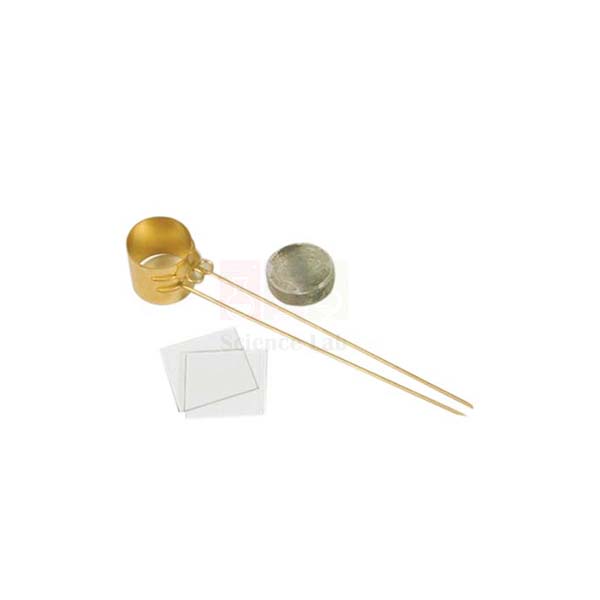
Le Chatelier moulds
Le Chatelier moulds (Product Code: SLE/CE/49) are spring-tensioned split-cylinder moulds used to measure the expansion (soundness) of cement in cement testing laboratories. Each mould is 30 mm in internal diameter and 30 mm high, with two indicator stems whose points are 165 mm from the cylinder’s centre line, so a slight opening of the split shows up clearly at the pointers. Jain Scientific Equipments Pvt Ltd (ScienceLab), an OEM manufacturer, makes them at its own factory in Ambala, India.
Specifications
| Parameter | Detail |
|---|---|
| Test | Expansion of cement |
| Mould type | Spring-tensioned split cylinder |
| Internal diameter | 30 mm |
| Height | 30 mm |
| Indicator stems | Two, measuring 165 mm from the points to the centre line of the cylinder |
| Moulds per test | Two or three |
| Kit consists of | Le Chatelier moulds; glass plates, 50 mm square |
| Kit scope | Includes the accessories to perform the test and to check the conformity of the moulds |
| Product code | SLE/CE/49 |
| Manufacturer | Jain Scientific Equipments Pvt Ltd (ScienceLab) — OEM |
| Country of origin | India (made in Ambala, Haryana) |
What Is the Le Chatelier Mould Used For?
Unsound cement contains constituents that keep expanding after the cement has set, which can crack hardened mortar and concrete; the Le Chatelier test detects this. The mould is set on a glass plate, filled with cement paste, covered with a second plate and stored, then heated in water, and the increase in distance between the indicator points shows how far the cement has expanded. The long stems magnify the tiny movement of the split so it can be read with an ordinary scale.
Because two or three moulds are needed for each test, laboratories normally keep moulds in sets. Before use, check that the split edges close evenly and the stems are straight, and lightly oil the inside so the hardened paste releases cleanly. The moulds are standard technical educational equipment for building-materials practicals in civil engineering diploma and degree courses.
What to Specify When Ordering
- Number of moulds: two or three are needed for each test, multiplied by the number of cement samples tested at once
- Number of 50 mm square glass plates, since each mould sits between a lower and an upper plate
- Whether a water bath or curing cabinet for the storage and heating stages should be quoted at the same time
OEM Manufacturer
The Le Chatelier moulds are manufactured by Jain Scientific Equipments Private Limited, trading as ScienceLab, which acts as the OEM and produces them at its own licensed factory at Saha, Ambala, Haryana. Cement plants, engineering colleges, dealers and importers therefore source them direct from the maker.
Replacement moulds and repeat orders are handled by the manufacturer, so a laboratory can match additional moulds to the ones already in use — ask us when you enquire. Read more about the company on the ScienceLab company profile.
Related Civil Engineering Lab Equipment
A cement soundness test also needs paste of standard consistency and controlled storage, supported by these items:
- Vicat Needle Apparatus With Dashpot — determines the standard-consistency paste used to fill the moulds
- Water Bath (6 Holes) — for the stage in which the moulds are heated in water
- Cement curing bench-type cabinet — humid, temperature-controlled storage before the heating stage
- Cement samplers — for taking the cement sample to be tested
Other cement and concrete testing apparatus is listed in the Civil Engineering Lab Equipment category.
Frequently Asked Questions
How many Le Chatelier moulds are needed for one test?
Two or three Le Chatelier moulds are required for each cement expansion test, and the readings are averaged. Laboratories testing several cement lots at the same time should multiply that number when ordering Le Chatelier moulds from ScienceLab.
What are the dimensions of the Le Chatelier mould?
The Le Chatelier mould is a spring-tensioned split cylinder 30 mm in internal diameter and 30 mm high. Its two indicator stems measure 165 mm from their points to the centre line of the cylinder, which magnifies any expansion of the cement paste.
What is included in the Le Chatelier mould kit?
The Le Chatelier mould kit (SLE/CE/49) consists of Le Chatelier moulds and glass plates 50 mm square, and is described as including the accessories to perform the test and check the moulds. Confirm the number of moulds and plates required in your quotation.
Who manufactures the Le Chatelier moulds?
Jain Scientific Equipments Pvt Ltd (ScienceLab) is the OEM manufacturer of these Le Chatelier moulds, making them at its own factory at Saha, Ambala, Haryana, India. Repeat orders and replacement moulds are handled directly by the manufacturer.
Can Le Chatelier moulds be supplied in bulk for export?
Yes. Le Chatelier moulds can be supplied in quantity to laboratories, institutions, dealers and importers in India and international markets. Send the number of moulds and the destination through the contact page so the manufacturer can prepare a quotation.
Request a Quote
For a quotation on Le Chatelier moulds (SLE/CE/49), tell us how many moulds and glass plates you need via the contact page, or add the item to the enquiry cart. You receive the quotation directly from the manufacturer.
Last updated: 24 September 2026
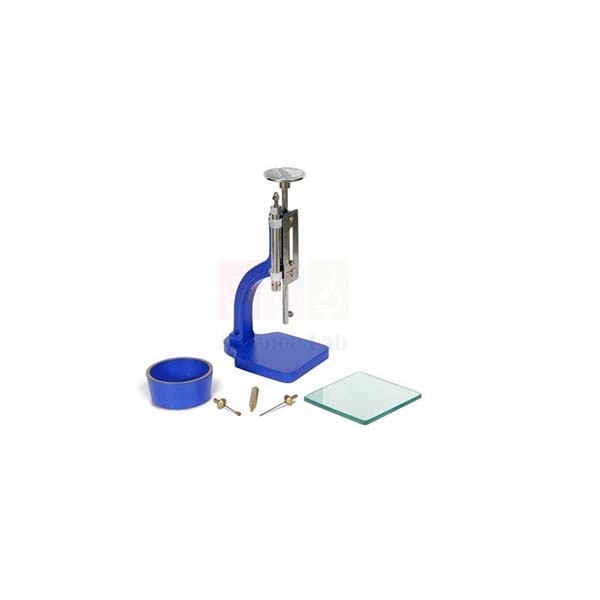
Vicat Needle Apparatus With Dashpot
Vicat Needle Apparatus With Dashpot (Product Code: SLE/CE/50) is a frame-mounted penetration instrument used to determine the standard consistency and the initial and final setting times of cement paste in construction-materials laboratories. Its distinguishing feature is a dashpot that lowers the needles gently onto the paste, and it comes with an initial needle, final needle and consistency plunger. It is built by Jain Scientific Equipments Pvt Ltd (ScienceLab), an OEM manufacturer, at its own factory in Ambala, India.
Specifications
| Parameter | Detail |
|---|---|
| Frame | Metallic frame bearing a freely movable rod with a cap at the top |
| Dashpot | Provided for gentle lowering of the needles |
| Needle set | One each: initial setting needle, final setting needle, consistency plunger |
| Vicat mould | Brass, 40 mm high; 80 mm internal diameter at the base and 70 mm at the top |
| Base plates | Glass base plate; mild steel base plate 5 in × 5 in (approx. 127 × 127 mm) |
| Product code | SLE/CE/50 |
| Manufacturer | Jain Scientific Equipments Pvt Ltd (ScienceLab) — OEM |
| Country of origin | India (made in Ambala, Haryana) |
What Is the Vicat Needle Apparatus Used For?
Three linked cement tests use the same frame. The consistency plunger first finds the water content that gives paste of standard consistency; the initial setting needle is then lowered at intervals until the paste starts to resist penetration, and the final setting needle shows when the paste has hardened so that it barely marks the surface. These results set the water content for mortar and soundness specimens and tell site engineers how long cement stays workable.
The dashpot damps the fall so each needle meets the paste without impact, making readings more repeatable between students and operators. It is a core piece of lab equipment for technical institutes teaching building materials. Clean the needle after every penetration, keep the moving rod free-running, and position the mould so that each test point is clear of earlier marks and of the mould edge.
What to Specify When Ordering
- Number of apparatus sets required for your class or testing bench
- Spare needles: initial setting needle, final setting needle or consistency plunger
- Extra brass Vicat moulds, and whether glass or 5 in × 5 in mild steel base plates are preferred
OEM Manufacturer
Jain Scientific Equipments Private Limited, which trades as ScienceLab, is the OEM of the Vicat Needle Apparatus With Dashpot and makes it at its own licensed factory at Saha, Ambala, Haryana. The apparatus reaches colleges, cement and construction laboratories, dealers and importers straight from the factory, with no middleman in the supply chain.
Since the apparatus comes straight from its maker, spare needles, moulds and plates for an existing set can be requested directly — ask us with your order details. See the company profile for more about ScienceLab.
Related Civil Engineering Lab Equipment
These items are commonly used alongside the Vicat apparatus in a cement testing bench:
- Automatic Vicat apparatus — an automated alternative for unattended setting-time runs
- Le Chatelier moulds — for the soundness test using standard-consistency paste
- Cement curing bench-type cabinet — holds moulds in humid, controlled conditions between penetrations
- Straight Edge — for levelling the paste flush with the top of the mould
Find more cement, concrete and soil apparatus in the Civil Engineering Lab Equipment category.
Frequently Asked Questions
What is the dashpot on the Vicat Needle Apparatus for?
The dashpot on the Vicat Needle Apparatus With Dashpot (SLE/CE/50) lets the initial needle, final needle or consistency plunger be lowered gently onto the cement paste instead of dropping abruptly, which helps give consistent penetration readings between operators.
Which needles come with the Vicat Needle Apparatus With Dashpot?
The Vicat Needle Apparatus With Dashpot is supplied with one set of needles — an initial setting needle, a final setting needle and a consistency plunger — together with one Vicat mould and a glass base plate.
What size is the Vicat mould supplied with the apparatus?
The Vicat mould listed with the Vicat Needle Apparatus With Dashpot is brass, 40 mm high, with an internal diameter of 80 mm at the base and 70 mm at the top. A 5 in × 5 in mild steel base plate is listed among the accessories.
Who manufactures the Vicat Needle Apparatus With Dashpot?
Jain Scientific Equipments Pvt Ltd (ScienceLab) manufactures the Vicat Needle Apparatus With Dashpot as the OEM at its own factory at Saha, Ambala, Haryana, India, and supplies it directly to colleges, testing laboratories, dealers and importers.
Is a calibration certificate available for the Vicat apparatus?
Calibration-certificate availability for the Vicat Needle Apparatus With Dashpot should be discussed with us before ordering. Describe the checks your laboratory requires through the contact page and we will confirm what documentation can accompany the apparatus.
What details does a quotation for the Vicat apparatus need?
A quotation for the Vicat Needle Apparatus With Dashpot needs the number of sets, any extra moulds, base plates or spare needles, and the delivery location in India or abroad. Send these through the contact page or add the item to the enquiry cart.
Request a Quote
Ask for a quotation on the Vicat Needle Apparatus With Dashpot through the contact page, or add it to the enquiry cart with any spare needles or moulds. Quotes are prepared directly by the manufacturer.
Last updated: 24 September 2026
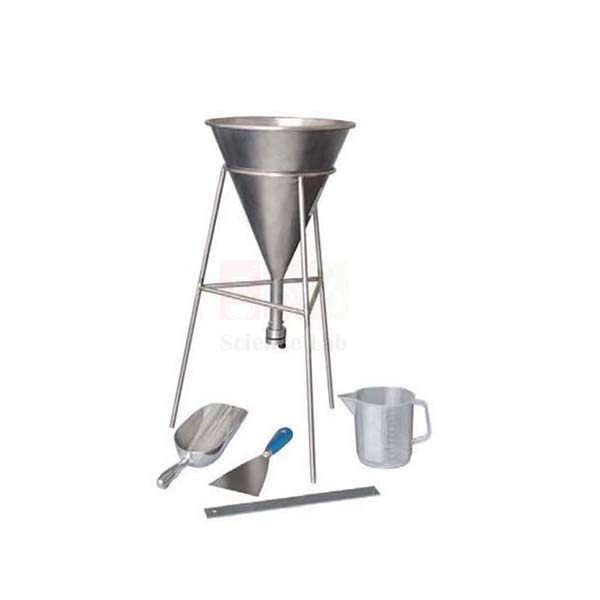
Bulk density of cement
Bulk density of cement (Product Code: SLE/CE/51) is a bulk density apparatus used to determine the loose bulk density, or unit weight, of cement in materials-testing laboratories across India and abroad. The set combines a sieve funnel on a tripod with a 1 litre unit weight measure and a straightedge, so cement falls into the measure in a consistent, uncompacted state. Jain Scientific Equipments Pvt Ltd (ScienceLab), an OEM manufacturer, produces the set at its own factory in Ambala, India.
Specifications
| Parameter | Detail |
|---|---|
| Components | Sieve funnel, unit weight measure, tripod and straightedge |
| Measure capacity | 1 litre |
| Dimensions | 350 × 350 × 520 mm |
| Weight | 3 kg (approx.) |
| Product code | SLE/CE/51 |
| Manufacturer | Jain Scientific Equipments Pvt Ltd (ScienceLab) — OEM |
| Country of origin | India (made in Ambala, Haryana) |
What Is the Cement Bulk Density Apparatus Used For?
Bulk density tells a laboratory or batching plant how much a given volume of loose cement weighs, which matters when cement is proportioned by volume, when storage bins are sized and when consignments are checked. Cement is passed through the sieve funnel, which breaks up lumps and lets it fall freely into the 1 litre measure standing beneath; the heap is struck off level with the straightedge and the filled measure is weighed. With a measure of 1 litre capacity, the net mass gives bulk density directly.
Avoid tapping or jolting the measure while it fills, since vibration packs the cement and raises the result, and weigh the empty measure first. Repeating the determination two or three times shows whether readings agree. At 350 × 350 × 520 mm and about 3 kg, it is convenient lab equipment for technical institutes where bench space is shared between several experiments.
OEM Manufacturer
ScienceLab is the trading name of Jain Scientific Equipments Private Limited, the OEM that manufactures this cement bulk density set at its own licensed factory at Saha, Ambala, Haryana. Laboratories, contractors, dealers and importers deal with the maker itself for quotations and repeat supply.
The company is a registered MSME enterprise (Udyam UDYAM-HR-01-0003714) with manufacturing as its major activity, and export shipments are handled under Importer-Exporter Code AAECJ8618A issued by the DGFT. More information is on the ScienceLab company profile.
Related Civil Engineering Lab Equipment
These related items support sampling and density testing of cement and aggregates:
- Cement samplers — for drawing the cement sample from bulk storage
- Cylindrical Measures — for the bulk density or unit weight of aggregates
- Scoops — for handling cement when loading the sieve funnel
- Vicat Needle Apparatus With Dashpot — for consistency and setting-time tests on the same cement
The full Civil Engineering Lab Equipment category lists further cement, concrete and aggregate apparatus.
Frequently Asked Questions
What does the Bulk density of cement apparatus consist of?
The Bulk density of cement apparatus (SLE/CE/51) consists of a sieve funnel, a unit weight measure of 1 litre capacity, a tripod and a straightedge. The straightedge strikes off excess cement level with the measure before it is weighed.
What is the capacity of the measure in the Bulk density of cement set?
The unit weight measure in the Bulk density of cement set has a capacity of 1 litre, so the net mass of cement in kilograms equals its bulk density in kilograms per litre, which multiplies by 1000 to give kg/m³.
How big is the Bulk density of cement apparatus?
The Bulk density of cement apparatus measures 350 × 350 × 520 mm and weighs approximately 3 kg, so it fits on a standard laboratory bench and can be moved easily between work areas or stored in a cupboard.
Who manufactures the Bulk density of cement apparatus?
Jain Scientific Equipments Pvt Ltd (ScienceLab) manufactures the Bulk density of cement apparatus as the OEM at its own factory at Saha, Ambala, Haryana, India, and supplies institutions, laboratories, dealers and importers directly.
Do I need a balance with the Bulk density of cement apparatus?
Yes, a weighing balance is needed to weigh the empty and filled 1 litre measure, and it is not listed as part of the Bulk density of cement apparatus. Ask us through the contact page if you would like a balance included in the quotation.
Request a Quote
Send your requirement for the Bulk density of cement apparatus (SLE/CE/51) through the contact page or add it to the enquiry cart. The quotation is issued directly by the manufacturer.
Last updated: 24 September 2026
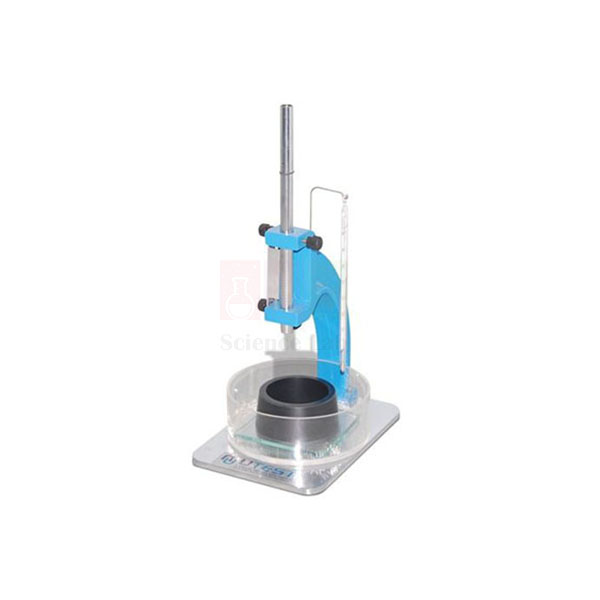
Plunger penetration apparatus
Plunger penetration apparatus (Product Code: SLE/CE/52) is a drop-plunger instrument used to determine the consistency of masonry cement and building limes in construction-materials laboratories. A 90 g plunger assembly falls 100 mm into mortar held in an 80 mm diameter test cup, and the penetration depth shows how stiff or fluid the mix is. It is made by Jain Scientific Equipments Pvt Ltd (ScienceLab), an OEM manufacturer of engineering lab equipment, at its own factory in Ambala, India.
Specifications
| Parameter | Detail |
|---|---|
| Application | Consistency of masonry cement and building limes |
| Height of drop | 100 mm |
| Plunger assembly mass | 90 g |
| Base | Steel base with a recess to house the test cup |
| Column | Vertical column holding the penetration plunger assembly |
| Test cup | 80 mm diameter × 70 mm deep |
| Supplied with | Test cup and tamper |
| Weight | 6 kg (approx.) |
| Product code | SLE/CE/52 |
| Manufacturer | Jain Scientific Equipments Pvt Ltd (ScienceLab) — OEM |
| Country of origin | India (made in Ambala, Haryana) |
What Is the Plunger Penetration Apparatus Used For?
Masonry cement and lime mortars must be brought to a standard workability before their other properties are tested, and this apparatus puts a number on that workability. Fresh mortar is filled into the test cup in layers with the tamper and levelled, the cup is placed in the recess of the steel base, and the plunger is released from 100 mm above the surface. The water content is adjusted until the penetration falls within the range your test procedure specifies.
Students quickly see how a small change in water alters penetration, which makes it useful technical educational equipment for building-materials practicals. Keep the plunger shaft clean and dry so it falls freely, release it without pushing, and wipe the cup between mixes so old mortar does not change the next reading.
What to Specify When Ordering
- Number of apparatus units required
- Additional test cups (80 mm diameter × 70 mm deep) for testing several mixes in sequence
- Whether a spare tamper should be included
OEM Manufacturer
Jain Scientific Equipments Private Limited trades as ScienceLab and manufactures the Plunger penetration apparatus as the OEM at its licensed factory at Saha, Ambala, Haryana. Buyers therefore order from the maker itself, and consignments are dispatched factory-direct to colleges, testing labs, dealers and importers.
Additional test cups and tampers for units already in service can be requested from the manufacturer — ask us with your order reference. The manufacturer’s background is described on the ScienceLab profile page.
Related Civil Engineering Lab Equipment
For a complete mortar consistency bench, consider these items from the same range:
- Flow tables for mortar and building lime — the spread-based consistency test for mortars and building lime
- Vicat Needle Apparatus With Dashpot — consistency and setting time of cement paste
- Straight Edge — for levelling mortar flush with the rim of the test cup
- Scoops — for transferring mortar into the test cup
Explore the Civil Engineering Lab Equipment category for more cement and mortar testing apparatus.
Frequently Asked Questions
What does the Plunger penetration apparatus measure?
The Plunger penetration apparatus (SLE/CE/52) measures the consistency of masonry cement and building lime mortars by how far a 90 g plunger assembly penetrates the mortar after dropping from a height of 100 mm.
What is supplied with the Plunger penetration apparatus?
The Plunger penetration apparatus is supplied complete with a test cup 80 mm in diameter and 70 mm deep and a tamper. The steel base has a recess that locates the cup, and the vertical column carries the plunger assembly.
How heavy is the Plunger penetration apparatus?
The Plunger penetration apparatus weighs approximately 6 kg. Its steel base keeps it steady on the bench while the plunger drops, yet it is light enough to move between laboratory work areas or store in a cupboard.
How is the plunger penetration test different from a flow table test?
Both assess mortar consistency, but the Plunger penetration apparatus reads the depth a falling plunger sinks into the mortar, while a flow table measures how far mortar spreads after repeated drops. Your test specification decides which method applies.
Who manufactures the Plunger penetration apparatus?
Jain Scientific Equipments Pvt Ltd (ScienceLab) is the OEM manufacturer of the Plunger penetration apparatus, producing it at its own factory at Saha, Ambala, Haryana, India, and supplying buyers in India and international markets directly.
What should I include in a quotation request for the Plunger penetration apparatus?
For a Plunger penetration apparatus quotation, include the number of units, any extra test cups or tampers, and the delivery location. Send the request through the contact page or add the product to the enquiry cart.
Request a Quote
Request a quotation for the Plunger penetration apparatus (SLE/CE/52) via the contact page, or add it to the enquiry cart with other mortar-testing items. The manufacturer quotes you directly.
Last updated: 24 September 2026
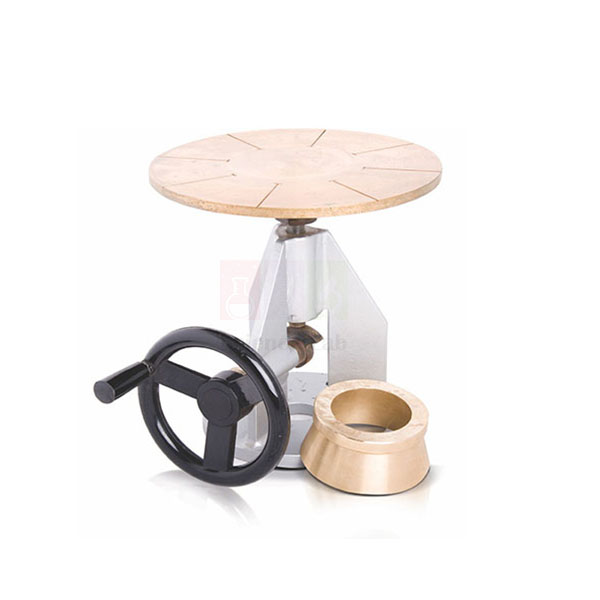
Flow tables for mortar and building lime
Flow tables for mortar and building lime (Product Code: SLE/CE/53) are drop tables used to determine the consistency of fresh mortars and building lime by how far a moulded sample spreads after a set number of drops. They come in EN and ASTM versions, manual or motor operated, and motor models stop automatically when a digital counter reaches the preset number of drops. Both versions are made by Jain Scientific Equipments Pvt Ltd (ScienceLab), an OEM manufacturer, at its own factory in Ambala, India.
Specifications
| Parameter | Detail |
|---|---|
| Application | Consistency of mortars and building lime |
| Versions | EN and ASTM versions; manual or motor operated |
| Motor-operated drive | Motor speed reducer; number of drops preset on a digital counter that stops the machine at the end of the cycle |
| Power (motor models) | 180 W |
| Table diameter | 300 mm (steel) or 254 mm (bronze), according to version |
| Height (drop) | 10 mm or 12.7 mm, according to version |
| Total mass of movable parts | 4.2 to 4.5 kg |
| Flow mould | 100 mm base, 70 mm top, 60 mm height |
| Dimensions (L × D × H) | 421 × 310 × 390 mm |
| Weight | 10 kg (approx.) |
| Supplied with | Flow mould and tamper; EN versions also include the filling hopper |
| Product code | SLE/CE/53 |
| Manufacturer | Jain Scientific Equipments Pvt Ltd (ScienceLab) — OEM |
| Country of origin | India (made in Ambala, Haryana) |
What Is the Mortar Flow Table Used For?
The flow mould is placed at the centre of the table, filled with fresh mortar in layers using the tamper, and lifted away to leave a cone of mortar. The table is then raised and dropped the specified number of times, and the diameter of the spread is measured; a wider spread means a more fluid mix. Laboratories use the result to fix the water content for mortar specimens and to compare lime, masonry and cement mortars.
A manual table suits teaching labs with modest throughput, while motor-operated models remove variation in drop rate because the digital counter ends each cycle automatically. For engineering lab equipment in India that must serve students and project testing, keep the table top clean, dry and level, and wipe the flow mould between tests.
What to Specify When Ordering
- The version your test procedure follows: EN or ASTM (EN versions include the filling hopper)
- Manual or motor-operated model; motor models have the 180 W drive and digital preset counter
- Table type that matches your procedure: 300 mm steel or 254 mm bronze
- Quantity, and any spare flow moulds or tampers
OEM Manufacturer
ScienceLab, the trading name of Jain Scientific Equipments Private Limited, is the OEM that builds these flow tables at its own licensed factory at Saha, Ambala, Haryana. Because the manufacturer supplies both EN and ASTM versions, a laboratory can settle the version, drive type and accessories directly with the people who make the table.
Institutions, dealers and importers receive factory-direct supply, and replacement flow moulds or tampers can be requested from the maker — ask us. More about the company: ScienceLab company profile.
Related Civil Engineering Lab Equipment
These items from the same range support mortar consistency and specimen preparation:
- Plunger penetration apparatus — the penetration method for masonry cement and building lime consistency
- Flow Table — another flow table listing with manual and motorised models
- Straight Edge — for striking off mortar level with the top of the flow mould
- Jolting Apparatus — compacts mortar prisms once the mix consistency is settled
All related apparatus is grouped in the Civil Engineering Lab Equipment category.
Frequently Asked Questions
What is the difference between the EN and ASTM flow tables?
The Flow tables for mortar and building lime come in EN and ASTM versions to suit the procedure your laboratory follows. Listed table options are 300 mm steel or 254 mm bronze with drop heights of 10 mm or 12.7 mm, and EN versions include a filling hopper.
Is the mortar flow table manual or motorised?
Both are available. The Flow tables for mortar and building lime are offered as manual or motor-operated models; motor-operated models use a motor speed reducer and a digital counter preset to the number of drops, which stops the machine automatically at the end of the cycle.
What are the flow mould dimensions?
The flow mould supplied with the Flow tables for mortar and building lime measures 100 mm at the base, 70 mm at the top and 60 mm in height. A tamper is supplied with every table, and EN versions also include the filling hopper.
What are the size and weight of the flow table?
The Flow tables for mortar and building lime are listed at 421 × 310 × 390 mm overall with an approximate weight of 10 kg, and the total mass of the movable parts is 4.2 to 4.5 kg. Motor-operated models are rated at 180 W.
Who manufactures the Flow tables for mortar and building lime?
Jain Scientific Equipments Pvt Ltd (ScienceLab) manufactures the Flow tables for mortar and building lime as the OEM at its own factory at Saha, Ambala, Haryana, India, and supplies them factory-direct to laboratories, institutions, dealers and importers.
Can the flow tables be supplied for export?
Yes. The Flow tables for mortar and building lime are supplied to India and international markets. State the version, manual or motor operation, quantity and destination through the contact page, and the manufacturer will send a quotation.
Request a Quote
To get a quotation for the Flow tables for mortar and building lime, specify EN or ASTM and manual or motor operation via the contact page, or add the item to the enquiry cart. Quotes come direct from the manufacturer.
Last updated: 24 September 2026